

How Much Does an Agricultural Drone Cost in 2026? A Complete Buyer’s Guide
If you are planning to buy an agricultural drone in 2026, the first question is usually straightforward:
How much does an agricultural drone actually cost?
The problem is that there is no single price that applies to every agricultural drone.
A small spraying drone for a limited operation is completely different from a high-payload agricultural UAV designed for commercial crop protection. The aircraft, batteries, motors, spraying system, flight controller, sensors, charger, spare parts, and customization can all change the final quotation.
For international buyers, there is another issue that is often overlooked.
The price shown on a product page may not be the price of the complete operating system.
A drone quotation may include the aircraft but exclude additional batteries, spare parts, chargers, transportation, customized packaging, or other equipment required for commercial operation.
That is why a professional buyer should not simply ask:
“What is your drone price?”
A better question is:
“What exactly is included in the complete agricultural drone package, and what will my total purchasing cost be?”
This guide explains how to evaluate agricultural drone pricing in 2026, what creates the price difference between models, and how buyers can compare quotations before placing an order.
Agricultural Drone Prices Depend on What You Are Actually Buying
An agricultural drone is not just a flying machine.
A commercial spraying system can include:
- Drone airframe
- Motors
- Propellers
- Electronic speed controllers
- Flight controller
- Navigation system
- Remote controller
- Spraying tank
- Pumps
- Nozzles
- Flow-control components
- Batteries
- Battery charger
- Radar or obstacle-detection equipment
- Spare parts
- Software
- User documentation
- Packaging
- Technical support
Two drones can therefore have similar tank capacities but very different prices.
For example, one quotation may include only the basic aircraft and controller.
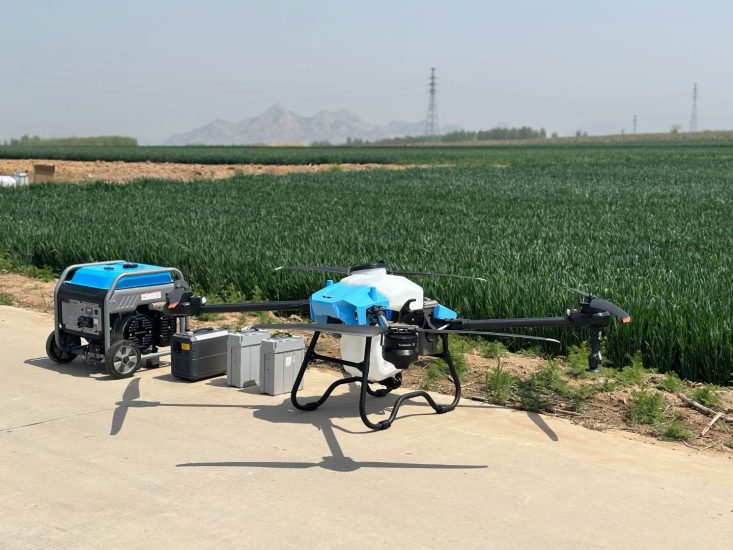
Another quotation may include several batteries, a high-power charger, spare propellers, pumps, nozzles, filters, packaging, and technical support.
At first glance, the second quotation looks more expensive.
But it may actually be the more complete and economical package.
This is one reason buyers should compare specification against specification, rather than simply comparing the final numbers on two quotations.
What Is the Real Price of an Agricultural Drone in 2026?
There is no universal factory price because agricultural drones are built for different applications.
As a general purchasing principle, smaller agricultural drones normally require less propulsion power, smaller batteries, lighter structures, and simpler spraying systems.
As payload increases, the engineering requirements also increase.
A larger agricultural drone may require:
- Stronger frame construction
- Higher-power motors
- Larger propellers
- Higher-capacity batteries
- More powerful ESCs
- Higher-capacity pumps
- Larger landing systems
- More robust flight-control systems
Therefore, it is normal for the price to rise significantly as the payload class increases.
However, tank capacity should not be used as the only method of comparing price.
A better comparison includes:
Drone configuration + payload + battery system + spraying system + navigation + accessories + support + customization
This provides a much more realistic picture of what you are purchasing.
10L, 20L, 30L or Larger: Why Capacity Changes the Price
Tank capacity is one of the first specifications buyers notice.
But the tank itself is not what makes a large agricultural drone expensive.
The aircraft has to carry the additional liquid while maintaining acceptable flight performance.
That affects almost every major system.
Smaller agricultural drones
Smaller-capacity drones can be suitable for:
- Small farms
- Specialty crops
- Demonstration projects
- New operators
- Areas where transportation is difficult
- Smaller agricultural service operations
Their main advantage is not simply the lower purchase price.
They can also be easier to transport, easier to handle, and potentially simpler to deploy.
Medium-capacity agricultural drones
Medium-capacity systems are often more interesting to commercial operators.
The additional tank capacity can reduce the number of refill cycles during field operations.
But buyers should check whether the larger tank is supported by a sufficiently strong propulsion and battery system.
A larger tank without sufficient power management does not automatically create higher productivity.
High-payload agricultural drones
High-payload systems are designed for more demanding operations.
They may be suitable for:
- Large agricultural service companies
- Commercial farms
- Large-scale crop protection
- Fertilizer spreading
- Heavy agricultural payloads
- Professional drone fleets
For buyers considering a high-payload configuration, the aircraft should be evaluated as a complete system rather than simply as a larger tank.
MSOEN’s 50KG Agricultural Spraying Drone Manufacturer page provides a more specific example of what needs to be considered when evaluating a high-payload agricultural spraying platform.
The Battery Can Change the Final Price More Than Buyers Expect
One of the most common mistakes in agricultural drone purchasing is focusing on the aircraft price while ignoring the battery system.
Agricultural drones consume substantial electrical power because they must keep multiple motors operating while carrying a payload.
A commercial operator may need several battery packs so that one battery can be charging while another is being used.
When comparing quotations, ask:
- How many batteries are included?
- What is the battery capacity?
- What is the battery voltage?
- How long does a battery normally operate under load?
- How long does charging take?
- What charger is included?
- Is fast charging available?
- What is the expected battery service life?
- How much does a replacement battery cost?
A drone that appears inexpensive may become considerably more expensive after adding the batteries required for continuous operation.
For a commercial fleet, the battery replacement cost should also be included in the long-term operating calculation.
The Cheapest Drone May Not Have the Lowest Operating Cost
Suppose Buyer A receives a quotation for a low-priced agricultural drone.
Buyer B receives a higher quotation for a more advanced configuration.
It is tempting to assume Buyer A has found the better deal.
But what happens if the cheaper drone has:
- Shorter loaded flight time
- Slower battery charging
- Smaller working capacity
- More frequent battery replacement
- Higher maintenance requirements
- Less reliable pumps
- Limited spare parts
- Poor technical support
The purchase price may be lower, but the operating cost can be higher.
For commercial agricultural operations, productivity often matters more than the initial purchase price.
The correct calculation is closer to:
Total Cost ÷ Actual Working Output
rather than:
Purchase Price ÷ Drone Capacity
This distinction is particularly important for agricultural service companies that charge customers by acre, hectare, field, or treatment operation.
How Much Area Can an Agricultural Drone Really Cover?
This is another area where buyers should be careful with manufacturer specifications.
A drone may have a theoretical working efficiency based on flight speed and spray width.
But real agricultural operations include:
- Takeoff
- Landing
- Turning
- Battery changes
- Tank refilling
- Route planning
- Field relocation
- Obstacle avoidance
- Operator adjustments
- Equipment cleaning
- Weather interruptions
Therefore, advertised theoretical coverage should not automatically be treated as guaranteed daily productivity.
For orchard operations, the difference can be even greater because tree density, terrain, row spacing, and obstacles can significantly affect the operating cycle.
MSOEN’s guide on How Many Acres Can an Orchard Spraying Drone Cover in One Day explains why tank capacity alone cannot determine actual daily coverage.
For a buyer, the more useful question is:
How many acres or hectares can this specific configuration realistically treat under my operating conditions?
That question produces a much more meaningful purchasing decision.
Spray System Configuration Also Affects Price
A spraying drone is only useful if the spraying system performs consistently.
The configuration can include:
- Pump
- Nozzles
- Spray pipes
- Filters
- Flow-control system
- Tank
- Pressure management
- Automatic spray control
A buyer should ask the manufacturer for the complete spraying specification instead of accepting a statement such as “high-efficiency spraying system.”
Important questions include:
What is the pump flow rate?
How many nozzles are used?
What is the effective spray width?
Can the flow rate be adjusted?
How is spraying controlled during flight?
Can the system maintain consistent application during changes in speed?
These details can have a direct effect on field productivity.
A more expensive spraying system may be justified if it provides better control and consistency for the intended application.
GPS, RTK, Radar and Flight-Control Technology
Another major pricing factor is the flight-control and navigation system.
Depending on the model, an agricultural drone may include functions such as:
- GPS/GNSS positioning
- Automatic route planning
- Altitude control
- Return-to-home
- Obstacle detection
- Terrain following
- Flight-path recording
- Automated spraying
- Remote monitoring
Not every buyer needs every advanced function.
For example, an open field with relatively simple terrain may have different requirements from an orchard with trees, slopes, power lines, and irregular rows.
The correct approach is therefore not:
“Buy the drone with the most expensive technology.”
It is:
“Buy the technology that solves the operating problem.”
This can prevent unnecessary spending while still providing the features required for safe and efficient operation.
Why Maximum Payload and Tank Capacity Are Not the Same Thing
Buyers should pay particular attention to terminology.
A supplier may advertise a drone as a certain payload class, but the buyer still needs to understand:
- Maximum payload
- Recommended working payload
- Tank capacity
- Hopper capacity
- Empty weight
- Maximum takeoff weight
- Battery weight
- Spray-system weight
These numbers describe different things.
For example, a drone may technically be capable of carrying a certain maximum payload, while its recommended commercial working load may be lower depending on flight conditions and configuration.
When requesting a quotation, ask the supplier to provide these specifications in writing.
This makes supplier comparison much easier.
The Difference Between Standard and Customized Agricultural Drones
A standard agricultural drone is usually the simplest purchasing option.
You select an existing model and purchase it according to the manufacturer’s standard configuration.
Customization can change the economics considerably.
OEM requirements may include:
- Brand logo
- Product labels
- Packaging
- User manuals
- Product colors
- Remote-controller branding
- Accessories
- Spare-parts packages
More extensive ODM projects can involve changes to:
- Aircraft structure
- Payload system
- Battery configuration
- Spraying system
- Spreading system
- Controller
- Software
- Product appearance
For distributors that want to establish their own agricultural drone brand, this can be more valuable than simply purchasing standard units.
MSOEN’s Agricultural Drone OEM and ODM Manufacturing Guide explains the difference between OEM and ODM and the development issues buyers should consider before starting a customized project.
How OEM Orders Change the Agricultural Drone Cost
OEM purchasing introduces several additional cost factors.
For example:
Standard product
Drone + standard accessories + standard packaging
versus:
OEM product
Drone + customized branding + customized packaging + documentation + accessories + possible configuration changes + development/testing
The second project naturally requires more communication and potentially more development work.
Before asking for an OEM quotation, prepare the following information:
- Target market
- Expected annual quantity
- Required payload
- Tank capacity
- Intended crops
- Spraying application
- Branding requirements
- Packaging requirements
- Required accessories
- Battery requirements
- Regulatory requirements
The more complete your requirements are, the more useful the manufacturer’s quotation will be.
China Agricultural Drone Factory Pricing vs. Trading Company Pricing
International buyers should also understand where the quotation comes from.
A manufacturer with its own engineering, assembly, testing, and quality-control capabilities may quote differently from a trading company that purchases products from another factory.
This does not mean every trading company is unsuitable.
The important issue is whether you understand the supply chain behind the quotation.
Before placing a large order, ask:
- Who manufactures the drone?
- Where is the product assembled?
- Who controls the quality?
- Who provides technical support?
- Who supplies spare parts?
- Who handles warranty issues?
- Who is responsible for customized products?
- Can the same configuration be reproduced for future orders?
If you are purchasing hundreds of units, supply consistency becomes particularly important.
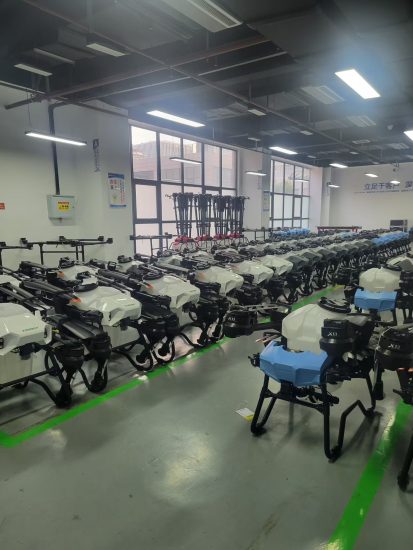
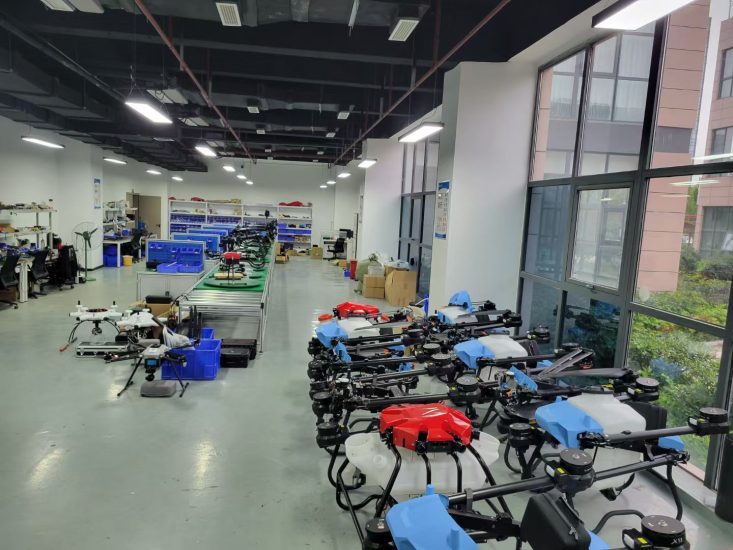
MSOEN’s China Agricultural Drone Factory: From R&D to Mass Production explains why manufacturing capability matters when evaluating a long-term agricultural UAV supplier.
What Should Be Included in an Agricultural Drone Quotation?
Before comparing two suppliers, ask both suppliers to quote the same configuration.
A useful quotation should clearly identify:
| Cost Item | What to Confirm |
|---|---|
| Drone | Exact model and configuration |
| Remote Controller | Included or optional |
| Batteries | Quantity and specification |
| Charger | Type and quantity |
| Spraying System | Tank, pumps, nozzles and pipes |
| Navigation | GPS/RTK and related functions |
| Radar | Included or optional |
| Spare Parts | Quantity and list |
| Packaging | Standard or customized |
| Manuals | Included or customized |
| OEM | Branding and development cost |
| Warranty | Period and coverage |
| Technical Support | Included or additional |
| Shipping | Shipping method and destination |
| Production | Lead time |
| MOQ | Minimum order quantity |
Without this information, two quotations are difficult to compare accurately.
Don’t Forget Shipping and Import Costs
For international buyers, the factory quotation is not necessarily the final landed cost.
The actual cost can include:
Product price + batteries + accessories + spare parts + packaging + shipping + import-related costs + local expenses
Battery transportation deserves particular attention because lithium battery shipments can have additional transportation requirements.
Before placing an order, confirm:
- Package dimensions
- Gross weight
- Number of packages
- Battery quantity
- Shipping method
- Destination
- Shipping terms
- Required transport documentation
A low factory quotation can become much less attractive if the logistics cost is significantly higher.
Spare Parts Are Part of the Purchase Decision
A professional agricultural drone buyer should think about maintenance before placing the order.
Common replacement items can include:
- Propellers
- Motors
- Pumps
- Nozzles
- Filters
- Spray pipes
- Landing components
- Connectors
- Electronic components
- Batteries
For a single farm, a small spare-parts package may be sufficient.
For a distributor operating a fleet, the requirements can be considerably larger.
When negotiating a bulk order, ask the manufacturer to provide a recommended spare-parts list.
This can be more useful than simply asking for the lowest possible unit price.
How to Compare Two Agricultural Drone Quotations
Imagine you receive two offers.
Supplier A
Lower drone price.
But:
- One battery
- Basic charger
- Limited spare parts
- Standard packaging
- No customization
- Limited technical support
Supplier B
Higher initial quotation.
But:
- Multiple batteries
- Complete charger system
- Spare propellers and pumps
- Better documentation
- Customized packaging
- Technical support
- OEM capability
Supplier A may look cheaper.
But Supplier B may have a lower total cost of ownership.
This is why professional procurement teams should create a quotation comparison sheet instead of choosing the first low price they receive.
Agricultural Drone Price Should Be Connected to Productivity
The most important question for a commercial buyer is not:
“How cheap is this drone?”
It is:
“How much useful work can this drone perform during its service life?”
For an agricultural contractor, useful measurements may include:
- Acres treated per day
- Hectares treated per day
- Liters applied per hour
- Battery cycles per working day
- Labor hours saved
- Downtime
- Maintenance frequency
- Cost per hectare
- Cost per acre
A more expensive aircraft can make financial sense if it produces significantly more usable output and remains reliable over a longer operating period.
This is also why buyers should calculate operating economics before making a large investment.
MSOEN has also published an Agricultural Drone ROI Analysis that looks at the relationship between investment, operating costs, productivity, and return.
When Should You Buy a More Expensive Agricultural Drone?
A higher-priced drone can make sense when you need:
- Higher payload
- Larger working capacity
- Better battery management
- More advanced navigation
- More automation
- Greater operational endurance
- Higher commercial productivity
- OEM customization
- Long-term fleet deployment
But spending more is not automatically better.
If your operation does not require those capabilities, buying a much larger system may simply increase capital costs.
The correct drone is the one that matches your actual workload.
When Is a Lower-Cost Agricultural Drone More Practical?
A smaller or simpler drone may be appropriate when:
- You are testing the agricultural drone business
- Your farm area is relatively small
- You operate specialty crops
- Transportation is difficult
- You need a demonstration unit
- You are entering a new market
- You want to test customer demand before placing a large order
For distributors, starting with samples can also be useful.
Instead of immediately ordering a large fleet, test the aircraft under real operating conditions first.
Evaluate flight stability, battery performance, spraying quality, maintenance requirements, operator usability, and spare-parts availability.
Then use the results to determine the configuration for the bulk order.
What Should an International Buyer Ask a Manufacturer?
Before requesting a final quotation, prepare a short specification sheet.
At minimum, include:
1. What crops will the drone be used for?
2. What is the required tank or payload capacity?
3. How many acres or hectares need to be treated?
4. Is the application spraying, spreading, or both?
5. What is the expected daily operating time?
6. What country will the drone be shipped to?
7. How many units are required?
8. Is OEM or private labeling required?
9. How many batteries are needed per unit?
10. What spare parts should be included?
11. What certifications or documentation are required?
12. What is the expected delivery schedule?
A manufacturer can provide a much more accurate quotation when these requirements are clearly defined.
A Better Way to Calculate Your Agricultural Drone Budget
Instead of setting your budget based only on the drone itself, divide the investment into four categories.
1. Initial Equipment
Include:
- Drone
- Controller
- Batteries
- Chargers
- Spraying or spreading system
- Accessories
2. Deployment
Include:
- Shipping
- Packaging
- Training
- Documentation
- Local setup
- Regulatory requirements where applicable
3. Operating
Include:
- Electricity
- Labor
- Maintenance
- Spare parts
- Battery replacement
- Transportation
4. Business Development
For distributors and service providers, also consider:
- Demonstration units
- Marketing
- Local technicians
- Customer training
- Spare-parts inventory
- Warranty support
This four-part approach provides a more realistic budget than simply looking at the manufacturer’s headline price.
How to Choose an Agricultural Drone Manufacturer
Price should be only one part of the supplier evaluation.
Before placing a bulk order, examine:
Manufacturing capability
Can the supplier consistently produce the required quantity?
Engineering capability
Can the manufacturer explain why the drone uses its specific motors, batteries, pumps, flight controller, and structure?
Quality control
Are finished drones tested before shipment?
Spare parts
Can replacement parts be supplied after the sale?
Technical support
Can the manufacturer help troubleshoot problems?
OEM/ODM
Can the supplier support future customization?
Production capacity
Can the factory maintain consistent specifications across future orders?
Documentation
Are specifications, manuals, warranty terms, and other documents clearly provided?
MSOEN’s guide on How to Choose a Reliable Agricultural Drone Manufacturer in China covers these supplier-evaluation questions in greater detail.
The Most Important Question Is Not “How Much?”
When purchasing an agricultural drone, price is important.
But price without context is not enough.
A $5,000 drone and a $10,000 drone cannot be judged fairly until you know exactly what each package contains and what each aircraft can actually accomplish.
The better purchasing process is:
Define the application → determine the required payload → compare configurations → calculate the complete equipment cost → evaluate productivity → test the product → compare manufacturers → negotiate the final order.
This approach reduces the risk of buying a drone that looks inexpensive but becomes expensive to operate.
Agricultural Drone Cost FAQ
How much does an agricultural drone cost in 2026?
There is no single price. The final cost depends on payload, tank capacity, battery system, spraying equipment, navigation technology, accessories, customization, order quantity, and shipping requirements.
Is a larger agricultural drone always better?
No. A larger drone can carry more payload, but it may also require more expensive batteries, stronger propulsion, larger transport arrangements, and more complex maintenance. The correct size depends on the application.
Does the battery come with the agricultural drone?
It depends on the quotation. Buyers should confirm the battery quantity, charger, battery specification, and whether additional batteries are recommended for continuous operation.
Why do two agricultural drones with similar capacity have different prices?
The difference can come from motors, batteries, flight controllers, radar, RTK, pumps, nozzles, structural design, software, accessories, quality control, customization, and after-sales support.
Is buying an agricultural drone directly from China cheaper?
Direct factory purchasing can provide competitive sourcing options, particularly for distributors and bulk buyers, but the buyer should calculate shipping, batteries, spare parts, import-related costs, and support rather than comparing only the factory quotation.
Should I buy a sample before placing a bulk order?
For distributors and importers, sample testing is strongly recommended. Testing can reveal differences in flight stability, spraying performance, battery behavior, assembly quality, maintenance, and actual operating efficiency.
Can agricultural drones be customized with my own brand?
Yes, depending on the manufacturer’s OEM/ODM capabilities. Customization can include branding, packaging, manuals, colors, accessories, controller branding, and in some projects hardware or software modifications.
What information should I send to a manufacturer for a quotation?
Provide your target country, crop type, required payload, tank capacity, intended application, expected quantity, operating environment, OEM requirements, battery requirements, and any required documentation or certifications.
Final Takeaway
The cost of an agricultural drone in 2026 should never be judged by the aircraft price alone.
The real investment includes the drone platform, batteries, charger, spraying system, accessories, spare parts, shipping, support, maintenance, and potentially OEM development.
For a small farm, a compact system may provide the best balance between investment and usability.
For commercial agricultural service companies, a higher-capacity system may make more sense if it improves daily productivity.
For importers and distributors, the calculation is different again. Product consistency, OEM capability, spare-parts supply, documentation, technical support, and long-term production capability can be just as important as the initial unit price.
The best agricultural drone is therefore not necessarily the cheapest one.
It is the configuration that provides the right combination of purchase cost, productivity, reliability, operating cost, and long-term support for the market and application you actually serve.


No comments yet