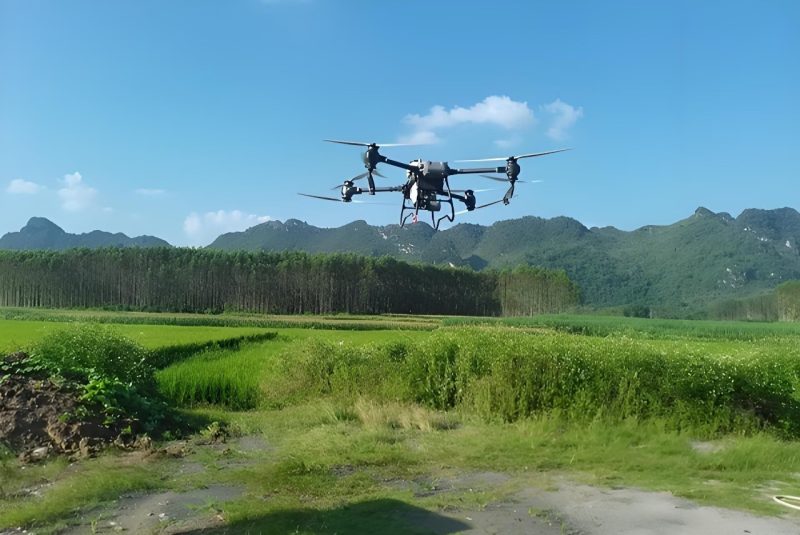



Choosing the right agricultural drone manufacturer in China is an important decision for distributors, agricultural equipment dealers, farm operators, and businesses planning to develop their own drone brand. China has become a major manufacturing base for agricultural UAVs, but manufacturers can differ significantly in product quality, engineering capability, production capacity, customization services, and after-sales support.
A professional-looking website or a low factory price does not necessarily mean that a supplier is reliable. Buyers should evaluate the manufacturer from several practical perspectives before placing an order.
This guide explains how to identify a reliable agricultural drone manufacturer in China and what you should check before requesting samples, negotiating an OEM project, or placing a bulk order.
1. Start With the Manufacturer’s Actual Product Range
The first step is to determine whether the company actually specializes in agricultural drones.
A reliable manufacturer should be able to provide clear information about its agricultural UAV products, including:
- Spraying drone capacity
- Spreading drone models
- Flight time
- Payload capacity
- Spraying width
- Pump type
- Nozzle configuration
- Flow rate
- Battery specifications
- Charging system
- Navigation system
- Obstacle avoidance
- Radar configuration
- Remote controller
- Spare parts
- Optional accessories
Do not evaluate a supplier only by the number of products displayed on its website.
A better question is:
Does the manufacturer have engineering knowledge behind these products?
For example, if you ask why a particular drone uses a specific pump, nozzle, battery configuration, or flight-control system, a professional manufacturer should be able to explain the engineering considerations.
2. Check Whether the Company Is a Manufacturer or Trading Company
One of the biggest challenges when sourcing agricultural drones from China is determining whether you are dealing directly with a factory or with a trading company.
A trading company is not automatically unreliable. In some cases, a professional trading company can provide useful sourcing and export services. However, buyers looking for OEM, ODM, technical customization, or long-term cooperation should understand who actually manufactures the drone.
Ask the supplier for information such as:
- Factory location
- Production facility
- Assembly process
- R&D capability
- Quality-control process
- Testing equipment
- Production capacity
- Main product categories
- Engineering team
- Product development history
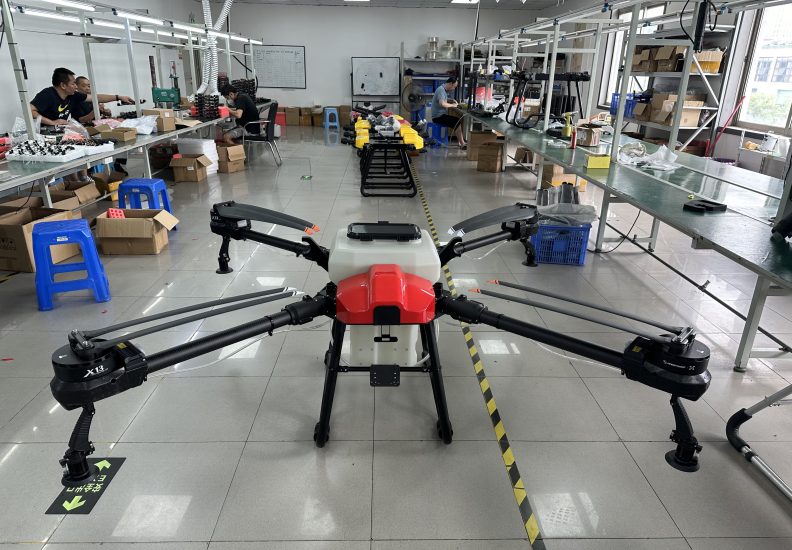
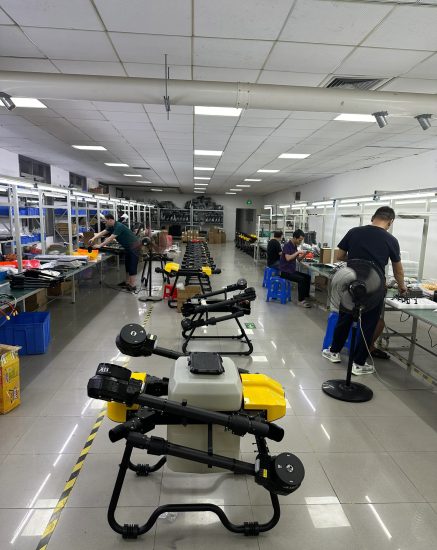
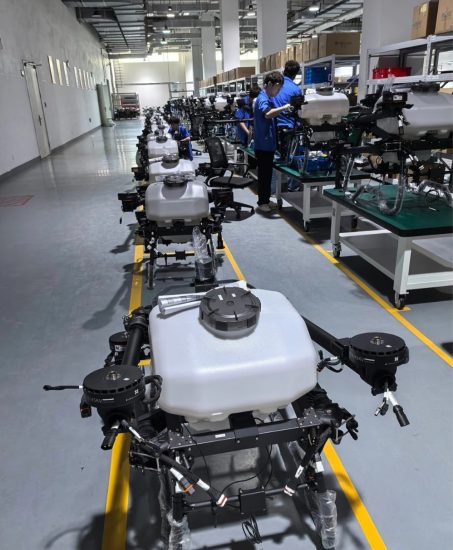
You can also request recent factory photos or arrange a video factory tour.
A video call can be particularly useful. Ask the supplier to show the production area, testing area, inventory, assembly line, and actual products rather than relying only on professionally edited promotional videos.
3. Evaluate Engineering and R&D Capability
Agricultural drones are not simply flying platforms with tanks attached.
A commercial agricultural UAV combines multiple systems, including:
- Flight-control systems
- Motors
- Electronic speed controllers
- Batteries
- Pumps
- Flow-control systems
- Navigation systems
- Radar
- Remote-control systems
- Communication systems
- Spray systems
- Mechanical structures
- Software
The reliability of the complete system depends on how these components work together.
When evaluating a manufacturer, ask technical questions related to your intended application.
For example:
What is the maximum payload under normal operating conditions?
How long can the drone operate with a full payload?
How is spraying flow controlled?
What happens if the spraying pump fails during operation?
How does the drone respond to low battery voltage?
What happens if communication with the remote controller is interrupted?
The quality of the answers can tell you a lot about the supplier’s technical competence.
4. Compare Drone Specifications Carefully
Different manufacturers may use similar marketing terms while offering very different real-world performance.
For example, two drones may both be advertised as “30L agricultural spraying drones,” but their actual performance can vary.
You should compare at least the following specifications:
| Specification | What Buyers Should Check |
|---|---|
| Tank capacity | Actual usable capacity |
| Maximum payload | Recommended operating payload |
| Flight time | Flight time under specified load |
| Spraying width | Effective working width |
| Flow rate | Minimum and maximum flow |
| Pump | Pump type and performance |
| Nozzles | Number, type and replacement cost |
| Battery | Voltage, capacity and cycle life |
| Charging | Charging time and charger type |
| Navigation | GPS, RTK or other positioning options |
| Radar | Obstacle or terrain detection |
| Remote controller | Range, display and control functions |
| Protection rating | Protection against dust and water |
| Spare parts | Availability and lead time |
Never compare prices without comparing specifications.
A cheaper drone may have a lower-quality battery, weaker motors, simpler electronics, fewer safety features, or more expensive replacement parts.
5. Request a Product Sample Before a Large Order
If you are a distributor or importer, placing a large order without testing the product can create unnecessary risk.
Whenever possible, purchase a sample or demonstration unit first.
During testing, evaluate:
Flight performance
Check:
- Takeoff stability
- Hovering performance
- Flight response
- Wind resistance
- Return-to-home function
- Battery performance
- Remote-control responsiveness
Spraying performance
Check:
- Spray uniformity
- Pump stability
- Flow-rate accuracy
- Nozzle performance
- Leakage
- Spray coverage
- Tank sealing
Battery performance
Check:
- Charging time
- Operating time
- Battery temperature
- Battery monitoring
- Charging safety
- Battery communication
Testing the complete system is more useful than simply inspecting the drone when it is switched off.
6. Pay Special Attention to Battery Quality
The battery is one of the most important components of an agricultural drone.
A high-capacity battery may provide longer operating time, but capacity alone does not determine performance.
Ask the manufacturer about:
- Battery voltage
- Rated capacity
- Cell configuration
- Weight
- Charging cycles
- Charging current
- Battery management system
- Temperature monitoring
- Low-voltage protection
- Storage requirements
- Warranty
- Replacement availability
You should also determine whether the manufacturer supplies replacement batteries and how long batteries normally take to produce and ship.
For international buyers, battery transportation is another important consideration because lithium batteries may be subject to specific transportation and documentation requirements.
A manufacturer experienced in international exports should understand the documentation and packaging requirements relevant to the destination market.
7. Examine the Manufacturer’s Quality-Control System
A reliable manufacturer should have a defined quality-control process.
Ask how the company checks components and finished drones.
A practical quality-control process may include:
- Incoming component inspection
- Battery inspection
- Electronic component testing
- Motor testing
- Assembly inspection
- Flight-control testing
- Spray-system testing
- Full-load testing
- Remote-control testing
- Final inspection
- Packaging inspection
You can also ask whether the manufacturer records test results for each unit.
This becomes increasingly important when ordering hundreds of units for a new market.
8. Verify Certifications and Export Documentation
Before importing agricultural drones, determine which documents and certifications are required in your target country.
Requirements can vary by market and may involve:
- Product documentation
- Battery documentation
- Radio equipment requirements
- EMC requirements
- Safety requirements
- Import documentation
- Wireless communication approvals
- Agricultural UAV operating regulations
Do not simply accept a statement such as “our products are certified.”
Ask for the actual documentation and verify whether it applies to the exact model you intend to purchase.
If you plan to sell drones under your own brand, discuss labeling, manuals, packaging, certification responsibilities, and regulatory requirements with the manufacturer before production begins.
9. Evaluate OEM and ODM Capabilities
For distributors and established agricultural equipment companies, OEM and ODM capability can be more important than the initial product price.
OEM projects may involve:
- Logo customization
- Product labels
- Packaging
- User manuals
- Remote-controller branding
- Color customization
- Software interface
- Accessories
- Spare-parts packages
More advanced ODM cooperation may involve modifications to the product itself.
Before starting an OEM project, ask:
- What is the MOQ?
- What is the sample-development process?
- What is the tooling cost?
- What is the production lead time?
- Can the manufacturer modify hardware?
- Can software be customized?
- Who owns the customized design?
- What are the warranty terms?
- How are replacement parts supplied?
A manufacturer that clearly explains the OEM process is usually easier to work with over the long term.
10. Check Spare Parts Availability
Agricultural drones operate in demanding environments.
Dust, water, chemicals, vibration, frequent takeoffs and landings, and long operating hours can eventually cause component wear.
Important spare parts may include:
- Motors
- Propellers
- ESCs
- Pumps
- Nozzles
- Flow meters
- Landing components
- Radar modules
- Batteries
- Chargers
- Spray pipes
- Remote controllers
- Electronic modules
Before ordering, ask the manufacturer for a spare-parts list and recommended stock quantities.
For distributors, having spare parts available locally can significantly improve customer satisfaction.
11. Understand the Warranty Policy
A reliable supplier should provide clear warranty terms.
Do not accept a vague statement such as “one-year warranty” without understanding what it covers.
Ask:
- Which components are covered?
- Is the battery covered?
- What counts as a manufacturing defect?
- Who pays shipping for replacement parts?
- How are warranty claims handled?
- How quickly are replacement parts shipped?
- Is remote technical support available?
- Can technicians receive training?
The warranty is especially important for distributors because your customers will expect you to provide after-sales support.
12. Evaluate Communication Before Placing an Order
Communication quality is often overlooked during supplier selection.
However, poor communication before the order may become a much bigger problem after payment.
Pay attention to whether the supplier:
- Answers technical questions clearly
- Provides complete specifications
- Responds within a reasonable time
- Understands your target market
- Provides realistic lead times
- Explains potential risks
- Communicates changes promptly
- Provides professional documents
A supplier who always says “yes” but cannot provide technical details should be treated cautiously.
Professional manufacturers should also be willing to tell you when a requested configuration is impractical.
13. Compare Total Cost, Not Just Factory Price
The lowest quotation is not always the lowest-cost solution.
Your actual cost may include:
Product price + accessories + spare parts + packaging + tooling + certification + shipping + import costs + after-sales costs
For example, a drone with a lower initial price may use more expensive batteries or replacement parts.
Another supplier may offer a slightly higher unit price but provide better durability, more complete spare parts, stronger technical support, and better warranty service.
For a long-term distribution business, total ownership cost is more important than the initial quotation.
14. Ask for a Detailed Quotation
A professional quotation should clearly identify the configuration.
Ideally, the quotation should include:
- Model
- Quantity
- Unit price
- Drone configuration
- Battery quantity
- Charger
- Remote controller
- Accessories
- Spare parts
- Packaging
- OEM costs
- Production lead time
- Warranty
- Payment terms
- Shipping terms
Avoid comparing two quotations if their configurations are not identical.
For international purchasing, also confirm whether the quotation is EXW, FOB, CIF, DAP, DDP, or another Incoterm.
15. Check the Manufacturer’s After-Sales Support
Agricultural drones require technical support because customers may encounter problems involving software, batteries, motors, pumps, communication, calibration, or spraying systems.
Ask the manufacturer whether it can provide:
- Installation instructions
- User manuals
- Video tutorials
- Troubleshooting guides
- Remote technical support
- Spare-parts recommendations
- Maintenance instructions
- Operator training
For distributors, technical training can be particularly valuable.
If the manufacturer provides structured training materials, your local team can resolve common problems without waiting for factory support.
16. Look for Real Industry Experience
A reliable agricultural drone manufacturer should be able to demonstrate experience beyond marketing claims.
Useful evidence can include:
- Product development history
- Demonstration videos
- Field-testing records
- Customer applications
- Distributor relationships
- Export experience
- Product manuals
- Technical documentation
- Factory testing
- Industry exhibitions
- Long-term product support
You do not need to choose a supplier simply because it claims to have “many years of experience.”
Instead, look for evidence that demonstrates what that experience has produced.
17. Be Careful With Unrealistically Low Prices
Price is important, but an unusually low quotation should trigger additional questions.
A very low price may result from differences in:
- Battery capacity
- Motor quality
- Electronic components
- Pump quality
- Radar configuration
- Remote controller
- Charger
- Spare parts
- Warranty
- Packaging
- Quality control
Ask the supplier to provide a complete configuration sheet before comparing prices.
The correct question is not:
“Which factory is cheapest?”
It is:
“Which manufacturer provides the best combination of performance, reliability, support, and total cost?”
18. Build a Supplier Evaluation Checklist
Before selecting a manufacturer, score each supplier using the same criteria.
For example:
| Evaluation Category | Suggested Priority |
|---|---|
| Product performance | High |
| Manufacturing capability | High |
| R&D capability | High |
| Quality control | High |
| Battery technology | High |
| OEM/ODM capability | High |
| Spare parts | High |
| After-sales service | High |
| Export experience | Medium |
| Certifications | High |
| Price | Medium |
| Delivery time | High |
| Communication | Medium |
This approach helps prevent price from becoming the only factor in your purchasing decision.
19. Questions to Ask an Agricultural Drone Manufacturer in China
Before requesting a formal quotation, prepare a detailed list of questions.
For example:
- What agricultural drone models do you currently manufacture?
- What are the available tank capacities?
- What is the recommended payload?
- What is the typical flight time under load?
- What is the effective spraying width?
- What is the flow rate?
- What battery configurations are available?
- How many batteries are recommended per drone?
- What is the charging time?
- What spare parts are normally recommended?
- What is the MOQ?
- Can you provide samples?
- Do you support OEM and ODM?
- What is the OEM MOQ?
- What is the production lead time?
- What quality-control tests are performed?
- What warranty is provided?
- What technical support is available?
- Which export markets do you currently serve?
- Can you provide product documentation for our market?
A manufacturer that can answer these questions clearly is easier to evaluate than a supplier that only provides a price list.
20. Final Checklist Before Choosing a China Agricultural Drone Manufacturer
Before placing a purchase order, confirm all of the following:
- The company can demonstrate actual manufacturing capability.
- The exact product configuration is clearly documented.
- The drone has been tested under realistic operating conditions.
- Battery specifications are clearly stated.
- Spare parts are available.
- Warranty terms are documented.
- OEM requirements are understood.
- Export documentation is available.
- Target-market regulations have been considered.
- Production lead time is realistic.
- Payment terms are clear.
- Shipping terms are clear.
- After-sales support has been discussed.
- Technical communication is satisfactory.
Most importantly, do not select a manufacturer based only on a website, Alibaba-style product listing, or the lowest quotation.
Conclusion
Choosing a reliable agricultural drone manufacturer in China requires more than comparing product prices.
Buyers should evaluate the manufacturer’s actual production capability, engineering expertise, product specifications, quality-control procedures, battery technology, OEM capabilities, spare-parts supply, certifications, export experience, warranty, and after-sales support.
For distributors and agricultural equipment companies, the best supplier is usually not the manufacturer offering the cheapest drone. It is the manufacturer that can provide consistent product quality, technical support, stable production, reliable spare parts, and long-term cooperation.
A good sourcing process should therefore begin with supplier verification, continue with sample testing, and only then move to bulk purchasing or OEM development.
If you are planning to source agricultural spraying drones from China, prepare your required payload, tank capacity, target crops, operating environment, expected quantity, destination market, and customization requirements before contacting manufacturers. Providing this information allows the manufacturer to recommend a more suitable configuration and prepare a more accurate quotation.


No comments yet