


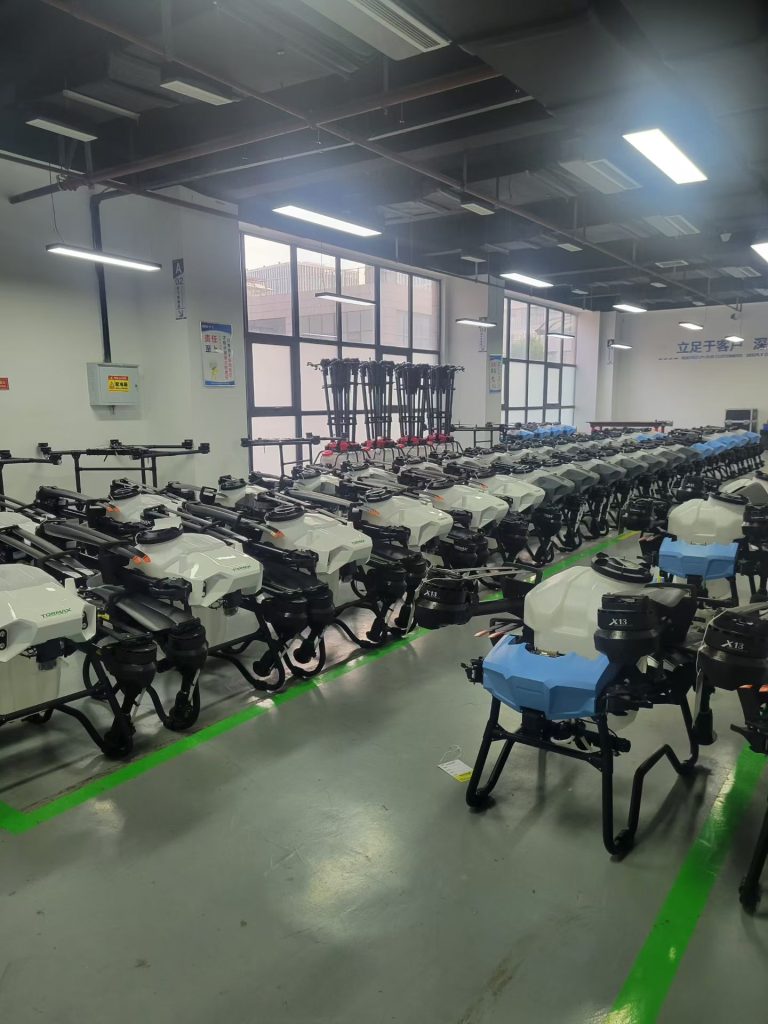
China has become an important manufacturing center for agricultural drones, supplying spraying, spreading, mapping, and customized UAV solutions to agricultural businesses and distributors around the world.
For international buyers, finding a reliable China agricultural drone factory is about more than finding a competitive price. Production capability, quality control, engineering experience, testing procedures, OEM services, spare-parts supply, and export experience can all affect the success of a long-term purchasing relationship.
This guide explains what international buyers should know when evaluating an agricultural drone factory in China.
What Does an Agricultural Drone Factory Do?
A professional agricultural drone factory may be involved in multiple stages of product development and manufacturing.
These can include:
-
Product design
-
Engineering
-
Component sourcing
-
Structural assembly
-
Electrical integration
-
Flight-controller installation
-
Battery integration
-
Spraying-system assembly
-
Software configuration
-
Flight testing
-
Quality inspection
-
Packaging
-
Spare-parts preparation
The exact manufacturing process varies between factories.
Some companies manufacture many components internally, while others use specialized suppliers for motors, batteries, electronic components, and other parts.
Agricultural Drone Manufacturing Process
A typical manufacturing process may include the following stages.
1. Product Design
Engineers define the aircraft structure, propulsion system, payload capacity, battery configuration, spraying system, and control system.
The design needs to balance:
-
Payload
-
Weight
-
Flight time
-
Structural strength
-
Power consumption
-
Stability
-
Maintenance
2. Component Procurement
Agricultural drones contain many specialized components.
These may include:
-
Motors
-
Propellers
-
Electronic speed controllers
-
Flight controllers
-
GNSS modules
-
RTK modules
-
Pumps
-
Nozzles
-
Batteries
-
Chargers
-
Sensors
-
Remote controllers
Component quality can directly influence final drone performance.
3. Frame Assembly
The aircraft frame is assembled according to the manufacturer’s production specifications.
The factory should inspect:
-
Structural connections
-
Arms
-
Landing gear
-
Tank installation
-
Fasteners
-
Wiring
-
Protective components
4. Electrical Assembly
Electrical components are integrated into the aircraft.
This stage may include:
-
Motor connections
-
Power distribution
-
Flight controller
-
Sensors
-
GPS/RTK
-
Communication modules
-
Battery connections
Correct wiring and inspection are critical for operational reliability.
5. Spraying System Installation
For spraying drones, the factory installs:
-
Pumps
-
Pipes
-
Filters
-
Nozzles
-
Flow-control components
-
Tanks
-
Spray-control systems
The system should be tested for leakage and consistent liquid delivery.
6. Software Configuration
The flight-control system is configured and tested.
Depending on the model, this may include:
-
Flight parameters
-
Navigation
-
Automatic route planning
-
Return-to-home
-
Spraying parameters
-
Safety settings
-
Remote-controller functions
7. Flight Testing
Flight testing is one of the most important stages.
The factory may test:
-
Takeoff
-
Hover
-
Forward flight
-
Turning
-
Landing
-
GPS positioning
-
RTK positioning
-
Remote control
-
Battery performance
-
Safety functions
For agricultural drones, spraying performance should also be tested.
Quality Control at an Agricultural Drone Factory
A professional factory should have a defined quality-control process.
A typical process may look like:
Incoming Inspection → Assembly Inspection → Electrical Testing → System Testing → Flight Testing → Final Inspection → Packaging
Quality control should not happen only at the end of production.
Problems should be identified as early as possible.
Incoming Component Inspection
Components should be checked before entering production.
Examples include:
-
Motors
-
Propellers
-
Batteries
-
Controllers
-
Pumps
-
Electronic components
This can reduce the risk of defective components entering finished products.
Assembly Inspection
During assembly, technicians can inspect:
-
Screws
-
Wiring
-
Connectors
-
Structural components
-
Motors
-
Pipes
-
Tanks
Correct assembly is especially important for aircraft that operate under heavy loads.
Electrical Testing
Electrical systems should be checked before flight.
Testing can include:
-
Power supply
-
Battery communication
-
Motor operation
-
Sensor communication
-
Controller communication
-
Flight-controller functions
Flight Testing
A professional agricultural drone should undergo actual flight testing before shipment.
Testing can evaluate:
-
Stability
-
Motor performance
-
Navigation
-
Controller response
-
Battery performance
-
Automatic return
-
Emergency functions
For large orders, buyers can request factory flight-test videos or inspection reports.
Agricultural Drone Factory Production Capacity
Production capacity is important for distributors planning regular purchases.
Ask the manufacturer:
-
How many drones can you produce per month?
-
How many production workers are available?
-
How many assembly lines are operating?
-
What is the normal lead time?
-
Can production capacity increase for larger orders?
-
How are peak-season orders managed?
A supplier may be able to manufacture a small order but struggle with a large repeat order.
Therefore, future capacity should be considered before establishing a long-term partnership.
Agricultural Drone OEM Manufacturing
A capable factory may provide OEM services for international distributors and brands.
OEM options can include:
-
Logo customization
-
Product labels
-
Packaging
-
Manuals
-
Product colors
-
Remote-controller branding
-
Product model names
More advanced OEM projects may involve changes to:
-
Battery configuration
-
Spraying system
-
Hardware
-
Software
-
Controller
-
Product structure
The available options depend on the factory’s engineering capabilities.
ODM Agricultural Drone Development
ODM is generally more advanced than standard OEM.
An ODM project may involve the manufacturer helping develop a product according to the customer’s technical requirements.
The development process may include:
Requirements → Engineering Design → Prototype → Testing → Modification → Final Approval → Mass Production
ODM projects normally require more engineering resources, development time, and testing than simple private-label production.
Agricultural Drone Factory Spare Parts
Long-term spare-parts support is an important consideration.
Common replacement components may include:
-
Propellers
-
Motors
-
Pumps
-
Nozzles
-
Filters
-
Pipes
-
Arms
-
Landing gear
-
Batteries
-
Chargers
-
Sensors
-
Electronic modules
International distributors should ask whether spare parts will remain available after the original purchase.
A stable spare-parts system can help reduce customer downtime.
Agricultural Drone Factory Battery Management
Batteries are critical components of agricultural drones.
The factory should provide clear information about:
-
Battery voltage
-
Battery capacity
-
Charging method
-
Charging time
-
Battery management
-
Cycle life
-
Storage requirements
-
Transportation requirements
Buyers should also ask whether replacement batteries can be purchased separately.
Battery Safety
Because agricultural drone batteries can contain high amounts of stored energy, proper charging, storage, transportation, and handling are essential.
The buyer should follow the manufacturer’s instructions and applicable transportation regulations.
Testing a China Agricultural Drone Factory
Before placing a large order, buyers can use several methods to evaluate the factory.
Factory Video Inspection
Request a live video tour showing:
-
Production area
-
Assembly area
-
Testing area
-
Warehouse
-
Finished products
Factory Visit
If practical, visit the factory personally or arrange a third-party inspection.
Sample Order
Purchase a sample and evaluate:
-
Build quality
-
Flight performance
-
Spraying system
-
Battery
-
Controller
-
Packaging
-
Technical support
Third-Party Inspection
For larger orders, an independent inspection company can check the products before shipment.
How to Compare Agricultural Drone Factories in China
Create a supplier comparison table.
Factor |
Factory A |
Factory B |
Factory C |
|---|---|---|---|
Factory Experience |
|||
Production Capacity |
|||
Drone Models |
|||
Payload |
|||
Flight Time |
|||
Spraying System |
|||
Battery |
|||
RTK |
|||
OEM |
|||
ODM |
|||
Spare Parts |
|||
Warranty |
|||
Lead Time |
|||
Export Experience |
This makes supplier selection more objective.
What Makes a Reliable Agricultural Drone Factory?
A reliable factory should be able to provide clear information about:
Manufacturing
-
Production facilities
-
Assembly process
-
Production capacity
-
Quality control
Engineering
-
Product development
-
Hardware capabilities
-
Software capabilities
-
Testing
Products
-
Detailed specifications
-
Real flight data
-
Spraying performance
-
Battery information
Customer Support
-
Warranty
-
Spare parts
-
Technical support
-
Training
International Business
-
Export documentation
-
Packaging
-
Shipping coordination
-
International customer experience
No single factor proves that a factory is reliable. Buyers should evaluate the complete picture.
Agricultural Drone Factory vs. Trading Company
International buyers may encounter both manufacturers and trading companies.
A trading company can sometimes provide useful sourcing and export services, but a direct factory relationship may offer advantages for buyers requiring:
-
OEM
-
ODM
-
Product customization
-
Large quantities
-
Technical cooperation
-
Long-term spare-parts supply
However, the key consideration is the supplier’s actual capability and reliability rather than the label “factory” or “trading company.”
How to Request a Quotation From a China Agricultural Drone Factory
A detailed RFQ can help the factory provide a more accurate price.
Include:
Product
-
Model
-
Tank capacity
-
Payload
-
Spraying system
-
Spreading system
Battery
-
Battery quantity
-
Battery capacity
-
Charger
Technology
-
RTK
-
Obstacle avoidance
-
Navigation
-
Remote controller
Business
-
Quantity
-
OEM requirements
-
Target market
-
Delivery destination
-
Shipping terms
For example:
We are looking for 20 units of agricultural spraying drones for commercial farming. Please provide the specifications, price, battery configuration, charger, spare-parts package, OEM options, production lead time, warranty, and available shipping terms.
This is much more useful than simply asking:
“How much is your agricultural drone?”
Agricultural Drone Factory Price
Factory prices vary according to configuration.
Major factors include:
-
Drone size
-
Payload
-
Tank capacity
-
Motor system
-
Battery
-
Spraying equipment
-
Spreading equipment
-
RTK
-
Sensors
-
Controller
-
Quantity
-
OEM customization
For accurate purchasing decisions, compare suppliers using identical specifications.
Why Two Similar Drones Can Have Different Prices
Two 30L agricultural drones may have different prices because one may include:
-
More batteries
-
Faster charger
-
RTK
-
Better sensors
-
Different spraying system
-
Higher-quality components
-
More advanced controller
Therefore, buyers should compare the complete configuration rather than only the headline unit price.
Agricultural Drone Export From China
International export requires appropriate preparation.
Depending on the destination, the shipment may involve:
-
Commercial invoice
-
Packing list
-
Product information
-
Battery documentation
-
Shipping documentation
-
Certificate of origin where applicable
-
Other destination-specific documents
Lithium batteries can also have transportation requirements.
The buyer and logistics provider should confirm the applicable requirements before shipment.
Local Regulations
Agricultural drones can be subject to aviation, telecommunications, agricultural, and import regulations.
Depending on the destination market, requirements may include:
-
Drone registration
-
Operator requirements
-
Radio-frequency compliance
-
Import approval
-
Product certification
-
Agricultural application rules
The manufacturer can provide technical documents, but buyers should verify the current requirements with the relevant authorities in their own country.
FAQ
How can I find a reliable agricultural drone factory in China?
Search for manufacturers through company websites, B2B platforms, trade exhibitions, industry networks, and referrals. Then verify the factory’s production capability, products, testing, quality control, and export experience.
How can I verify that a supplier is a real factory?
Request factory information, production photos, videos, business documentation, and a live factory tour. For larger purchases, consider an in-person or third-party inspection.
Can a China agricultural drone factory provide OEM?
Many manufacturers offer OEM services such as logo, packaging, manuals, colors, and product labeling. More advanced customization depends on the manufacturer’s engineering capabilities.
Can agricultural drone factories provide ODM?
Some manufacturers have the engineering resources to support ODM development. The project scope, development cost, and timeline should be agreed upon before development begins.
What should I ask an agricultural drone factory?
Ask about payload, flight time, battery, spraying system, production capacity, quality control, OEM capability, warranty, spare parts, lead time, and export experience.
How long does agricultural drone production take?
Production time depends on the model, order quantity, customization, component availability, and factory production schedule. The manufacturer should provide a specific lead time after confirming the order configuration.
Can I visit an agricultural drone factory in China?
If the manufacturer allows factory visits, visiting the production site can provide valuable information about manufacturing capability, testing, inventory, and quality-control procedures.
Should I order a sample before a bulk order?
For a new supplier, a sample can be a useful way to evaluate product quality, flight performance, spraying performance, and after-sales support before placing a larger order.
Can the factory provide spare parts?
Many agricultural drone manufacturers offer spare parts, but availability and pricing vary. International buyers should confirm the spare-parts system before placing an order.
China Agricultural Drone Factory Buyer Checklist
Before selecting a manufacturer, confirm:
-
[ ] Factory information
-
[ ] Manufacturing capability
-
[ ] Production capacity
-
[ ] Engineering capability
-
[ ] Product specifications
-
[ ] Flight-test data
-
[ ] Spraying performance
-
[ ] Battery specifications
-
[ ] Charging system
-
[ ] RTK
-
[ ] Obstacle avoidance
-
[ ] Quality-control process
-
[ ] OEM services
-
[ ] ODM capability
-
[ ] Spare parts
-
[ ] Warranty
-
[ ] Technical support
-
[ ] Export experience
-
[ ] Packaging
-
[ ] Lead time
-
[ ] Shipping requirements
Conclusion
Choosing the right China agricultural drone factory requires a complete evaluation of manufacturing, engineering, quality control, product performance, customization, and international support.
A reliable factory should be able to provide more than a competitive quotation. It should have the ability to produce consistent products, conduct proper testing, supply spare parts, support OEM projects, and communicate effectively with international buyers.
For distributors, agricultural equipment companies, and commercial farming businesses, the best long-term manufacturing partner is the supplier that can provide the right combination of product quality, production capacity, engineering capability, OEM/ODM services, technical support, spare-parts availability, and international supply-chain reliability.
Before placing a large order, request detailed specifications, test a representative product when practical, verify the manufacturer’s capabilities, and clearly define quality, warranty, delivery, and customization requirements in the purchase agreement.
THE END






No comments yet