

How Much Area Can an Agricultural Spraying Drone Cover in One Day?
One of the first questions farmers ask when they consider buying an agricultural spraying drone is simple:
How many hectares or acres can one drone spray in a day?
It sounds like a specification question, but it is actually an operating question.
A drone may be advertised with a very high theoretical spraying efficiency, yet the actual area completed during a working day can be much lower.
Why?
Because a spraying drone does not spend the entire day spraying.
The operation also includes:
- Filling the tank
- Mixing and preparing the application
- Taking off and landing
- Flying between working areas
- Turning at field boundaries
- Changing batteries
- Charging batteries
- Adjusting routes
- Avoiding obstacles
- Cleaning the spraying system
- Moving between fields
- Dealing with wind and weather
- Performing routine inspections
Therefore, the useful number for a buyer is not the manufacturer’s maximum theoretical area.
It is the realistic daily field capacity under your own working conditions.
The Short Answer: There Is No Universal Daily Coverage Number
There is no single number that applies to every agricultural spraying drone.
A 20L drone operating in a large, flat field can have a very different daily output from the same drone working in an orchard.
A 50L drone may reduce refill frequency, but if the field has many obstacles, the larger tank does not automatically make the entire operation twice as productive.
The actual daily area depends on several variables working together:
Tank capacity + application rate + spray width + flight speed + battery endurance + refill time + charging + field efficiency + terrain + weather + operator
This is why buyers should be careful with statements such as:
“This drone can spray X hectares per day.”
The next question should always be:
Under what conditions?
MSOEN’s current guide on How Much Area Can an Agricultural Drone Cover? also emphasizes that real productivity depends on tank capacity, flight speed, spray width, flow rate, battery endurance, crop conditions and field layout.
The Difference Between Theoretical and Real Productivity
This is the most important concept to understand.
Suppose a drone has:
- 6 m effective spray width
- 5 m/s operating speed
The theoretical ground coverage is:
6 × 5 = 30 m²/s
Over one hour:
30 × 3,600 = 108,000 m²/hour
Because one hectare equals 10,000 m²:
108,000 ÷ 10,000 = 10.8 hectares/hour
That looks impressive.
But this is not necessarily the number you will achieve in a real farm.
The drone cannot spend 60 minutes continuously spraying at the same speed and width.
There will be interruptions.
If actual operational efficiency is 60%, the practical theoretical result becomes:
10.8 × 60% = 6.48 hectares/hour
And even that may not represent the complete working day because battery changes, refilling and transportation may still reduce output.
MSOEN’s existing guide on How Many Acres Can an Agricultural Spraying Drone Cover Per Hour? uses the same distinction between theoretical coverage and actual field productivity.
Why Spray Width Matters So Much
Many buyers focus heavily on tank capacity.
But spray width can have an equally important effect on productivity.
Imagine two drones:
Drone A
- 30L tank
- 4 m effective spray width
Drone B
- 30L tank
- 6 m effective spray width
They carry the same amount of liquid.
But their potential ground coverage can be very different.
If both fly at the same speed, the wider effective spray pattern allows the second drone to cover more ground during the same flight period.
However, wider is not automatically better.
The actual spray width must be suitable for:
- Nozzle configuration
- Crop
- Flight height
- Droplet characteristics
- Wind conditions
- Application requirements
A manufacturer should therefore explain how the advertised spray width was measured.
Flight Speed Is Not the Same as Productivity
It is tempting to think:
Faster drone = more hectares per hour
That is only partly true.
If the drone flies too quickly for the spraying system, several problems can occur.
The aircraft may:
- Reduce spray overlap
- Produce inconsistent coverage
- Miss parts of the crop
- Reduce deposition
- Make route control more difficult
The correct operating speed depends on the complete spraying system.
The objective is not to make the drone move as quickly as possible.
The objective is to achieve the required agricultural result while maintaining good field productivity.
MSOEN’s spraying-efficiency guide specifically points out that spraying performance depends on flight speed, spraying height, nozzle selection, liquid flow, battery management, weather, crop characteristics and operator experience.
Application Rate Can Completely Change the Calculation
This is one of the most overlooked factors when calculating daily coverage.
Consider a 30L tank.
If the application rate is:
10 L/hectare
then one full tank theoretically covers:
30 ÷ 10 = 3 hectares
But if the application rate is:
20 L/hectare
the same tank covers:
30 ÷ 20 = 1.5 hectares
Nothing about the drone has changed.
The tank is still 30L.
The difference comes entirely from the required application rate.
Therefore, asking:
“How many hectares can a 30L drone spray?”
does not have enough information.
You should instead ask:
“How many hectares can it spray at my required application rate, under my actual field conditions?”
This is a much more useful purchasing question.
Tank Capacity Determines How Often You Need to Refill
Tank capacity has a direct effect on the number of refill cycles.
Suppose the operation requires 10L/hectare.
A 20L drone theoretically covers:
20 ÷ 10 = 2 hectares per load
A 30L drone:
30 ÷ 10 = 3 hectares per load
A 50L drone:
50 ÷ 10 = 5 hectares per load
A larger tank can therefore reduce the number of refill cycles.
But there is another side to the equation.
A larger liquid load also means:
- Greater aircraft weight
- Higher energy consumption
- Greater demands on motors and propulsion
- Potentially shorter flight time under heavy load
So the calculation is not simply:
Bigger tank = better
The correct calculation is:
More liquid per flight vs. additional energy and operating requirements
Refill Time Can Become the Real Bottleneck
Imagine a drone can technically spray 8 hectares per hour.
But every tank refill takes 10 minutes.
If the aircraft requires frequent refilling, the operator may spend a surprisingly large percentage of the day standing on the ground rather than flying.
This is especially important when:
- The water source is far away
- Mixing is slow
- The refill equipment is small
- The field is large
- The operator works alone
For a professional agricultural operation, improving the refill process can sometimes increase daily output more effectively than purchasing a larger drone.
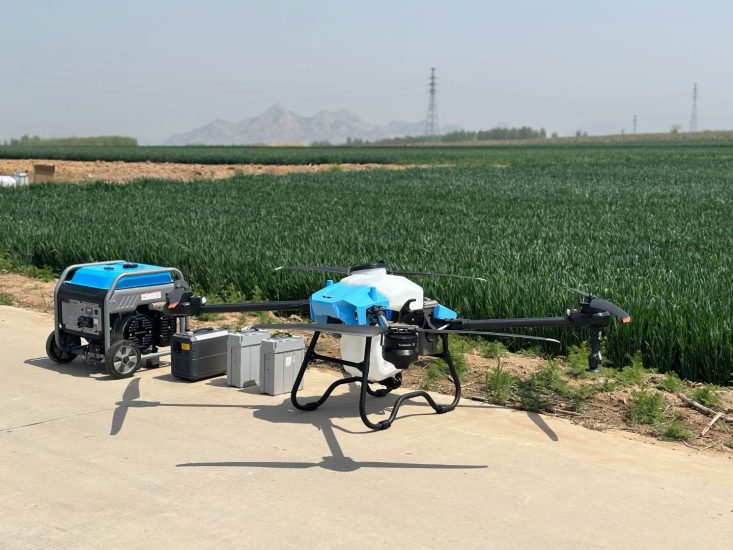
A Refill Station Should Be Part of the Drone System
A productive spraying operation normally needs more than the aircraft.
A practical workflow may include:
Water source → mixing area → refill tank → charging area → drone → field
If these locations are badly arranged, the drone spends more time moving between them.
For large farms, the refill station should ideally be positioned so that the aircraft can return quickly.
The goal is to minimize unnecessary ground time.
This is one reason why two farms with identical drones can achieve very different daily coverage.
Battery Management Can Decide the Daily Output
A drone cannot continue flying while its battery is being charged.
Therefore, battery rotation is essential for serious agricultural operations.
Consider a simplified workflow:
Battery A → Flight
Battery B → Flight
Battery C → Flight
While one battery is being used, another can be charging.
This creates a rotation system.
Without enough batteries, the aircraft may spend long periods waiting.
The battery system therefore includes more than battery capacity.
You should consider:
- Number of batteries
- Charging speed
- Charger capacity
- Electrical supply
- Battery cooling
- Battery replacement time
- Battery health
- Number of daily cycles
For commercial operators, the drone, battery and charger should be evaluated as one system.
One Drone With More Batteries Can Outperform a Larger Drone
This is an important purchasing lesson.
Imagine:
Drone A
- Larger tank
- High payload
- Only two batteries
- Slow charging
versus:
Drone B
- Smaller tank
- Lower payload
- Multiple batteries
- Fast battery rotation
- Efficient refill system
Drone A may look stronger on a specification sheet.
But Drone B may complete more productive work during a full operating day.
That is why daily coverage should be calculated from the complete workflow rather than from tank capacity alone.
Field Shape Has a Major Impact
A large farm does not necessarily mean high drone productivity.
Consider two farms, each with 500 hectares.
Farm A
- Large rectangular fields
- Few obstacles
- Short distance between fields
- Flat terrain
- Central refill station
Farm B
- Small irregular plots
- Trees and buildings
- Long distances between fields
- Slopes
- Multiple refill locations
The first farm may achieve significantly higher practical productivity.
The drone is not necessarily different.
The working environment is different.
Turning Time Is Easy to Ignore
A drone flying across a large rectangular field can maintain a relatively efficient route.
But when it reaches the boundary, it needs to turn.
If the field is irregular, there may be many more turns.
Every turn consumes time.
The same applies to:
- Narrow fields
- Small plots
- Orchard rows
- Terraced farmland
- Fields separated by obstacles
This is why field geometry should be included in any serious productivity estimate.
Orchard Productivity Is Different From Open-Field Productivity
Orchards create a three-dimensional operating environment.
The drone may need to work around:
- Tree canopies
- Branches
- Narrow rows
- Slopes
- Uneven terrain
- Different tree heights
The aircraft may need to slow down and adjust its flight path.
This means a drone that performs very well in an open rice field may achieve a very different daily coverage rate in a dense orchard.
MSOEN’s How Many Acres Can an Orchard Spraying Drone Cover in One Day? explains why orchard productivity depends on spray width, flight speed, battery endurance, tank capacity, tree density, terrain, refilling and operator experience.
Terrain Can Reduce Daily Coverage
Flat farmland is generally easier to operate than steep or mountainous terrain.
On uneven farmland, the drone may need to:
- Adjust altitude
- Follow terrain
- Reduce speed
- Avoid obstacles
- Modify routes
The operator may also spend more time monitoring the aircraft.
This reduces the percentage of the working day spent on uninterrupted spraying.
Therefore, a manufacturer should ideally provide field-test information relevant to your terrain.
Wind Can Change the Result
Weather is one of the variables that buyers cannot completely control.
Wind can affect:
- Flight speed
- Battery consumption
- Spray drift
- Spray pattern
- Route stability
- Operating safety
A drone may achieve excellent productivity on a calm day but lower productivity under stronger wind conditions.
For this reason, daily capacity should be treated as a realistic operating range rather than a guaranteed number.
Chemical Preparation Also Takes Time
The spraying process begins before takeoff.
Operators may need to:
- Prepare water
- Prepare the approved agricultural product
- Mix the application
- Fill the tank
- Inspect the system
- Check the route
- Check battery condition
If preparation takes 30 minutes at the beginning of every operating period, that time needs to be included in the daily productivity calculation.
For professional operators, standardized preparation procedures can significantly reduce wasted time.
Cleaning Is Part of the Working Day
Agricultural spraying equipment should not be treated like a normal camera drone.
After spraying, the equipment may require appropriate cleaning and inspection.
This can involve:
- Tank
- Pump
- Pipes
- Filters
- Nozzles
- External surfaces
Cleaning takes time.
But skipping appropriate maintenance can create larger problems later.
Blocked nozzles, pump problems and chemical residue can reduce spraying quality and increase downtime.
What Does a Real Daily Productivity Calculation Look Like?
Let’s build a simplified example.
Assume a drone has:
- Effective spray width: 6 m
- Operating speed: 5 m/s
- Application rate: 10 L/hectare
- Tank capacity: 30 L
Theoretical ground coverage:
6 × 5 × 3,600 = 108,000 m²/hour
That equals:
10.8 hectares/hour
Now suppose real field efficiency is 60%.
Practical field coverage becomes approximately:
10.8 × 0.60 = 6.48 hectares/hour
But this is still not the complete daily result.
Suppose the operator has 8 hours available.
The theoretical practical field capacity would be:
6.48 × 8 = 51.84 hectares
Now subtract time for:
- Battery changes
- Refilling
- Moving between fields
- Preparation
- Breaks
- Maintenance
- Weather interruptions
If only six hours are actually spent in productive field operation:
6.48 × 6 = 38.88 hectares
This example demonstrates why a manufacturer’s maximum theoretical number should not automatically be used as your daily production target.
Why a 100L Drone Does Not Automatically Spray More Than a 50L Drone
A common assumption is:
100L = twice the productivity of 50L
That is not necessarily true.
The 100L drone may carry twice as much liquid.
But its:
- Energy consumption
- Battery requirements
- Aircraft weight
- Refill equipment
- Transport requirements
may also be different.
If the 50L aircraft has a more efficient battery rotation and faster refill process, its actual daily productivity could be closer to the larger system than expected.
The correct comparison is the complete operating cycle.
Productivity Should Be Measured Per Complete Cycle
A useful operating cycle is:
Takeoff → spray → return → refill → battery change → takeoff again
Measure how long the complete cycle takes.
For example:
- Flight and spraying: 8 minutes
- Landing: 1 minute
- Refill: 2 minutes
- Battery change: 1 minute
- Preparation: 1 minute
Total cycle:
13 minutes
Then determine how much area was actually treated during that cycle.
This gives you a much more useful field productivity figure than simply looking at flight time.
What Buyers Should Ask the Manufacturer
When comparing agricultural spraying drones, ask the manufacturer for specific operating data.
Do not ask only:
“How many hectares per day?”
Ask:
- What flight speed was used?
- What spray width was used?
- What application rate was used?
- What tank capacity was used?
- What payload was carried?
- How long did each flight last?
- How long did refilling take?
- How many batteries were used?
- What was the charging time?
- Was the test performed in an open field or orchard?
- What weather conditions were present?
- Was the field flat or hilly?
- Was the figure theoretical or field-tested?
- What percentage of operational efficiency was assumed?
These questions force the productivity claim to become measurable.
Ask for Field-Test Data, Not Just Marketing Numbers
A serious agricultural drone manufacturer should be able to explain how its performance figures were obtained.
For example, a useful test report might specify:
Crop: Rice
Field: Open field
Tank: 30L
Application rate: 10 L/ha
Flight speed: 5 m/s
Working width: 6 m
Battery: Specified model
Average flight time: Specified
Refill time: Specified
Weather: Specified
Actual coverage: Specified
This is far more useful than simply saying:
“Up to 100 hectares per day.”
The Operator Can Make a Huge Difference
Two operators using the same drone may produce different results.
An experienced operator may:
- Plan routes efficiently
- Minimize unnecessary movement
- Manage batteries correctly
- Refill quickly
- Recognize abnormal spraying
- Adjust to field conditions
- Maintain the aircraft properly
A new operator may spend more time:
- Checking routes
- Changing settings
- Preparing equipment
- Handling batteries
- Moving between fields
Training is therefore part of agricultural drone productivity.
Route Planning Can Increase Practical Coverage
Automatic route planning can reduce unnecessary flight movement.
A well-planned route can help:
- Reduce overlap
- Reduce missed areas
- Reduce unnecessary turns
- Improve boundary management
- Improve battery planning
This is especially useful for irregular fields.
For agricultural drone buyers who want to understand how navigation and agricultural operations fit together, MSOEN’s Agricultural Drone Spraying Guide: How to Improve Efficiency covers practical factors such as route planning, nozzle selection, flight parameters, battery management and field efficiency.
What Happens When the Farm Is Too Large for One Drone?
Sometimes the right answer is not a bigger drone.
It may be multiple drones.
For example, a commercial agricultural service company may prefer:
- Two medium-capacity drones
- Multiple batteries
- Multiple charging systems
- A standardized refill station
- Two trained operators
instead of relying on one very large aircraft.
The advantage is operational redundancy.
If one aircraft requires maintenance, the entire business does not necessarily stop.
For large farms and contractors, fleet productivity can therefore be more important than the maximum capacity of one individual drone.
When Should You Choose a Larger Drone?
A larger drone may make sense when:
- Fields are large and continuous
- Refill stations are far away
- Daily treatment requirements are high
- Battery infrastructure is sufficient
- Transportation is manageable
- The aircraft can maintain useful flight performance under load
The purpose of buying larger capacity should be to remove a real bottleneck.
If the bottleneck is battery charging, a larger tank alone may not help.
If the bottleneck is refill distance, a larger tank may be valuable.
If the bottleneck is field navigation, better route planning may have greater value.
When Is a Smaller Drone More Efficient?
A smaller drone can make more sense when:
- Fields are small
- Fields are irregular
- Access is difficult
- Transportation is frequent
- Refill points are close
- The operator works alone
- Investment needs to remain controlled
A smaller aircraft may also be easier to use for farms that do not require high daily output.
The right choice is determined by the workflow—not by the size of the product brochure.
How Much Area Can a 30L Drone Cover?
There is no single answer.
For example, at an application rate of 10L/hectare:
30L ÷ 10L/ha = 3 hectares per full tank
But this does not mean the drone can spray only three hectares per hour or per day.
It may complete multiple tank cycles.
Actual daily coverage depends on:
- Flight time
- Refill time
- Battery rotation
- Spray width
- Flight speed
- Field efficiency
- Working hours
MSOEN also has a dedicated 30L Agricultural Drone for Large-Scale Farm Spraying page for buyers evaluating this capacity class.
How Much Area Can a 50L Drone Cover?
Using the same simplified application rate:
50L ÷ 10L/ha = 5 hectares per full tank
This reduces the number of refill cycles compared with a 30L system.
But again, the actual daily result depends on the complete operating cycle.
If the 50L aircraft requires significantly more charging time or has fewer available batteries, the theoretical advantage can be reduced.
How Much Area Can a 100L Drone Cover?
The same principle applies.
At 10L/hectare:
100L ÷ 10L/ha = 10 hectares per full tank
But this is only the theoretical coverage based on tank volume and application rate.
It does not tell you:
- Flight time
- Battery consumption
- Refill time
- Spray width
- Actual field efficiency
- Daily operating hours
Therefore, never use tank capacity alone to predict daily acreage.
How to Calculate Your Own Expected Daily Coverage
You can use a simple process.
Step 1: Determine the application rate
For example:
10 L/hectare
Step 2: Calculate theoretical tank coverage
Tank capacity ÷ application rate
For a 30L tank:
30 ÷ 10 = 3 hectares
Step 3: Determine the actual flight cycle
Measure:
- Flight time
- Landing
- Refill
- Battery replacement
Step 4: Determine field efficiency
Account for:
- Turning
- Obstacles
- Transportation
- Route changes
Step 5: Determine usable working hours
Do not assume eight hours of continuous spraying.
Step 6: Calculate realistic daily output
Use actual operating data rather than maximum specifications.
This gives you a much more realistic purchasing estimate.
The Most Important Number Is Cost Per Hectare
Daily coverage is useful, but commercial buyers should go one step further.
Calculate:
Total operating cost ÷ hectares treated
Operating cost may include:
- Drone depreciation
- Battery depreciation
- Electricity
- Labor
- Maintenance
- Spare parts
- Transportation
- Agricultural inputs
- Downtime
A drone that sprays slightly fewer hectares per day may still be the better investment if its cost per hectare is lower.
Productivity and Spray Quality Must Be Balanced
The fastest possible operation is not necessarily the best operation.
If the drone moves too quickly, sprays too high, uses an unsuitable nozzle or applies the wrong flow rate, the field may not receive the required treatment.
That can lead to:
- Missed areas
- Uneven coverage
- Repeated applications
- Additional chemical cost
- Lower crop-protection performance
Therefore, the goal should be:
Maximum useful productivity
—not—
Maximum flight speed
What Is a Good Agricultural Drone for Commercial Operations?
A commercial agricultural drone should provide a balance of:
- Payload
- Spray performance
- Flight endurance
- Battery turnaround
- Refill efficiency
- Navigation
- Reliability
- Maintenance
- Operator usability
If one component is significantly weaker than the others, it can become the bottleneck.
For example:
Long flight time + slow refill = poor workflow
Large tank + insufficient batteries = poor workflow
Wide spray width + unsuitable application rate = poor spray quality
High payload + weak maintenance support = high downtime risk
The complete system matters more than any single specification.
Final Buyer Checklist
Before purchasing an agricultural spraying drone, ask the manufacturer for:
Aircraft
- Maximum payload
- Recommended operating payload
- Tank capacity
- Empty weight
- Maximum takeoff weight
Spraying
- Effective spray width
- Flow rate
- Nozzle configuration
- Application-rate range
- Pump specifications
Flight
- Full-load flight time
- Recommended operating speed
- Navigation system
- Route-planning functions
- Obstacle-detection functions
Battery
- Battery capacity
- Charging time
- Recommended number of batteries
- Expected battery cycles
- Charger requirements
Productivity
- Theoretical hectares/hour
- Real field-test hectares/hour
- Typical daily coverage
- Conditions used for testing
Operation
- Refill time
- Cleaning procedure
- Maintenance requirements
- Spare parts
- Operator training
This information will allow you to compare manufacturers on something more meaningful than advertising claims.
Frequently Asked Questions
How many hectares can an agricultural spraying drone cover in one day?
There is no universal number. Daily coverage depends on tank capacity, application rate, spray width, flight speed, battery endurance, refill time, field layout, terrain, weather and operator experience.
How many acres can an agricultural drone spray per hour?
It depends on the effective spray width, flight speed, application rate and field efficiency. The theoretical figure can be calculated, but real field productivity will normally be lower because of refilling, turning, battery changes and other interruptions.
Does a larger tank mean higher daily productivity?
Not automatically. A larger tank can reduce refill frequency, but the additional payload can increase energy consumption and may require a stronger battery and propulsion system.
What is more important: tank capacity or spray width?
Both matter. Tank capacity determines how much material can be carried per load, while spray width affects the amount of ground that can be covered during flight. They should be evaluated together.
Does application rate affect drone coverage?
Yes. It can have a major effect. A 30L tank can theoretically cover 3 hectares at 10L/ha but only 1.5 hectares at 20L/ha.
Can an agricultural drone really spray hundreds of acres per day?
It can be possible under certain operating conditions and with appropriate equipment and workflow, but buyers should not treat a maximum marketing number as a guaranteed daily output. Ask for the conditions behind the claim.
How can I increase agricultural drone productivity?
Improve the entire workflow: use enough batteries, optimize charging, reduce refill time, plan routes efficiently, maintain the spraying system, train operators and operate under suitable weather conditions.
Is a 30L agricultural drone suitable for a large farm?
It can be suitable depending on the farm’s daily workload and operating conditions. If refill time is low and the farm has good battery and charging infrastructure, a 30L system can be productive. If refill logistics are the main bottleneck, a larger capacity may be more appropriate.
Is an agricultural drone suitable for orchards?
Yes, agricultural spraying drones can be used in orchard applications, but productivity depends heavily on tree density, row spacing, terrain, canopy structure, flight parameters and obstacle conditions. Orchard productivity should be evaluated separately from open-field spraying.
Final Takeaway
The answer to “How much area can an agricultural spraying drone cover in one day?” should never be a single number taken from a product brochure.
The more useful calculation is:
Daily Productivity = Flight Capability × Spray Width × Application Requirements × Field Efficiency × Available Working Time
And field efficiency must include the things that happen between flights:
Refilling + battery changes + charging + turning + transportation + route changes + maintenance + weather
A drone with a larger tank can reduce refill frequency.
A drone with a wider effective spray pattern can cover more ground.
A stronger battery system can increase flight availability.
Better route planning can reduce unnecessary movement.
A faster refill station can reduce downtime.
And a well-trained operator can make the entire system work more efficiently.
For this reason, the best agricultural spraying drone is not necessarily the one with the largest tank or the highest advertised hectares-per-day figure.
It is the drone and operating system that can consistently complete the required agricultural work at the required application quality and at a reasonable cost per hectare.
That is the number serious farm owners, agricultural contractors and international buyers should calculate before placing an order.


No comments yet