


Vegetable farming requires timely and accurate crop protection. Unlike large field crops, vegetables can vary greatly in plant height, row spacing, canopy density, planting method, and field size. Leafy vegetables, root vegetables, fruiting vegetables, and greenhouse-grown crops may all require different spraying approaches.
Traditional backpack sprayers can provide flexibility for small fields, but they require workers to enter the crop. Tractor-mounted equipment can improve field capacity but may be difficult to use when fields are wet, densely planted, or have narrow rows.
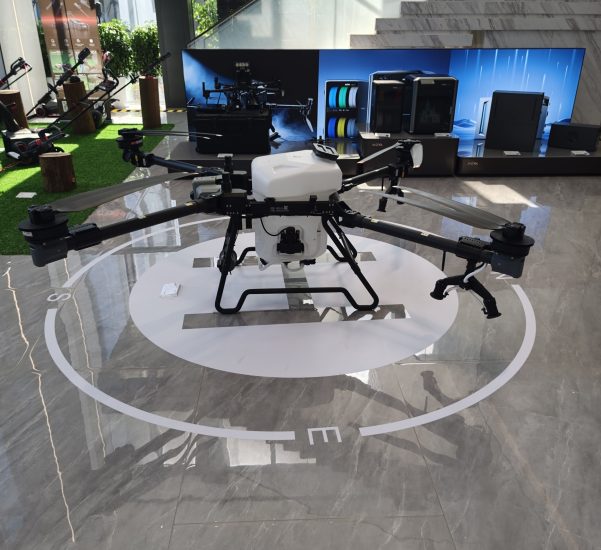
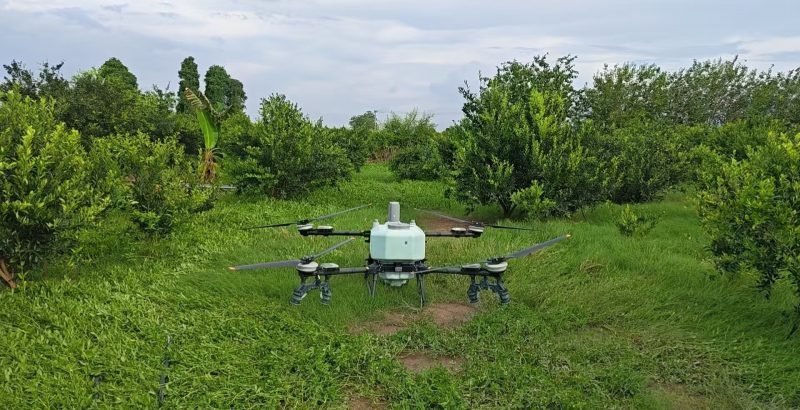
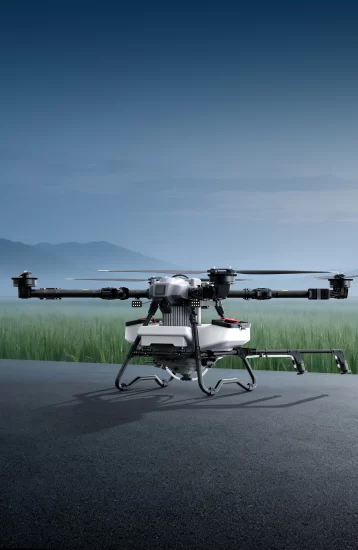
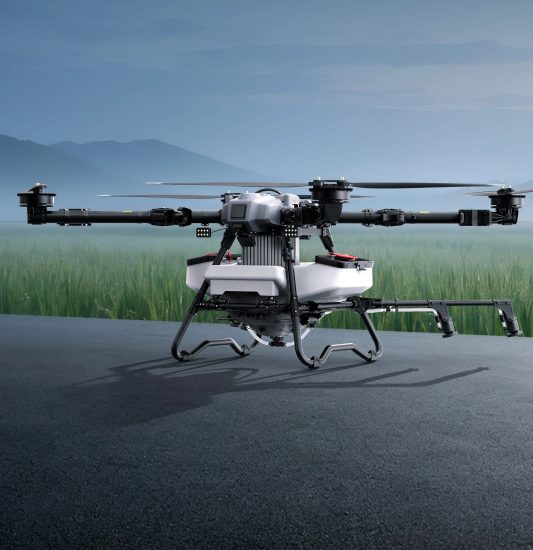
A vegetable spraying agricultural drone provides an aerial application option. The drone carries a liquid tank and spraying system above the crop while following a planned flight route. When properly configured and operated, it can reduce the need for people or ground machinery to travel directly through the crop.
A professional vegetable spraying drone manufacturer should focus on the complete application system rather than only the aircraft. Flight stability, liquid delivery, nozzle selection, battery capacity, route planning, maintenance, and operator training all influence actual field performance.
What Is a Vegetable Spraying Agricultural Drone?
A vegetable spraying agricultural drone is an unmanned aerial vehicle equipped with a liquid application system designed for crop protection and other permitted agricultural applications.
A typical system may include:
-
Agricultural UAV frame
-
Brushless motors
-
Propellers
-
Flight controller
-
Liquid tank
-
Electric pumps
-
Filters
-
Spray pipes
-
Agricultural nozzles
-
Flow-control system
-
GPS or RTK positioning
-
Remote controller
-
Intelligent batteries
-
Battery charger
-
Obstacle-detection sensors
-
Safety and monitoring functions
During operation, the drone follows a manually controlled or programmed route while the pump and nozzle system distributes liquid across the designated area.
The objective is controlled application rather than simply maximizing spray volume.
Why Use a Drone for Vegetable Spraying?
Vegetable fields can be difficult to manage with conventional equipment, particularly when crops are densely planted or soil conditions are unsuitable for heavy machinery.
Reduced Crop Contact
The drone flies above the crop instead of driving through planting rows. This can reduce mechanical contact with plants and avoid some wheel-track problems.
Reduced Manual Labor
Workers do not need to carry a full backpack sprayer through the entire field. The operator can control the aircraft from a suitable position outside the treated area.
Fast Response
Vegetable crops can have relatively short treatment windows. A drone can help operators organize spraying operations quickly when field and weather conditions are suitable.
Flexible Field Access
Aerial equipment can be useful when wet soil, narrow rows, or crop density makes ground machinery inconvenient.
Programmable Operation
Agricultural drones can create field boundaries and planned flight routes. This helps operators organize systematic coverage and reduce unnecessary overlap.
What Vegetables Can Be Sprayed by Drone?
The appropriate application depends on the crop, agricultural product, crop stage, field conditions, and local regulations.
Potential applications may include vegetable crops such as:
-
Lettuce
-
Spinach
-
Cabbage
-
Broccoli
-
Cauliflower
-
Celery
-
Carrots
-
Potatoes
-
Onions
-
Tomatoes
-
Peppers
-
Cucumbers
-
Eggplants
-
Beans
-
Peanuts
The same drone platform can potentially serve several vegetable crops, but operating parameters should not automatically remain identical.
A cabbage field, for example, has a very different canopy structure from a young carrot field.
Main Applications
Insect Control
Vegetables can be affected by different insect pests during different growth stages.
A spraying drone can provide an aerial application method for approved insect-control products when aerial application is legally permitted.
The application rate, nozzle configuration, and operating conditions should be selected according to the product requirements.
Disease Management
Vegetable crops can be susceptible to fungal, bacterial, and other diseases.
Timely application can be important when disease pressure is high.
A drone can help cover larger areas without requiring workers or tractors to move repeatedly through the crop.
Weed Management
Weeds compete with vegetables for nutrients, water, sunlight, and growing space.
Where an agricultural product is approved for the crop and aerial application, the drone can be used as part of a weed-management program.
Herbicide applications require particular attention to spray drift and crop sensitivity.
Foliar Nutrition
Some liquid fertilizers and foliar nutrients may be applied by agricultural drone when the product and application method are appropriate.
The concentration and application volume should be based on the product requirements and crop needs.
Different Vegetable Crops Require Different Settings
One of the most important considerations for vegetable spraying is crop diversity.
Leafy Vegetables
Lettuce, spinach, and similar crops have relatively low canopies. Excessive spray volume or unsuitable flight parameters may increase runoff or unnecessary application.
Brassica Vegetables
Cabbage, broccoli, and cauliflower can develop broad and dense leaves. Coverage can become more challenging as the canopy expands.
Root Vegetables
Carrots, onions, and similar crops have different target structures and may require different application parameters from leafy crops.
Fruiting Vegetables
Tomatoes, peppers, cucumbers, and eggplants develop more complex plant structures as they mature.
The appropriate flight configuration should therefore consider crop height, canopy density, row spacing, and the intended target.
Spray Tank Capacity
Tank capacity affects field productivity, but a larger tank is not automatically the best choice.
Increasing liquid capacity also increases aircraft payload and energy consumption.
The appropriate tank size depends on:
-
Vegetable field size
-
Application volume
-
Crop density
-
Battery capacity
-
Water availability
-
Refill distance
-
Daily working target
-
Transportation requirements
For smaller farms, a compact drone may be easier to transport and refill.
For agricultural contractors working across large vegetable farms, a larger payload may reduce downtime.
Pump and Flow Control
A reliable pump is essential for consistent spraying.
The pump should provide stable flow within the required operating range.
A high maximum flow rate is not necessarily an advantage if the system cannot maintain accurate control at lower application rates.
A flow-control system can help coordinate liquid delivery with flight speed.
For example, if the aircraft accelerates while maintaining the same liquid flow, the application rate per unit area decreases.
This relationship can be simplified as:
Application Rate ≈ Flow Rate ÷ (Flight Speed × Effective Spray Width)
Actual field calibration must also consider nozzle distribution, route overlap, wind, crop structure, and other variables.
Nozzle Selection
Nozzles determine how liquid leaves the aircraft.
They influence:
-
Droplet characteristics
-
Spray pattern
-
Distribution
-
Coverage
-
Drift potential
Different vegetable crops may require different nozzle configurations.
A low-growing leafy vegetable may require a different approach from a tall tomato crop.
The nozzle should be selected according to the agricultural product, target crop, required application rate, environmental conditions, and equipment specifications.
Spray Width and Route Spacing
A wide spray pattern can improve theoretical productivity, but the maximum advertised spray width should not automatically be used as the working width.
Effective coverage depends on:
-
Nozzle arrangement
-
Flight altitude
-
Flight speed
-
Crop height
-
Droplet characteristics
-
Rotor airflow
-
Wind
-
Route overlap
If flight paths are too far apart, untreated strips can appear.
If paths overlap excessively, some areas may receive more product than intended.
Field calibration is therefore essential.
Flight Height
Flight height affects spray behavior.
Flying too high can increase droplet travel distance and may increase drift under unsuitable conditions.
Flying too low can create excessive airflow interaction with the crop and reduce operational clearance.
The appropriate height depends on:
-
Crop height
-
Canopy structure
-
Drone design
-
Nozzle configuration
-
Flight speed
-
Weather
-
Terrain
-
Product requirements
There is no single flight height suitable for every vegetable crop.
Crop Canopy and Spray Coverage
Vegetable crops vary greatly in canopy structure.
A dense cabbage canopy can behave differently from an open carrot field.
Tomatoes and peppers can also develop complex structures that require consideration of plant height and leaf arrangement.
For this reason, operators should not assume that increasing liquid flow will solve coverage problems.
Better results generally come from matching the complete system:
Crop Structure + Nozzle + Flow Rate + Flight Speed + Flight Height + Spray Width + Weather
Battery Management
Battery performance directly affects agricultural drone productivity.
A fully loaded aircraft consumes more energy than an empty aircraft.
Wind, frequent takeoffs, and long travel distances between fields can also increase energy consumption.
Commercial operators should calculate the complete operating cycle:
Takeoff → Spraying → Landing → Battery Replacement → Refilling → Inspection → Next Flight
A practical battery system should therefore include enough batteries and charging capacity to support the expected daily workload.
Navigation and Route Planning
Accurate navigation is valuable for vegetable fields, particularly where planting rows are narrow or field boundaries are irregular.
Depending on the drone configuration, navigation functions may include:
-
GPS positioning
-
RTK positioning
-
Automatic route planning
-
Field boundary mapping
-
Route recording
-
Automatic return
-
Obstacle detection
-
Terrain-related functions
RTK can be particularly useful when the operator needs repeatable routes.
However, navigation accuracy alone does not guarantee good spraying.
Correct liquid calibration remains essential.
Obstacle Detection
Vegetable farms may contain many obstacles, including:
-
Trees
-
Utility poles
-
Power lines
-
Greenhouses
-
Irrigation equipment
-
Buildings
-
Fences
-
Agricultural machinery
Obstacle-detection systems can provide additional assistance.
However, automated detection should not be treated as a complete substitute for operator awareness.
The operator should inspect the work area before takeoff and remain responsible for safe operation.
Greenhouse and Protected-Crop Considerations
Greenhouses require special attention.
A conventional outdoor agricultural drone may not be suitable for indoor greenhouse operation because of limited space, structural obstacles, ventilation conditions, and different safety requirements.
If a customer plans to use a drone in protected cultivation, the manufacturer should first understand:
-
Greenhouse dimensions
-
Internal height
-
Row spacing
-
Structural layout
-
Ventilation
-
Obstacles
-
Required payload
-
Intended application
A system designed specifically for the environment may be more appropriate than simply using a standard open-field drone.
Weather and Spray Drift
Vegetable farms can be located close to homes, roads, waterways, and other crops.
Spray drift must therefore be carefully managed.
Operators should evaluate:
-
Wind speed
-
Wind direction
-
Temperature
-
Humidity
-
Rain conditions
-
Crop sensitivity
-
Product requirements
Spraying should only be performed when conditions are suitable for the selected agricultural product and allowed under local regulations.
The objective is accurate application on the target crop while minimizing unnecessary off-target movement.
Maintenance
Vegetable spraying drones require routine maintenance because agricultural chemicals, water, soil, and plant material can enter the working environment.
Tank
Clean and inspect the tank after spraying.
Pump
Check for abnormal noise, leakage, and changes in flow.
Filters
Inspect and clean filters regularly.
Nozzles
Check for blockage and wear.
Pipes
Inspect all connections for leakage.
Motors
Check motors for contamination and abnormal operation.
Propellers
Inspect propellers for cracks, deformation, or other damage.
Batteries
Follow the manufacturer’s charging, storage, transportation, and inspection procedures.
Sensors
Keep cameras, radar, and other sensors clean and inspect them before flight.
Regular maintenance reduces the possibility of unexpected downtime during critical crop-protection periods.
OEM Vegetable Spraying Drone Manufacturing
International distributors and agricultural companies may require customized drone systems.
OEM and ODM options can include:
-
Custom logo
-
Custom colors
-
Packaging
-
Controller language
-
User manuals
-
Tank capacity
-
Battery configuration
-
Nozzle configuration
-
Spray system
-
Spare parts package
-
Software localization
The final configuration should be based on the target market and actual agricultural requirements.
Buyers should also confirm local requirements for drone operation, radio equipment, batteries, agricultural chemicals, and aerial application before importing equipment.
Quality Control Before Shipment
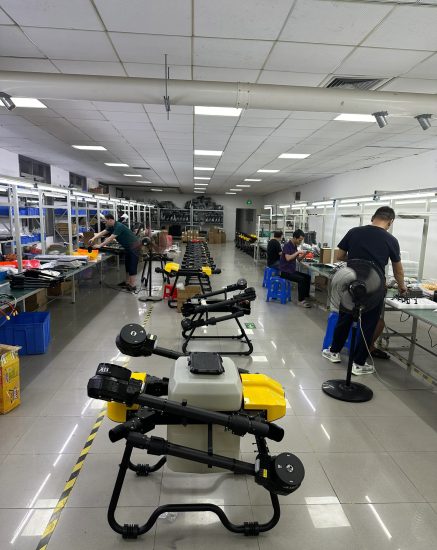
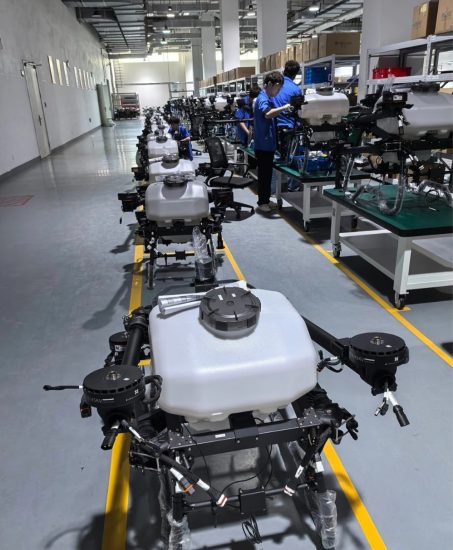
A professional manufacturer should inspect the drone before delivery.
Structural Inspection
Check the frame, arms, landing gear, motor mounts, and fasteners.
Electrical Inspection
Check wiring, connectors, batteries, charger, controller, and communication systems.
Spray System Testing
Test the tank, pump, filters, pipes, nozzles, and flow-control system.
Flight Testing
Check:
-
Takeoff
-
Hovering
-
Directional control
-
Turning
-
Route operation
-
Landing
-
Return functions
-
Safety systems
Final Packaging
Confirm that the aircraft, controller, batteries, charger, tools, spare parts, and documentation are complete before export packaging.
How to Choose a Vegetable Spraying Drone Manufacturer
Buyers should not compare manufacturers based only on price.
Important factors include:
-
Aircraft stability
-
Payload capacity
-
Tank capacity
-
Pump quality
-
Nozzle options
-
Flow-control accuracy
-
Navigation system
-
Battery endurance
-
Charging solution
-
Obstacle detection
-
Spare parts availability
-
Warranty
-
Training
-
Technical support
-
OEM capability
-
Export experience
The manufacturer should be able to explain how its equipment performs under realistic agricultural conditions.
After-Sales Support
Agricultural drones require technical support after delivery.
Customers may need assistance with:
-
Spray calibration
-
Nozzle replacement
-
Pump maintenance
-
Battery management
-
Controller settings
-
Flight planning
-
Sensor maintenance
-
Software configuration
-
Spare parts
-
Troubleshooting
For commercial agricultural service providers, fast technical support can be particularly important because vegetable crops may have narrow treatment windows.
Final Thoughts
Vegetable spraying requires a flexible agricultural drone because vegetable crops vary significantly in height, density, planting pattern, and field conditions.
A professional vegetable spraying agricultural drone can help reduce manual field work, avoid some ground-access problems, and provide a programmable aerial application method.
However, successful spraying depends on more than the aircraft.
A complete solution should combine:
-
Stable flight performance
-
Suitable payload capacity
-
Reliable liquid delivery
-
Appropriate nozzles
-
Accurate flow control
-
Proper route planning
-
Reliable batteries
-
Regular maintenance
-
Operator training
-
Safe agricultural practices
The best vegetable spraying drone is not necessarily the model with the largest tank or highest advertised speed. The correct system is the one that matches the vegetable crop, field size, planting layout, application requirements, and local operating environment.
FAQ
1. What is a vegetable spraying agricultural drone?
It is an agricultural UAV equipped with a liquid tank, pump, nozzles, navigation, and flight-control systems for permitted crop protection and agricultural applications.
2. What vegetables can be sprayed with an agricultural drone?
Depending on the equipment and application requirements, drones can potentially be used for crops such as lettuce, cabbage, broccoli, cauliflower, spinach, carrots, onions, potatoes, tomatoes, peppers, cucumbers, eggplants, beans, and other vegetables.
3. Can one drone spray different vegetable crops?
Yes. Many agricultural drone platforms can support multiple crops. However, the flight speed, spray volume, nozzle configuration, and other parameters may need to be adjusted for each crop.
4. What tank capacity should I choose?
The appropriate tank capacity depends on field size, application volume, battery capacity, refill facilities, transportation requirements, and daily operating targets.
5. How much vegetable farmland can a drone spray per hour?
There is no universal number. Actual productivity depends on spray width, flight speed, application rate, tank capacity, battery changes, refilling time, field shape, and weather.
6. Can drones spray leafy vegetables?
Yes, when the agricultural product and aerial application are legally permitted. Leafy vegetables may require careful control of application rate and droplet characteristics because of their low and dense canopy.
7. Can a drone spray tomatoes and peppers?
Agricultural drones can potentially be used for these crops, but mature tomato and pepper plants can have more complex canopies. Flight height, spray configuration, and application parameters should be adjusted accordingly.
8. Is RTK necessary for vegetable spraying?
Not always. RTK can improve route positioning and repeatability, especially for irregular fields or operations requiring precise route control.
9. Can agricultural drones be used inside greenhouses?
A standard outdoor spraying drone should not automatically be used inside a greenhouse. The manufacturer needs to evaluate the internal height, structure, row spacing, obstacles, ventilation, and safety requirements first.
10. How can spray drift be controlled?
Operators should select suitable nozzles and operating parameters, maintain an appropriate flight height, avoid unsuitable wind conditions, and follow the agricultural product label and local regulations.
11. How often should the spraying system be cleaned?
The tank, pump, filters, pipes, and nozzles should be cleaned and inspected after spraying according to the manufacturer’s procedures and the requirements of the agricultural product.
12. Can you provide OEM vegetable spraying drones?
OEM customization may include logo, product colors, packaging, controller language, manuals, tank configuration, battery configuration, spray components, and spare-parts packages, depending on project requirements.
13. What information should I provide for a quotation?
Provide the destination country, expected quantity, vegetable crop, field size, average plant height, row spacing, preferred tank capacity, intended application, battery requirements, OEM requirements, and delivery destination. This information allows the manufacturer to recommend a suitable configuration for the actual farming environment.
THE END


No comments yet