



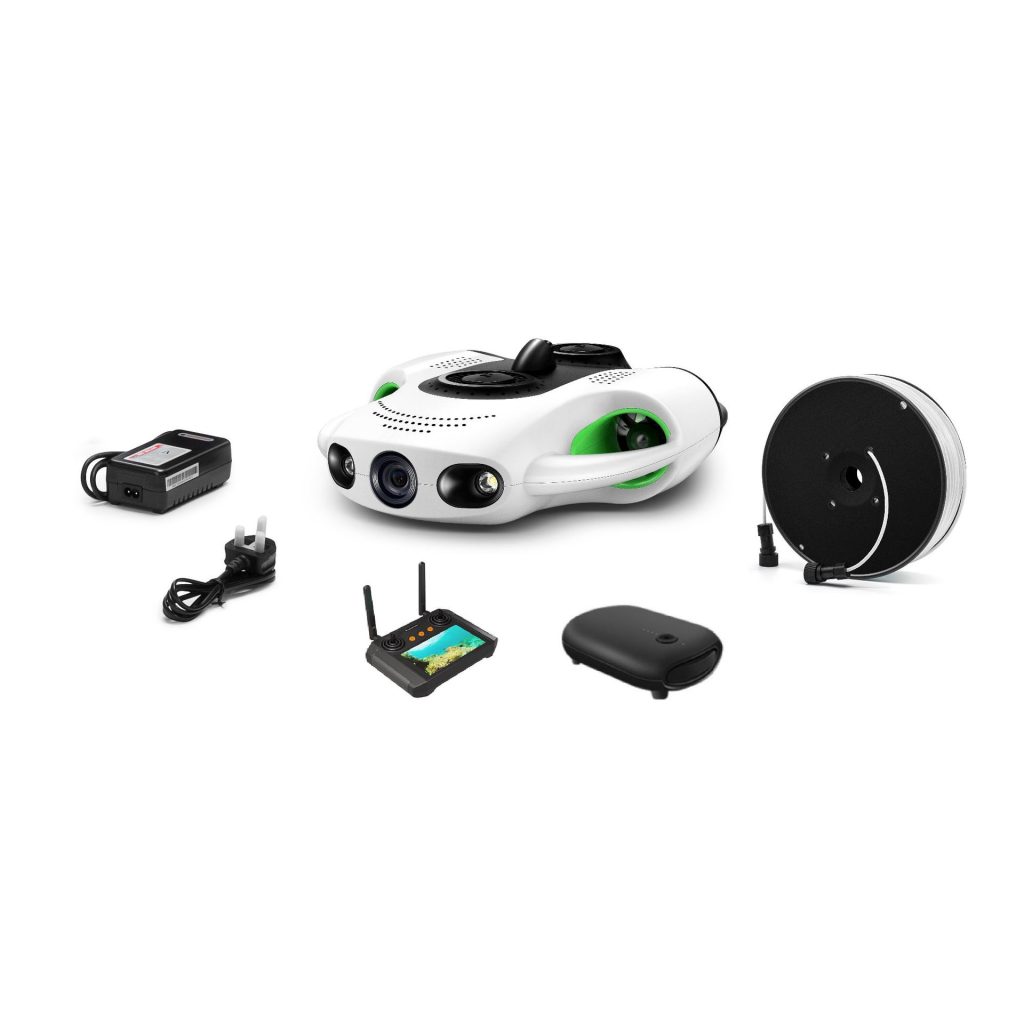
Introduction: The Real Meaning of Visual Evolution Underwater
For many years, the selling point of underwater drones was simple: they could provide live video beneath the surface. For operators who had previously relied on blind diving, grappling hooks, or indirect sonar feedback, even basic visual confirmation was a significant advancement.
But in professional environments—dam inspection, offshore infrastructure, aquaculture systems, underwater construction, or search operations—seeing is not enough.
The real breakthrough in underwater drone technology is the transition from merely detecting shapes and movement to capturing high-fidelity, inspection-grade visual data. This evolution—from “visible” to “visually precise”—is redefining industrial underwater operations.
In this article, we examine the engineering foundations behind this transition, focusing on imaging sensors, optics, lighting systems, signal processing, transmission architecture, and stabilization technologies that collectively enable clarity rather than just visibility.
1. The Limitations of Early Underwater Imaging Systems
1.1 Low-Resolution CMOS Sensors
Early underwater drones often used consumer-grade image sensors:
- 720p or 1080p resolution
- Small pixel size (1.12–1.4 µm)
- Limited dynamic range
- Poor low-light performance
Underwater environments inherently reduce light intensity and contrast. When paired with limited sensors, images appeared:
- Grainy
- Washed out
- Lacking fine structural detail
For recreational use, this was acceptable. For industrial inspection, it was insufficient.
1.2 Light Attenuation and Color Absorption
Water absorbs light at different wavelengths:
- Red disappears first
- Orange and yellow follow
- Blue and green penetrate deeper
This leads to:
- Color distortion
- Loss of contrast
- Reduced object differentiation
Without correction algorithms or spectral compensation, visual clarity is compromised.
1.3 Backscatter and Turbidity
Suspended particles reflect light back to the camera, creating “marine snow” effects.
High-intensity but poorly positioned lighting can worsen backscatter.
Thus, clarity depends not only on brightness but on illumination engineering geometry.
2. Sensor Technology: The Core of High-Definition Underwater Vision
The first major breakthrough in underwater drone clarity came from upgraded imaging sensors.
2.1 Larger Sensor Size
Modern inspection-grade underwater drones increasingly adopt:
- 1-inch CMOS sensors
- Backside-illuminated (BSI) architecture
- High quantum efficiency
Advantages:
- Larger photosites (2.4 µm or above)
- Improved signal-to-noise ratio (SNR)
- Enhanced low-light sensitivity
2.2 Dynamic Range and Bit Depth
Dynamic range determines how well a camera handles highlights and shadows.
Typical early systems:
- 8-bit color depth
- Limited highlight retention
Modern systems:
- 10-bit or 12-bit processing
- Dynamic range exceeding 12 stops
This enables detection of subtle surface irregularities on:
- Concrete
- Steel
- Coated pipelines
- Aquaculture nets
2.3 Resolution vs Usable Detail
Resolution alone does not equal clarity.
For inspection tasks, important metrics include:
- Modulation Transfer Function (MTF)
- Signal-to-Noise Ratio (SNR)
- Optical distortion rate
- Edge sharpness
Inspection-grade drones may feature:
| Parameter | Typical High-End Value |
|---|---|
| Resolution | 4K / 8K |
| Sensor Size | 1 inch |
| Pixel Size | 2.4 µm |
| Dynamic Range | ≥ 12 stops |
| Bit Depth | 10–12 bit |
| ISO Range | 100–6400 |
| Lens Aperture | f/1.8 – f/2.8 |
Clarity comes from combined optical and electronic optimization.
3. Optical Engineering: Glass Matters Underwater
3.1 Wide-Angle vs Inspection Lens
Wide-angle lenses increase coverage but can introduce:
- Barrel distortion
- Edge softness
Professional underwater inspection lenses use:
- Multi-element glass construction
- Anti-reflective coatings
- Low-dispersion glass
Field of View (FOV) is typically between 120°–160°, but distortion correction algorithms are applied.
3.2 Dome Ports and Refraction Compensation
Water changes the effective focal length of lenses due to refraction.
High-quality underwater drones incorporate:
- Optical dome ports
- Refraction index compensation
- Calibrated focus adjustments
This prevents blurred edges and geometric distortion.
4. Lighting System Engineering: More Than Just Lumens
Lighting is often misunderstood.
Brightness alone does not guarantee clarity.
4.1 Lumen Output
Professional underwater drones may provide:
- 4,000 – 10,000 lumens adjustable output
But more critical factors include:
- Color temperature (5000K–6500K)
- Beam angle
- Symmetry
- Adjustable intensity
4.2 Backscatter Reduction Strategy
Advanced lighting systems use:
- Angled LED arrays
- Offset positioning from camera axis
- Diffused beam control
This reduces particle reflection and improves contrast.
5. Image Processing and Real-Time Optimization
Raw data must be processed effectively.
Modern underwater drones employ:
- Real-time digital noise reduction (DNR)
- Adaptive contrast enhancement
- White balance correction
- Dehazing algorithms
These systems operate through embedded image processors.
Latency typically remains below 100ms in high-bandwidth tethered systems.
6. Stabilization: The Hidden Factor Behind Clarity
Motion blur destroys detail.
Underwater drones face:
- Current drift
- Thruster vibration
- Operator movement
Stabilization systems include:
- 6-axis IMU
- Gyro-based stabilization
- Closed-loop thruster control
- Electronic image stabilization (EIS)
Advanced models may integrate mechanical gimbal stabilization.
7. Technical Specification Overview – Clarity-Oriented Configuration
Below is a representative inspection-grade configuration:
| Category | Specification |
|---|---|
| Max Depth | 200–300 meters |
| Camera Resolution | 4K / 8K |
| Sensor Type | 1-inch BSI CMOS |
| Dynamic Range | ≥12 stops |
| Lighting Output | Up to 8000 lumens |
| Thruster System | 6-vector configuration |
| Stabilization | 6-DOF closed-loop |
| Transmission | Zero-latency tethered |
| Recording Format | H.265 / ProRes |
| Operating Temp | -10°C to 45°C |
8. Comparison: “Seeing” vs “Seeing Clearly”
| Feature | Basic Visibility System | High-Clarity Inspection System |
|---|---|---|
| Resolution | 1080p | 4K / 8K |
| Sensor Size | Small | 1-inch |
| Dynamic Range | Limited | Wide |
| Lighting | Fixed | Adjustable, angled |
| Stabilization | Basic | 6-axis + EIS |
| Use Case | Hobby / Monitoring | Industrial Inspection |
| Detail Recognition | Low | Micro-crack detection |
The difference becomes critical in:
- Dam crack detection
- Weld seam inspection
- Biofouling analysis
- Structural corrosion assessment
9. Industrial Impact of High-Clarity Imaging
Dam Inspection
Hairline cracks under 1mm can now be visually confirmed.
Offshore Energy
Corrosion and coating degradation are measurable.
Aquaculture
Fish health and net integrity are documented clearly.
Marine Research
Precise species identification becomes feasible.
10. FAQ
Q1: Why is high resolution important underwater?
High resolution improves edge definition and structural defect identification, particularly in industrial inspections.
Q2: Does 8K make a practical difference?
Yes, especially when zooming into recorded footage for analysis without losing detail.
Q3: What reduces underwater image noise?
Larger sensors, improved SNR, better lighting geometry, and digital noise reduction algorithms.
Q4: Is lighting brightness the most important factor?
No. Beam angle, positioning, and spectral balance are equally critical.
Q5: Can these systems operate in turbid water?
Yes, especially when combined with optimized lighting and optional sonar support.
Conclusion: Clarity Defines Capability
Underwater drone technology has moved beyond novelty.
The transition from “seeing something underwater” to “analyzing structural detail with measurable clarity” marks a technological maturation.
Resolution alone is not the breakthrough.
The true evolution lies in:
- Sensor architecture
- Optical engineering
- Lighting geometry
- Stabilization systems
- Intelligent image processing
Together, they enable underwater drones to move from observation tools to precision inspection instruments.
And in industrial environments, clarity is not a luxury.
It is a requirement.


No comments yet