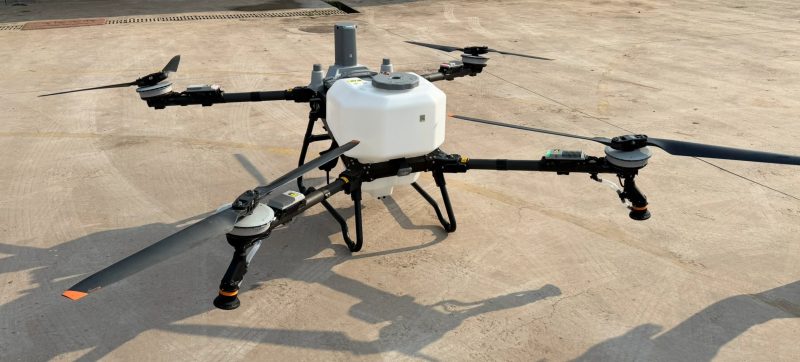



Viticulture presents some of the most challenging conditions in all of agriculture. Steep inclines, narrow rows, fragile trellising systems, and high-value fruit demand a crop protection approach that traditional tractor-based spraying simply cannot deliver safely or efficiently. In many of the world’s premier wine regions — from the terraced slopes of the Valais to the rolling hills of Napa, Mendoza, and Marlborough — tractor spraying on gradients exceeding 15 degrees is not merely inefficient; it is genuinely hazardous.
A Swiss-made vineyard spraying drone is engineered specifically for these constraints. Built to the exacting standards of Swiss manufacturing and designed around precision crop protection, these UAVs represent the benchmark for professional vineyard operations across Europe, the Americas, and emerging wine regions worldwide.
This article examines the engineering principles, regulatory advantages, and commercial considerations that define a Swiss-made vineyard spraying drone, and why global distributors and vineyard operators are increasingly sourcing these platforms from precision crop protection UAV manufacturers based in Switzerland.
The Meaning of “Swiss Made” in Viticulture Technology
In Switzerland, the “Swiss made” designation is a legally protected label governed by federal ordinance. For an agricultural UAV to carry this mark, a substantial portion of its production costs must originate in Switzerland, and the final stage of manufacturing must occur on Swiss soil.
For vineyard operators and distributors, this designation translates into three procurement guarantees:
-
Engineering Integrity — Every flight controller, nozzle calibration, and structural component is designed and tested under Swiss quality management systems. In viticulture, where a single miscalculation can damage an entire row of vines, this level of engineering rigor is not optional.
-
Traceability — Component sourcing is documented and auditable. When a vineyard operator applies crop protection chemicals using a Swiss-made drone, the entire application chain — from nozzle flow rate to flight path — is logged, verifiable, and defensible before regulatory authorities.
-
Regulatory Alignment — Swiss environmental and aviation authorities maintain some of the world’s strictest certification processes. A “Swiss made” vineyard UAV arrives with a documentation package that satisfies the most rigorous global import and operation requirements.
Engineered for the Vineyard Environment
Swiss vineyard spraying drones are not adapted from flat-land agricultural platforms. They are designed from the ground up for the specific geometry and challenges of viticulture.
Narrow-Profile Airframe Design
Vineyard rows are typically spaced 1.5 to 2.5 meters apart. A Swiss-made vineyard UAV features a compact airframe that navigates between rows without risking contact with trellising wires, posts, or canopy. Folding arm mechanisms allow the drone to transition from road transport to flight-ready in under three minutes, and the narrow-body configuration ensures that the propellers and spray boom remain clear of vine structures during operation.
Terrain-Following Flight on Steep Slopes
The Swiss landscape — defined by alpine valleys and steep terraced vineyards — dictated the development of advanced terrain-following algorithms. Using RTK positioning combined with downward-facing sensors, the drone maintains a consistent altitude above the vine canopy even as the ground slope changes by 20, 30, or 40 degrees. This ensures uniform spray deposition from the valley floor to the ridgeline.
Dual-Direction Nozzle Configurations
Unlike broad-acre crop spraying, which relies primarily on downward-facing nozzles, vineyard applications require sideward and downward spray patterns to penetrate the vertical canopy. Swiss precision crop protection UAVs feature adjustable nozzle mounts that can be configured for:
-
Downward spraying for overhead canopy coverage
-
Sideward spraying for targeted application on trellised vines
-
Angled spraying for dense canopy penetration without overspray
Lightweight Composite Construction
Swiss manufacturers utilize aerospace-grade carbon fiber reinforced polymers and anodized aluminum alloys to achieve an optimal payload-to-weight ratio. A lighter airframe extends flight time, improves maneuverability in crosswinds (common in exposed vineyard sites), and reduces ground pressure during takeoff and landing on soft or uneven terrain.
Precision Crop Protection Technology
The term “precision” in precision agriculture is often overused. In a Swiss-made vineyard spraying drone, precision is engineered into every subsystem.
RTK Centimeter-Level Positioning
Standard GPS carries a margin of error of 1–5 meters — unacceptable in a vineyard where rows are separated by less than 2 meters. RTK (Real-Time Kinematic) positioning corrects GNSS signals in real time using a ground-based reference station, achieving positional accuracy of 1–3 centimeters.
In vineyard operations, this level of precision enables:
-
Boundary-following flight — the drone can maintain a consistent 50 cm offset from the edge of the vineyard block, even around irregular field shapes
-
Row-aligned autonomous flight — the drone follows the exact line of the rows without manual piloting
-
Pinpoint landing — after a spraying mission, the drone returns to within 10 cm of its exact takeoff point for battery and liquid exchange
Centrifugal Atomization for Uniform Coverage
Swiss vineyard UAVs employ high-speed centrifugal nozzles rather than pressure-based systems. A rotating disc operating at up to 10,000 RPM shears the liquid into uniformly sized droplets. Droplet diameter is adjustable in real time (typically 50–300 microns) based on:
-
Canopy density and leaf area index
-
Wind speed and direction
-
Flight speed
-
Chemical viscosity and active ingredient characteristics
This level of control ensures that the active ingredient reaches the target surface — whether that is the upper leaf surface, the lower leaf (where many vineyard pests reside), or the grape cluster zone — with minimal drift and maximum efficacy.
Closed-Loop Flow Control
The spray controller is integrated directly with the flight controller. As the drone’s ground speed changes — slowing on a steep climb, accelerating on a descent — the flow rate adjusts automatically to maintain a constant application rate measured in liters per hectare. This eliminates the two most common problems in vineyard spraying: over-application on slow sections and under-application on fast sections.
Electric Propulsion and Low-Noise Operation
Swiss vineyard drones run on clean electric propulsion. In wine regions where vineyards border residential areas, tasting rooms, or hotels, low-noise operation is a significant operational advantage. Electric motors also produce zero direct emissions at the point of application, aligning with the sustainability certifications that many premium wine producers now pursue (e.g., organic, biodynamic, or sustainability-in-practice certifications).
Regulatory Compliance: The Swiss Advantage for Vineyards
Swine environmental law imposes strict buffer zones near water sources, residential areas, and ecologically sensitive zones. Swiss-made vineyard spraying drones are engineered to operate within these buffer zones through:
-
Drift-reduction technology validated through ISO 22866-compliant drift assessment protocols
-
Precision boundary-following that maintains exact distances from sensitive areas
-
Droplet size optimization that minimizes fine droplets prone to off-target movement
-
Automated no-spray zones — operators can program GPS polygons where spraying is automatically suppressed
For vineyard operators in the EU, UK, North America, and other regulated markets, this means the drone can legally operate in conditions and locations where conventional tractor spraying would be restricted or prohibited.
Why Global Distributors Source Swiss-Made Vineyard UAVs
For distributors serving wine regions worldwide, Swiss-made vineyard spraying drones offer a differentiated product with strong commercial positioning:
Premium Market Alignment
Wine is a high-value crop. A single hectare of premium vineyard can produce grapes worth tens of thousands of dollars. Vineyard owners who invest in Swiss precision equipment are not looking for the lowest-cost option — they are looking for the lowest-risk, highest-precision solution that protects their crop and their brand.
Complete Certification Package
A Switzerland-based precision crop protection UAV manufacturer provides:
-
CE marking (EMC + RED directives) for European market access
-
FCC Part 15B for North American operations
-
UN38.3 and MSDS for battery transport
-
ISO 9001 quality management certification
-
Drift measurement reports from accredited laboratories
-
Noise level assessments
This documentation enables distributors to clear customs and obtain local operational permits significantly faster than with uncertified or poorly documented alternatives.
OEM and Private-Label Opportunities
Swiss manufacturers typically offer white-label and custom-configuration OEM programs, allowing distributors to:
-
Market the drone under their own brand
-
Adapt nozzle configurations for local grape varieties and trellising systems
-
Customize tank capacity to match typical vineyard block sizes in their region
-
Localize the ground control station software and documentation
Procurement Evaluation Framework
When evaluating a Swiss precision crop protection UAV manufacturer for vineyard spraying drones, distributors and vineyard managers should assess the following:
1. Verify the “Swiss Made” Certification
Request documentation proving the legal right to use the “Swiss made” designation. Confirm that the production cost threshold and final manufacturing location requirements are met.
2. Evaluate Vineyard-Specific Features
Confirm that the platform includes:
-
Narrow-profile airframe suitable for local row spacing
-
Sideward nozzle capability for vertical canopy targeting
-
Terrain-following flight modes for local slope conditions
-
RTK positioning as a standard (not optional) feature
3. Request Agronomic Performance Data
A credible manufacturer will provide:
-
Drift measurement reports (ISO 22866-compliant)
-
Deposit uniformity studies on vineyard canopies
-
Application rate accuracy validation across varying flight speeds
-
Noise level measurements at specified distances
4. Assess After-Sales and Training
-
Factory-level technical training for distributor technicians
-
Remote diagnostics capability
-
Spare parts availability and lead times
-
Regional service center partnerships for high-volume markets
5. Review Software and Data Policies
-
Confirm that flight logs and application records are fully exportable
-
Verify compatibility with local farm management or viticulture software platforms
-
Ensure the manufacturer’s data policy gives the operator full ownership of their application data
Frequently Asked Questions
Q: What defines a “Swiss made” vineyard spraying drone?
A: The “Swiss made” designation is a legally protected label in Switzerland. For an agricultural UAV to carry it, a substantial portion of production costs must originate in Switzerland, the final manufacturing stage must occur on Swiss soil, and the essential manufacturing steps that give the product its distinctive character must be performed in Switzerland. This is not a marketing claim — it is an auditable, enforceable standard.
Q: Can a Swiss vineyard drone operate on slopes greater than 25 degrees?
A: Yes. Swiss vineyard UAVs are specifically engineered for steep-terrain viticulture. Using RTK positioning and terrain-following flight modes, these drones maintain consistent altitude and spray coverage on slopes exceeding 30 degrees. The electric propulsion system is optimized for high-altitude lift efficiency, and the flight controller includes wind-resistance algorithms for stable operation in crosswinds common in exposed vineyard sites.
Q: How many rows can a Swiss vineyard drone cover per flight?
A: Coverage depends on row length, spacing, and tank capacity. With a 17–20 liter tank, a typical mission covers 1,500–2,500 square meters per flight (approximately 3–5 standard vineyard rows of 100 meters in length). With a 2–3 battery rotation, a single operator can treat 2–4 hectares per day, depending on terrain complexity and refill logistics.
Q: What type of spray nozzles are used for vineyard applications?
A: Swiss vineyard spraying drones use high-speed centrifugal atomizers rather than pressure nozzles. These produce uniformly sized droplets (adjustable from 50–300 microns) and can be mounted in downward, sideward, or angled configurations to match the vine canopy geometry. Individual nozzles are independently controllable, allowing section-based spraying and precise boundary management.
Q: Is the drone capable of spreading granular fertilizer for cover crops?
A: Many Swiss precision crop protection UAVs are convertible platforms. The liquid tank and spray boom can be swapped for a granular hopper and centrifugal spreading disc in under 4 minutes. This allows vineyard operators to use the same drone for under-vine cover crop seeding, granular fertilizer application, and pest control spraying — all with the same RTK accuracy and flight controller integration.
Q: What certifications are included for international buyers?
A: At minimum, a Swiss manufacturer provides CE marking (EMC + RED), UN38.3 battery transport certification, MSDS documentation, and ISO 9001 certification. Additional certifications (FCC for North America, RCM for Australia/New Zealand, local type-approvals) can be arranged based on the target market. Drift test reports and noise assessments are also provided to support local regulatory compliance.
Q: How long does it take to train a new operator?
A: Basic flight and spraying operation can typically be mastered in 2–3 days of hands-on training. Full proficiency — including complex terrain mission planning, nozzle calibration, and regulatory compliance — usually requires 1–2 weeks. Most Swiss manufacturers offer factory training programs (on-site in Switzerland or remote), comprehensive video-based learning modules, and certification upon completion.
Q: What is the typical service life of a Swiss-made vineyard UAV?
A: With proper maintenance, the airframe and propulsion system are designed for 5–7 years of professional use (1,500–3,000 flight hours). Battery packs typically require replacement every 300–500 cycles (12–18 months under daily use during the growing season). The modular architecture ensures that individual components — arms, motors, pumps, flight controllers — can be replaced without retiring the entire system.
Q: Can the drone operate in vineyards with mixed trellising systems?
A: Yes. The ground control station software allows operators to program different flight parameters for different blocks within the same mission. This means the drone can automatically adjust altitude, flight speed, nozzle configuration, and application rate as it moves from, for example, a vertical shoot positioned (VSP) trellis to a Geneva double curtain or pergola system — all within a single autonomous flight plan.
Q: How does the manufacturer handle spare parts for international distributors?
A: Swiss precision crop protection UAV manufacturers typically provide a recommended spare parts inventory based on MTBF (Mean Time Between Failures) data. Critical components — propellers, nozzles, pumps, batteries, ESCs, and flight controllers — are stocked at the factory and can be shipped globally within 48–72 hours. High-volume distributors may qualify for regional spare parts depot partnerships to minimize downtime during peak spraying windows.
Conclusion
A Swiss-made vineyard spraying drone is not simply an alternative to tractor-based application. It is a fundamentally different approach to crop protection — one that prioritizes precision over volume, safety over shortcuts, and long-term sustainability over short-term cost.
For vineyard operators working in steep, fragmented, or high-value terroirs, and for distributors serving these premium markets, a precision crop protection UAV manufacturer based in Switzerland offers a platform that is engineered for exactly the conditions that make viticulture both challenging and rewarding. The “Swiss made” label is not merely a point of pride — it is a procurement assurance that the equipment will perform, comply, and endure.
In an industry where the margin between an exceptional vintage and a lost harvest can be measured in centimeters, that assurance is not a luxury. It is the foundation of professional vineyard management.
About Swiss-Made Vineyard Spraying Drones: This article is written for global vineyard operators, agricultural distributors, and procurement professionals evaluating Swiss-manufactured precision crop protection UAVs for viticulture applications. All technical specifications and regulatory references reflect industry-standard practices for Swiss agricultural drone manufacturing. For detailed technical documentation, certification status, OEM program information, or distribution inquiries, contact a verified Swiss precision crop protection UAV manufacturer directly.
THE END


No comments yet