

![Image [1]-No More Waiting for Low Tide: 24/7 Offshore Wind Turbine Inspection with Underwater Drones-msoen](https://www.msoen.com/wp-content/uploads/2026/02/5096d44e7508.jpg)


⬛ Executive Summary (60 Words)
Offshore wind operators no longer need to wait for low tide or diver availability to inspect submerged turbine structures. Modern underwater drones (ROVs) enable 24/7, all-weather inspection of monopiles, foundations, and submerged blade risks. By improving safety, reducing downtime, and delivering high-precision imaging and sonar data, ROV systems are transforming offshore wind maintenance worldwide.
1. The Offshore Wind Inspection Challenge
Offshore wind energy is expanding rapidly across Europe, Asia, and North America. As wind farms move further offshore and into deeper waters, maintenance becomes increasingly complex. While turbine blades rotate above the surface, critical structural components lie underwater:
- Monopile foundations
- Transition pieces
- J-tubes and cable entries
- Scour protection systems
- Corrosion-prone weld seams
Traditionally, inspections required:
- Waiting for favorable tide conditions
- Calm sea states
- Deployment of commercial divers
- Heavy support vessels
This process is time-sensitive, costly, and weather-dependent. Even minor delays can disrupt maintenance schedules and increase operational expenditure (OPEX).
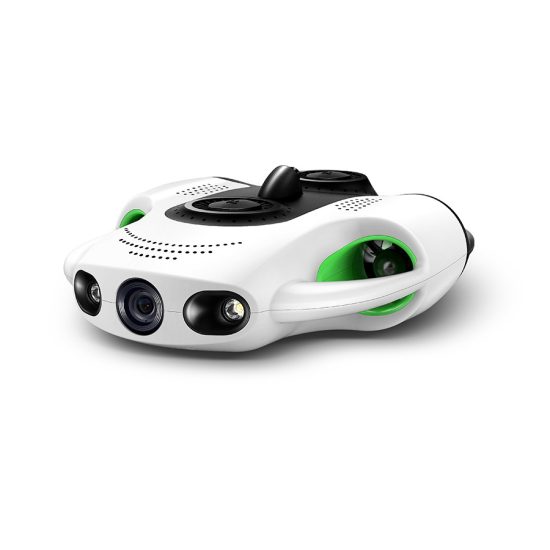
Underwater drones—industrial-grade ROVs (Remotely Operated Vehicles)—are eliminating these limitations.
2. Why Waiting for Low Tide Is No Longer Necessary
2.1 Traditional Limitation
Diver-based inspections depend on:
- Safe tidal windows
- Acceptable current velocity
- Visibility conditions
- Strict decompression protocols
This significantly narrows operational windows.
2.2 ROV Advantage
Modern underwater drones operate:
- At any tide level
- In low visibility conditions
- During nighttime operations
- In moderate sea states
With real-time sonar and high-lumen LED arrays, ROVs provide consistent imaging even in turbid offshore environments.
Result: Inspection schedules become flexible and predictable.
3. How Underwater Drones Detect Submerged Blade & Structural Risks
Although turbine blades are above water, foundation instability directly affects blade alignment and stress loads. Early detection of underwater issues prevents catastrophic structural consequences.
ROVs help identify:
- Scour erosion around monopiles
- Crack propagation in weld seams
- Biofouling accumulation
- Corrosion damage
- Cable exposure
- Structural deformation
Imaging Capabilities
- 4K Ultra-HD underwater cameras
- Forward-looking sonar
- Multibeam imaging sonar
- Laser scaling for crack measurement
- Thickness measurement integration
These technologies enable engineering teams to detect micro-defects before they escalate.
4. E-E-A-T Framework: Why This Technology Is Reliable
Experience
Underwater ROV technology has been deployed in offshore oil & gas since the 1980s. Offshore wind operators now leverage decades of proven subsea robotics experience.
Expertise
Industrial ROV systems are developed by multidisciplinary engineering teams specializing in:
- Marine robotics
- Offshore structural engineering
- Hydrodynamics
- Corrosion science
- Electrical subsea systems
Inspection data is often reviewed by certified structural engineers and NDT (Non-Destructive Testing) specialists.
Authoritativeness
ROVs are used globally in:
- North Sea offshore wind farms
- Baltic Sea installations
- East China Sea wind projects
- U.S. Atlantic offshore developments
Their integration into maintenance protocols reflects industry-wide recognition.
Trustworthiness
Modern inspection ROVs:
- Comply with marine safety standards
- Include digital data logging
- Provide timestamped reporting
- Support third-party verification
Digital archives ensure audit-ready documentation for insurance and regulatory compliance.
5. Technical Specifications for Offshore Wind Applications
Typical offshore wind inspection ROV features include:
Depth Rating
- 150m – 300m standard
- Customizable up to 1,000m+
Propulsion
- 6–8 vector thrusters
- 360° maneuverability
- Station-keeping capability
Imaging
- 4K camera with wide dynamic range
- 120°–160° field of view
- Ultra-bright LED lighting
- Sonar for zero-visibility scanning
Stability Systems
- Auto-depth lock
- Auto-heading hold
- Gyro stabilization
Tether System
- Reinforced neutrally buoyant cable
- Fiber optic transmission optional
- Length options: 150m–500m
6. Cost and Operational Efficiency
Diver-Based Inspection Costs
- Vessel charter
- Diver team
- Safety supervision
- Weather delay risk
- Insurance
ROV-Based Inspection Benefits
- Smaller crew
- Faster deployment
- Reduced weather dependency
- Continuous operation capability
- Lower long-term OPEX
Wind farm operators report significant cost reductions after integrating ROV-based inspection programs.
7. 24/7 Monitoring and Predictive Maintenance
With ROV systems integrated into maintenance cycles, operators can:
- Schedule routine inspections quarterly
- Conduct emergency inspections immediately
- Capture digital twin datasets
- Enable predictive maintenance analytics
Future integration with AI will allow automatic defect recognition and anomaly detection.
8. Environmental & Safety Benefits
Replacing divers reduces:
- Human risk exposure
- Carbon emissions from large support vessels
- Operational disruption
Early detection of foundation issues also prevents catastrophic structural failures and environmental hazards.
9. Customization for Offshore Wind Projects
ROV systems can be configured specifically for wind farm operations:
- Sonar integration for scour mapping
- Robotic arm for sample retrieval
- Cathodic protection inspection tools
- Laser crack measurement modules
- Anti-fouling cleaning attachments
Branding and OEM customization are also available for large-scale deployments.
Frequently Asked Questions (FAQ)
Q1: Can this system be used for offshore wind turbine inspection?
Yes. The system is specifically suitable for offshore wind monopile inspection, scour monitoring, weld seam analysis, cable route inspection, and structural integrity assessment.
Q2: Can you do this (Is it feasible)?
Yes. Underwater drone technology is fully capable of replacing or supplementing diver-based inspections in offshore wind projects. It enables all-weather, 24/7 deployment without dependence on tidal conditions.
Q3: What is the MOQ (Minimum Order Quantity)?
- Standard industrial ROV: 1 unit
- OEM / customized production: 5–10 units
- Bulk procurement for wind farm operators: Negotiable
Q4: What is the delivery time?
- Standard models: 7–15 working days
- Customized offshore wind configuration: 20–45 working days
- Large-scale project orders: Based on final technical specification
Q5: Do you have stock available?
Yes. Standard inspection ROV models are usually available in stock for fast dispatch. Customized sonar-integrated or high-depth systems may require assembly time.
Q6: Can the system be customized?
Yes. Available customization options include:
- Extended depth rating
- Advanced sonar modules
- Manipulator arm integration
- Extended tether length
- OEM branding
- Data reporting software integration
- Language interface customization
Full OEM and ODM services are supported.
Q7: Is training provided?
Yes. Training options include:
- Remote operator training
- On-site commissioning support
- Maintenance guidance
- Digital operation manuals
Operators typically become proficient within a few days of structured training.
Q8: What maintenance is required?
Routine maintenance includes:
- Freshwater rinsing after saltwater use
- Thruster inspection
- Seal integrity checks
- Tether inspection
- Periodic software updates
Industrial-grade systems are designed for long service life.
10. The Future of Offshore Wind Inspection
As offshore wind farms scale globally, operational efficiency becomes critical. Waiting for low tide or diver availability is no longer sustainable. Underwater drones provide:
- Continuous inspection capability
- Digital traceability
- Enhanced safety
- Predictable maintenance cycles
In a sector where downtime costs millions per day, proactive subsea inspection is no longer optional—it is essential.
Offshore wind power is built on innovation above the water.
Underwater drones now deliver the same innovation below the surface.


No comments yet