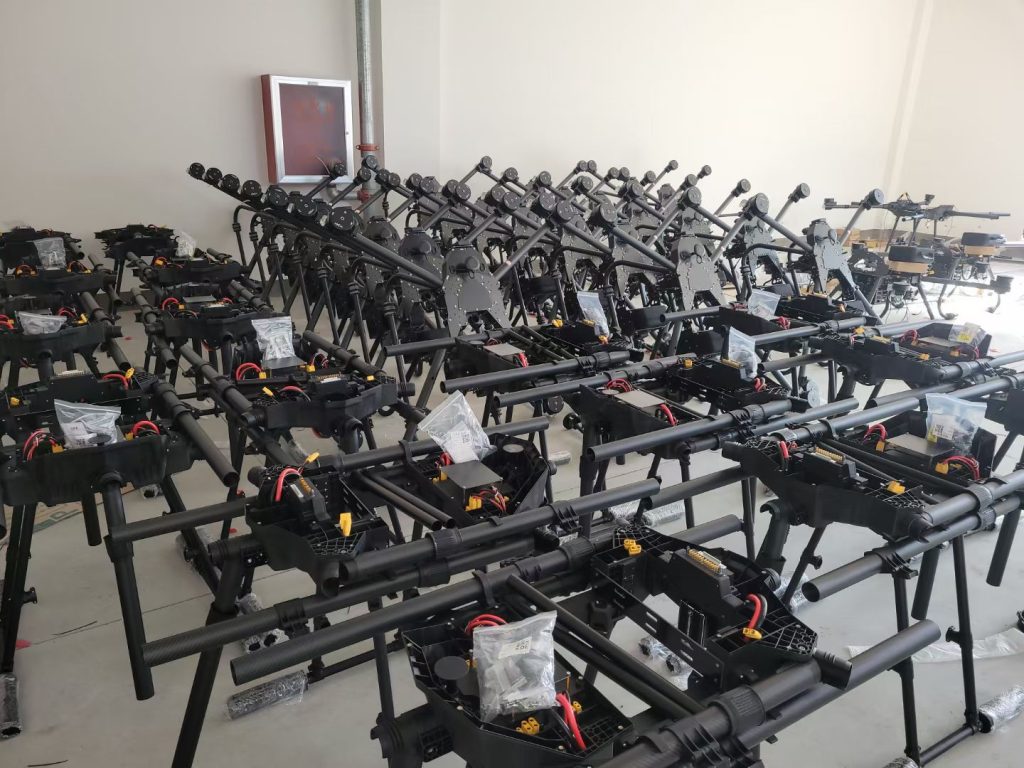
Agricultural drone seeding is becoming an increasingly practical option for farmers who need to distribute seed across large fields, wet farmland, difficult terrain, or areas where conventional ground equipment is inconvenient to operate.
However, purchasing a powerful agricultural drone is only the first step.
The real challenge is achieving the correct seed application rate and uniform distribution.
A drone may have a large hopper, powerful motors, RTK positioning, and an advanced flight controller, but these features alone cannot guarantee good seeding results.
The operator must match the drone to the seed, calibrate the metering system, determine the effective spreading width, select an appropriate flight speed, and verify the actual distribution pattern.
MSOEN agricultural seeding drones are designed around this practical approach, with different payload configurations for small farms, commercial operations, and high-volume agricultural applications.
This guide explains how to calibrate an MSOEN agricultural seeding drone, how to choose the correct configuration, how different seeds affect the spreading system, and what buyers should consider before purchasing.
Why Agricultural Drone Seeding Requires Calibration
Different seeds behave differently.
Wheat, rice, rapeseed, grass seed, barley, and cover-crop mixtures can have different:
-
Particle sizes
-
Weight
-
Density
-
Shape
-
Moisture content
-
Surface texture
-
Flowability
Because of these differences, the same feeder setting cannot be expected to deliver the same amount of every seed.
For example, a setting that delivers 30 kg/ha of wheat may deliver a completely different rate when used with a lightweight grass seed.
The same principle applies to the spreading width.
Changing:
-
Flight height
-
Flight speed
-
Spreading-disc speed
-
Feeder opening
-
Seed type
can change the final distribution pattern.
Therefore, calibration should be performed with the actual material that will be used in the field.
How an MSOEN Seeding System Works
A typical MSOEN agricultural seeding drone consists of several major systems.
1. Drone Airframe
The airframe supports the motors, battery, hopper, flight controller, and other components.
2. Seed Hopper
The hopper stores the seed before it enters the metering system.
3. Metering System
The metering system controls how much seed leaves the hopper.
Depending on the configuration, this can use:
-
Adjustable gate
-
Auger feeder
-
Motorized feeder
-
Interchangeable feeder components
4. Spreading System
The spreading system distributes the seed across the field.
A centrifugal disc can be used to spread material horizontally across the required working width.
5. Positioning System
GNSS positioning provides basic navigation.
RTK can provide higher positioning accuracy for automated route planning.
6. Flight Controller
The flight controller manages:
-
Flight stability
-
Speed
-
Altitude
-
Route
-
Position
-
Battery information
MSOEN SD-20 Agricultural Seeding Drone
The MSOEN SD-20 is a lightweight seeding configuration designed for smaller farms and lower-volume applications.
Typical Specifications
Parameter
|
MSOEN SD-20
|
Maximum payload
|
20 kg
|
Hopper capacity
|
25–35 L
|
Effective spreading width
|
3–6 m
|
Operating speed
|
3–7 m/s
|
Loaded flight time
|
8–15 min
|
Positioning
|
GNSS / Optional RTK
|
Feeder
|
Adjustable motorized feeder
|
Spreading system
|
Centrifugal disc
|
Control
|
Manual / Automatic route
|
Recommended application
|
Small farms and specialty seeding
|
Suitable Materials
The SD-20 can be configured for:
-
Grass seed
-
Rapeseed
-
Small grains
-
Pasture seed
-
Selected cover crops
Its relatively small size makes transportation and field deployment easier.
Estimated Price
A typical equipment budget is approximately:
US$3,000–8,000
A complete package with additional batteries, charger, RTK, spare parts, and accessories can cost more.
MSOEN SD-30 Agricultural Seeding Drone
The MSOEN SD-30 is designed for farmers who need more capacity while maintaining relatively flexible transportation.
Typical Specifications
Parameter
|
MSOEN SD-30
|
Maximum payload
|
30 kg
|
Hopper capacity
|
35–50 L
|
Effective spreading width
|
4–8 m
|
Operating speed
|
4–8 m/s
|
Loaded flight time
|
7–14 min
|
Positioning
|
GNSS / RTK
|
Feeder
|
Motorized auger
|
Spreading system
|
Centrifugal
|
Obstacle sensing
|
Optional radar
|
Route planning
|
Automatic
|
Recommended application
|
Rice, wheat, pasture, cover crops
|
Estimated Price
Approximately:
US$5,000–11,000
A professional package may reach approximately:
US$8,000–15,000
depending on battery quantity and configuration.
MSOEN SD-50 Commercial Agricultural Seeding Drone
The MSOEN SD-50 is intended for larger farms, agricultural contractors, and commercial aerial seeding operations.
Typical Specifications
Parameter
|
MSOEN SD-50
|
Maximum payload
|
50 kg
|
Hopper capacity
|
60–80 L
|
Effective spreading width
|
5–9 m
|
Operating speed
|
4–9 m/s
|
Loaded flight time
|
6–12 min
|
Positioning
|
RTK
|
Feeder
|
Heavy-duty auger
|
Spreading system
|
High-capacity centrifugal
|
Obstacle detection
|
Radar
|
Route planning
|
Automatic
|
Recommended application
|
Commercial agriculture
|
Suitable Crops
The SD-50 can be considered for:
-
Rice
-
Wheat
-
Barley
-
Cover crops
-
Pasture
-
Cereal grains
Estimated Price
Approximately:
US$8,000–18,000
A complete commercial package may cost approximately:
US$15,000–25,000+
depending on batteries, charger, RTK equipment, spare parts, and other accessories.
MSOEN SD-80 Heavy-Duty Seeding Drone
The MSOEN SD-80 is designed for high-volume agricultural operations.
The main advantage of this configuration is its ability to carry more seed per flight, reducing the number of loading cycles.
Typical Specifications
Parameter
|
MSOEN SD-80
|
Maximum payload
|
80 kg
|
Recommended working payload
|
50–80 kg
|
Hopper capacity
|
100–150 L
|
Effective spreading width
|
7–10 m
|
Operating speed
|
5–10 m/s
|
Loaded flight time
|
5–9 min
|
Positioning
|
High-precision RTK
|
Feeder
|
Heavy-duty metering auger
|
Spreading system
|
High-capacity centrifugal
|
Obstacle detection
|
Multi-directional radar
|
Route planning
|
Automatic
|
Recommended application
|
Large commercial farms
|
Estimated Price
Approximately:
US$18,000–35,000+
A complete commercial system may reach:
US$25,000–40,000+
depending on the battery package, charger, RTK equipment, spreading configuration, and accessories.
Step 1: Identify the Seed Before Calibration
Before calibrating the MSOEN drone, identify the actual material.
Record:
-
Crop name
-
Seed variety
-
Seed size
-
Bulk density
-
Moisture
-
Target seeding rate
-
Expected hectares
-
Required total seed quantity
This information determines the appropriate feeder configuration.
For example:
Wheat
Usually requires relatively high material flow.
Rice
Requires stable metering and consistent distribution.
Rapeseed
Requires better control at lower application rates.
Grass Seed
Requires particular attention to wind and lightweight material.
Cover-Crop Mixtures
Can be more difficult because different seeds may have different physical properties.
A single-species material is generally easier to calibrate than a mixture with large differences in seed size and density.
Step 2: Calculate the Target Seeding Rate
The first number to determine is:
Target seeding rate
For example:
30 kg/ha
If the farm is:
100 hectares
the total seed requirement is:
30 × 100 = 3,000 kg
If using the MSOEN SD-50 with a 50 kg working payload:
3,000 ÷ 50 = 60 loads
This provides an initial estimate of the required loading cycles.
Step 3: Check the Hopper
Before filling the hopper, inspect:
-
Hopper interior
-
Feeder opening
-
Auger
-
Spreading disc
-
Motor
-
Wiring
-
Mounting points
Make sure the hopper is clean and dry.
Seed remaining from a previous operation can affect the next calibration.
Step 4: Perform a Static Flow Test
A static flow test measures how much seed leaves the hopper during a fixed period.
For example:
Run the feeder for:
30 seconds
Collect the discharged seed.
Suppose the collected seed weighs:
12 kg
Then:
12 ÷ 30 = 0.4 kg/second
The calculated flow rate is:
0.4 kg/s
or:
24 kg/min
This provides a starting point for adjusting the feeder.
A measured output test is more reliable than simply selecting a percentage on the controller because different seeds flow differently. Agricultural calibration procedures commonly use measured discharge and repeated tests to establish a calibration relationship.
Step 5: Adjust the Feeder
If the output is too low:
Increase the feeder opening or feeder speed.
If the output is too high:
Reduce the feeder opening or feeder speed.
Repeat the test.
For example:
Feeder Setting
|
Output
|
20%
|
12 kg/min
|
30%
|
18 kg/min
|
40%
|
25 kg/min
|
50%
|
32 kg/min
|
60%
|
39 kg/min
|
This type of table can be developed for each seed.
The operator can then use the calibration table when setting up the field operation.
Step 6: Calculate the Required Material Flow
The required material flow depends on:
-
Target seeding rate
-
Flight speed
-
Effective spreading width
A practical calculation is:
Required flow = Target rate × Flight speed × Effective width × 0.36
when:
-
Target rate is kg/ha
-
Speed is m/s
-
Width is m
For example:
Target rate:
30 kg/ha
Flight speed:
5 m/s
Effective width:
6 m
Required flow:
30 × 5 × 6 × 0.36 = 324 kg/min
This number is only a mathematical example and demonstrates why the operator must ensure that the feeder and spreading system are capable of the required material flow.
If the calculated flow exceeds the actual capability of the spreading system, the operator must reduce speed, reduce effective width, or select a more suitable configuration.
Step 7: Determine the Effective Spreading Width
Do not automatically use the manufacturer’s maximum spreading width.
The important measurement is:
Uniform effective width.
A drone may physically distribute seed over a wide area, but the edges may receive significantly less material.
A practical spread-pattern test can use collection trays or pans positioned across the flight path.
The drone can fly repeated passes over the test line, and the amount collected at each position can then be weighed and compared.
This type of testing is specifically used to evaluate the actual spreading pattern and determine a suitable swath.
Step 8: Test the Spreading Pattern
Suppose the MSOEN SD-50 is being tested at:
6 meters effective width
Place collection containers across the expected spreading area.
After several passes, compare the collected seed.
Example:
Position
|
Collected Seed
|
-3 m
|
105 g
|
-2 m
|
110 g
|
-1 m
|
108 g
|
Center
|
112 g
|
+1 m
|
109 g
|
+2 m
|
106 g
|
+3 m
|
101 g
|
This would indicate a relatively balanced distribution.
If the center receives significantly more material than the edges, the effective width may need to be reduced or the spreading system adjusted.
Step 9: Adjust Flight Speed
Flight speed directly affects application rate.
If the drone flies faster while feeder output remains unchanged, less seed will be applied to each hectare.
For example:
At:
4 m/s
the drone may be calibrated for:
30 kg/ha
If speed increases to:
6 m/s
the feeder must increase its output to maintain the same target rate, assuming the same effective width.
Therefore, flight speed and material flow must always be considered together.
Step 10: Adjust Spreading-Disc Speed
Spreading-disc speed affects how material leaves the drone and the resulting swath.
Increasing disc speed can increase throwing distance.
However, excessive disc speed may:
-
Increase drift
-
Change distribution shape
-
Increase seed damage for sensitive materials
-
Produce an excessively wide but uneven pattern
The correct disc speed should therefore be determined through testing.
Step 11: Consider Flight Height
Flight height affects the time seed particles spend in the air before reaching the ground.
Higher flight height can increase the available spreading distance.
However, it can also increase the influence of wind.
Lower flight height can improve control but may reduce effective width.
There is therefore no single ideal height for every seed.
Flight height should be calibrated together with:
-
Seed type
-
Disc speed
-
Flight speed
-
Wind
-
Working width
Step 12: Check Wind Before Field Operation
Wind can have a major influence on lightweight seeds.
This is particularly important for:
-
Grass
-
Small seeds
-
Lightweight cover crops
The aircraft may remain stable while the seed is pushed sideways.
If the distribution becomes inconsistent, the operator may need to:
-
Reduce spreading width
-
Reduce flight height
-
Change flight direction
-
Reduce speed
-
Delay the operation
The drone’s ability to fly in stronger wind does not necessarily mean that the seed distribution will remain acceptable.
MSOEN Drone Selection by Farm Size
Small Farm: 10–50 Hectares
Recommended:
MSOEN SD-20
Main advantages:
-
Lower purchase cost
-
Easier transportation
-
Lower battery requirements
-
Suitable for lower-volume applications
Estimated price:
US$3,000–8,000
Medium Farm: 50–200 Hectares
Recommended:
MSOEN SD-30
Main advantages:
-
Higher payload
-
Better productivity
-
Suitable for multiple seed types
-
Good balance between investment and capacity
Estimated price:
US$5,000–11,000
Commercial Farm: 100–500 Hectares
Recommended:
MSOEN SD-50
Main advantages:
-
50 kg payload class
-
Larger hopper
-
Heavy-duty feeder
-
RTK positioning
-
Automatic route planning
Estimated price:
US$8,000–18,000
Large Farm: 300–1,000+ Hectares
Recommended:
MSOEN SD-80
Main advantages:
-
80 kg payload class
-
High-capacity hopper
-
Heavy-duty feeder
-
High-capacity spreading system
-
RTK
-
Automatic route planning
Estimated price:
US$18,000–35,000+
How Much Area Can an MSOEN Seeding Drone Cover?
Theoretical field capacity can be estimated using:
Area/hour = Width × Speed × 3.6
For example:
6 m width
5 m/s
gives:
6 × 5 × 3.6 = 108 hectares/hour
But this is a theoretical number.
Actual productivity will be lower because the operator must account for:
-
Takeoff
-
Landing
-
Turning
-
Battery changes
-
Seed loading
-
Transportation
-
Field boundaries
-
Obstacles
-
Weather
A realistic commercial calculation should use actual field efficiency rather than maximum theoretical capacity.
Example: 100-Hectare Rice Field
Assume:
Farm size:
100 hectares
Seed rate:
40 kg/ha
Total seed:
4,000 kg
Using an MSOEN SD-20:
4,000 ÷ 20 = 200 loads
Using an MSOEN SD-50:
4,000 ÷ 50 = 80 loads
Using an MSOEN SD-80:
4,000 ÷ 80 = 50 loads
The larger drone can significantly reduce loading frequency.
However, the operator must also evaluate battery rotation and charging capacity.
One Large MSOEN Drone or Several Smaller Drones?
For very large farms, fleet configuration should be considered.
For example:
Option A
1 × SD-80
Option B
2 × SD-50
The second option can provide:
-
Backup capacity
-
Simultaneous operation
-
Easier transportation
-
Greater flexibility
If one aircraft requires maintenance, the second aircraft can continue operating.
For agricultural contractors, this redundancy can be commercially valuable.
MSOEN Seeding Drone Price Guide
Model
|
Payload
|
Typical Price
|
MSOEN SD-20
|
20 kg
|
US$3,000–8,000
|
MSOEN SD-30
|
30 kg
|
US$5,000–11,000
|
MSOEN SD-50
|
50 kg
|
US$8,000–18,000
|
MSOEN SD-80
|
80 kg
|
US$18,000–35,000+
|
Complete systems may cost more depending on:
-
Number of batteries
-
Charger
-
RTK equipment
-
Spare parts
-
Additional feeder
-
Spreading disc
-
Remote controller
-
Transport equipment
-
Generator
These prices are indicative configuration ranges rather than fixed quotations.
What Should Be Included in an MSOEN Commercial Package?
A commercial seeding package can be configured with:
Aircraft
Main drone platform.
Seed Hopper
Different capacities according to payload class.
Metering System
Adjustable feeder for different seeds.
Spreading System
Centrifugal disc or other compatible spreading mechanism.
Batteries
Multiple batteries for field rotation.
Charger
High-power charging system.
RTK
For high-precision navigation and route planning.
Remote Controller
For manual control and automatic missions.
Spare Parts
Recommended spare parts include:
-
Propellers
-
Motors
-
Feeder components
-
Bearings
-
Seals
-
Cables
-
Connectors
Why MSOEN Uses Different Payload Classes
A single drone configuration cannot efficiently meet every agricultural requirement.
A small farm does not necessarily need an 80 kg aircraft.
A large agricultural contractor may find a 20 kg drone too slow for high-volume operations.
MSOEN therefore uses different payload classes to match different workloads.
The selection can be based on:
Farm area
↓
Crop
↓
Seed rate
↓
Daily workload
↓
Payload requirement
↓
Battery requirement
↓
Spreading system
This approach allows the aircraft to be selected according to the actual agricultural application.
Common Problems During Drone Seeding
Problem 1: Uneven Distribution
Possible causes:
-
Incorrect spreading width
-
Incorrect disc speed
-
Wind
-
Incorrect feeder calibration
-
Excessive flight speed
Solution:
Perform another spread-pattern test.
Problem 2: Hopper Bridging
Possible causes:
-
Moisture
-
Sticky seed
-
Irregular particles
-
Incorrect hopper design
Solution:
Inspect the seed and feeder, and use a suitable agitation or metering configuration if available.
Problem 3: Application Rate Too High
Possible causes:
-
Feeder opening too large
-
Flight speed too low
-
Incorrect calibration
Solution:
Reduce feeder output or increase speed while maintaining the desired distribution pattern.
Problem 4: Application Rate Too Low
Possible causes:
-
Feeder opening too small
-
Flight speed too high
-
Feeder obstruction
-
Seed not flowing correctly
Solution:
Check the feeder and perform another measured output test.
Problem 5: Seed Drifts Outside the Field
Possible causes:
-
Excessive wind
-
Excessive spreading width
-
Excessive flight height
-
Lightweight seed
Solution:
Reduce the effective width or operate under more suitable weather conditions.
FAQ
What is the best MSOEN drone for seed spreading?
It depends on the farm.
The MSOEN SD-20 is suitable for smaller operations.
The SD-30 provides additional capacity.
The SD-50 is suitable for commercial operations.
The SD-80 is designed for high-volume agricultural work.
How much does an MSOEN agricultural seeding drone cost?
Indicative equipment prices are:
SD-20: US$3,000–8,000
SD-30: US$5,000–11,000
SD-50: US$8,000–18,000
SD-80: US$18,000–35,000+
The final configuration depends on batteries, charger, RTK, spreading system, and accessories.
Can MSOEN drones spread rice seed?
Yes. The appropriate model depends on rice variety, seed rate, field size, and required daily capacity.
Can MSOEN drones spread wheat?
Yes.
For high-rate wheat applications, a 30–80 kg configuration can provide more practical hopper capacity.
Can MSOEN drones spread grass seed?
Yes.
A smaller payload configuration can be suitable because grass seed can be lightweight and may require careful low-rate metering.
Can one MSOEN drone spread different seeds?
Yes, when the spreading system is appropriately configured.
However, each seed should be calibrated separately.
Does RTK improve seed distribution?
RTK improves positioning and route repeatability.
It does not automatically guarantee uniform spreading.
The feeder, disc speed, flight height, speed, and seed properties still need to be calibrated.
How do I calibrate an MSOEN seeding drone?
Start with a static flow test.
Measure the amount of seed discharged during a fixed period.
Then determine the spreading pattern using a controlled test area.
Adjust:
-
Feeder output
-
Flight speed
-
Flight height
-
Disc speed
-
Route spacing
until the required application rate and distribution uniformity are achieved.
Why can’t I use the same settings for every seed?
Because different seeds have different physical characteristics.
Wheat, rice, rapeseed, and grass seed do not necessarily flow through the feeder at the same rate.
How much seed can the MSOEN SD-50 carry?
The SD-50 is designed around a 50 kg maximum payload class.
The actual recommended payload should be determined according to the operating conditions and material being used.
How much seed can the MSOEN SD-80 carry?
The SD-80 is designed around an 80 kg maximum payload class.
The operator should still consider battery condition, weather, temperature, and operating requirements.
How many batteries should I buy?
For commercial work, a practical starting configuration is approximately:
3–6 batteries
The exact number depends on flight time, charging speed, daily operating hours, and workload.
Can MSOEN drones operate automatically?
Selected configurations can support automated route planning.
The operator should still monitor the aircraft, field conditions, battery status, obstacles, and spreading performance.
Can an agricultural seeding drone replace a conventional seed drill?
Not in every situation.
A spreading drone is primarily designed for aerial broadcasting.
A conventional seed drill can place seed at a controlled depth and row spacing.
Therefore, drone seeding is best considered for agricultural applications where aerial broadcasting is appropriate.
Is a bigger drone always better?
No.
The correct drone should match the farm’s workload.
A 20 kg drone can be more economical for a small farm, while an 80 kg system can reduce loading cycles on large farms.
How important is seed calibration?
It is critical.
The correct calibration determines:
How much seed is released
and:
How evenly it is distributed.
A professional setup should measure actual material output and verify the spread pattern before full-field operation.
Final Guide to MSOEN Agricultural Seeding Drones
Agricultural drone seeding should not be evaluated only by payload, flight time, or maximum spreading width.
The real performance comes from the complete system:
Drone + Hopper + Feeder + Spreading System + Battery + RTK + Flight Planning + Seed Calibration
For small farms, the MSOEN SD-20 provides a compact and economical configuration.
For medium agricultural operations, the MSOEN SD-30 offers additional payload capacity.
For commercial farms and agricultural contractors, the MSOEN SD-50 provides a stronger balance between payload and operating efficiency.
For large-scale operations, the MSOEN SD-80 provides high-capacity seed handling and fewer loading cycles.
The most important step before commercial operation is calibration.
The operator should determine:
Seed type → Seed density → Target rate → Feeder output → Flight speed → Flight height → Disc speed → Effective spreading width → Field test
Only after these parameters have been verified should the drone be used for full-field seeding.
For buyers comparing agricultural seeding drones, MSOEN can therefore be positioned around a practical concept:
Different farms need different drone configurations.
The right agricultural drone is not necessarily the biggest or fastest model.
It is the model that can deliver the required seed rate, achieve acceptable distribution uniformity, complete the required hectares per day, and maintain a reasonable total operating cost.
MSOEN Agricultural Drones — Designed for Practical Seeding, Flexible Payload Configurations, and Commercial Field Operations.
THE END
Support it if you like it









No comments yet