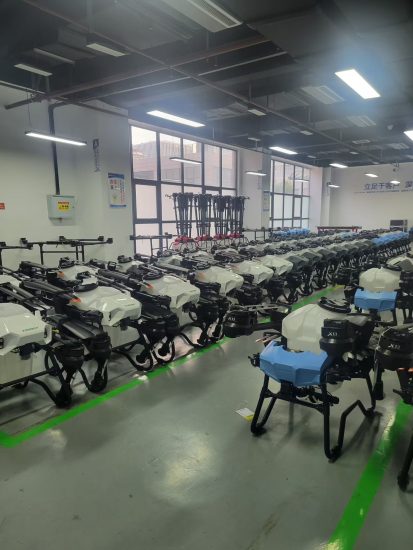


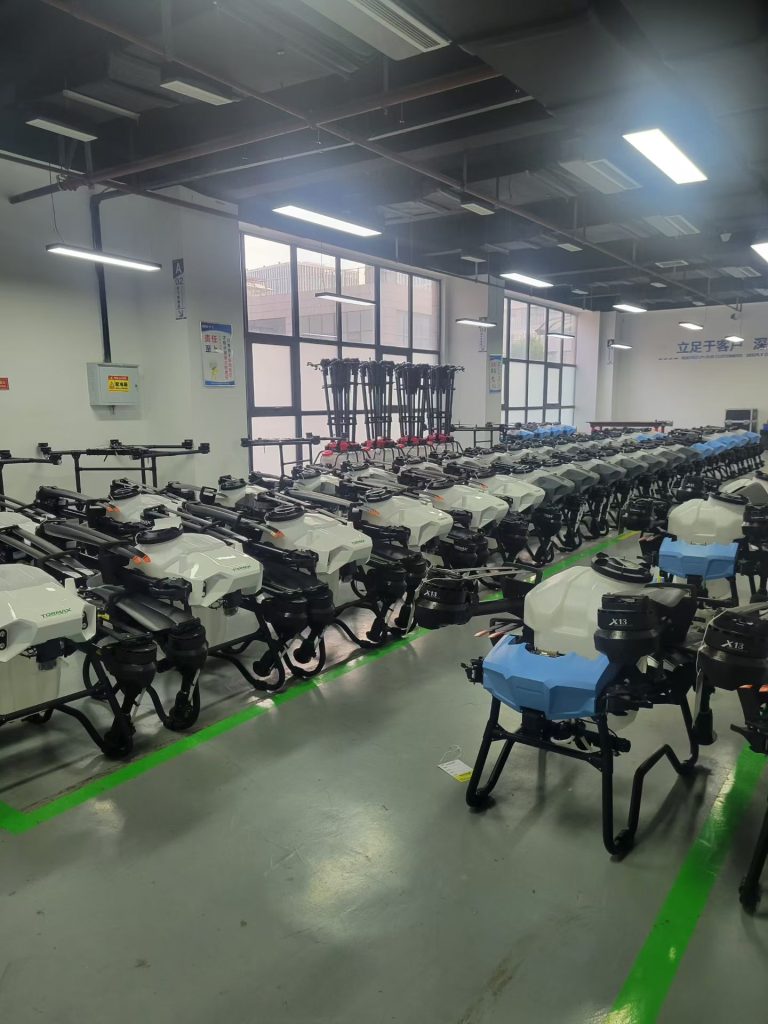
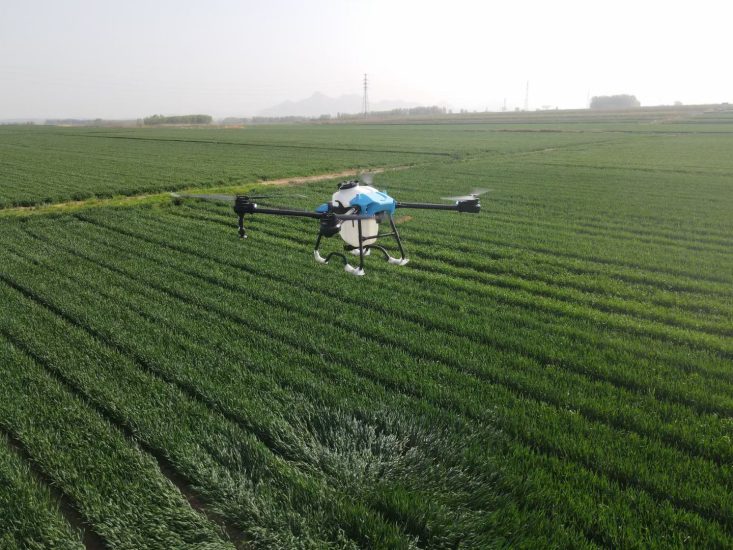
China has become an important manufacturing base for agricultural drones, including drones designed for spraying, spreading granular fertilizer, sowing seeds, and other precision agriculture applications.
For an overseas buyer, however, purchasing a fertilizer drone from China is very different from buying an ordinary agricultural machine.
The aircraft itself is only one part of the purchase.
The buyer also needs to evaluate the spreading system, batteries, charger, flight controller, navigation equipment, spare parts, technical support, packaging, transportation, import requirements, and after-sales service.
A low factory price may look attractive at first, but the wrong specification or an unreliable supplier can create much larger costs after the equipment arrives.
This guide explains how international buyers can evaluate Chinese fertilizer drone suppliers and build a safer purchasing process.
1. First Define What You Actually Need
Before contacting Chinese manufacturers, prepare a basic specification sheet.
You should know:
-
Target payload
-
Crop type
-
Fertilizer type
-
Application rate
-
Farm area
-
Field size
-
Terrain
-
Expected daily operating area
-
Number of working days per season
-
Destination country
-
Required quantity
-
Battery requirements
For example, these two buyers may both search for a “fertilizer drone,” but their requirements are completely different.
Buyer A
-
Small farm
-
30 hectares
-
Rice
-
Wet fields
-
Granular fertilizer
-
Occasional operation
Buyer B
-
Agricultural service company
-
2,000+ hectares
-
Multiple crops
-
Commercial operation
-
Daily deployment
-
Large number of batteries required
The second buyer should evaluate the drone as a commercial production system rather than simply a flying machine.
2. Decide the Payload Class
Chinese agricultural drone manufacturers offer different payload configurations.
Common commercial categories may include approximately:
-
20 kg
-
30 kg
-
40 kg
-
50 kg
The exact specifications vary by model.
A larger payload reduces the number of fertilizer refills.
For example, at an application rate of 25 kg/ha:
A 25 kg payload provides approximately:
25 ÷ 25 = 1 hectare per full load
A 50 kg payload provides:
50 ÷ 25 = 2 hectares per full load
That can significantly affect workflow.
However, a larger payload usually means a larger aircraft and greater battery requirements.
Do not buy a 50 kg model simply because “50 kg” sounds better.
Choose the payload according to the actual application rate and required daily area.
3. Ask About the Spreading System Separately
Some buyers spend most of their time comparing the aircraft and almost ignore the fertilizer spreader.
That is a mistake.
The spreading system determines how fertilizer is released and distributed.
Ask the manufacturer:
-
What spreading mechanism is used?
-
What is the hopper capacity?
-
Is the fertilizer output adjustable?
-
Is the spreading width adjustable?
-
Is there an agitator?
-
How is material flow controlled?
-
Can the spreading system be removed easily?
-
What parts normally wear out?
A good aircraft with a poor spreading mechanism is not a good fertilizer drone.
4. Verify the Real Spreading Width
Manufacturers may advertise a maximum spreading width.
For example, a specification may state:
6–8 meters
or another range.
Do not immediately use the maximum figure in your productivity calculation.
What matters is the width at which the fertilizer distribution remains acceptably uniform.
The effective width depends on:
-
Fertilizer density
-
Particle size
-
Flight altitude
-
Rotor airflow
-
Wind
-
Flight speed
-
Spreader design
Ask the supplier for field-test information.
If possible, request a spreading pattern test using the actual fertilizer you intend to use.
5. Test Your Fertilizer
This is particularly important for overseas buyers.
“Granular fertilizer” is not one standardized material.
Different products may have different:
-
Particle diameters
-
Density
-
Moisture content
-
Shape
-
Flowability
A spreading mechanism that works perfectly with one product may perform differently with another.
Before placing a large order, provide the manufacturer with information about your fertilizer.
If practical, ask for a test using your actual material.
The objective is to confirm:
Output rate + spreading pattern + working width
rather than simply confirming that fertilizer comes out of the hopper.
6. Ask for Loaded Flight Time
One of the most common mistakes when comparing agricultural drones is relying on maximum flight time.
A supplier may advertise a maximum flight time under light-load conditions.
That number is less useful for fertilizer application.
You should ask:
What is the actual flight time with the rated fertilizer payload?
Also ask about:
-
Battery capacity
-
Battery voltage
-
Charging time
-
Recommended charging method
-
Number of batteries
-
Battery cycle expectations
Loaded performance is much more relevant to commercial operation.
7. Battery Configuration Can Change the Entire Purchase Price
A drone quotation may appear inexpensive until you add enough batteries for continuous operation.
When requesting a quotation, ask for separate prices for:
-
Aircraft
-
Battery
-
Charger
-
Additional battery
-
Additional charger
-
Charging station
-
Generator-compatible charging equipment
-
Spare parts
This makes supplier comparison much easier.
For a commercial operation, buying only one battery is rarely a realistic productivity plan.
8. Understand Charging Requirements
International buyers should confirm the electrical specifications before ordering.
Ask:
-
What input voltage does the charger require?
-
What frequency is supported?
-
What is the charger power?
-
How long does charging take?
-
Can multiple batteries be charged simultaneously?
-
Is a generator recommended?
-
Is a local power adapter required?
The destination country’s electrical system should be considered before shipping.
A charging system designed for one market may require additional equipment in another.
9. Evaluate the Remote Controller
The controller is part of the operating system.
Ask whether it supports:
-
Automatic flight planning
-
Field mapping
-
Route planning
-
Manual operation
-
Return-to-home
-
Battery monitoring
-
Flight telemetry
-
Firmware updates
Also check the display.
If the controller has a built-in screen, confirm:
-
Screen brightness
-
Outdoor visibility
-
Battery life
-
Language options
-
Map functions
For agricultural work, operators often work under strong sunlight, so screen readability matters.
10. Check Navigation and Positioning
For professional agricultural operations, navigation accuracy can affect route efficiency and application consistency.
Depending on the system, the drone may use satellite positioning and other navigation technologies.
Ask the supplier:
-
Which positioning system is supported?
-
What accuracy can be expected?
-
Is RTK available?
-
Is a base station required?
-
Does the system support automatic route planning?
-
What happens if the positioning signal is interrupted?
Do not assume that every drone with GPS has the same navigation capability.
11. Ask About Obstacle Detection
Agricultural fields are rarely completely empty.
Potential obstacles include:
-
Trees
-
Power poles
-
Wires
-
Buildings
-
Greenhouses
-
Irrigation equipment
-
Fences
If the drone has obstacle-detection sensors, ask:
-
Which directions are covered?
-
What is the detection range?
-
Does obstacle detection operate during automatic flight?
-
What types of objects can be detected?
-
How does the drone respond?
Obstacle avoidance is a safety feature, not a guarantee that the aircraft can safely fly through every environment.
Operators still need to inspect the field.
12. Verify Wind Performance
A drone’s maximum wind-resistance specification should not be treated as its ideal fertilizer operating condition.
Wind affects both:
Flight stability
and
Fertilizer distribution
Even if the aircraft can remain airborne, strong wind can cause fertilizer drift and uneven distribution.
Ask the supplier for recommended operating conditions rather than only the maximum wind-resistance number.
13. Check Environmental Protection
Agricultural drones operate around:
-
Fertilizer dust
-
Moisture
-
Mud
-
Heat
-
Chemical residues
Ask the manufacturer about environmental protection and cleaning procedures.
Important questions include:
-
Is the aircraft water-resistant?
-
Which components require special protection?
-
How should fertilizer residue be removed?
-
Can the spreading system be washed?
-
What areas should never be exposed directly to water?
Proper cleaning can have a major impact on equipment service life.
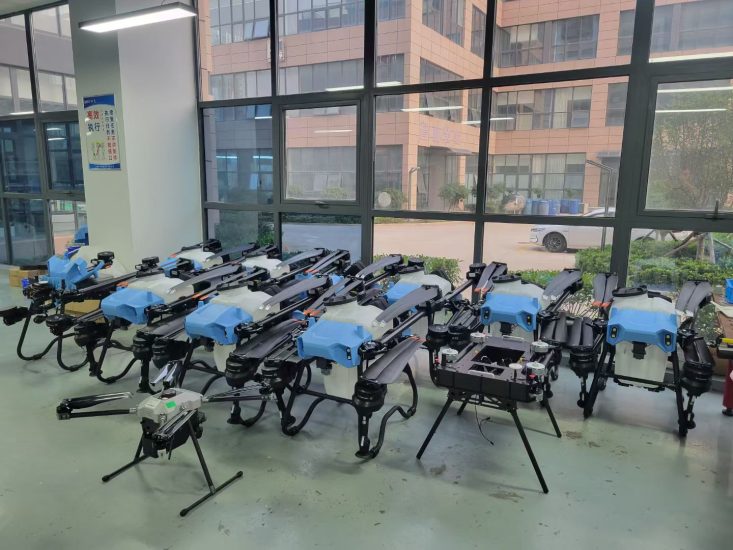
14. Verify the Factory
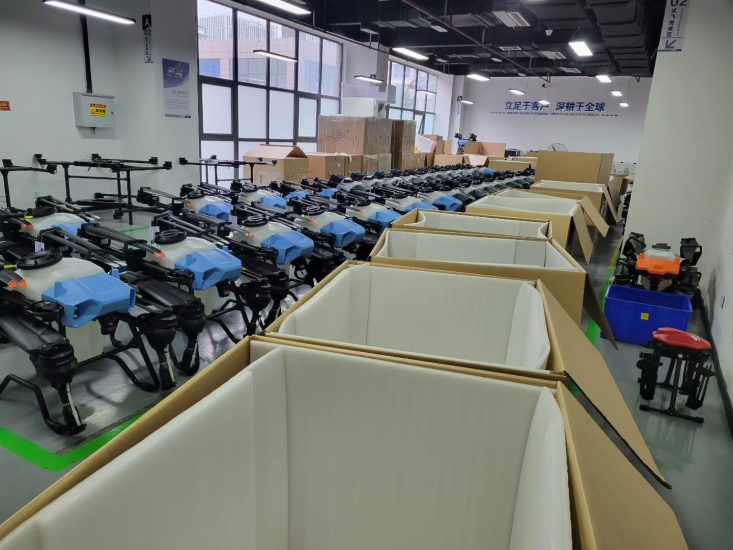
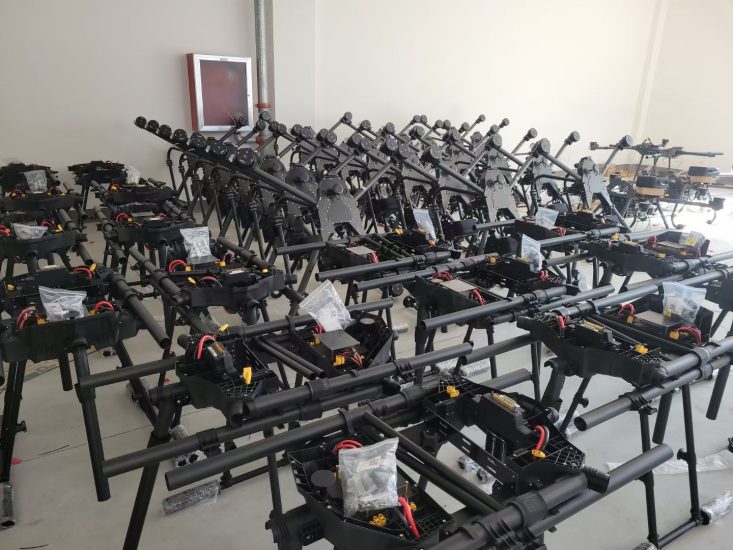
A website alone is not enough to establish whether a supplier is a real manufacturer.
When evaluating a Chinese supplier, ask for:
-
Company registration information
-
Factory address
-
Production photographs
-
Product assembly photographs
-
Testing videos
-
Quality-control process
-
Product certificates
-
Export experience
If the order is substantial, consider a factory inspection.
You want to know whether you are dealing with:
Manufacturer
Trading company
or
Distributor
A trading company is not necessarily bad, but buyers should understand who is actually responsible for manufacturing and technical support.
15. Ask for Recent Production Videos
A useful verification method is to request a short video showing the actual model.
Ask the supplier to demonstrate:
-
Aircraft
-
Hopper
-
Spreading system
-
Battery
-
Charger
-
Remote controller
-
Product label
-
Factory environment
For a customized order, the supplier can also show the aircraft with the buyer’s branding before shipment.
This is more useful than relying exclusively on promotional photographs.
16. Compare Technical Documents
A professional manufacturer should be able to provide documentation such as:
-
Product specifications
-
User manual
-
Battery instructions
-
Charger specifications
-
Maintenance instructions
-
Spare-parts list
-
Packing information
For international buyers, English documentation is particularly useful.
If the supplier cannot provide basic technical documentation for a commercial aircraft, investigate further before placing a large order.
17. Ask About Warranty
Warranty terms should be written clearly.
Ask:
-
Warranty period
-
What components are covered
-
What is excluded
-
Who pays shipping
-
How remote troubleshooting works
-
How replacement parts are provided
Battery warranty may be different from aircraft warranty.
Ask about both separately.
Avoid vague statements such as:
“We provide good after-sales service.”
A better quotation specifies exactly what the warranty covers.
18. Spare Parts Are More Important Than Many Buyers Expect
For agricultural drones, spare parts should be considered before shipment.
Common replacement items may include:
-
Propellers
-
Motors
-
Spreading components
-
Bearings
-
Connectors
-
Cables
-
Seals
-
Landing components
A commercial buyer should consider purchasing a basic spare-parts package with the initial order.
The objective is simple:
Keep the aircraft working during the agricultural season.
19. Ask How Fast Spare Parts Can Be Supplied
Price is not the only spare-parts issue.
Delivery time matters.
Ask the manufacturer:
If a motor or spreading component fails, how quickly can you ship the replacement?
Also ask:
-
Where are spare parts shipped from?
-
Are parts kept in stock?
-
Can urgent shipments be arranged?
-
Are repair instructions available?
For overseas distributors, keeping common parts locally can significantly reduce customer downtime.
20. Request a Complete Commercial Quotation
A professional quotation should clearly identify:
Item |
Required Information |
|---|---|
Aircraft |
Model and quantity |
Payload |
Rated fertilizer capacity |
Hopper |
Capacity |
Spreader |
Type and specifications |
Battery |
Quantity and capacity |
Charger |
Quantity and input requirements |
Controller |
Included or optional |
Navigation |
Standard or optional |
Spare parts |
List and price |
Packaging |
Export packaging |
Warranty |
Terms |
Training |
Included or optional |
Shipping |
Quoted separately if required |
This makes it much easier to compare multiple Chinese suppliers.
21. Don’t Compare Factory Prices Alone
Suppose Supplier A quotes $12,000.
Supplier B quotes $14,000.
At first glance, Supplier A appears cheaper.
But imagine:
Supplier A includes:
-
1 battery
-
Standard charger
-
Basic controller
Supplier B includes:
-
3 batteries
-
Fast charger
-
Spare parts
-
Training
-
Better navigation equipment
Supplier B may actually offer better value.
Therefore, compare complete operating packages, not just aircraft prices.
22. Understand Shipping Before Ordering
Agricultural drones contain batteries, and batteries can create additional transportation requirements.
International buyers should ask the supplier about:
-
Battery shipping method
-
Dangerous-goods requirements where applicable
-
Export packaging
-
Battery documentation
-
Shipping weight
-
Package dimensions
Do not assume that shipping an aircraft with batteries is identical to shipping ordinary electronic equipment.
The logistics plan should be confirmed before payment and production.
23. Confirm Import Requirements in Your Country
The manufacturer can provide product documentation, but the buyer is responsible for confirming local import and operation requirements.
Depending on the destination country, requirements may involve:
-
Drone registration
-
Radio equipment compliance
-
Import documentation
-
Operator certification
-
Agricultural-use regulations
-
Flight restrictions
-
Battery transportation requirements
The fact that a drone can legally operate in China does not automatically mean it can be legally operated in another country.
24. Ask About Radio Frequency Compatibility
Remote controllers and aircraft communicate using wireless systems.
The operating frequency and radio equipment requirements can vary between markets.
Before importing a commercial quantity, confirm that the communication equipment is appropriate for the destination market.
This is especially important for distributors who plan to sell the same model to multiple countries.
25. Consider OEM Branding
International distributors may want their own brand on the aircraft.
Chinese manufacturers may offer different levels of OEM service.
Basic OEM can include:
-
Logo
-
Product label
-
Packaging
-
Manual
More advanced customization may involve:
-
Software
-
Controller interface
-
Spreading system
-
Hardware configuration
Ask exactly what the supplier can modify.
Do not assume that putting a logo on a product means the factory provides full OEM development.
26. Ask About Minimum Order Quantity
MOQ can vary significantly between suppliers.
A factory may accept:
-
One sample unit
-
Small trial orders
-
Commercial orders
-
Full container-scale orders
For a new distributor, starting with a sample or small batch can reduce risk.
Once the aircraft has been tested in the destination market, larger orders can be considered.
27. Sample Testing Is Worth the Money
If the buyer plans to import dozens or hundreds of units, purchasing one sample for testing can be inexpensive insurance.
The sample can be evaluated for:
-
Flight stability
-
Fertilizer output
-
Spreading pattern
-
Battery performance
-
Controller operation
-
Navigation
-
Maintenance
-
Local regulatory compliance
It is much easier to correct a supplier problem with one sample than with a large shipment.
28. Build a Realistic Field Test
A good field test should reproduce actual operating conditions.
Use:
-
Your normal fertilizer
-
Your target application rate
-
Realistic payload
-
Typical field size
-
Normal flight height
-
Expected weather conditions
Record:
Flight time
Battery consumption
Fertilizer output
Spreading width
Application uniformity
Loading time
Battery replacement time
Area treated
These numbers can later be used to calculate the real cost per hectare.
29. Beware of Unrealistic Productivity Claims
Be cautious if a supplier gives a very high hectares-per-hour figure without explaining the conditions.
Ask:
-
What fertilizer rate was used?
-
What payload?
-
What working width?
-
What flight speed?
-
How large was the test field?
-
Was loading time included?
-
Was battery replacement included?
-
What weather conditions were used?
This turns a marketing claim into measurable information.
30. Calculate Your Total Land Requirement
Before choosing the drone, calculate your expected workload.
Suppose your company serves 500 hectares per month.
If the practical capacity of the selected drone is 10 hectares per hour, the theoretical flying requirement is:
500 ÷ 10 = 50 flight hours
But the actual operating time will be higher after considering:
-
Loading
-
Battery changes
-
Transportation
-
Setup
-
Weather
-
Maintenance
This helps determine how many aircraft and batteries are actually required.
31. Think About After-Sales Support Before Payment
For international buyers, after-sales service should be discussed before the purchase order is confirmed.
Ask:
If the drone stops working in my country, what exactly will your technical team do?
A useful supplier should be able to explain:
-
Remote diagnosis
-
Troubleshooting instructions
-
Replacement components
-
Repair procedures
-
Software support
-
Escalation process
A supplier that gives detailed answers before the sale is generally easier to work with after the sale.
32. Protect the Purchase Contract
The final purchase agreement should clearly specify:
-
Exact model
-
Payload
-
Battery quantity
-
Charger quantity
-
Accessories
-
Branding
-
Warranty
-
Delivery schedule
-
Packaging
-
Inspection requirements
-
Payment terms
For customized equipment, specifications should not exist only in WhatsApp or informal messages.
Important technical requirements should be included in the commercial documentation.
33. Consider Pre-Shipment Inspection
For larger orders, buyers can arrange inspection before shipment.
Inspection may verify:
-
Model
-
Quantity
-
Appearance
-
Accessories
-
Battery quantity
-
Packaging
-
Product labels
-
Basic operation
For a large commercial shipment, pre-shipment inspection can reduce the risk of receiving incorrect equipment.
34. Keep a Local Spare-Parts Strategy
If you plan to distribute fertilizer drones in your country, do not wait for every spare part to come from China.
Identify fast-moving parts and maintain local inventory.
This can include:
-
Propellers
-
Spreading components
-
Connectors
-
Cables
-
Seals
-
Other manufacturer-recommended consumables
The goal is to provide local customers with faster service.
35. Questions You Should Send to Every Supplier
Instead of sending a vague message such as:
“Please send your best price.”
Send a structured inquiry.
For example:
1. What is the rated fertilizer payload?
2. What is the hopper capacity?
3. What is the practical spreading width?
4. What fertilizer types have been tested?
5. What is the loaded flight time?
6. How many batteries are included?
7. What is the battery charging time?
8. What is the recommended daily working capacity?
9. What navigation system is included?
10. Is obstacle detection available?
11. What warranty is provided?
12. What spare parts are recommended?
13. Can you provide English manuals?
14. Do you support OEM branding?
15. What is the MOQ?
16. What is the lead time?
17. Can you provide a sample for testing?
This type of inquiry allows suppliers to be compared on the same basis.
36. A Practical Supplier Evaluation Scorecard
For a serious procurement project, score each supplier.
Category |
Suggested Importance |
|---|---|
Product performance |
Very High |
Spreading system |
Very High |
Battery system |
High |
Factory capability |
High |
Spare parts |
High |
Technical support |
High |
Warranty |
High |
Price |
High |
OEM capability |
Medium |
Delivery time |
Medium |
Documentation |
Medium |
Price should be important, but it should not be the only deciding factor.
A reliable supplier with slightly higher pricing can be more profitable over the lifetime of the equipment.
37. Red Flags When Buying From China
Be cautious if a supplier:
-
Refuses to provide basic specifications
-
Cannot explain loaded flight time
-
Gives only promotional videos
-
Avoids questions about warranty
-
Has no clear spare-parts system
-
Changes specifications after quotation
-
Cannot provide an English manual
-
Offers an unusually low price without explaining the configuration
-
Refuses reasonable sample testing
None of these points automatically proves that a supplier is unreliable, but they justify additional verification.
38. What a Good Supplier Should Be Able to Explain
A professional supplier should be able to explain the relationship between:
Payload
Application rate
Flight time
Working width
Fertilizer output
Battery consumption
Productivity
If the supplier can explain these relationships using actual test data, you can make a much more informed purchasing decision.
39. Don’t Buy Based on Payload Alone
Consider two drones:
Drone A
50 kg payload
Drone B
40 kg payload
At first glance, Drone A appears superior.
But suppose Drone A has:
-
Longer battery turnaround
-
Higher battery cost
-
Poorer spreading uniformity
-
Limited spare parts
while Drone B has:
-
Better spreading control
-
Faster battery replacement
-
Strong technical support
-
Lower maintenance cost
Drone B could provide better overall value.
The best drone is the one that performs the required job reliably.
40. A Better Way to Evaluate Chinese Fertilizer Drones
Use five stages.
Stage 1 — Define the application
Determine crop, fertilizer, rate, field size, terrain, and annual hectares.
Stage 2 — Shortlist suppliers
Compare manufacturers based on product specifications and factory capability.
Stage 3 — Request complete quotations
Include aircraft, batteries, chargers, accessories, spare parts, warranty, and shipping information.
Stage 4 — Test a sample
Use the actual fertilizer and realistic field conditions.
Stage 5 — Place the commercial order
Only after technical performance and supplier reliability have been verified.
This process takes more time than simply choosing the cheapest quotation, but it substantially reduces purchasing risk.
Final Buying Recommendation
A fertilizer spreading drone should be purchased as a complete agricultural operating system.
For international buyers sourcing from China, the most important factors are not simply:
“How many kilograms can it carry?”
and
“How much does it cost?”
The better questions are:
-
How much fertilizer can it carry under real conditions?
-
How long can it fly with a full load?
-
What is the effective spreading width?
-
Can it maintain the required application rate?
-
How quickly can it be refilled?
-
How many batteries are required?
-
How much area can it realistically treat per day?
-
Are spare parts readily available?
-
Can the manufacturer provide technical support?
-
Can the equipment legally be imported and operated in the destination country?
For a first purchase, a sample unit and realistic field test are often more valuable than negotiating the last few hundred dollars off the factory quotation.
The goal is not to find the cheapest fertilizer drone in China.
The goal is to find a reliable fertilizer drone supplier that can provide consistent equipment, complete documentation, spare parts, technical support, and repeatable performance.
That is what determines whether the equipment will remain useful after the first shipment—and whether an overseas distributor can confidently sell and support the product in its local market.
FAQ
How do I find a fertilizer drone manufacturer in China?
Start by identifying manufacturers that produce agricultural drones with granular fertilizer spreading systems. Then verify their factory, product documentation, technical specifications, export experience, warranty, and spare-parts support.
How much does a fertilizer drone from China cost?
Prices vary considerably according to payload, aircraft configuration, batteries, charger, navigation system, spreading system, accessories, and order quantity. A complete quotation should be requested instead of comparing aircraft prices alone.
What payload should I choose?
Common commercial models may be available in approximately 20 kg, 30 kg, 40 kg, and 50 kg classes. The appropriate payload depends on your application rate, field area, and daily workload.
Can Chinese fertilizer drones use different granular fertilizers?
Many models can handle different granular materials, but performance varies according to particle size, density, moisture, and flowability. Testing the actual fertilizer is recommended.
How many batteries should I buy?
The correct number depends on loaded flight time, charging speed, daily working area, and desired operating continuity. Commercial users normally need multiple batteries.
What should I ask a Chinese manufacturer before ordering?
Ask for rated payload, hopper capacity, effective spreading width, loaded flight time, application-rate range, battery specifications, charger requirements, navigation functions, warranty, spare parts, lead time, and technical support.
Should I buy one sample before placing a large order?
For a new supplier, this is often a sensible approach. A sample allows the buyer to test the drone, spreading system, fertilizer compatibility, battery performance, software, and build quality before committing to a larger shipment.
Do agricultural drones with batteries require special shipping arrangements?
Battery transportation can involve additional logistics and documentation requirements. The supplier and freight provider should confirm the appropriate shipping method and packaging before shipment.
Can I put my own brand on a Chinese fertilizer drone?
Some manufacturers offer OEM branding, such as logos, labels, packaging, and manuals. More extensive customization depends on the supplier and model.
How can I verify a Chinese drone supplier?
Request company information, factory evidence, product documentation, test videos, warranty terms, spare-parts information, and export references where available. For larger orders, consider a factory or pre-shipment inspection.
What is more important, low price or after-sales service?
For commercial agricultural equipment, both matter, but reliable after-sales support can have a major impact on total ownership cost. Downtime during a critical fertilization period can be much more expensive than a small difference in purchase price.
What is the biggest mistake when buying a fertilizer drone?
Buying based only on advertised payload, flight time, or factory price.
A better decision considers the entire operating cycle:
Payload → fertilizer output → spreading width → loaded flight time → battery turnaround → refill time → hectares per day → maintenance → support.
THE END


No comments yet