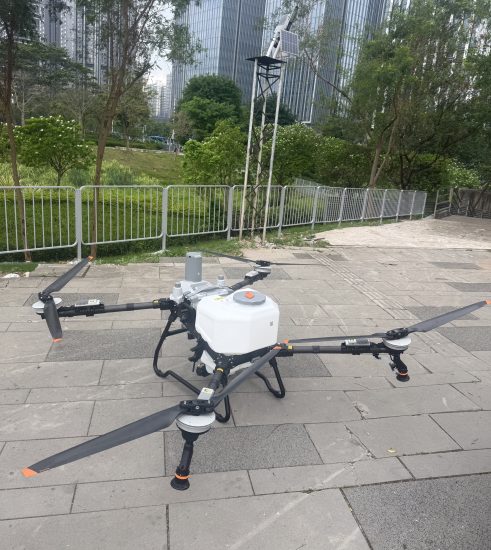



Mountain orchards are among the most difficult agricultural environments to spray. Steep slopes, uneven terrain, narrow access roads, dense trees, and limited tractor access can make traditional spraying labor-intensive and expensive.
This is one area where orchard spraying drones can provide a practical alternative. Because a drone flies above the orchard rather than driving between rows, it can reach areas that are difficult for tractors and ground equipment.
However, choosing the right drone and operating it correctly are essential for safe and effective spraying.
Why Are Steep Orchards Difficult to Spray?
Mountain orchards often have:
- Steep slopes
- Uneven ground
- Narrow planting rows
- Different elevations
- Dense canopies
- Limited vehicle access
- Utility poles and power lines
- Irregular orchard boundaries
Traditional ground equipment can have difficulty maintaining stable operation on steep slopes.
Manual backpack spraying can reach difficult areas, but it may require considerable labor and time.
A spraying drone avoids many of these ground-access limitations.
1. Can Spraying Drones Fly Over Steep Slopes?
Yes, agricultural spraying drones can operate over many sloped orchards.
The important distinction is that the drone does not need to physically climb the slope.
It can fly along a planned route above the trees.
However, actual performance depends on:
- Drone flight-control system
- Positioning accuracy
- Terrain-following capability
- Wind conditions
- Tree height
- Obstacles
- Battery capacity
- Operator experience
- Local regulations
A drone manufacturer should provide field-test information for terrain similar to your orchard.
2. Terrain Following Is an Important Feature
Terrain following can be especially useful in mountain orchards.
Imagine an orchard where the ground rises continuously.
If the drone maintains a fixed altitude relative to the takeoff point, the distance between the aircraft and the trees can change significantly.
A suitable terrain-following system can help maintain a more consistent relative flight height.
This can improve:
- Spray consistency
- Flight control
- Route repeatability
- Operator workload
However, buyers should ask exactly how the terrain-following system works and what sensors are used.
3. Accurate Positioning Matters
Reliable positioning is important when flying around steep terrain and dense trees.
The system should maintain accurate information about the drone’s position relative to:
- Orchard boundaries
- Flight routes
- Tree rows
- Obstacles
- Takeoff points
Accurate positioning can help the drone follow planned routes more consistently.
Buyers should also ask manufacturers about positioning performance in areas where trees, terrain, or other conditions may affect satellite reception.
4. Obstacle Detection Is Essential
Mountain orchards may contain many hazards.
Examples include:
- Large branches
- Tall trees
- Power lines
- Utility poles
- Buildings
- Fences
- Irrigation systems
Obstacle-sensing technology can help detect certain hazards and reduce collision risks.
However, operators should not assume that sensors can detect every object.
Thin wires and small branches can be difficult for some systems to identify.
A complete pre-flight inspection is still essential.
5. Wind Can Be a Major Challenge
Mountain areas can experience rapidly changing wind conditions.
Wind may behave differently around:
- Mountain ridges
- Valleys
- Slopes
- Buildings
- Dense vegetation
Wind can affect both drone stability and spray deposition.
Strong wind can also increase spray drift.
Therefore, operators should check local weather conditions before spraying and follow the pesticide label and applicable regulations.
If conditions become unsafe, spraying should be stopped.
6. What Drone Size Is Suitable for Mountain Orchards?
A larger drone is not automatically better.
Typical capacity categories include:
| Tank Capacity | Possible Application |
|---|---|
| 5–10 L | Small mountain orchards |
| 10–16 L | Small/medium farms |
| 16–25 L | Medium commercial orchards |
| 25–40 L | Large commercial farms |
| 40 L+ | Large professional operations |
For difficult terrain, maneuverability can sometimes be more important than maximum tank capacity.
A smaller drone may be easier to transport between remote orchard sections.
A larger drone may reduce refilling frequency but requires more energy and ground support.
7. Battery Performance Is Important
Mountain spraying can place additional demands on the battery system.
The drone needs energy to:
- Lift its own weight
- Carry liquid
- Maintain stable flight
- Navigate the terrain
- Complete route changes
When choosing a drone, ask for:
Actual flight time with a full spraying load.
Do not rely only on the manufacturer’s maximum flight time under ideal conditions.
For professional operations, multiple batteries can help reduce downtime.
8. How Much Does a Mountain Orchard Spraying Drone Cost?
The equipment price varies according to capacity and configuration.
A general budget range is:
| Drone Capacity | Indicative Price Range |
|---|---|
| 5–10 L | US$2,000–5,000 |
| 10–16 L | US$3,500–7,000 |
| 16–25 L | US$5,000–10,000 |
| 25–40 L | US$8,000–15,000+ |
| Professional/customized | US$15,000–25,000+ |
These are indicative equipment price ranges, not fixed quotations.
Actual prices depend on:
- Batteries
- Charger
- Spray system
- Sensors
- Remote controller
- Spare parts
- OEM customization
- Shipping
- Import duties
- Local taxes
- Certification requirements
9. Can Drones Replace Tractor Spraying?
In some mountain orchards, drones can provide an alternative to ground spraying.
A tractor needs to physically travel through the orchard.
A drone can fly above the trees.
This can be useful when:
- Roads are narrow
- Slopes are steep
- Ground is soft
- Trees are densely planted
- Tractor access is limited
However, drones do not eliminate all labor.
An operator is still needed to manage the aircraft and ground equipment.
10. How Much Can a Drone Spray Per Day?
There is no universal daily acreage figure.
Productivity depends on:
- Tank capacity
- Flight speed
- Spray width
- Battery endurance
- Refilling time
- Orchard size
- Tree density
- Terrain
- Wind
- Operator experience
A flat orchard may allow considerably higher productivity than a steep mountain orchard.
For this reason, buyers should ask the manufacturer for real field-test data under similar terrain conditions.
11. How to Improve Productivity in Mountain Orchards
Several practical measures can improve efficiency.
Plan Flight Routes
Map the orchard before spraying and avoid unnecessary flight paths.
Use Multiple Batteries
Reduce waiting time between flights.
Prepare Water and Mixing Equipment
A well-organized ground station can reduce refilling delays.
Mark Hazards
Identify power lines, poles, buildings, and other obstacles before flight.
Maintain the Drone
Regularly inspect motors, propellers, pumps, nozzles, filters, batteries, and other components.
Train Operators
Mountain operations require careful route planning and good understanding of the aircraft.
12. What About Spray Coverage on Slopes?
Maintaining consistent spray coverage can be more difficult on uneven terrain.
Important factors include:
- Flight altitude
- Flight speed
- Spray flow
- Nozzle configuration
- Canopy density
- Wind
Terrain-following technology can help maintain an appropriate relative distance from the crop.
However, operators should conduct small-scale field tests before treating the entire orchard.
Water-sensitive cards or other suitable coverage assessment methods can help evaluate spray deposition.
13. Safety Should Come First
Before operating a drone on a steep orchard:
- Inspect the terrain.
- Identify power lines and other hazards.
- Check weather and wind conditions.
- Confirm battery condition.
- Verify the flight route.
- Keep unauthorized people away from the operating area.
- Maintain appropriate clearance from obstacles.
- Follow local drone regulations.
- Follow pesticide handling and application requirements.
- Stop operations if conditions become unsafe.
A drone’s obstacle avoidance system should be considered a safety aid, not a replacement for responsible operation.
FAQ
Can spraying drones work on steep mountain orchards?
Yes. They can be particularly useful where tractors and other ground equipment cannot easily access steep terrain.
What is the most important feature for mountain spraying?
Terrain-following capability, reliable positioning, stable flight control, obstacle awareness, and adequate battery performance are all important.
Is a 40 L drone necessary for a mountain orchard?
Not necessarily. A smaller drone may be easier to transport and maneuver. The correct capacity depends on orchard size and operating requirements.
Can a drone replace manual spraying completely?
No. Operators are still needed for flight operations, refilling, battery management, equipment inspection, and safety.
How much does an orchard spraying drone cost?
Depending on configuration, a general equipment budget can range from approximately US$2,000 to more than US$25,000.
Does terrain following guarantee perfect spraying?
No. It can help maintain a more consistent flight height, but actual spray coverage also depends on wind, canopy structure, nozzle selection, flight speed, spray flow, and other factors.
Conclusion
Orchard spraying drones can be a valuable solution for steep and mountainous fruit farms.
Their biggest advantage is simple:
The drone flies over the orchard instead of requiring ground equipment to travel through difficult terrain.
For mountain applications, buyers should pay particular attention to:
Terrain following + positioning accuracy + obstacle awareness + battery performance + flight stability
The drone should also be tested under real orchard conditions before large-scale adoption.
When comparing models, do not focus only on tank capacity or purchase price. Evaluate the complete system, including actual flight time, spraying performance, daily productivity, battery costs, spare parts, maintenance, training, and after-sales support.
For farmers managing steep orchards, the right spraying drone can potentially reduce physical labor, improve access to difficult areas, and make orchard spraying more efficient—provided the equipment is properly selected and operated.







No comments yet