


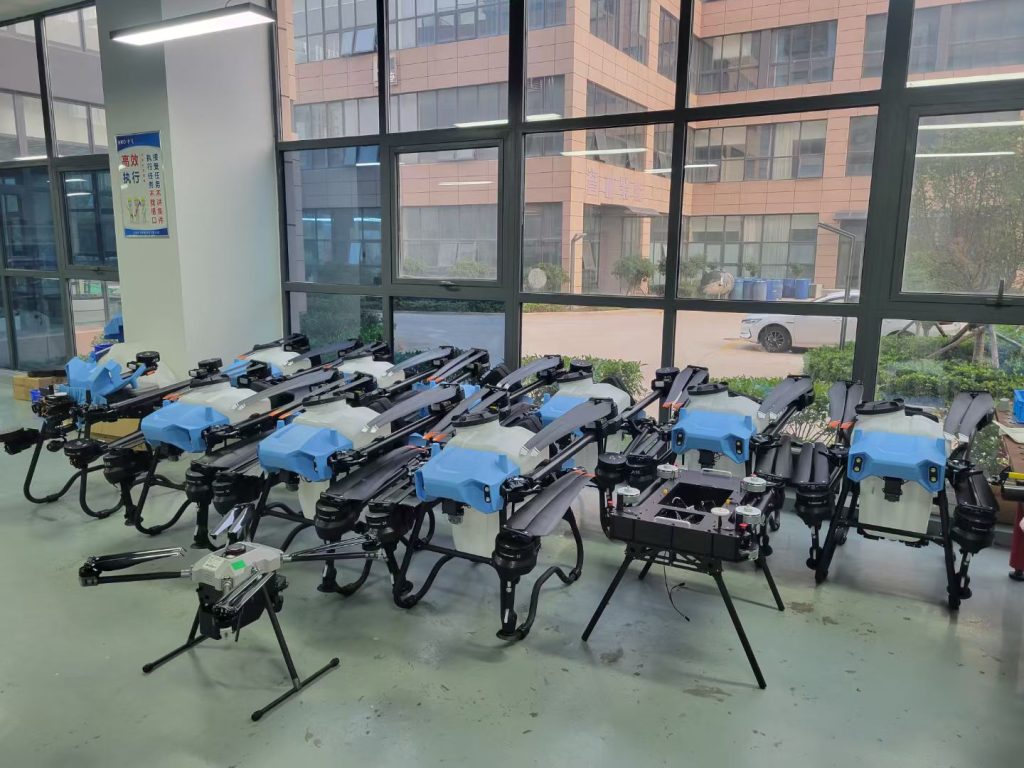
Agricultural spraying drones have become an important tool for modern farming, helping growers apply pesticides, fertilizers, herbicides, and other agricultural inputs more efficiently.
However, agricultural spraying drone prices can vary significantly. Two drones with similar tank capacities may have very different prices because of differences in flight-control systems, batteries, spraying systems, sensors, RTK positioning, obstacle avoidance, remote controllers, and after-sales support.
For importers, distributors, agricultural companies, and large farms, understanding these cost factors is essential before purchasing an agricultural spraying drone from China.
How Much Does an Agricultural Spraying Drone Cost?
The price of an agricultural spraying drone depends mainly on its capacity, configuration, battery system, navigation technology, spraying equipment, and customization requirements.
As a general purchasing reference, international buyers may encounter approximately these price ranges:
Drone Type |
Typical Capacity |
Approximate Factory Price Range* |
|---|---|---|
Small spraying drone |
10L–15L |
US$2,000–4,000 |
Medium spraying drone |
20L–30L |
US$3,000–7,000 |
Large spraying drone |
40L–50L |
US$6,000–12,000+ |
Heavy-duty agricultural drone |
50KG+ payload |
US$8,000–20,000+ |
*These are general market reference ranges rather than fixed quotations. Actual prices depend on configuration, order quantity, battery packages, customization, certifications, shipping terms, and supplier.
Buyers should always request a detailed quotation based on the exact configuration they need.
What Determines Agricultural Spraying Drone Price?
Several major components influence the final price.
1. Tank Capacity
Tank capacity is one of the most visible differences between agricultural spraying drones.
Common configurations include:
-
10L
-
16L
-
20L
-
30L
-
40L
-
50L and above
A larger tank generally allows the drone to carry more liquid per flight, but it also requires stronger motors, a larger frame, higher battery capacity, and a stronger spraying system.
Therefore, increasing capacity can increase the overall manufacturing cost.
2. Payload Capacity
Tank capacity and payload are related but should not always be treated as identical.
The maximum payload depends on the aircraft’s:
-
Motor power
-
Propeller size
-
Battery system
-
Frame structure
-
Flight controller
-
Maximum takeoff weight
For example, a drone designed for a 50KG payload requires a significantly different propulsion and structural system from a small 10L spraying drone.
Buyers should therefore compare the maximum payload and recommended working payload, not only the tank volume.
3. Battery Cost
Battery systems can represent a significant portion of the total purchase cost.
Agricultural drones often use high-capacity lithium batteries because they need enough power for multiple motors and agricultural equipment.
When comparing quotations, check whether the quoted price includes:
-
One battery
-
Two batteries
-
Multiple batteries
-
Smart battery management
-
Dedicated charger
-
Spare charging cables
-
Battery transport case
A quotation that looks inexpensive may only include one battery and a basic configuration.
4. Charger Configuration
Fast charging can be important for commercial farming operations.
A professional charging system can help reduce downtime between flights.
Buyers should check:
-
Charging time
-
Input voltage
-
Charging power
-
Number of batteries supported
-
Automatic charging management
-
Local electrical compatibility
If you are importing drones to another country, confirm that the charging equipment is compatible with the local power supply.
5. Spraying System
The spraying system directly affects application performance.
Depending on the model, a drone may use:
-
Multiple nozzles
-
High-flow pumps
-
Centrifugal atomizers
-
Pressure spraying
-
Adjustable flow control
-
Automatic spray control
The price can increase when the spraying system provides higher flow rates, better control, or additional functions.
Buyers should compare the complete spraying system instead of simply comparing the number of nozzles.
6. RTK Positioning
RTK can improve positioning accuracy and route planning.
For large agricultural operations, precise positioning may help with:
-
Straight-line flight
-
Repeated routes
-
Field mapping
-
Boundary management
-
Automatic flight planning
-
More consistent application
However, RTK configurations may increase the equipment cost.
When comparing prices, ask whether RTK equipment is included or sold separately.
7. Obstacle Avoidance
Obstacle-avoidance systems can increase the cost of an agricultural drone.
Depending on the configuration, sensors may help detect:
-
Trees
-
Poles
-
Buildings
-
Other obstacles
-
Terrain changes
The actual capabilities vary significantly between systems.
Buyers should request a demonstration instead of assuming that all drones advertised as having “obstacle avoidance” provide the same level of protection.
8. Flight Controller and Software
The flight-control system is one of the most important parts of an agricultural drone.
A professional system may provide:
-
Automatic route planning
-
Automatic takeoff and landing
-
Return-to-home
-
Low-battery warnings
-
Loss-of-signal protection
-
Field mapping
-
Automatic spraying
-
Flight data recording
Software capabilities can have a major effect on the practical value of the aircraft.
9. Remote Controller
The remote controller should also be included in the price comparison.
Check:
-
Control range
-
Display size
-
Screen brightness
-
Battery capacity
-
Waterproof protection
-
Operating system
-
Mapping software
-
Camera preview
-
Flight-planning functions
A basic controller and an integrated professional controller can have very different prices.
Factory Price vs. Final Landed Cost
One of the biggest mistakes international buyers make is comparing only the factory price.
The final cost may include:
Drone + batteries + charger + spare parts + packaging + export documentation + shipping + customs clearance + import duties + local taxes
For example, a drone quoted at US$6,000 does not necessarily mean the buyer’s final landed cost will be US$6,000.
Before placing an order, calculate the complete import cost.
What Is the Best Agricultural Drone for the Price?
There is no single best agricultural drone for every buyer.
The right choice depends on:
-
Farm size
-
Crop type
-
Field conditions
-
Daily operating area
-
Application rate
-
Required payload
-
Local regulations
-
Battery availability
-
Maintenance capability
-
Budget
A smaller drone may be more economical for small farms.
A larger drone may be more efficient for commercial agricultural operations because it can carry more liquid or fertilizer per flight.
The goal should be to find the best cost-to-productivity ratio, not simply the lowest purchase price.
10L vs. 20L vs. 30L Agricultural Spraying Drones
10L Agricultural Drone
A 10L drone is generally suitable for smaller farms, demonstration operations, and applications where mobility is more important than maximum productivity.
Advantages can include:
-
Lower purchase cost
-
Lower battery requirements
-
Easier transportation
-
Easier operation
-
Lower replacement costs
20L Agricultural Drone
A 20L model provides a balance between capacity and operating flexibility.
It can be suitable for:
-
Medium-sized farms
-
Rice fields
-
Vegetable production
-
Orchard applications
-
Commercial spraying services
30L Agricultural Drone
A 30L drone provides greater capacity and can be attractive to professional agricultural operators.
Its advantages may include:
-
Higher working capacity
-
Fewer refilling stops
-
Better productivity for large fields
-
Greater suitability for commercial spraying
However, it also requires a stronger propulsion and battery system.
40L and 50KG Agricultural Drones
For large commercial operations, buyers may consider high-capacity drones.
These drones are designed for heavier workloads and may offer:
-
Higher payload
-
Larger spray systems
-
Stronger motors
-
Larger batteries
-
Higher flow rates
-
Longer operating cycles
However, purchasing a larger drone also means considering:
-
Battery replacement costs
-
Charging infrastructure
-
Transportation
-
Operator training
-
Spare parts
-
Local regulatory requirements
Large capacity does not automatically mean lower operating cost.
How to Get a Better Agricultural Drone Price from a Chinese Manufacturer
International buyers can often obtain more competitive pricing by preparing a detailed RFQ.
Instead of asking:
“How much is your agricultural drone?”
Provide information such as:
-
Required capacity
-
Required payload
-
Quantity
-
Target country
-
Spraying application
-
Required battery quantity
-
Charger requirements
-
OEM requirements
-
Spare-parts requirements
-
Shipping destination
For example:
We are looking for 10 units of 30L agricultural spraying drones for commercial rice farming. Please quote the drone, four batteries per unit, chargers, spare parts, OEM packaging, and FOB or CIF pricing.
A detailed request allows the manufacturer to provide a more accurate quotation.
How Quantity Affects Price
MOQ and order quantity can have a significant impact on unit price.
A single sample unit may have a higher price because of:
-
Individual packaging
-
Manual assembly
-
Small-batch production
-
Testing
-
Shipping arrangements
A larger order may allow the manufacturer to optimize production and packaging costs.
Distributors should therefore ask for tiered pricing, such as:
-
1 unit
-
5 units
-
10 units
-
20 units
-
50 units
-
100 units
This makes it easier to calculate potential margins.
OEM Agricultural Drone Pricing
OEM pricing depends on the level of customization.
Basic OEM services may include:
-
Logo printing
-
Custom labels
-
Custom packaging
-
User manuals
-
Product colors
More advanced customization may involve:
-
Hardware modifications
-
Software customization
-
New spraying systems
-
Custom remote controllers
-
New product structures
The more extensive the customization, the greater the development cost and production lead time may be.
Don’t Choose a Manufacturer Based Only on Price
The cheapest quotation is not always the cheapest solution.
Consider the total cost of ownership:
Purchase price + batteries + charger + spare parts + maintenance + downtime + technical support + shipping
A manufacturer with a slightly higher initial price may provide better batteries, stronger components, better software, faster spare-parts support, and more reliable after-sales service.
For commercial agriculture, these factors can have a significant impact on profitability.
What Should Be Included in a Professional Quotation?
A good quotation should clearly identify:
-
Drone model
-
Tank capacity
-
Payload
-
Battery specification
-
Number of batteries
-
Charger
-
Remote controller
-
Spraying system
-
RTK system
-
Obstacle avoidance
-
Spare parts
-
Warranty
-
Production lead time
-
Packaging
-
Trade terms
-
Payment terms
Avoid accepting a quotation that simply says:
Agricultural Drone — US$5,000
without explaining what is included.
Agricultural Drone Price FAQ
How much does an agricultural spraying drone cost?
Depending on capacity and configuration, agricultural spraying drones can range from several thousand US dollars to more than US$20,000 for heavy-duty professional systems.
Why are some agricultural drones much more expensive?
Differences in payload, batteries, motors, spraying systems, RTK, sensors, flight controllers, software, and accessories can significantly affect the price.
Is it cheaper to buy an agricultural drone directly from China?
China has a large agricultural drone manufacturing industry, and direct factory purchasing can provide competitive pricing. However, buyers should also calculate shipping, customs, taxes, certification, spare parts, and after-sales costs.
What size agricultural drone should I buy?
The correct size depends on your farm area, crop type, application rate, operating conditions, and budget. A larger drone is not necessarily better for every operation.
Does the battery come with the drone?
It depends on the supplier’s quotation. Always confirm the exact number of batteries and chargers included before ordering.
Are OEM agricultural drones more expensive?
OEM customization can increase the initial cost, particularly when hardware, software, packaging, or product design needs to be modified. Basic logo and packaging customization may have a lower additional cost.
How can I compare agricultural drone suppliers?
Compare not only the unit price but also specifications, battery configuration, spraying performance, warranty, spare parts, production capability, OEM services, and technical support.
Final Buying Checklist
Before purchasing an agricultural spraying drone, confirm:
-
[ ] Tank capacity
-
[ ] Maximum and recommended payload
-
[ ] Spray width
-
[ ] Flow rate
-
[ ] Flight time
-
[ ] Battery capacity
-
[ ] Number of batteries
-
[ ] Charger specification
-
[ ] RTK availability
-
[ ] Obstacle avoidance
-
[ ] Remote controller
-
[ ] Spare parts
-
[ ] Warranty
-
[ ] OEM capability
-
[ ] Production lead time
-
[ ] Shipping terms
-
[ ] Import requirements
Conclusion
Agricultural spraying drone prices vary because the products themselves can be very different.
When comparing suppliers, international buyers should look beyond the headline price and evaluate the complete configuration and long-term operating cost.
The best purchasing decision is usually the drone that provides the right combination of payload, spraying efficiency, flight performance, battery system, reliability, technical support, spare-parts availability, and total cost of ownership.
For buyers sourcing agricultural spraying drones from China, requesting a detailed configuration-based quotation is the best way to make an accurate supplier comparison and avoid unexpected costs.
THE END






No comments yet