

Orange orchards present unique spraying challenges. Trees can become tall and dense, rows may be planted across uneven terrain, and traditional ground equipment may have difficulty reaching every area without damaging soil or vegetation. An agricultural spraying drone can provide a flexible alternative for certain crop-protection and foliar-application tasks.
For growers considering an agricultural drone for spraying orange orchards, the key is not simply choosing the largest drone. Effective orchard spraying depends on spray coverage, flight planning, droplet characteristics, weather conditions, battery management, and correct application practices.
Why Use an Agricultural Drone in Orange Orchards?
Orange trees often develop broad, dense canopies that require careful application management. Ground sprayers can be effective, but they may require suitable access between rows and sufficient ground conditions.
A spraying drone can operate above the orchard without requiring the same type of ground access.
Potential benefits include:
- Access to uneven or difficult terrain
- Reduced soil compaction
- Flexible treatment of different orchard sections
- Efficient operation in areas where tractors are difficult to use
- Automated route planning
- Reduced dependence on large ground equipment
- Precise control of flight routes and application parameters
- Easier access to certain hard-to-reach areas
The actual benefit depends on orchard conditions and the specific application.
How Does a Spraying Drone Work in Orange Orchards?
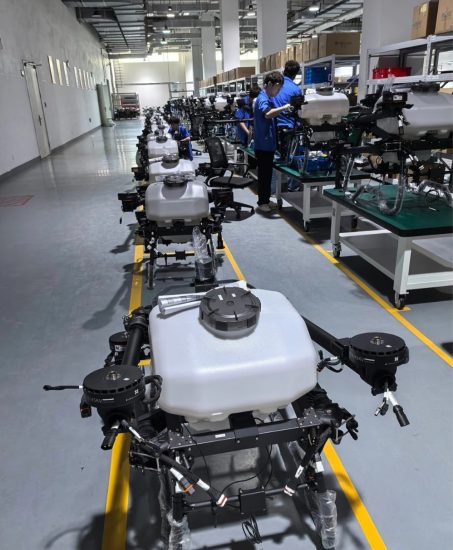
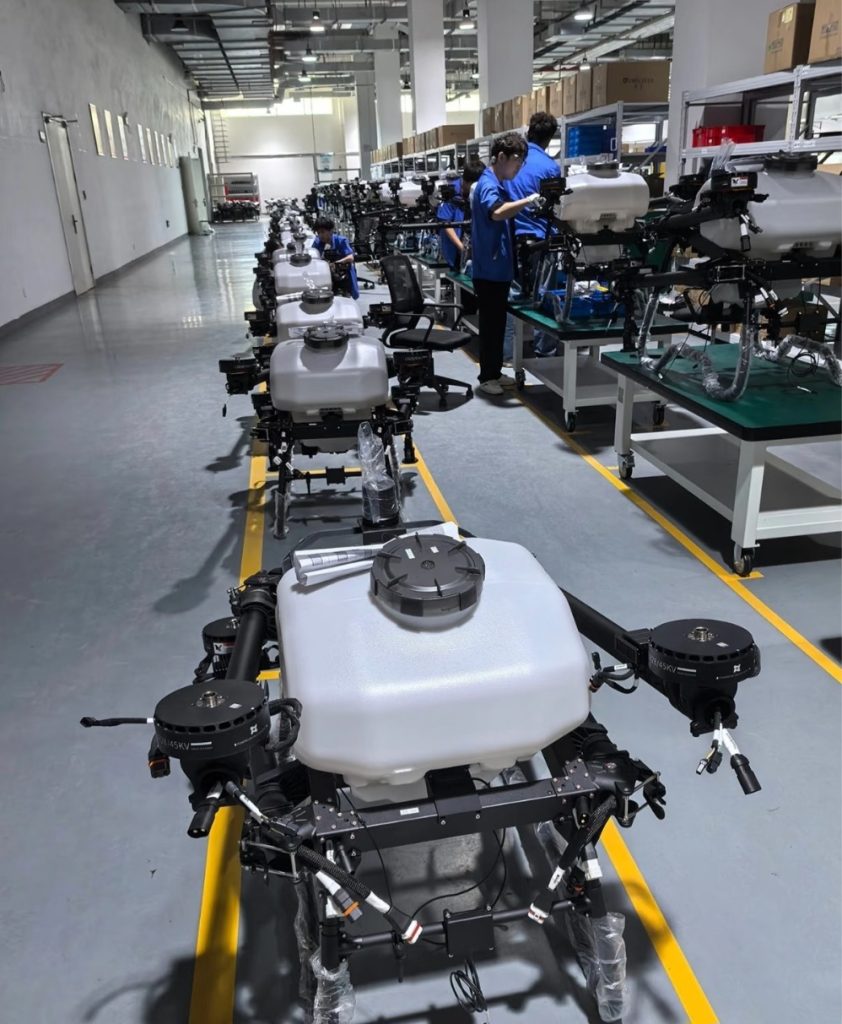
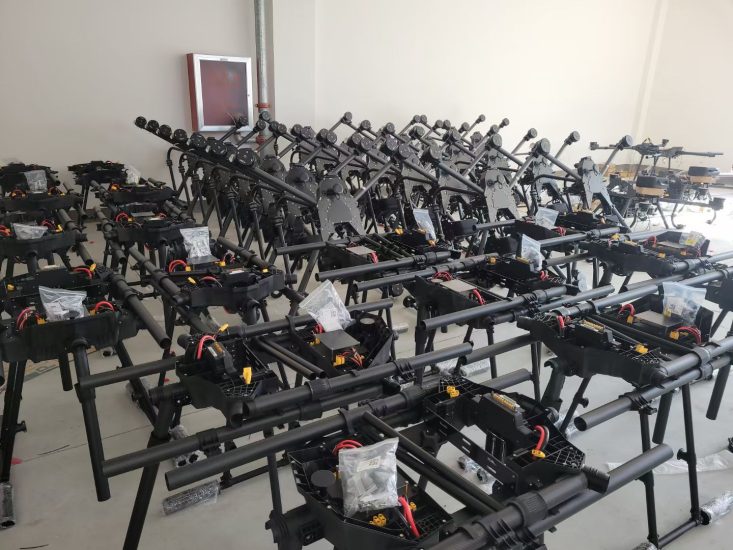
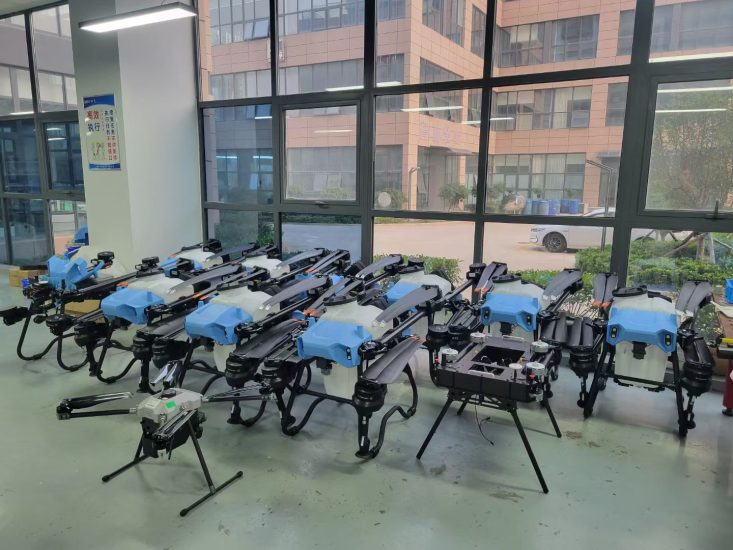
An agricultural spraying drone generally consists of a liquid tank, pump, spray lines, nozzles, batteries, flight-control electronics, positioning systems, and a remote controller.
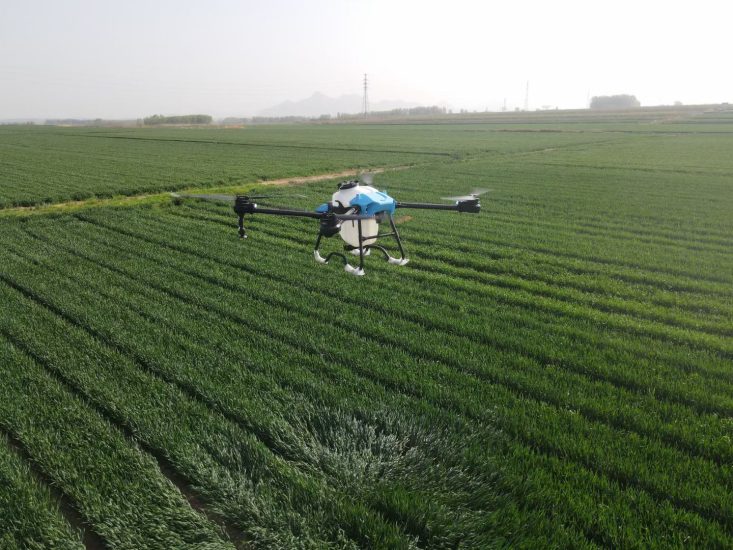
The operator first plans the treatment area and identifies obstacles such as trees, poles, buildings, roads, and power lines. The drone then follows a planned flight route while the spraying system applies the liquid.
Rotor airflow can influence spray movement toward the canopy, but good coverage cannot be guaranteed simply because the drone is flying over the trees. Application performance depends on several variables:
- Flight altitude
- Flight speed
- Spray rate
- Droplet size
- Nozzle type
- Canopy density
- Tree height
- Wind conditions
- Product characteristics
- Orchard spacing
For this reason, growers should conduct a controlled field test before applying a treatment across an entire orchard.
Selecting the Right Drone Tank Capacity
Agricultural spraying drones are available with different tank capacities. Smaller drones can be easier to maneuver and may be suitable for smaller orchards or difficult terrain. Larger drones can carry more liquid and potentially reduce the number of refilling operations.
However, tank capacity should not be the only purchasing criterion.
A better evaluation considers:
Tank capacity + application rate + flight time + refill time + battery replacement time + daily operating area
For example, a drone with a large tank may appear highly productive, but if its battery system or refill process creates significant downtime, its real-world productivity may not be as high as expected.
Spray Coverage Is Critical for Orange Trees
Orange trees have complex foliage, and effective coverage may require careful adjustment of operating parameters.
Flight Altitude
The drone should operate at a tested height appropriate for the tree canopy and spraying system.
Flying too high can increase drift and reduce deposition. Flying too low may create uneven coverage or increase the risk of contact with trees and obstacles.
Flight Speed
Flight speed directly affects the amount of spray delivered to a given area.
Increasing speed may improve theoretical coverage per hour but can reduce application uniformity if the spray system is not adjusted accordingly.
Droplet Size
Droplet size is an important factor in both coverage and drift.
Smaller droplets may improve surface coverage but can be more vulnerable to wind. Larger droplets generally have different deposition and drift characteristics.
The appropriate settings should be determined according to the agricultural product label, local requirements, and field conditions.
Spray Volume
The correct spray volume depends on the crop, growth stage, canopy structure, formulation, and application objective.
Using more liquid does not automatically produce better results. Calibration and uniformity are more important than simply increasing application volume.
Mapping and Route Planning for Orange Orchards
Modern agricultural drones can use positioning technology and flight-planning software to create repeatable routes.
Before spraying, operators can map:
- Orchard boundaries
- Tree rows
- Buildings
- Roads
- Power lines
- Poles
- Water sources
- Other obstacles
This can help reduce unnecessary flight movements and improve operational consistency.
For large orange orchards, route planning can also make it easier to divide the farm into manageable treatment zones.
Battery Management and Field Productivity
Battery performance has a major influence on agricultural drone productivity.
Actual flight time depends on:
- Payload
- Battery capacity
- Wind
- Temperature
- Flight speed
- Terrain
- Aircraft design
- Battery condition
A professional operation should therefore prepare multiple batteries and an appropriate charging solution.
A typical workflow may include:
- Prepare fully charged batteries.
- Inspect the aircraft.
- Prepare the spraying system.
- Fill the tank.
- Check the planned route.
- Conduct the flight.
- Replace the battery when required.
- Refill the tank.
- Continue the planned route.
- Inspect the treated orchard area.
Efficient logistics between flights can be just as important as the drone’s specifications.
Safety and Compliance
Agricultural spraying drones should only be operated by appropriately trained personnel and in accordance with local aviation and agricultural regulations.
Before each operation, inspect:
- Propellers
- Motors
- Batteries
- Spray nozzles
- Pump
- Pipes
- Tank
- Positioning system
- Flight-control system
- Obstacle-detection system
- Emergency functions
Operators should also consider people, animals, buildings, roads, neighboring properties, and other aircraft in the operating area.
Only agricultural products approved for the intended crop and application method should be used. Product labels and local regulations should always take priority over generic spraying recommendations.
Can a Drone Replace Traditional Orange Orchard Sprayers?
Not in every situation.
Traditional orchard sprayers remain useful for many commercial applications, especially where orchards have suitable access roads and the equipment is already available.
Agricultural drones can provide additional flexibility where:
- Ground access is difficult
- Soil is wet
- Terrain is steep
- Orchard sections are isolated
- Labor availability is limited
- Rapid treatment is required
- Ground equipment could cause excessive soil disturbance
The best solution depends on the individual farm rather than one universal spraying method.
How to Improve Drone Spraying Results
1. Test Before Large-Scale Application
Begin with a small area and inspect spray deposition and coverage.
2. Monitor Weather
Wind speed and direction can significantly affect aerial spraying. Avoid unsuitable conditions.
3. Maintain Nozzles
Dirty, blocked, or damaged nozzles can cause inconsistent application.
4. Optimize Refilling
A nearby water source and organized mixing/refilling area can reduce downtime.
5. Use Consistent Flight Routes
Repeatable routes make it easier to maintain consistent application across different orchard blocks.
6. Record Operating Parameters
Keep records of application date, field area, weather, product, spray volume, flight speed, altitude, and other relevant parameters where required.
What Should Orange Growers Consider Before Buying?
A buyer should evaluate the complete agricultural drone system rather than focusing on one specification.
| Feature | Importance |
|---|---|
| Tank capacity | Determines liquid carried per flight |
| Pump performance | Influences spray consistency |
| Nozzle system | Affects spray distribution |
| Flight endurance | Influences operating efficiency |
| Battery system | Determines turnaround time |
| Positioning accuracy | Helps maintain planned routes |
| Obstacle avoidance | Useful in complex orchards |
| Route planning | Improves repeatability |
| Terrain capability | Important for uneven land |
| Controller | Affects operational convenience |
| Spare parts | Helps minimize downtime |
| Technical support | Important for long-term operation |
Growers should also request practical field data, training information, maintenance requirements, and after-sales support details before purchasing.
Frequently Asked Questions
Can agricultural drones spray orange trees?
Yes. Agricultural spraying drones can be used for certain agricultural applications in orange orchards when the aircraft, application method, agricultural product, and operation comply with applicable local requirements.
What size drone is suitable for an orange orchard?
There is no universal answer. The appropriate capacity depends on orchard size, tree density, terrain, application rate, refill facilities, and the desired operating workflow.
Can drones operate in uneven orange orchards?
Many agricultural drones are designed to operate over varying terrain, but performance depends on the specific aircraft and flight-control system. Terrain should always be evaluated before commercial operation.
Can drone spraying completely prevent drift?
No. Spray drift remains possible. Operators need to consider wind, droplet size, altitude, flight speed, spray pressure, and product requirements.
Should I choose the largest available agricultural drone?
Not necessarily. A larger drone can carry more liquid, but it may also require more battery power and suitable field logistics. The best choice is the drone that matches the orchard’s actual operating conditions.
Conclusion
An agricultural drone for spraying orange orchards can provide growers with a practical tool for improving operational flexibility in modern orchard management. Its effectiveness depends on proper calibration, route planning, weather monitoring, battery management, equipment maintenance, and trained operation.
Rather than selecting a drone based only on tank capacity or advertised flight time, orange growers should evaluate the complete system and conduct field testing under their actual orchard conditions. With the right configuration and operating procedures, agricultural spraying drones can become a valuable part of a modern orchard-management program.


No comments yet