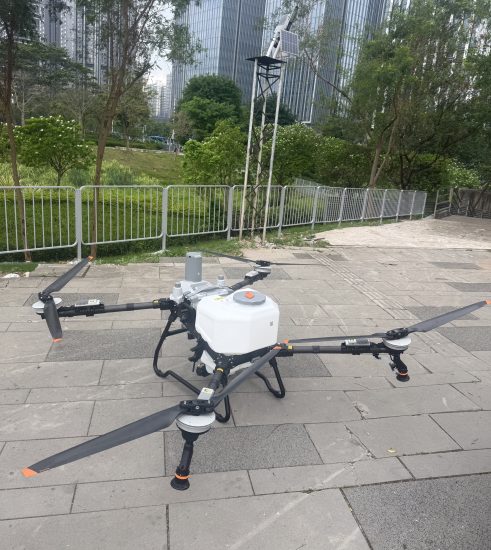




Choosing the right agricultural drone is an important decision for farmers, agricultural contractors, distributors, and crop-protection service providers.
Among the most common options are 10L, 20L, and 30L agricultural spraying drones. At first glance, the difference seems simple: a larger drone carries more liquid. In practice, however, payload capacity affects battery consumption, flight time, productivity, transport, maintenance, and the overall cost of operation.
So, should you choose a 10L, 20L, or 30L agricultural drone?
The answer depends on your farm size, crop type, field conditions, operating area, budget, and expected workload.
This guide compares the three capacities and explains which type may be suitable for different agricultural applications.
Quick Comparison
| Feature | 10L Drone | 20L Drone | 30L Drone |
|---|---|---|---|
| Payload | Up to about 10L | Up to about 20L | Up to about 30L |
| Typical factory price | US$2,000–US$4,000 | US$4,000–US$7,000 | US$6,000–US$10,000+ |
| Farm application | Small to medium | Medium to large | Large-scale |
| Maneuverability | High | High | Moderate to high |
| Battery demand | Lower | Medium | Higher |
| Refilling frequency | Higher | Medium | Lower |
| Initial investment | Lower | Medium | Higher |
| Suitable for testing | Excellent | Good | Less economical |
| Commercial operation | Good | Excellent | Excellent |
The prices above are indicative factory-level ranges. Actual prices depend on configuration, batteries, charger, navigation system, radar, spraying equipment, order quantity, and customization.
1. What Does 10L, 20L, or 30L Mean?
The number generally refers to the approximate liquid tank capacity of the spraying system.
For example:
10L agricultural drone
can carry approximately 10 liters of spraying liquid under the specified operating configuration.
20L agricultural drone
can carry approximately 20 liters.
30L agricultural drone
can carry approximately 30 liters.
However, tank capacity is only one part of the drone’s performance.
You also need to consider:
- Maximum takeoff weight
- Empty drone weight
- Battery capacity
- Flight time
- Spray width
- Flow rate
- Flight speed
- Pump performance
- Navigation system
A larger tank does not automatically mean higher productivity.
2. How Much Does Each Size Cost?
A general factory-level price range is:
10L Agricultural Drone
Approximately:
US$2,000–US$4,000
This is often the entry point for buyers who want to test agricultural drone technology.
20L Agricultural Drone
Approximately:
US$4,000–US$7,000
This range is commonly suitable for commercial agricultural operations.
30L Agricultural Drone
Approximately:
US$6,000–US$10,000+
These larger models are generally designed for higher-volume operations.
The final price can change significantly depending on the included batteries, charger, remote controller, RTK, radar, pump system, spare parts, and OEM customization.
3. 10L Agricultural Drone: Who Should Choose It?
A 10L drone can be a practical choice for smaller farms, new operators, and buyers entering the agricultural drone market.
Advantages
- Lower purchase cost
- Easier transportation
- Good maneuverability
- Lower battery demand
- Easier to operate in smaller fields
- Lower initial investment
- Suitable for testing
Disadvantages
- Smaller payload
- More frequent refilling
- Lower productivity for very large farms
- May require more operational cycles
A 10L drone can be especially attractive when fields are divided into many smaller sections.
4. 20L Agricultural Drone: The Balanced Option
For many commercial users, a 20L drone can provide a useful balance between payload capacity and maneuverability.
Advantages
- Higher productivity than smaller models
- Fewer refilling cycles
- Suitable for medium and large farms
- Good balance between size and performance
- Suitable for commercial spraying
- More practical for professional contractors
Disadvantages
- Higher purchase price
- Higher battery requirements
- Greater transport requirements
- More expensive spare parts in some configurations
If you are uncertain between 10L and 30L, a 20L model may be worth considering because it provides a middle ground.
5. 30L Agricultural Drone: When Does It Make Sense?
A 30L agricultural drone is designed for users who prioritize payload capacity and high-volume operations.
Advantages
- Large payload
- Fewer refilling cycles
- Suitable for large-scale farming
- Potentially higher productivity
- Suitable for professional spraying contractors
Disadvantages
- Higher initial investment
- Higher battery consumption
- Larger physical size
- More demanding transportation
- Higher equipment and maintenance costs
A 30L drone makes more sense when the operator has enough agricultural area to take advantage of the additional capacity.
Buying a 30L drone for a very small farm may result in underutilized equipment.
6. Which Drone Is Best for Small Farms?
For small farms, a 10L agricultural drone may be the most practical starting point.
The main advantages are:
- Lower investment
- Easy transportation
- Easy field maneuvering
- Lower battery requirements
However, if the farm is expected to expand or the drone will also be used for commercial spraying services, a 20L model may provide better long-term value.
7. Which Drone Is Best for Large Farms?
For large-scale agricultural operations, 20L or 30L models are generally more suitable.
The larger payload can reduce the number of refill cycles.
For example, if the application rate is 10L per hectare:
- 10L tank = approximately 1 hectare per tank
- 20L tank = approximately 2 hectares per tank
- 30L tank = approximately 3 hectares per tank
This is a simplified example. Actual field coverage depends on spray settings, overlap, application rate, field conditions, and operational efficiency.
8. Don’t Forget Spray Width
Tank capacity alone does not determine productivity.
Consider two drones:
Drone A
20L tank + 4m effective spray width
Drone B
20L tank + 6m effective spray width
If other operating conditions are comparable, Drone B may potentially cover more area per flight.
Therefore, when comparing manufacturers, ask for:
- Effective spray width
- Flight speed
- Recommended application rate
- Flow rate
- Actual field efficiency
9. Battery Requirements
Larger agricultural drones generally require more powerful battery systems.
A typical configuration may include:
- Intelligent lithium battery
- Smart charger
- Battery management system
- Battery monitoring
- Temperature protection
When purchasing, ask:
How many batteries are required for one working cycle?
For professional operations, you may need multiple batteries so that one set can be charging while another set is being used.
The cost of additional batteries can significantly affect the total purchase price.
10. Charging Time Matters
A drone with a large battery may provide longer flight time, but charging can also take longer.
Ask the supplier for:
- Full charging time
- Fast charging capability
- Recommended charging temperature
- Charger power
- Number of batteries supported simultaneously
If you operate for many hours per day, charging infrastructure should be considered before purchasing the drone.
11. Which Size Is Best for Rice Farming?
Rice farming can be well suited to agricultural drones because wet fields can make ground equipment difficult to operate.
A 10L, 20L, or 30L drone can potentially be used depending on the scale of the operation.
For larger rice farms, 20L or 30L models may reduce refilling frequency.
For smaller or fragmented rice fields, a 10L or 16L model may offer better maneuverability.
12. Which Size Is Best for Orchards?
Orchards are different from open fields.
You may need:
- Obstacle avoidance
- Stable low-altitude flight
- Terrain following
- Accurate navigation
- Good spray penetration
- Strong maneuverability
A larger tank does not necessarily provide better orchard performance.
In some orchard applications, maneuverability and spraying characteristics can be more important than maximum payload.
13. Which Size Is Best for Spraying Contractors?
Professional spraying contractors usually prioritize:
Productivity + Reliability + Operating Cost
For this type of business, a 20L or 30L drone may provide advantages because it can reduce refill frequency.
However, contractors should calculate the complete cost per hectare.
Consider:
- Drone purchase price
- Battery cost
- Electricity
- Maintenance
- Spare parts
- Transportation
- Operator labor
- Chemical loading
- Refilling time
The cheapest drone is not necessarily the most profitable.
14. 10L vs 20L vs 30L: Operating Cost
A simple comparison:
10L
Lower initial investment but potentially more refilling cycles.
20L
Higher investment but potentially better productivity.
30L
Highest investment but potentially lower refill frequency for large-scale operations.
The correct choice depends on how many hectares you expect to treat each day.
15. How to Calculate the Right Capacity
You can start with this simple formula:
Required Tank Capacity = Target Area × Application Rate ÷ Number of Desired Refills
For example, suppose:
- Target area = 60 hectares
- Application rate = 10L/hectare
- Desired number of tank cycles = 30
Then:
60 × 10 ÷ 30 = 20L
A 20L tank would theoretically match this simplified operating target.
Actual productivity still needs to account for battery changes, refilling, field layout, and flight efficiency.
16. What About 16L Agricultural Drones?
Although this article focuses on 10L, 20L, and 30L models, 16L drones are also worth considering.
A 16L model can sit between the smaller and larger categories.
It may be suitable for:
- Medium-sized farms
- Distributors
- Agricultural contractors
- Users who want more capacity than 10L
- Users who want lower investment than some 20L or 30L systems
When comparing 16L and 20L models, evaluate the complete specifications rather than the tank size alone.
17. Which Size Should a New Buyer Choose?
For a new buyer, the following approach can help:
Choose 10L if:
You want a lower-cost entry point and mainly operate smaller fields.
Choose 20L if:
You want a balance between capacity, productivity, price, and maneuverability.
Choose 30L if:
You operate large-scale farms or commercial spraying projects and can utilize the additional capacity.
For many professional agricultural users, 20L can be a practical middle-ground configuration, but it is not automatically the best choice for every operation.
18. Questions to Ask the Manufacturer
Before ordering, ask:
- What is the actual payload?
- What is the full-load flight time?
- What is the effective spray width?
- What is the flow rate?
- How many batteries are included?
- How long does each battery take to charge?
- What is the battery cycle life?
- Is RTK included?
- What obstacle-avoidance system is used?
- What spare parts are recommended?
- What is the warranty?
- What is the MOQ?
- What is the production lead time?
- Can the product be customized?
- Can the supplier provide a field test?
These questions can help you compare different agricultural drone manufacturers more accurately.
FAQ
Is a 20L agricultural drone better than a 10L drone?
Not necessarily. A 20L drone carries more liquid and can reduce refill frequency, but a 10L model may be easier to transport and maneuver.
Is a 30L agricultural drone worth the extra cost?
It can be worthwhile for large-scale operations where the higher payload can improve productivity. For smaller farms, the additional capacity may not provide enough benefit to justify the investment.
How much does a 10L agricultural drone cost?
A typical factory-level price may be around US$2,000–US$4,000, depending on configuration.
How much does a 20L agricultural drone cost?
A typical factory-level price may be around US$4,000–US$7,000.
How much does a 30L agricultural drone cost?
A typical factory-level price may be around US$6,000–US$10,000+.
How many hectares can an agricultural drone spray?
There is no single answer. Actual coverage depends on application rate, flight speed, spray width, battery endurance, field layout, refilling time, and operator efficiency.
What is the most important factor when choosing an agricultural drone?
You should evaluate the complete operating system rather than one specification. Payload, flight time, spray performance, battery system, navigation, reliability, maintenance, and total cost should all be considered.
Conclusion
The choice between a 10L, 20L, and 30L agricultural drone should be based on your actual agricultural operation rather than simply choosing the largest available model.
A 10L drone can be a good choice for smaller farms and new users.
A 20L drone can provide a strong balance between payload, productivity, maneuverability, and investment.
A 30L drone can be more appropriate for large-scale farms and professional spraying contractors.
Before buying, compare the complete specifications, calculate expected cost per hectare, check battery requirements, verify local regulations, and request real field-performance data from the manufacturer.
The best agricultural drone is not necessarily the biggest or cheapest one. It is the model that provides the right combination of productivity, reliability, operating cost, and long-term support for your specific farm.


No comments yet