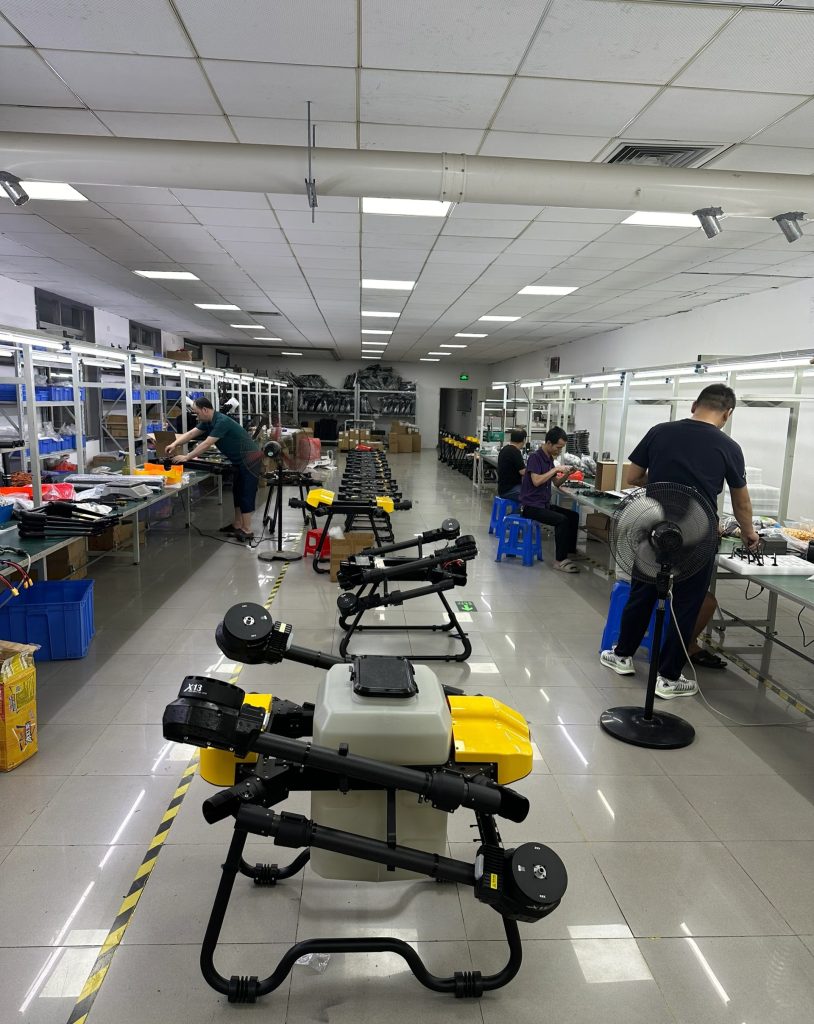
If you grow vegetables on anything other than flat, open ground, you know the frustration of crop protection. Sloped fields wash out your knapsack sprayer team within an hour. Greenhouse structures block every attempt at efficient coverage. Terraced plots force workers to crawl along narrow ridges with heavy equipment strapped to their backs. And when you finally finish, the coverage is uneven, the chemical waste is high, and half your crew is exhausted or at risk of injury.
For decades, farmers with complex terrain had no real alternative. Tractors cannot operate on slopes steeper than 15°, and even all-terrain vehicles struggle above 25°. Greenhouses and high tunnels eliminate tractor access entirely. Manual spraying was—and for many still is—the only option.
That reality is changing. Modern all-terrain agricultural drones are now routinely operating on slopes up to 40°, inside greenhouse structures as low as 2.5 meters, and across terraced vegetable plots that were previously considered unsprayable. This article explains the technologies that make this possible, the operational techniques professionals use, and what it means for farmers working with difficult terrain.
The Terrain Problem: Why Traditional Methods Fail
Before looking at the drone solution, it is worth understanding exactly where and why conventional spraying breaks down.
Terrain Type
|
Traditional Method Failure Point
|
Consequence
|
Sloped fields (>15°)
|
Tractor cannot climb safely; manual workers slip and fatigue quickly
|
Uneven coverage; safety incidents; reduced labor efficiency
|
Terraced plots
|
No vehicle access; workers carry 15–20 kg sprayers up and down steps
|
Extreme fatigue; inconsistent spray pressure; chemical exposure
|
Greenhouses / hoop houses
|
Boom sprayers cannot enter; manual spraying is slow and poorly ventilated
|
Heat stress for workers; poor coverage in dense canopy zones
|
Narrow strip fields
|
Tractors cannot turn; boom width exceeds field width
|
Manual fallback; higher cost per hectare
|
Muddy or saturated soil
|
Wheeled equipment causes compaction or gets stuck
|
Delayed spraying; crop damage; soil structure destruction
|
Raised bed systems
|
Standard nozzles cannot target bed tops without hitting aisles
|
Over-spray on walkways; chemical waste; runoff into drainage
|
These are not edge cases. Across Asia, Latin America, Southern Europe, and parts of North America, an estimated 30% to 40% of vegetable acreage falls into at least one of these categories. For those farmers, “precision agriculture” has always felt like a promise meant for someone else’s flat cornfield.
All-Terrain Drone Technology: What Makes It Possible
An all-terrain agricultural drone is not simply a standard drone flown in difficult places. It incorporates several purpose-built technologies that allow safe, effective operation where other methods cannot go.
1. Terrain-Following Flight Systems
The foundation of slope operation is a real-time kinematic (RTK) positioning system combined with a downward-facing LiDAR or stereo-vision terrain sensor. Together, these systems allow the drone to:
-
Maintain a constant altitude above the crop canopy rather than above sea level. On a 30° slope, a standard GPS-only drone would fly closer and closer to the ground as it ascends the hill, eventually crashing into the crop. A terrain-following drone adjusts its altitude 50 to 100 times per second, keeping the spray height consistent regardless of ground slope.
-
Automatically map and navigate terrace edges without the pilot manually adjusting altitude at each step.
-
Operate safely in greenhouses where GPS signal is weak or unavailable, using visual-inertial odometry (VIO) and internal navigation sensors to maintain position.
Performance specification: Modern terrain-following systems maintain altitude accuracy within ±10 cm on slopes up to 40° and in structures with partial GPS denial.
2. Slope Takeoff and Landing Capability
Traditional agricultural drones require a flat, open area for takeoff and landing. All-terrain models feature:
-
Oblique takeoff and landing: The drone can launch from and return to surfaces tilted up to 15°–20°, such as a terrace wall, a sloped farm road, or the edge of a greenhouse bench.
-
Mobile ground station: A compact, wheeled takeoff platform that the ground crew can position on uneven ground, providing a stable launch point without requiring a flat landing zone.
-
Cable-suspended landing: In extreme terrain, some systems support landing the drone onto a padded platform via a tether, eliminating the need for a precise touchdown on rough ground.
3. Compact Form Factor for Confined Spaces
Greenhouse and high-tunnel operation demands a drone that can fit and maneuver in tight spaces:
-
Folded dimensions: All-terrain models typically fold to under 80 cm diagonally, allowing them to pass through standard greenhouse doors (minimum 90 cm width).
-
Reduced rotor span: Some models feature foldable or telescoping arms that reduce the flight profile to 1.2–1.5 meters during operation—narrow enough to fly between greenhouse rows spaced 1.8–2.0 meters apart.
-
Propeller guards: Soft or rigid guards around the rotor tips prevent damage to greenhouse plastic, irrigation lines, and trellis wires in the event of a proximity breach.
4. Obstacle Avoidance and Indoor Navigation
Inside a greenhouse or under low-hanging orchard netting, GPS is unreliable or absent. All-terrain drones use a suite of sensors to navigate safely:
-
Forward, backward, and downward binocular vision sensors: Detect posts, beams, hanging irrigation lines, and plant trellises up to 15–20 meters ahead.
-
ToF (Time-of-Flight) side sensors: Maintain safe distance from greenhouse walls and adjacent crop rows.
-
Ultrasonic altitude hold: Provides precise height control when downward vision is partially obscured by dense foliage.
-
Dead reckoning mode: If all external signals are lost, the drone continues its pre-programmed flight path using internal inertial measurement and returns to the last known GPS point at the greenhouse exit.
5. All-Weather and All-Surface Operation
Complex terrain often means unpredictable surfaces and conditions:
-
Waterproof and dustproof rating (IPX6 or higher): Allows operation in light rain, high humidity (common in greenhouses), and dusty conditions after tillage.
-
Corrosion-resistant materials: Stainless steel and composite frames resist the salt and chemical exposure common in coastal vegetable farms and high-frequency spraying operations.
-
High-torque motors: Provide the power headroom needed for heavy-lift takeoffs from high-altitude fields (2,000+ meters above sea level) where rotor efficiency is reduced.
Operational Techniques for Complex Terrain
Having the right equipment is only half the equation. Professional operators use specific techniques to maximize safety and coverage in difficult environments.
Slope Operations: The Zig-Zag Pattern
On slopes steeper than 20°, flying straight up and down the hill is inefficient and increases the risk of the drone being pushed into the ground by its own downwash reflecting off the slope. Instead, pilots use a contour-following zig-zag pattern:
-
The drone flies parallel to the contour line at a consistent altitude above the canopy.
-
At the field edge, it climbs or descends 2–3 meters along the slope face.
-
It reverses direction and flies the next contour line.
-
This pattern keeps the drone’s downwash airflow perpendicular to the slope surface, maximizing canopy penetration while minimizing reflection and drift.
Coverage rate on slopes: A skilled pilot can cover 60–80 mu (4–5.3 hectares) per day on 25°–35° slopes—compared to 15–20 mu for a manual team on the same terrain.
Greenhouse Operations: The Corridor Fly-Through
Inside a greenhouse, the drone does not take off from outside and fly in. Instead:
-
The drone is assembled and powered on inside the greenhouse at one end of a row corridor.
-
It takes off vertically and hovers at the target spray height (typically 1.0–1.5 meters above the crop).
-
It flies the length of the corridor autonomously, spraying both sides of the row as it passes.
-
At the far end, it lands on a padded platform, the ground assistant rotates the batteries and refills, and the process repeats on the next corridor.
Key safety note: Greenhouse operators always maintain a minimum 50 cm clearance between the drone and the greenhouse roof/truss structure, and keep a fire extinguisher rated for lithium battery fires at the entry point as a standard safety protocol.
Terraced Fields: The Step-Down Sequence
On terraced vegetable plots (common in mountainous regions growing tea, herbs, leafy greens, and root vegetables):
-
The pilot maps each terrace level as a separate sub-field within the flight planning software.
-
The drone sprays Terrace 1, lands at the terrace edge, and the ground assistant swaps batteries and refills.
-
The pilot adjusts the home-point altitude for Terrace 2 (typically 1.5–3 meters lower) and repeats.
-
This step-down sequence continues until all terraces are covered.
Efficiency gain: What takes a 4-person manual team 2 full days on a 10-terrace hillside can be completed by one drone + one assistant in 5–6 hours.
Real-World Performance Data
Terrain Type
|
Manual Coverage per Day (2-person team)
|
Drone Coverage per Day (1 pilot + 1 assistant)
|
Time Savings
|
Chemical Savings
|
25°–35° slope, 5 ha field
|
1.5–2 ha
|
4–5.5 ha
|
~65%
|
30–40%
|
Greenhouse, 1 ha (10 corridors)
|
0.3–0.4 ha
|
0.8–1.2 ha
|
~60%
|
25–35%
|
Terraced hillside, 3 ha (8 levels)
|
0.5–0.8 ha
|
2.5–3.5 ha
|
~75%
|
35–45%
|
Raised bed system, 2 ha
|
1.0–1.5 ha
|
3.5–4.5 ha
|
~65%
|
30–40%
|
Data from commercial drone spraying operations in China, Japan, Italy, and Colombia (2023–2025), covering vegetables including lettuce, chili, tomato, cucumber, and leafy brassicas.
Limitations and Safety Considerations
All-terrain drones are powerful tools, but they are not magic. Farmers should be aware of the following constraints:
-
Maximum recommended slope: Most manufacturers rate their aircraft for safe operation up to 40°–45°. Beyond that, the risk of GPS signal reflection from the slope face and downwash turbulence increases significantly.
-
Greenhouse height minimum: A minimum internal clearance of 2.5 meters is recommended for safe drone operation. Lower structures require specialized micro-drones with smaller rotor spans.
-
Ventilation requirement: Even with a drone producing less chemical mist than manual methods, greenhouses should have active ventilation during and for 30 minutes after spraying to protect the pilot and assistant.
-
Battery performance on slopes: Climbing a 30° slope requires 20%–30% more power per minute than level flight. Pilots must reduce their planned flight time per battery by 25% when operating on steep terrain to maintain a safe return-to-home margin.
-
Regulatory restrictions: Some regions prohibit drone spraying in or around greenhouse structures due to chemical drift concerns. Always verify local regulations before beginning operations.
The Bottom Line
If your vegetable farm includes slopes, terraces, greenhouses, or any combination of the above, you have likely accepted higher spraying costs and lower coverage quality as an unavoidable cost of doing business. All-terrain drone technology is removing that acceptance from the equation.
The ability to maintain consistent spray height on a 35° slope, navigate a 2.8-meter greenhouse corridor, or step down a terraced hillside without a single worker setting foot on the field is no longer experimental. It is happening daily on commercial vegetable farms across the world. For farmers in complex terrain, the question is no longer whether drones can handle their land—it is how quickly they can get one into the air.
FAQ
Q: Can a drone really spray effectively on a 30° or 35° slope without the chemical sliding off the plants?
A: Yes, and the reason is droplet size and airflow angle. On a slope, the drone’s downwash hits the canopy at an angle perpendicular to the slope surface (thanks to terrain-following flight). This pushes droplets into the canopy rather than letting them run downhill. Combined with the optimal 100–200 micron droplet size, the spray adheres to leaves on contact rather than beading and sliding. Field trials on 30°+ slopes show deposition efficiency of 55%–65%—comparable to flat-field performance.
Q: What happens if the drone loses GPS signal inside a greenhouse?
A: All-terrain drones designed for greenhouse use rely primarily on visual-inertial navigation rather than GPS once inside the structure. The drone uses its onboard cameras and internal motion sensors to track its position relative to the greenhouse rows. If the visual system is temporarily obscured (e.g., by a sudden dense mist), the drone enters a hover-and-wait state, maintaining altitude while the pilot regains visual contact. It does not fly blindly or crash.
Q: How do I handle narrow greenhouse rows where the drone’s rotor span is wider than the aisle?
A: In rows narrower than the drone’s rotor span, operators use a technique called offset corridor flight. The drone flies above the crop row itself (rather than the aisle), centering its body over the plants and spraying downward. This requires a rotor span of no more than 1.2–1.4 meters and a minimum crop row width of 60–80 cm. For rows narrower than 50 cm, a specialized micro-drone (<80 cm rotor span) is required.
Q: Is it safe to use a lithium-battery-powered drone in a hot, humid greenhouse?
A: Modern agricultural drone batteries are rated for operation in temperatures up to 45°–50°C and humidity up to 95% non-condensing. However, greenhouse temperatures above 40°C can accelerate battery degradation and reduce flight time by 15%–20%. Best practice is to schedule greenhouse spraying during the cooler morning or evening hours, and to store spare batteries in a shaded, ventilated area outside the greenhouse during operation.
Q: Can the drone spray on wet, muddy slopes where a tractor would get stuck?
A: Yes. Because the drone never touches the ground, soil conditions are irrelevant to its operation. This is one of the biggest advantages of drone spraying in hilly vegetable regions during the rainy season. However, the ground assistant still needs a safe position to stand for battery swaps and refills—operators typically identify a dry, stable spot at the top or bottom of the slope before beginning work.
Q: What about spraying in hoop houses (polytunnels) with curved plastic roofs?
A: Hoop houses present a unique challenge because the curved roof reduces internal clearance at the edges. Operators typically fly down the center aisle of a hoop house, angling the spray nozzles slightly outward (15°–20°) to reach crops on both sides. This works well for houses 6–8 meters wide with a center height of at least 2.8 meters. For narrower hoop houses (4–5 meters), the drone may need to fly above the crop rows directly, as described for narrow greenhouse corridors.
Q: How do I train a pilot specifically for slope and greenhouse operations?
A: Standard agricultural drone certification covers flat-field operation. For slope and greenhouse work, additional training is essential. Most equipment dealers offer advanced terrain operation modules that cover: (1) terrain-following system calibration, (2) slope takeoff and landing procedures, (3) greenhouse safety protocols, (4) obstacle avoidance sensor management in GPS-denied environments, and (5) emergency procedures for confined-space battery incidents. This advanced training typically takes 2–3 additional days beyond the basic certification.
THE END
Support it if you like it




No comments yet