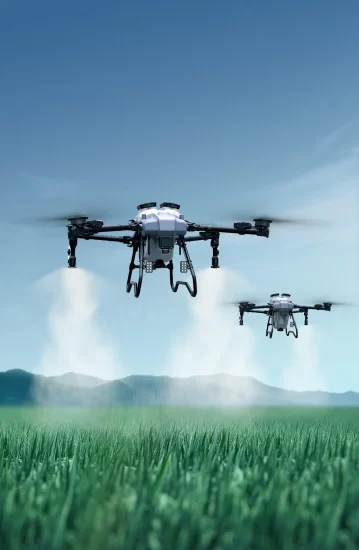


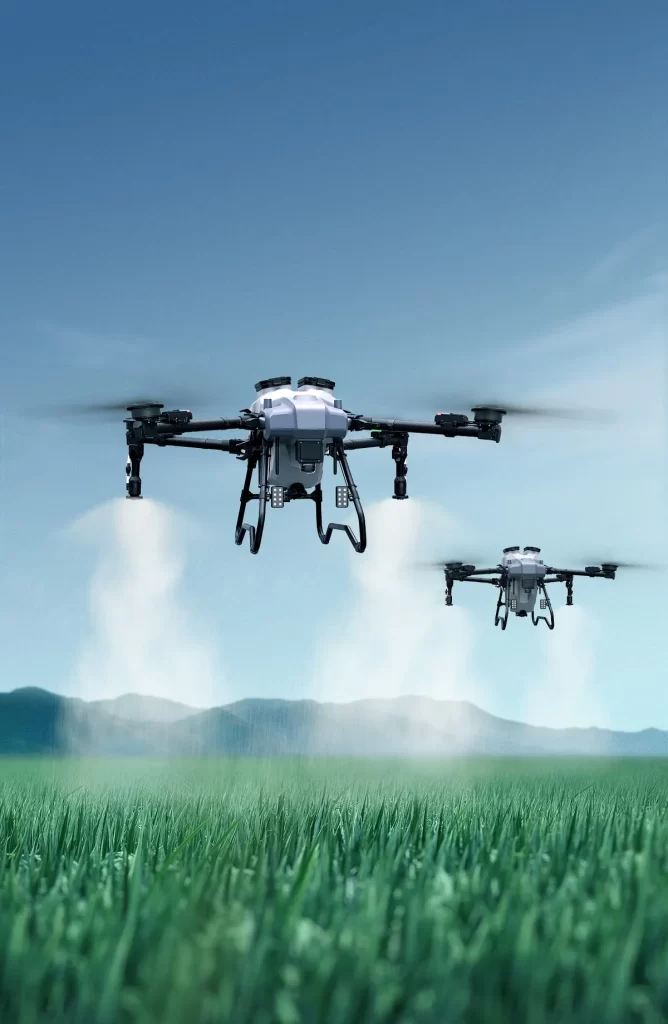
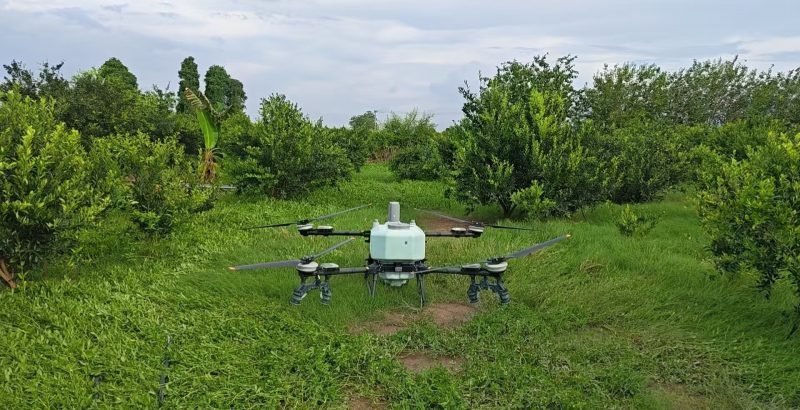
Choosing an orchard spraying drone is more complicated than choosing a drone with the largest tank. Fruit orchards often have dense tree canopies, narrow rows, uneven ground, slopes, and obstacles. These conditions require a drone with stable flight, accurate positioning, appropriate spray coverage, and enough payload capacity.
For farmers and agricultural service companies, the right drone should improve spraying efficiency while reducing labor and unnecessary pesticide consumption.
Why Orchard Spraying Is Different
Open-field crops are relatively easy to cover because the plants are usually at a similar height and arranged uniformly.
Orchards are different. Common challenges include:
- Dense branches and leaves
- Tall trees
- Narrow planting rows
- Uneven terrain
- Mountain slopes
- Irregular tree spacing
- Buildings, wires, and other obstacles
- Different canopy densities
Because of these conditions, a drone designed mainly for open farmland may not provide the best performance in an orchard.
What Features Should an Orchard Spraying Drone Have?
When choosing a drone for dense fruit trees, pay particular attention to the following features.
1. Stable Flight
A spraying drone needs to maintain a relatively stable flight path when operating close to trees.
Strong flight control is especially important when the orchard is located in mountainous or windy areas.
2. Obstacle Avoidance
Branches can extend into the drone’s flight path.
A drone equipped with appropriate obstacle-sensing technology can help the operator identify potential obstacles and reduce the risk of collisions.
However, obstacle avoidance should not be treated as a substitute for proper operation. Operators still need to inspect the orchard before spraying.
3. Terrain Following
Mountain orchards can have significant changes in elevation.
Terrain-following capability can help maintain a more consistent distance between the drone and the crop.
This can contribute to more uniform spraying.
4. Suitable Spray System
The spray system is just as important as the tank capacity.
Important specifications include:
- Pump flow rate
- Nozzle configuration
- Spray width
- Droplet characteristics
- Flow control
- Number of spray outlets
A large tank does not automatically mean better spraying performance.
What Payload Capacity Is Suitable?
The right payload depends on the size and type of orchard.
| Tank Capacity | Typical Application |
|---|---|
| 5–10 L | Small orchards and difficult terrain |
| 10–16 L | Small and medium commercial orchards |
| 16–25 L | Medium-sized commercial orchards |
| 25–40 L | Large orchards and professional spraying services |
| 40 L+ | Large-scale agricultural operations |
These ranges are general guidelines. Actual performance depends on flight speed, spray rate, canopy density, terrain, battery capacity, and operating conditions.
Estimated Orchard Spraying Drone Price Range
The purchase price can vary significantly depending on payload capacity, flight-control systems, spraying technology, batteries, chargers, obstacle-sensing systems, and manufacturer configuration.
A general market-oriented budget range for agricultural spraying drones is:
| Drone Type | Approximate Price Range* |
|---|---|
| 5–10 L | US$2,000–5,000 |
| 10–16 L | US$3,500–7,000 |
| 16–25 L | US$5,000–10,000 |
| 25–40 L | US$8,000–15,000+ |
| Professional customized systems | US$15,000–25,000+ |
*These are indicative price ranges, not fixed quotations. Actual prices can vary substantially by manufacturer, configuration, battery quantity, charger, remote controller, spare parts, shipping, taxes, certification, and destination country.
For international buyers, the final landed cost may be higher than the factory price because of freight, customs duties, local taxes, and other import expenses.
Why Dense Canopies Require Careful Drone Selection
A dense canopy can prevent spray droplets from reaching the interior of the tree.
For example, citrus, mango, avocado, and some apple orchards can have thick foliage.
Simply increasing the spray volume is not always the best solution.
The operator should consider:
Flight altitude + flight speed + spray flow + nozzle selection + canopy density
These parameters should be adjusted according to the crop and approved pesticide label requirements.
How Can Drone Spraying Improve Orchard Operations?
Traditional orchard spraying can require substantial labor.
Workers may need to carry equipment through narrow rows, operate ground machinery, or use manual spraying equipment.
A drone can potentially reduce the amount of manual movement required and make difficult-to-access areas easier to reach.
Potential benefits include:
- Reduced manual labor
- Faster coverage of difficult areas
- Access to slopes and uneven terrain
- Less dependence on ground vehicles
- Easier operation in wet soil
- More consistent flight paths
- Digital flight planning
However, actual savings depend on the orchard, labor costs, pesticide application requirements, and operating efficiency.
What About Mountain Orchards?
Mountain orchards are one of the situations where spraying drones can provide particular value.
Traditional equipment may have difficulty moving on steep slopes.
A drone can fly over the orchard without requiring a vehicle to travel through every row.
However, buyers should pay close attention to:
- Positioning accuracy
- Terrain-following performance
- Wind resistance
- Obstacle detection
- Battery endurance
- Return-to-home functions
- Communication reliability
For steep terrain, operator training is particularly important.
How Many Batteries Should You Buy?
Battery configuration can significantly affect productivity.
A drone may have good theoretical flight time, but frequent battery charging can interrupt actual operations.
For commercial spraying, buyers may consider purchasing multiple batteries so that one battery can be charging while another is operating.
You should also calculate the complete operating cycle:
Flight → landing → battery replacement → refilling → takeoff
This is more useful than looking only at the advertised maximum flight time.
What Is the Operating Cost?
The total cost of drone spraying includes more than the drone itself.
Typical expenses can include:
- Drone depreciation
- Battery replacement
- Electricity
- Maintenance
- Spare parts
- Nozzles
- Pumps
- Operator labor
- Transportation
- Pesticide
- Charging equipment
A buyer should calculate the estimated cost per hectare or acre rather than focusing only on the equipment purchase price.
For example, a US$4,000 drone may be cheaper to purchase, but if it requires frequent refilling and battery changes, a larger model may provide better productivity for a large commercial orchard.
Small Orchard vs. Large Orchard
Small Orchard
For a small farm, a 5–10 L drone may be sufficient.
The main priorities should be:
- Low purchase cost
- Easy transportation
- Simple operation
- Good maneuverability
- Affordable spare parts
Medium Orchard
A 10–25 L drone may provide a better balance.
The buyer should compare:
- Tank capacity
- Battery endurance
- Spray width
- Flight stability
- Refilling time
- Maintenance costs
Large Commercial Orchard
For large-scale operations, 25–40 L or larger systems may be worth considering.
The focus should shift toward:
- High productivity
- Large payload
- Fast refilling
- Multiple batteries
- Efficient charging
- Reliable flight control
- Professional after-sales support
Questions to Ask the Manufacturer
Before purchasing, ask the supplier:
- What is the actual liquid tank capacity?
- What is the recommended operating payload?
- What is the maximum flight time with a full tank?
- What is the effective spray width?
- What is the pump flow rate?
- Which nozzles are included?
- Does the drone support terrain following?
- What obstacle-detection system is included?
- How many batteries are included in the quoted price?
- What is the battery charging time?
- What spare parts are available?
- Is operator training provided?
- What warranty period is offered?
- What is the estimated FOB or EXW price?
- Can the manufacturer provide an orchard field test?
FAQ
How much does an orchard spraying drone cost?
A general equipment budget can range from approximately US$2,000 to more than US$25,000, depending on payload capacity and configuration. Small models generally cost less, while professional large-capacity systems can cost considerably more.
What size drone is best for a small orchard?
A 5–10 L model can be suitable for many small orchards. However, narrow rows and mountainous terrain may make maneuverability more important than tank capacity.
Are large drones better for fruit orchards?
Not necessarily. A large drone can reduce the number of refills, but it can also be heavier and require more battery power. The best size depends on the orchard’s actual conditions.
Can drones spray mango and citrus orchards?
Yes, agricultural spraying drones can be used for many types of fruit orchards. However, flight parameters and spraying practices need to be adjusted according to tree structure, canopy density, pesticide requirements, and local regulations.
Can orchard spraying drones operate on slopes?
Many agricultural drones are designed to operate over uneven terrain, but performance depends on the specific aircraft and its positioning and terrain-following capabilities.
Conclusion
For fruit orchards with dense canopies, difficult terrain, and narrow planting rows, choosing the right spraying drone requires more than comparing tank sizes.
A good purchasing decision should consider payload capacity, flight stability, terrain following, obstacle sensing, spray-system performance, battery endurance, maintenance, and total operating cost.
As a general equipment budget, orchard spraying drones may range from around US$2,000 for smaller systems to more than US$25,000 for professional customized systems. The actual quotation should always be confirmed according to the complete configuration and destination market.
The most suitable drone is not necessarily the largest or most expensive model. It is the one that matches your fruit tree type, orchard size, terrain, spraying requirements, and daily workload.


No comments yet