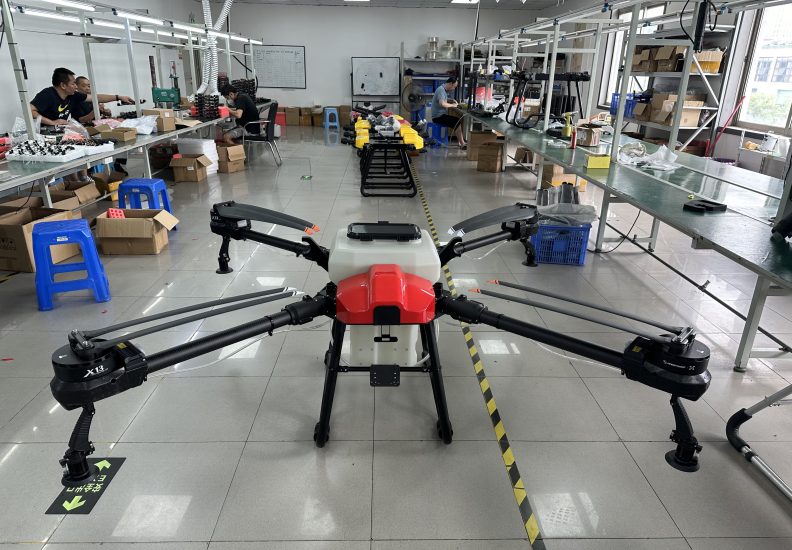


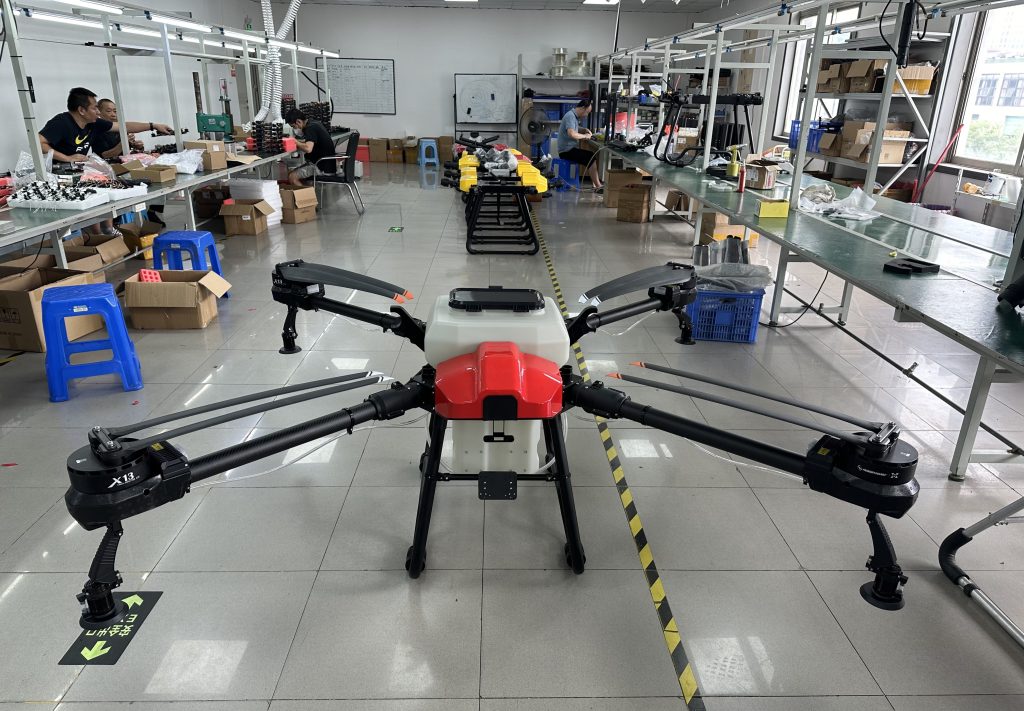
A 100KG payload agricultural spraying drone is designed for large-scale agricultural operations where carrying capacity and field efficiency are important. However, one of the most common questions from buyers is: How much area can a 100KG agricultural drone spray on a single flight?
There is no single answer because actual coverage depends on tank capacity, payload, battery capacity, spray rate, spray width, flight speed, terrain, weather, and the amount of agricultural liquid applied per hectare.
Instead of looking only at the advertised maximum flight time, buyers should calculate the drone’s actual working coverage under a realistic agricultural payload.
This guide explains how to estimate the spraying distance and field coverage of a 100KG-class agricultural drone.
How Much Can a 100KG Agricultural Drone Spray Per Flight?
A 100KG payload drone does not necessarily spray 100KG of liquid on every flight.
The actual amount depends on the drone’s:
-
Maximum takeoff weight
-
Empty weight
-
Battery weight
-
Spray tank capacity
-
Recommended working payload
-
Pump system
-
Flight conditions
For example, a drone may be structurally capable of carrying a high payload but operate with a smaller practical liquid load to maintain adequate flight time and safety margins.
Therefore, the first specification to request from the manufacturer is:
Actual spray coverage per flight with the intended working payload.
What Determines Spraying Coverage?
Several factors determine how much area a drone can treat during one flight.
1. Spray Tank Capacity
Tank capacity is one of the most obvious factors.
A larger tank allows the drone to carry more liquid per flight, potentially reducing the number of refilling operations.
For example, if the application rate is:
10 liters per hectare
and the usable spray tank contains:
100 liters
the theoretical liquid capacity is:
100 ÷ 10 = 10 hectares
However, this does not mean the drone will necessarily complete 10 hectares in one flight.
There may be:
-
Residual liquid
-
Flight restrictions
-
Battery limitations
-
Wind
-
Route changes
-
Safety margins
The actual completed area can therefore be lower.
2. Application Rate
Application rate is extremely important.
Suppose the drone applies:
10 L/ha
A 100-liter usable tank could theoretically cover:
100 ÷ 10 = 10 hectares
But if the application rate is increased to:
20 L/ha
the same tank would theoretically cover:
100 ÷ 20 = 5 hectares
Therefore, the amount of liquid required per hectare has a direct impact on coverage.
Different crops and agricultural applications can require different application rates.
3. Spray Width
Spray width determines how much ground the drone can cover during each flight pass.
A simplified calculation is:
Coverage Rate = Spray Width × Flight Speed × 3.6
where:
-
Spray width is measured in meters
-
Flight speed is measured in meters per second
-
3.6 converts the result into hectares per hour
For example, if the effective spray width is 8 meters and flight speed is 6 m/s:
8 × 6 × 3.6 = 172.8 hectares/hour
This is a theoretical coverage rate.
Actual field productivity will be lower because the drone needs to turn, refill, change batteries, avoid obstacles, and follow field boundaries.
4. Flight Speed
Higher flight speed can increase theoretical coverage, but flying faster does not automatically improve spraying performance.
If the drone flies too quickly:
-
Spray distribution can change
-
Coverage may become less consistent
-
Wind can influence droplet deposition
-
The required flow rate may increase
Therefore, the best operating speed should be based on the spraying system and application requirements.
A professional agricultural drone should allow the operator to adjust flight speed according to the crop and spraying task.
5. Battery Capacity
Battery capacity has a major effect on one-flight coverage.
A fully loaded drone requires more energy than an empty drone.
The battery must power:
-
Motors
-
Flight controller
-
Navigation system
-
Radar or sensors
-
Pumps
-
Communication equipment
As payload increases, energy consumption generally increases.
This means a drone’s advertised maximum flight time without payload should not be used to estimate actual agricultural coverage.
Instead, ask:
What is the flight time with a full working spray load?
This is a much more useful number.
6. Payload Weight
Payload is one of the biggest variables.
Imagine two operating conditions:
Light Load
The drone carries a relatively small amount of liquid.
Advantages may include:
-
Longer flight time
-
Lower energy consumption
-
Easier maneuverability
Heavy Load
The drone carries a large working payload.
Potential advantages:
-
More liquid per flight
-
Fewer refilling operations
Potential disadvantages:
-
Higher power consumption
-
Shorter flight time
-
Greater motor load
The optimal payload is therefore a balance between liquid capacity and flight efficiency.
How to Calculate Theoretical Area Per Flight
A simple calculation can help estimate coverage.
Formula 1: Tank-Based Coverage
Area per flight = Usable tank capacity ÷ Application rate
For example:
-
Usable tank capacity = 100 liters
-
Application rate = 10 L/ha
Therefore:
100 ÷ 10 = 10 hectares
This is the theoretical area based on liquid capacity.
Battery-Based Coverage
The battery may impose a different limitation.
For example, suppose:
-
Effective coverage rate = 20 hectares/hour
-
Practical flight time = 15 minutes
Then:
15 minutes = 0.25 hour
Therefore:
20 × 0.25 = 5 hectares
In this example, the battery would theoretically limit the flight to approximately 5 hectares.
This demonstrates why tank capacity alone cannot determine coverage.
Tank Capacity vs. Battery Capacity
The drone should ideally be designed so that tank capacity and battery endurance are reasonably balanced.
Consider this example:
Factor |
Example |
|---|---|
Usable tank capacity |
100 L |
Application rate |
10 L/ha |
Tank-based coverage |
10 ha |
Effective coverage rate |
20 ha/hour |
Practical flight time |
15 min |
Battery-based coverage |
5 ha |
The tank could theoretically support 10 hectares, but the battery may only allow approximately 5 hectares per flight.
This is why manufacturers should provide actual field-performance data.
How Wind Affects Coverage
Wind is a major factor in drone spraying.
Strong wind can affect:
-
Flight stability
-
Battery consumption
-
Spray drift
-
Droplet deposition
-
Flight speed
-
Route accuracy
A drone flying against the wind may consume more energy than when flying with the wind.
Crosswinds can also affect spray distribution.
Therefore, the same drone can produce different coverage results on different days.
For agricultural spraying, operators should follow the applicable pesticide label, agricultural guidance, and local regulations regarding weather conditions.
How Terrain Affects Flight Time
Flat agricultural land is generally easier to operate over than complex terrain.
Hills, slopes, orchards, and irregular fields may require:
-
More altitude adjustments
-
More route corrections
-
Terrain following
-
Additional maneuvering
These operations can affect energy consumption and effective field coverage.
A drone with terrain-following capability can be particularly useful in areas with significant elevation changes.
How Refilling Affects Daily Productivity
One-flight coverage is important, but daily coverage may be even more important for commercial farms.
Suppose a drone can treat:
5 hectares per flight
and completes:
10 flights per day
The theoretical daily coverage would be:
5 × 10 = 50 hectares/day
However, this does not include all downtime.
Actual productivity must account for:
-
Battery charging
-
Battery replacement
-
Refilling
-
Transportation
-
Field setup
-
Takeoff and landing
-
Maintenance
-
Weather interruptions
Therefore, a more useful measurement is:
Actual hectares completed per working day.
How Battery Charging Affects Productivity
If a drone takes a long time to recharge, it may spend significant time on the ground.
Commercial operators can improve productivity by using multiple batteries.
For example:
Battery Set A
Drone is operating.
Battery Set B
Battery is charging.
Battery Set C
Battery is available as a backup.
This can reduce downtime during large-scale operations.
The exact number of batteries required depends on the drone’s charging speed, battery capacity, field workload, and available electrical infrastructure.
Example: Estimating Daily Spraying Capacity
Consider a hypothetical 100KG agricultural drone:
-
Effective spray width: 8 m
-
Average operating speed: 6 m/s
-
Practical field efficiency: 60%
-
Working time: 6 hours/day
The theoretical coverage rate is:
8 × 6 × 3.6 = 172.8 hectares/hour
Applying a 60% field-efficiency factor:
172.8 × 60% = 103.68 hectares/hour
However, this calculation is still highly simplified.
Real agricultural productivity can be much lower because of tank capacity, battery endurance, refilling, field conditions, and other operational limitations.
This example demonstrates why manufacturers should provide field-test data rather than relying only on theoretical specifications.
What Does “Spray Distance” Actually Mean?
Buyers sometimes ask:
How many kilometers can the drone spray on one flight?
For agricultural drones, area coverage is usually more useful than linear flight distance.
For example, a drone could fly several kilometers while following narrow passes, but that does not necessarily mean it treated a large area.
Agricultural performance should instead be evaluated using:
-
Hectares per flight
-
Hectares per hour
-
Hectares per day
-
Liters per hectare
-
Battery consumption per hectare
These measurements provide a more realistic picture of commercial productivity.
How to Compare Two Agricultural Drones
Suppose you are comparing two 100KG-class models.
Drone A
-
Larger tank
-
Shorter flight time
-
Basic navigation
-
Lower purchase price
Drone B
-
Slightly smaller usable tank
-
Longer working flight time
-
Better route planning
-
More efficient battery system
Drone A may carry more liquid per flight, but Drone B could potentially complete more hectares per day.
This is why the best drone should be selected according to total field productivity, not tank size alone.
What Information Should You Request From the Manufacturer?
Before purchasing, ask for the following data:
Flight Performance
-
Maximum flight time
-
Flight time with working payload
-
Recommended working payload
-
Maximum flight speed
-
Typical operating speed
Spraying Performance
-
Tank capacity
-
Maximum pump flow
-
Normal pump flow
-
Spray width
-
Nozzle configuration
-
Application-rate range
Field Performance
-
Hectares per flight
-
Hectares per hour
-
Hectares per day
-
Battery consumption
-
Recommended operating conditions
Battery
-
Battery capacity
-
Charging time
-
Cycle life
-
Replacement cost
-
Number of recommended batteries
This information makes it easier to compare different suppliers objectively.
How to Improve One-Flight Coverage
Farm operators can improve efficiency by optimizing several factors.
Use the Correct Application Rate
Avoid applying more agricultural liquid than necessary.
Always follow the applicable product label and professional agricultural guidance.
Optimize Flight Routes
Automatic route planning can reduce unnecessary overlaps and improve field efficiency.
Maintain the Spray System
Blocked or damaged nozzles can affect application consistency.
Maintain Batteries
Proper battery maintenance can help preserve available capacity.
Minimize Ground Downtime
Prepare:
-
Water
-
Agricultural products
-
Batteries
-
Chargers
-
Spare parts
before beginning large-scale operations.
Is a 100KG Drone Always Better Than a Smaller Drone?
Not necessarily.
A 100KG-class drone can provide higher payload capacity, but larger drones can also have:
-
Higher purchase costs
-
Higher battery costs
-
Higher transportation requirements
-
Greater maintenance requirements
-
More demanding safety requirements
A smaller agricultural drone may be more economical for smaller farms or operations with limited field size.
The correct drone depends on:
Farm size + crop type + application rate + terrain + daily workload + budget
Final Buying Advice
When evaluating how far a 100KG payload agricultural spraying drone can spray on one flight, do not rely on a single number.
The actual coverage depends on:
Tank Capacity × Application Rate × Battery Endurance × Spray Width × Flight Speed × Field Efficiency
For commercial buyers, the most useful specifications are:
-
Actual hectares per flight
-
Actual hectares per hour
-
Actual hectares per day
-
Flight time with working payload
-
Application rate
-
Battery replacement time
-
Refilling time
A drone that can carry a large payload but requires frequent battery changes may not necessarily outperform a slightly smaller and more efficient aircraft.
The best purchasing decision comes from comparing real field productivity and cost per hectare under conditions similar to your intended operation.
FAQ
How many hectares can a 100KG agricultural drone spray in one flight?
There is no universal figure. Coverage depends on tank capacity, application rate, battery endurance, spray width, flight speed, and field conditions. Buyers should request actual hectares-per-flight data from the manufacturer.
Can a 100KG drone carry 100KG of pesticide?
Not necessarily. “100KG payload” generally refers to the maximum payload capability under specified conditions. The recommended working payload may be lower depending on battery configuration and operating conditions.
How does application rate affect coverage?
Higher application rates consume more liquid per hectare, reducing the area that can be treated from the same tank. For example, a 100-liter usable tank theoretically covers 10 hectares at 10 L/ha, but only 5 hectares at 20 L/ha.
Does wind reduce flight time?
Yes. Wind can increase energy consumption and affect flight speed and spray conditions. Actual flight performance can therefore vary according to weather.
Is spray width important?
Yes. A wider effective spray width can increase theoretical field coverage, but actual performance also depends on nozzle configuration, flight speed, application rate, and field efficiency.
How can I increase daily spraying capacity?
Use efficient route planning, maintain the spray system, prepare sufficient batteries and charging capacity, reduce refilling downtime, and organize water and agricultural materials close to the field.
Should I compare drones by flight distance?
For agricultural applications, hectares per flight and hectares per hour are generally more useful than total flight distance. The objective is to treat agricultural land efficiently, not simply fly the longest distance.
What is the most important number to request from a supplier?
Ask for real hectares per flight and hectares per day using the intended working payload. This provides a much more practical measure of commercial agricultural performance than maximum flight time alone.
THE END






No comments yet