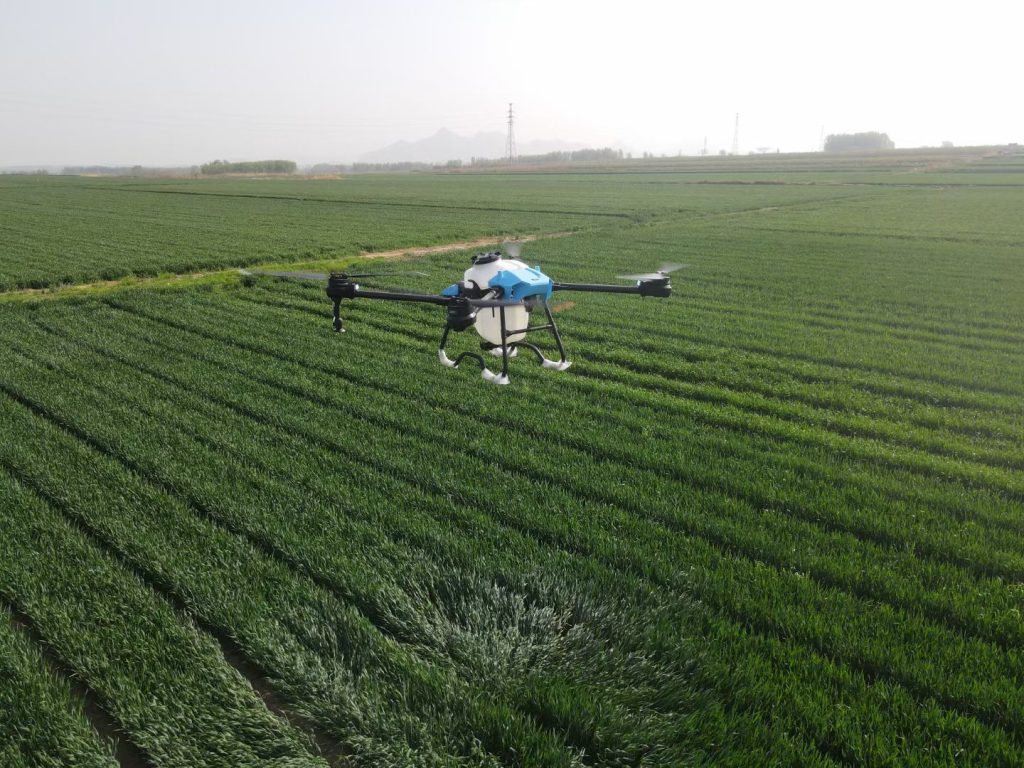
Choosing an agricultural seeding drone is not simply a matter of buying the aircraft with the largest payload or the longest flight time.
A drone that works well for rice may not be the best choice for grass seed. A 20 kg drone may be ideal for a small farm, while a 50 kg or 80 kg system may be more appropriate for commercial field operations.
The correct choice depends on the relationship between the crop, seed characteristics, application rate, field size, required daily capacity, battery system, spreading mechanism, and operating environment.
For farmers, agricultural contractors, distributors, and commercial buyers, the most important question is:
Which seeding drone configuration can complete the required work reliably at an acceptable cost per hectare?
This guide explains how to select an agricultural seeding drone, compares different payload classes, provides example technical configurations and price ranges, and explains what buyers should check before placing an order.
What Is an Agricultural Seeding Drone?
An agricultural seeding drone is an unmanned aircraft equipped with a hopper and material-spreading system designed to distribute seeds or other dry granular materials over agricultural land.
A typical system consists of:
-
Drone airframe
-
Flight controller
-
Motors
-
Propellers
-
Battery
-
Remote controller
-
GNSS positioning
-
Optional RTK positioning
-
Seed hopper
-
Metering mechanism
-
Spreading disc
-
Navigation system
-
Obstacle detection
-
Ground control software
The aircraft carries seed in the hopper and releases it through a controlled metering mechanism.
The spreading mechanism then distributes the material over the field.
The objective is not simply to release as much seed as possible.
The objective is to deliver the correct amount of seed at the correct location with acceptable distribution uniformity.
Why Drone Size Matters
Agricultural seeding drones are generally divided into several payload classes.
A practical classification is:
Drone Class
|
Payload
|
Typical Application
|
Small
|
10–20 kg
|
Small farms, grass seed, small seeds
|
Medium
|
20–30 kg
|
General agricultural use
|
Commercial
|
30–50 kg
|
Rice, wheat, cover crops
|
Heavy-duty
|
50–80 kg
|
Large farms and contractors
|
High-capacity
|
80 kg+
|
Large commercial operations
|
The largest drone is not necessarily the best.
A large aircraft may have:
-
Higher purchase cost
-
Larger batteries
-
Higher transportation requirements
-
More expensive replacement parts
-
Greater maintenance requirements
For a small farm, the additional capacity may not provide enough financial benefit to justify the investment.
Model SD-20: 20 kg Agricultural Seeding Drone
The SD-20 represents a lightweight commercial configuration.
It is designed for operators who need mobility and relatively low investment.
Typical Specifications
Parameter
|
SD-20
|
Maximum payload
|
20 kg
|
Recommended working payload
|
10–20 kg
|
Hopper capacity
|
25–35 L
|
Effective spreading width
|
3–6 m
|
Operating speed
|
3–7 m/s
|
Typical loaded flight time
|
8–15 min
|
Positioning
|
GNSS / optional RTK
|
Feeder
|
Adjustable motorized feeder
|
Spreading system
|
Centrifugal disc
|
Obstacle sensing
|
Optional
|
Battery
|
High-capacity lithium battery
|
Suitable Applications
The SD-20 can be considered for:
-
Grass seed
-
Pasture seed
-
Rapeseed
-
Small cover crops
-
Small cereal operations
-
Agricultural demonstration work
It is particularly useful where the required application rate is relatively low.
Estimated Price
A typical equipment budget could be approximately:
US$3,000–8,000
A complete package with additional batteries, charger, RTK, spare parts, and accessories may cost more.
Model SD-30: 30 kg Agricultural Seeding Drone
The SD-30 is a more versatile configuration.
It provides more payload capacity while remaining relatively easy to transport.
Typical Specifications
Parameter
|
SD-30
|
Maximum payload
|
30 kg
|
Hopper capacity
|
35–50 L
|
Effective spreading width
|
4–8 m
|
Operating speed
|
4–8 m/s
|
Loaded flight time
|
7–14 min
|
Positioning
|
GNSS / RTK
|
Feeder
|
Motorized auger
|
Spreading system
|
Dual-disc or centrifugal
|
Obstacle detection
|
Radar / optional vision
|
Flight control
|
Manual + autonomous route
|
Suitable Crops
The 30 kg class can be used for:
-
Rice
-
Wheat
-
Pasture
-
Cover crops
-
Cereal grains
-
Selected granular agricultural materials
It provides a useful balance between capacity and purchase cost.
Estimated Price
US$5,000–11,000
A complete professional package may be approximately:
US$8,000–15,000
depending on battery quantity and configuration.
Model SD-50: 50 kg Commercial Seeding Drone
The SD-50 is designed for larger farms and agricultural contractors.
A 50 kg hopper allows the aircraft to carry substantially more seed per flight than a 20 kg system.
Typical Specifications
Parameter
|
SD-50
|
Maximum payload
|
50 kg
|
Hopper capacity
|
60–80 L
|
Effective spreading width
|
5–9 m
|
Operating speed
|
4–9 m/s
|
Loaded flight time
|
6–12 min
|
Positioning
|
RTK
|
Feeder
|
Heavy-duty auger
|
Spreading system
|
High-capacity centrifugal
|
Obstacle detection
|
Multi-directional radar
|
Route planning
|
Automatic
|
Recommended operation
|
Commercial agriculture
|
Suitable Applications
The SD-50 is particularly suitable for:
-
Rice
-
Wheat
-
Barley
-
Cover crops
-
Pasture
-
Large grass areas
-
Commercial aerial broadcasting
Estimated Price
Approximately:
US$8,000–18,000
A complete commercial setup may reach:
US$15,000–25,000+
after adding batteries, chargers, RTK equipment, spare parts, and field accessories.
Model SD-80: 80 kg Heavy-Duty Seeding Drone
The SD-80 is designed for high-volume agricultural operations.
Its main advantage is not necessarily flight speed.
The main advantage is the ability to carry a larger amount of material per flight.
Typical Specifications
Parameter
|
SD-80
|
Maximum payload
|
80 kg
|
Recommended working payload
|
50–80 kg
|
Hopper capacity
|
100–150 L
|
Effective spreading width
|
7–10 m
|
Operating speed
|
5–10 m/s
|
Loaded flight time
|
5–9 min
|
Positioning
|
High-precision RTK
|
Feeder
|
Heavy-duty metering auger
|
Spreading system
|
High-capacity centrifugal
|
Obstacle detection
|
Radar
|
Route planning
|
Automatic
|
Suitable operation
|
Large commercial farms
|
Estimated Price
Approximately:
US$18,000–35,000+
A complete commercial package may reach:
US$25,000–40,000+
depending on battery quantity, charger, generator, RTK system, spreading equipment, and spare parts.
Which Drone Is Best for Rice?
Rice can require a relatively high material application rate.
For this reason, hopper capacity becomes important.
A small drone may work well on a small rice field, but the number of loading cycles can become inconvenient on a large farm.
Suggested configurations
Small farm:
20–30 kg
Medium farm:
30–50 kg
Large farm:
50–80 kg
The actual configuration should be based on:
-
Rice variety
-
Seed condition
-
Target seeding rate
-
Field size
-
Water level
-
Field accessibility
-
Required daily capacity
Rice seed distribution should be calibrated for the specific seed. Different seed conditions can change the material flow and spreading pattern. Professional calibration involves measuring actual discharge and checking the distribution pattern rather than relying only on a preset value.
Which Drone Is Best for Wheat?
Wheat is relatively dense compared with many small seeds.
This means that the hopper can become empty relatively quickly when high application rates are required.
For a small farm:
20–30 kg
may be sufficient.
For commercial operations:
30–50 kg
is often more practical.
For large-scale operations:
50–80 kg
can reduce loading cycles.
The most important factor is not the maximum payload alone.
The metering system must be capable of maintaining the required flow rate.
Which Drone Is Best for Grass Seed?
Grass seed can be considerably lighter than wheat or rice.
This changes the selection criteria.
For grass seed, operators should pay more attention to:
-
Fine metering
-
Low-rate control
-
Wind drift
-
Spreading uniformity
-
Hopper outlet size
-
Effective spreading width
A 20 kg drone can be a practical option.
A larger 50–80 kg aircraft may carry more material, but its larger spreading pattern may not necessarily improve results for lightweight seed.
Which Drone Is Best for Rapeseed?
Rapeseed requires controlled material flow because the seeds are relatively small.
A suitable system should provide:
-
Fine feeder adjustment
-
Small outlet options
-
Stable low-rate discharge
-
Accurate speed control
-
Good spreading uniformity
For many rapeseed applications:
20–30 kg
can be sufficient.
The operator should calibrate the actual seed before beginning full-field operation.
Which Drone Is Best for Cover Crops?
Cover crops can include several different seed types.
Examples include:
-
Cereal rye
-
Oats
-
Barley
-
Ryegrass
-
Clover
-
Other suitable species
The physical properties of different seeds can vary substantially.
Seed size, shape, density, and flowability can affect the way material moves through the hopper and spreading system. Recent agricultural guidance also emphasizes calibration for each seed or mixture rather than assuming one setting will work for all materials.
For cover crops:
20–30 kg
is suitable for smaller operations.
30–50 kg
is suitable for medium commercial work.
50–80 kg
is suitable when large areas must be covered quickly.
How to Choose a Drone by Farm Size
10–30 Hectares
Recommended:
10–20 kg class
Main priority:
Low investment and easy operation.
30–100 Hectares
Recommended:
20–30 kg class
Main priority:
Balance between payload and operating cost.
100–300 Hectares
Recommended:
30–50 kg class
Main priority:
Higher productivity and fewer refills.
300–1,000 Hectares
Recommended:
50–80 kg class
Main priority:
High daily capacity and efficient logistics.
More Than 1,000 Hectares
Consider:
Multiple 50–80 kg drones
instead of automatically purchasing one extremely large aircraft.
Multiple aircraft provide:
-
Backup capacity
-
Parallel field operations
-
Greater flexibility
-
Reduced downtime risk
Payload Is Not the Same as Hopper Volume
This is an important purchasing issue.
A hopper may have:
100 liters
of volume.
But that does not mean it can always carry:
100 kg
of material.
The actual payload depends on material density.
For example:
Material A:
0.4 kg/L
100 L hopper:
40 kg
Material B:
0.8 kg/L
100 L hopper:
80 kg
Therefore, buyers should ask for:
Maximum payload in kilograms
rather than only:
Hopper volume in liters.
Why Seed Density Matters
Two seeds occupying the same volume can have different weights.
This affects:
-
Payload
-
Number of hectares per load
-
Battery consumption
-
Material flow
-
Hopper emptying time
Before purchasing, provide the supplier with the actual seed specifications whenever possible.
Important information includes:
-
Seed type
-
Average particle size
-
Bulk density
-
Moisture
-
Coating
-
Target application rate
What Spreading System Should You Choose?
There are several basic spreading mechanisms.
Single-Disk Spreading
Simple and relatively lightweight.
Suitable for:
-
Smaller drones
-
Lower-volume materials
-
General broadcasting
Dual-Disk Spreading
Can provide greater control and wider distribution.
Suitable for:
-
Commercial operations
-
Higher material flow
-
Larger drones
Auger Metering
An auger controls the material flow before the material reaches the spreading disc.
Advantages include:
-
Better flow control
-
Adjustable output
-
Compatibility with different materials
However, the auger should be selected according to seed size and material characteristics.
Why Calibration Is More Important Than the Factory Setting
A factory setting is only a starting point.
The same drone may behave differently when using:
-
Different seed varieties
-
Different seed moisture
-
Different particle sizes
-
Different bulk densities
-
Different hopper loads
-
Different weather conditions
Professional calibration should measure actual material discharge.
A practical test can include:
-
Load a known quantity.
-
Run the feeder for a fixed period.
-
Collect discharged material.
-
Weigh the material.
-
Calculate the discharge rate.
-
Adjust the feeder.
-
Repeat the test.
-
Test the actual spreading pattern.
Field distribution should also be checked with collection trays or another suitable test method. This helps identify whether the selected working width is actually uniform.
How to Calculate Required Payload
Suppose:
Farm size:
200 hectares
Target seed rate:
30 kg/ha
Total seed required:
200 × 30 = 6,000 kg
Now compare drone sizes.
20 kg drone
6,000 ÷ 20 =
300 loads
30 kg drone
6,000 ÷ 30 =
200 loads
50 kg drone
6,000 ÷ 50 =
120 loads
80 kg drone
6,000 ÷ 80 =
75 loads
The larger aircraft dramatically reduces loading cycles.
But this does not automatically mean that the 80 kg drone is the cheapest solution.
The operator must also consider:
-
Purchase cost
-
Battery cost
-
Charging
-
Maintenance
-
Labor
-
Transportation
How to Calculate Operating Cost
A simple cost-per-hectare calculation is:
Total operating cost ÷ Total hectares completed
Total operating cost can include:
-
Drone depreciation
-
Battery depreciation
-
Electricity or fuel
-
Operator labor
-
Maintenance
-
Spare parts
-
Transportation
-
Seed loading
-
Insurance or permits where applicable
For example:
If the total operating cost is:
US$2,000
and the operation covers:
200 hectares
then:
US$2,000 ÷ 200 = US$10/ha
This is more useful than comparing the purchase price of two drones without considering actual utilization.
Estimated Agricultural Seeding Drone Prices
The following ranges can be used as preliminary purchasing budgets.
Payload Class
|
Approximate Equipment Price
|
10–20 kg
|
US$3,000–8,000
|
20–30 kg
|
US$5,000–11,000
|
30–50 kg
|
US$8,000–18,000
|
50–70 kg
|
US$13,000–28,000
|
70–80+ kg
|
US$18,000–35,000+
|
A complete professional system may cost more because the aircraft is only part of the equipment package.
What Is Included in a Complete Drone Package?
A commercial package may include:
Aircraft
Main flight platform.
Batteries
Usually several batteries are needed for continuous operation.
Charger
High-power charging equipment.
Seed Hopper
Dry-material container.
Spreading System
Feeder and spreading disc.
RTK System
For high-precision positioning.
Remote Controller
Used for manual operation and route management.
Spare Parts
Recommended parts include:
-
Propellers
-
Motors
-
Feeder components
-
Seals
-
Bearings
-
Cables
Maintenance Tools
Useful for field repairs.
Battery Selection
Battery capacity affects flight time and payload.
A larger battery can provide more energy, but it also adds weight.
The ideal battery therefore depends on:
-
Aircraft weight
-
Payload
-
Motor efficiency
-
Temperature
-
Wind
-
Flight speed
A drone should not be evaluated solely by its maximum no-load flight time.
For seeding operations, ask for:
Flight time under a specified payload.
For example:
Flight time with 50 kg payload
is much more useful than:
Maximum flight time without payload.
RTK Positioning
RTK can improve positioning accuracy and route repeatability.
This is useful for:
-
Large fields
-
Automated flight routes
-
Repeated operations
-
Narrow field boundaries
-
Accurate route spacing
However, RTK does not guarantee uniform seed distribution.
The spreading pattern still depends on:
-
Feeder output
-
Flight height
-
Flight speed
-
Disc speed
-
Seed characteristics
-
Wind
Position accuracy and spreading accuracy are two different things.
Obstacle Detection
Commercial agricultural drones may use sensors such as:
-
Radar
-
Vision sensors
-
Ultrasonic sensors
These systems can help detect obstacles.
They are particularly useful around:
-
Trees
-
Buildings
-
Poles
-
Farm structures
-
Uneven terrain
However, operators should still conduct a pre-flight inspection and maintain safe operating procedures.
Obstacle detection should be treated as an additional safety system, not a replacement for responsible flight planning.
Manual vs Automatic Flight
Manual Flight
Advantages:
-
Flexible
-
Useful for small fields
-
Easy to adjust during testing
Disadvantages:
-
Operator-dependent
-
More difficult to maintain consistent routes
-
Less suitable for very large fields
Automatic Route Flight
Advantages:
-
Repeatable
-
Efficient
-
Suitable for large fields
-
Better route consistency
Disadvantages:
-
Requires accurate field mapping
-
Requires correct route parameters
-
Needs careful obstacle planning
For commercial agriculture, automatic route planning can significantly simplify large-field operations.
What Should Buyers Ask Before Ordering?
Before purchasing a seeding drone, ask for answers to these questions:
1. What is the maximum payload?
Request the figure in kilograms.
2. What is the hopper volume?
Request liters.
3. What is the actual working width?
Do not ask only for maximum theoretical width.
4. What is the recommended flight speed?
Ask for different seed types if available.
5. What is the flight time under load?
Ask for flight time with a specific payload.
6. What seed sizes are supported?
Provide the actual seed sample if possible.
7. Can the feeder be changed?
A modular feeder is useful for different materials.
8. Is RTK available?
Important for automated agricultural operations.
9. How long does battery charging take?
This determines how many batteries are required.
10. What spare parts are included?
A commercial operator should maintain essential spare parts.
Common Mistakes When Buying a Seeding Drone
Mistake 1: Choosing by Maximum Payload Alone
A bigger payload does not guarantee lower cost per hectare.
Mistake 2: Ignoring Seed Characteristics
Different seeds flow differently.
Mistake 3: Using One Setting for Every Crop
Each material should be calibrated.
Mistake 4: Ignoring Effective Spreading Width
Maximum width and uniform width are not necessarily the same.
Mistake 5: Buying Too Few Batteries
This can cause long operational downtime.
Mistake 6: Ignoring Loading Logistics
A large hopper is less useful if loading takes too long.
Mistake 7: Focusing Only on Purchase Price
The long-term cost includes batteries, maintenance, labor, and spare parts.
Recommended Configurations by Application
Application
|
Suggested Drone Class
|
Main Priority
|
Grass seed
|
10–30 kg
|
Fine metering
|
Rapeseed
|
20–30 kg
|
Low-rate accuracy
|
Rice
|
30–80 kg
|
Payload and stable flow
|
Wheat
|
30–80 kg
|
High material capacity
|
Barley
|
30–50 kg
|
Flow rate
|
Pasture
|
20–50 kg
|
Terrain flexibility
|
Cover crops
|
20–50 kg
|
Versatility
|
Large commercial fields
|
50–80 kg
|
Productivity
|
These are starting points rather than universal specifications.
The final configuration should be based on actual field requirements.
FAQ
What is the best agricultural drone for seeding?
There is no single best configuration.
For small farms, a 20 kg drone may be sufficient.
For medium farms, 30–50 kg systems can provide a good balance.
For large farms, 50–80 kg systems can reduce loading cycles.
How much does an agricultural seeding drone cost?
Typical equipment budgets range from approximately:
US$3,000 to US$35,000+
depending on payload and configuration.
A complete commercial system can cost:
US$15,000–40,000+
when batteries, chargers, RTK, and accessories are included.
Is a 20 kg drone suitable for rice?
Yes, for smaller rice fields and suitable seeding rates.
For larger farms, a 30–80 kg configuration may reduce the number of refilling cycles.
Is a 50 kg drone enough for wheat?
It can be suitable for many commercial wheat applications.
The final choice depends on:
-
Seed rate
-
Farm size
-
Required daily capacity
-
Spreading width
-
Battery availability
Can one drone plant several types of seed?
Yes.
However, the spreading system should be recalibrated when changing material.
Do I need RTK for seeding?
RTK is not always mandatory, but it can be highly useful for accurate route planning and repeatable automated operation.
How many batteries do I need?
A practical commercial configuration may use:
3–6 batteries
The correct number depends on flight time and charging speed.
What is more important, payload or flight time?
Both matter.
A large payload reduces refilling frequency.
Longer flight time reduces battery-change frequency.
The best system balances both.
Can an 80 kg drone carry 80 kg of every seed?
Not necessarily.
The maximum payload is an aircraft limit.
Actual operation may require a lower payload depending on:
-
Battery
-
Temperature
-
Wind
-
Flight conditions
-
Material density
-
Safety requirements
Can drone seeding replace a conventional seeder?
Not in every situation.
A drone is primarily suitable for aerial broadcasting.
A conventional seeder can provide controlled seed depth and row spacing, which some crops require.
Is a larger drone always better?
No.
For lightweight seeds or small farms, a smaller aircraft may be more practical.
The correct drone should match the workload rather than simply maximize specifications.
How should a drone be calibrated?
Start with the specific seed, target application rate, feeder configuration, flight speed, height, and spreading width.
Measure actual material output and test the spreading pattern before full-field operation. Calibration procedures commonly use measured discharge and collection trays to evaluate distribution.
Why can the same drone give different results with different seeds?
Because seeds differ in:
-
Size
-
Shape
-
Density
-
Moisture
-
Surface texture
-
Flowability
These properties change the way the material moves through the feeder and spreads through the air.
What is the most important specification when buying a seeding drone?
For most buyers, the key specifications are:
-
Maximum payload
-
Effective spreading width
-
Material flow range
-
Loaded flight time
-
Battery charging time
-
Positioning accuracy
-
Feeder compatibility
-
Route-planning capability
-
Spare-parts availability
-
Total operating cost
Final Buying Guide
Choosing an agricultural seeding drone should begin with the farm rather than the aircraft.
First determine:
What crop will be planted?
Then determine:
What seed rate is required?
Then calculate:
How much seed is required for the entire farm?
Next determine:
How many hectares must be completed per day?
Only after these questions are answered should you choose the drone payload class.
For small agricultural operations, a 10–20 kg drone can offer a lower-cost entry point.
For general commercial applications, a 20–50 kg system provides a practical balance between capacity and investment.
For large farms and agricultural contractors, a 50–80 kg system can reduce loading frequency and improve daily productivity.
The most important point is that a seeding drone should be purchased as a complete agricultural system, not simply as an aircraft.
The aircraft, battery, hopper, feeder, spreading disc, RTK positioning, route planning, seed calibration, loading system, and maintenance support all affect the final cost per hectare.
A well-matched drone with accurate calibration can provide much better results than a larger drone operating with the wrong feeder, incorrect spreading width, or unsuitable seed settings.
For serious commercial buyers, the best purchasing strategy is therefore:
Crop → Seed characteristics → Application rate → Farm size → Daily capacity → Payload → Spreading system → Battery configuration → Total cost per hectare.
That approach makes it easier to select an agricultural seeding drone that is not only powerful on paper, but also practical and economical in real field operations.
THE END
Support it if you like it







No comments yet