


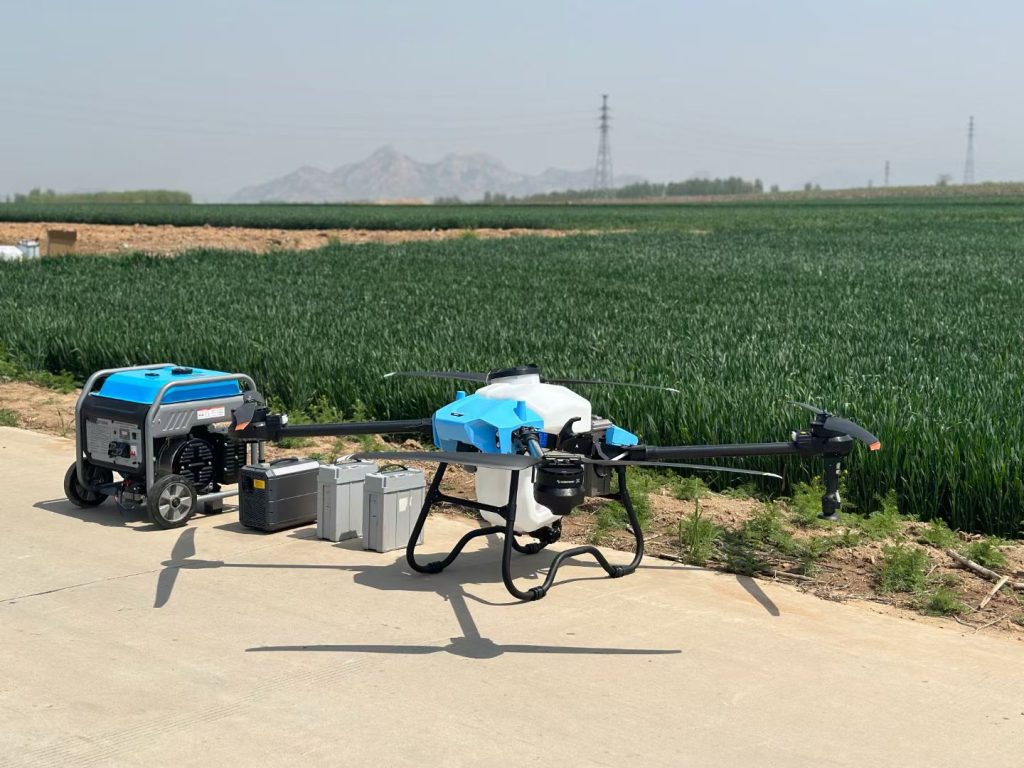
Large-scale farming requires efficient, reliable, and flexible crop protection equipment. As agricultural operations continue to expand, many farms and professional crop protection companies are considering agricultural spraying drones as an alternative or supplement to conventional spraying equipment.
A 50KG agricultural spraying drone is designed for high-capacity agricultural operations where a larger payload can help reduce the number of refilling cycles and improve overall field productivity.
However, choosing the right 50KG spraying drone for a large farm involves much more than checking the tank capacity. Buyers should evaluate flight endurance, spraying performance, battery systems, navigation technology, terrain, crop type, maintenance, and after-sales support.
This guide explains how large farms can select the right 50KG agricultural spraying drone.
Why Choose a 50KG Agricultural Spraying Drone for Large Farms?
Large farms typically require equipment that can cover substantial areas efficiently.
A higher-capacity spraying drone can offer several potential advantages.
Higher Payload Capacity
A 50KG-class spraying drone can carry a large volume of agricultural liquid during each operation.
This can reduce the frequency of refilling compared with smaller agricultural drones.
Fewer refilling cycles can be particularly useful when:
- The farm is large
- Water sources are far from the field
- Fields are divided into multiple sections
- Transportation between fields takes time
- Continuous spraying is required
Better Access to Agricultural Fields
Large farms may contain areas where tractors and other ground machinery are difficult to operate.
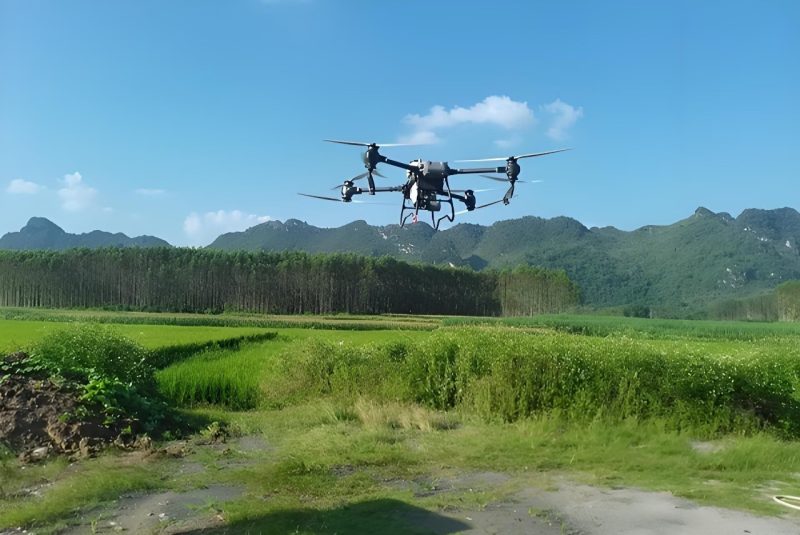
Agricultural drones can fly over:
- Wet fields
- Muddy farmland
- Sloped terrain
- Narrow agricultural areas
- Tall crops
- Areas with limited road access
This makes drones a useful option for certain crop-protection applications.
What Type of Large Farm Needs a 50KG Drone?
Not every farm needs a 50KG model.
The right payload depends on the size of the operation and the intended application.
A 50KG agricultural spraying drone may be particularly suitable for:
- Large crop farms
- Agricultural service companies
- Commercial plantations
- Crop protection contractors
- Agricultural equipment distributors
- Large orchards
- Rice farming operations
- Large-scale vegetable farms
Smaller farms may prefer a lower-capacity drone because it can be easier to transport and may have lower initial costs.
The goal is to select the capacity that matches the actual workload.
1. Start With Your Farm Size
The first factor to consider is the total agricultural area that needs to be treated.
A large farm should estimate:
- Total hectares
- Number of fields
- Distance between fields
- Average spraying frequency
- Available water sources
- Daily operating hours
For example, a farm that needs to spray hundreds or thousands of hectares during a limited application window may benefit from a high-capacity drone and multiple battery sets.
The larger the operation, the more important operational efficiency becomes.
2. Consider Crop Type
Different crops require different spraying strategies.
A 50KG agricultural spraying drone may be used for applications involving:
Rice
Flat rice fields are well suited to aerial agricultural spraying.
Wheat
Large wheat fields can benefit from efficient route planning and wide-area spraying.
Corn
Large corn fields may require suitable flight height and spray configuration depending on crop growth stage.
Cotton
Cotton farms may benefit from aerial access without heavy machinery driving through the crop.
Orchards
Orchards have additional requirements because trees can create complex flight environments.
For orchard applications, buyers should pay particular attention to:
- Obstacle avoidance
- Terrain following
- Flight stability
- Spray penetration
- Route planning
3. Check the Actual Spraying Capacity
Do not assume that every “50KG drone” has exactly the same spraying performance.
Ask the manufacturer to provide:
- Actual liquid payload
- Tank capacity
- Maximum flow rate
- Recommended application rate
- Number of nozzles
- Nozzle type
- Effective spray width
- Pump specifications
The actual coverage depends on multiple factors.
A simple way to understand field capacity is:
Coverage per hour = Effective spraying width × Operating speed × Field efficiency
Field efficiency accounts for turning, refilling, battery changes, transportation, and other operational interruptions.
Therefore, theoretical spraying width should not be treated as the same as actual daily productivity.
4. Evaluate Flight Time Under Real Payload
For a 50KG agricultural drone, payload has a significant effect on flight endurance.
Ask the manufacturer for separate figures for:
- Empty flight time
- Half-load flight time
- Full-load flight time
Also confirm the battery specifications used during testing.
A useful question to ask is:
“How long can the drone operate with a full liquid payload under normal agricultural conditions?”
This is more useful than asking only for the maximum flight time.
5. Choose the Right Battery System
Large farms should pay particular attention to battery logistics.
A high-capacity spraying drone may consume significant power during operation.
For continuous operations, farms may need:
- Multiple intelligent batteries
- Multiple chargers
- Fast charging equipment
- Battery storage areas
- Battery management procedures
The number of batteries should be planned according to the desired daily operating hours.
For example, if the drone needs to operate continuously while another battery is charging, the farm needs enough battery capacity to maintain the operation.
6. Check Charging Speed
Battery charging time can directly affect productivity.
A farm should consider:
Flight time + landing + battery replacement + charging time + refilling time
If charging takes too long, the drone may spend a significant part of the working day waiting.
Ask the manufacturer:
- How long does one battery take to charge?
- Can multiple batteries be charged simultaneously?
- Is a fast charger available?
- What power supply is required?
- Can the charger operate in the destination country?
The answers can help determine whether the complete drone system fits the farm’s infrastructure.
7. Evaluate RTK Positioning
For large agricultural fields, accurate navigation can improve route planning and repeatability.
RTK positioning may be useful when the drone needs to:
- Follow predefined routes
- Repeat operations
- Maintain accurate flight paths
- Operate over large areas
- Reduce unnecessary overlap
For farms with complex field boundaries, accurate positioning can be particularly useful.
However, buyers should confirm the actual RTK configuration and whether additional correction infrastructure is required.
8. Consider Obstacle Avoidance
Large open fields may contain relatively few obstacles.
However, agricultural environments can still include:
- Trees
- Power poles
- Buildings
- Fences
- Wires
- Irrigation equipment
For farms with orchards or complex terrain, obstacle avoidance can become more important.
Ask the manufacturer what sensing technology is used and how the system responds when an obstacle is detected.
9. Check Terrain-Following Functions
Terrain-following technology can be useful for farms located in hilly or uneven areas.
Maintaining a relatively consistent flight height can help provide more consistent spraying conditions.
If your farm includes:
- Hills
- Slopes
- Terraced fields
- Uneven ground
then terrain-following capability should be included in the purchasing evaluation.
10. Consider the Farm’s Water and Mixing Infrastructure
A 50KG drone requires a suitable liquid preparation and refilling system.
The drone itself is only one part of the spraying operation.
Large farms should consider:
- Water supply
- Mixing tanks
- Filling pumps
- Chemical storage
- Field transport
- Refilling locations
- Cleaning equipment
If the drone has a large tank but the farm cannot refill it efficiently, the theoretical capacity advantage may not translate into higher productivity.
11. Look at Transportation Requirements
A 50KG agricultural spraying drone is larger than many small agricultural UAVs.
Before purchasing, consider how the equipment will be transported between fields.
Check:
- Folded dimensions
- Aircraft weight
- Battery weight
- Transport case
- Vehicle requirements
- Loading and unloading requirements
A foldable design can make transportation easier.
12. Evaluate Maintenance Requirements
Large farms need equipment that can be maintained efficiently.
Ask the manufacturer about routine maintenance for:
- Motors
- Propellers
- Pumps
- Nozzles
- Pipes
- Valves
- Batteries
- Sensors
- Flight controller
The manufacturer should provide a maintenance schedule and recommended inspection procedures.
Easy maintenance can reduce downtime during critical agricultural seasons.
13. Check Spare Parts Availability
For professional agricultural operations, spare parts should be planned before the drone arrives.
Common spare parts include:
- Propellers
- Motors
- ESCs
- Pumps
- Nozzles
- Spray pipes
- Valves
- Landing gear
- Sensors
- Batteries
- Chargers
A large farm may want to purchase a basic spare-parts package together with the first drone order.
14. Choose a Manufacturer With Technical Support
A 50KG spraying drone is a complex agricultural machine.
The manufacturer should ideally provide:
- Installation instructions
- User manuals
- Training materials
- Operation videos
- Troubleshooting support
- Spare-parts support
- Remote technical assistance
This is especially important for international buyers.
When importing equipment from China, technical support can reduce downtime and simplify operator training.
15. Compare Manufacturers, Not Just Products
Two manufacturers may offer drones with the same advertised 50KG payload but very different overall capabilities.
Compare:
| Factor | Manufacturer A | Manufacturer B |
|---|---|---|
| Actual payload | Compare | Compare |
| Full-load flight time | Compare | Compare |
| Battery capacity | Compare | Compare |
| Charging speed | Compare | Compare |
| Spray flow rate | Compare | Compare |
| RTK | Compare | Compare |
| Obstacle avoidance | Compare | Compare |
| Terrain following | Compare | Compare |
| Spare parts | Compare | Compare |
| Warranty | Compare | Compare |
| OEM service | Compare | Compare |
| Technical support | Compare | Compare |
This gives buyers a much clearer understanding of the actual value.
16. Consider Buying More Than One Drone
For very large agricultural operations, one drone may not provide sufficient capacity during peak spraying periods.
A farm may consider:
- Multiple 50KG drones
- Additional battery sets
- Multiple chargers
- Shared spare parts
- Dedicated operators
Using several drones can provide greater operational flexibility.
It can also reduce the impact of equipment downtime during critical spraying windows.
17. Calculate the Total Operating Cost
Purchase price is only one part of the investment.
A large farm should estimate:
Initial equipment cost + batteries + chargers + spare parts + shipping + import costs + maintenance + labor + electricity + training
This helps determine the real cost of operating the drone over several years.
A manufacturer that offers reliable components and spare parts may provide better long-term value even if the initial quotation is not the lowest.
18. Check International Compliance
If the drone will be exported from China, the buyer should confirm the regulations applicable in the destination country.
Potential requirements may involve:
- UAV registration
- Operator certification
- Radio-frequency compliance
- Agricultural chemical regulations
- Import requirements
- Local operating restrictions
- Insurance
The specific requirements vary by country.
The importer and operator should verify local regulations before commercial operation.
What Configuration Is Suitable for a Large Farm?
A typical commercial 50KG agricultural spraying drone configuration may include:
- 50KG-class liquid payload
- High-thrust propulsion system
- Intelligent lithium battery
- Professional battery charger
- GPS/RTK positioning
- Intelligent flight controller
- Automatic route planning
- Obstacle detection
- Terrain-following capability
- High-efficiency spray pump
- Multiple spray nozzles
- Flow-control system
- Remote controller
- Essential spare parts
The final configuration should be selected according to the crop, terrain, climate, farm size, and local operating requirements.
How Can a Manufacturer Help Large-Farm Buyers?
A professional agricultural drone manufacturer should do more than sell an aircraft.
The factory can help buyers select:
- Payload capacity
- Battery configuration
- Spray system
- Nozzle options
- Navigation system
- Obstacle avoidance
- Spare-parts package
- OEM configuration
- Export packaging
For distributors, manufacturers may also provide private-label and OEM solutions.
These may include:
- Custom logo
- Packaging
- Product labels
- User manuals
- Brand colors
- Accessories
- Spare-parts packages
Final Buying Checklist
Before purchasing a 50KG agricultural spraying drone for a large farm, confirm:
Capacity
- [ ] Actual liquid payload
- [ ] Tank capacity
- [ ] Maximum takeoff weight
Performance
- [ ] Full-load flight time
- [ ] Flight speed
- [ ] Spray flow rate
- [ ] Effective spraying width
Navigation
- [ ] GPS
- [ ] RTK
- [ ] Automatic route planning
- [ ] Obstacle avoidance
- [ ] Terrain following
Battery
- [ ] Battery capacity
- [ ] Number of batteries
- [ ] Charging time
- [ ] Charger configuration
- [ ] Replacement battery cost
Factory Support
- [ ] Spare parts
- [ ] Warranty
- [ ] Technical support
- [ ] Training
- [ ] OEM availability
Logistics
- [ ] Product dimensions
- [ ] Export packaging
- [ ] Battery shipping requirements
- [ ] Import documentation
- [ ] Local regulations
Conclusion
A 50KG agricultural spraying drone can be a powerful solution for large farms that require high-capacity and efficient crop protection operations.
However, the right drone should be selected based on the complete operating environment rather than payload capacity alone.
Large farms should evaluate crop type, field size, terrain, spraying requirements, battery endurance, charging infrastructure, navigation accuracy, obstacle avoidance, maintenance, spare parts, and technical support.
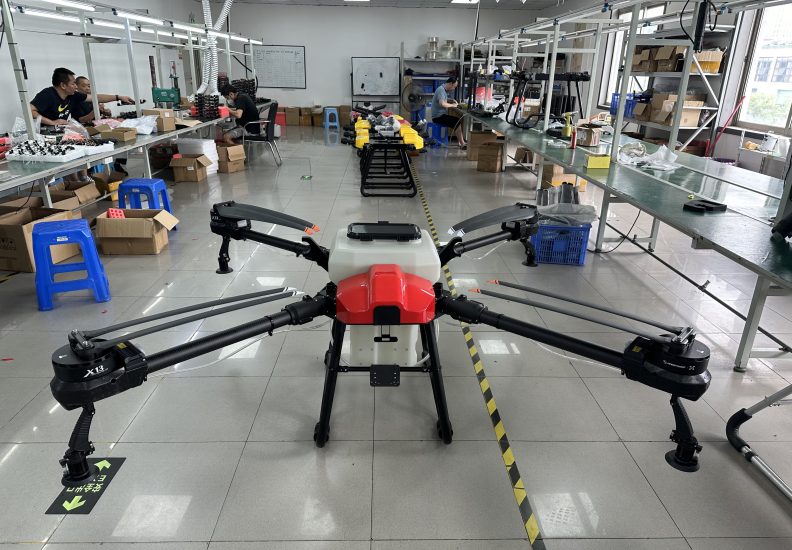
For international buyers, choosing a capable 50KG agricultural spraying drone manufacturer in China is equally important. A reliable factory should provide transparent specifications, practical testing data, stable production quality, OEM support, spare parts, and professional after-sales service.
The best solution is the one that matches your farm’s actual operating requirements and provides reliable performance throughout the agricultural season.





No comments yet