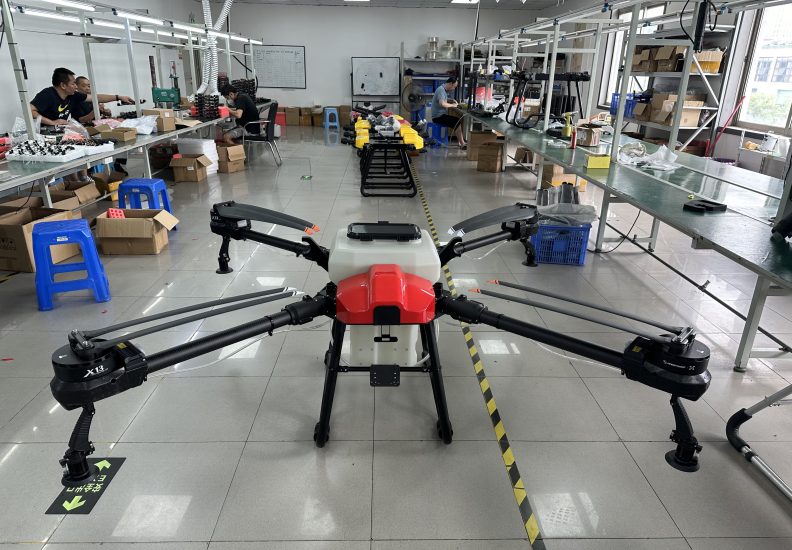


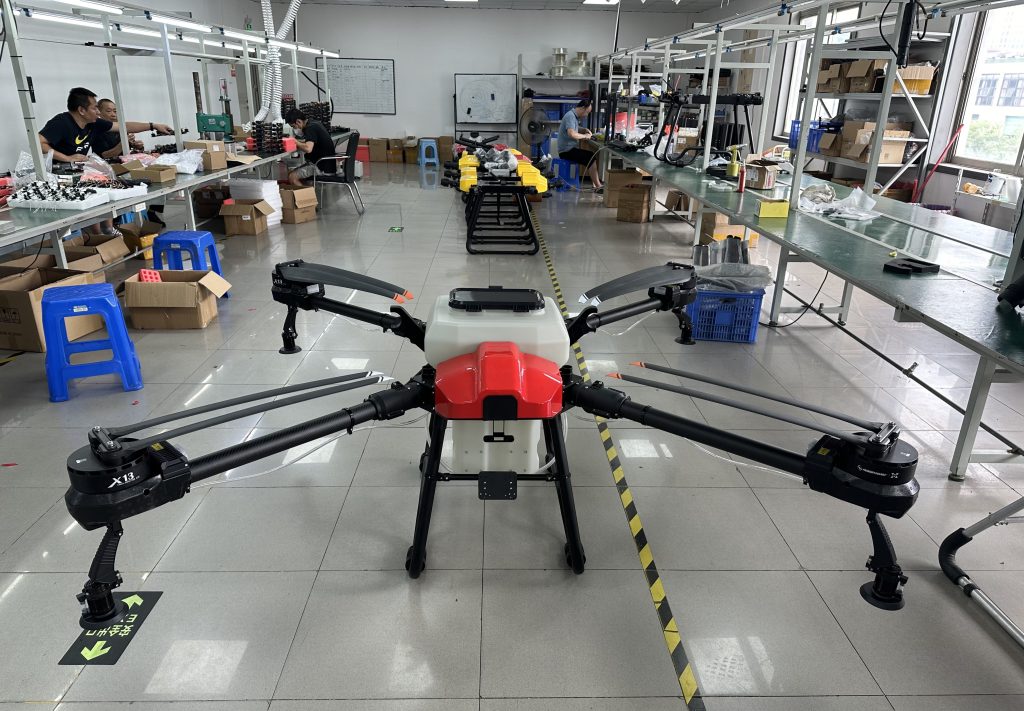
Corn is one of the world’s most widely cultivated field crops, and successful production depends heavily on timely weed control, pest management, disease prevention, and proper crop nutrition. As corn plants develop, field conditions can change quickly. Tall plants, wet soil, uneven terrain, and large planting areas can make conventional ground spraying less convenient.
A corn spraying drone provides an aerial solution that can operate above the crop without driving directly through the field. With a suitable liquid tank, pump, nozzle system, navigation system, and flight-control platform, the drone can be configured for different agricultural spraying applications.
As a professional corn spraying drone manufacturer, the goal is not simply to manufacture an aircraft capable of carrying liquid. A reliable agricultural UAV needs to combine stable flight performance, accurate liquid delivery, practical battery management, simple maintenance, and safe operation.
What Is a Corn Spraying Drone?
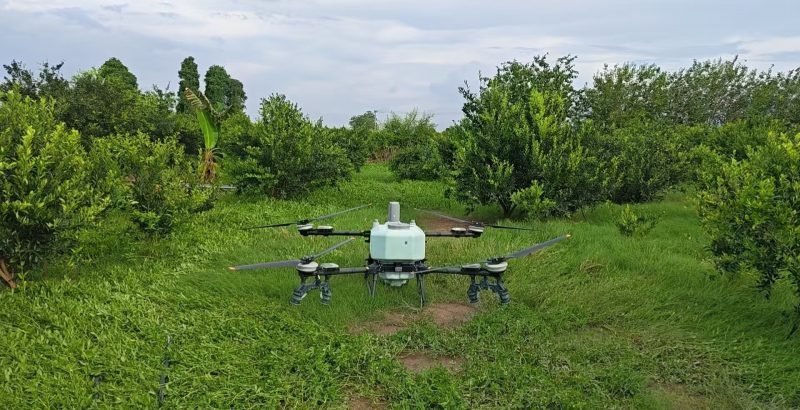
A corn spraying drone is an agricultural unmanned aerial vehicle equipped with a liquid spraying system for crop protection and other approved agricultural applications.
A typical system includes:
-
Agricultural UAV frame
-
Brushless motors
-
Propellers
-
Intelligent flight controller
-
Agricultural spray tank
-
Electric pump
-
Spray pipes
-
Filters
-
Nozzles
-
Flow-control system
-
Navigation and positioning system
-
Remote controller
-
Intelligent batteries
-
Battery charger
-
Safety and monitoring systems
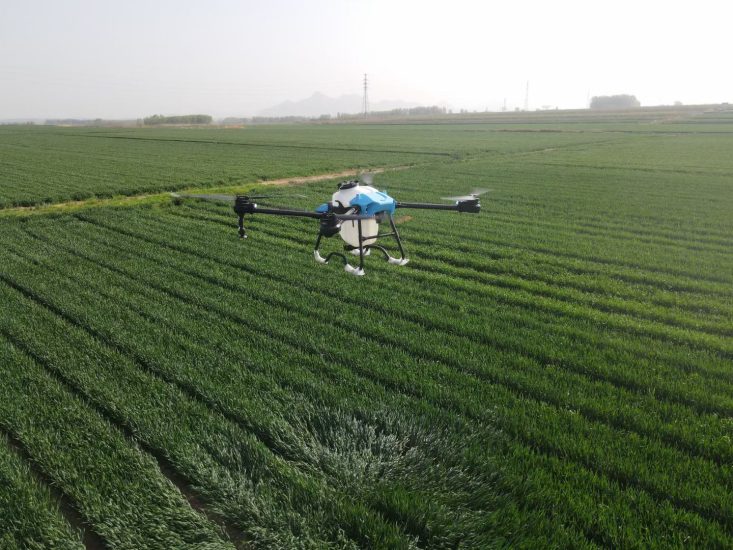
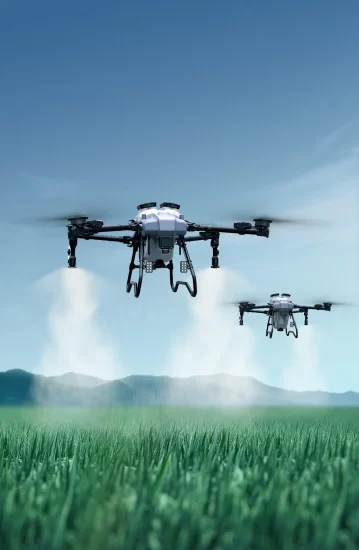
The drone flies over the cornfield according to a manually controlled or programmed route. During the flight, the spraying system delivers liquid through the nozzles.
The aircraft’s job is not merely to carry the liquid. The entire system must deliver a predictable amount of material across the target area.
Why Use a Drone for Corn Spraying?
Cornfields can become difficult to access as plants grow taller.
A tractor or other ground machine may need to travel between crop rows, while manual spraying requires workers to enter the field. In wet conditions, ground equipment can also create soil compaction or become difficult to operate.
An agricultural drone works from above.
Reduced Ground Disturbance
Because the aircraft does not need to drive through the field, it can reduce direct contact with plants and avoid some of the problems associated with ground machinery.
Better Access to Developed Crops
When corn plants become tall, entering the field becomes less convenient. An aerial spraying system can operate above the crop without requiring a vehicle to pass through the rows.
Less Manual Carrying
The operator does not need to carry a heavy backpack sprayer across the field. The drone carries the liquid while the operator controls and monitors the aircraft.
Flexible Field Operation
A drone can operate in fields where conventional machinery has difficulty reaching certain areas, subject to weather, terrain, regulations, and safe operating conditions.
Programmable Flight Routes
Agricultural drones can use field boundaries and planned routes to organize spraying operations. Proper route planning helps maintain consistent spacing and reduces unnecessary overlap.
Common Corn Spraying Applications
The exact application depends on the agricultural product, crop growth stage, local regulations, and application requirements.
Herbicide Application
Weed competition can reduce the availability of water, nutrients, sunlight, and growing space for corn.
Where aerial application is legally permitted, a properly calibrated drone can distribute an approved herbicide across the designated area.
Herbicide spraying requires particular attention to drift because unintended movement of droplets can affect neighboring crops.
Insect Control
Corn can be affected by different insect pests depending on the region and growing stage.
A spraying drone can be used as part of an integrated crop protection program when the selected agricultural product and application method are permitted.
Fungicide Application
Disease management may require treatment during specific crop stages.
For these applications, spray distribution and canopy coverage are important. The operator should select appropriate operating parameters rather than simply increasing the liquid flow.
Foliar Fertilizer
Some agricultural operations use drones to apply foliar fertilizers or other liquid crop nutrients.
The appropriate application rate depends on the fertilizer formulation and crop requirements. The drone should be calibrated before application.
The Importance of Spray System Design
The aircraft is only one part of the spraying solution.
A professional corn spraying drone should have a spraying system designed around consistent liquid delivery.
Spray Tank
Tank capacity affects the number of refilling operations required during the working day.
A larger tank can reduce refill frequency, but it also increases the aircraft’s payload.
Therefore, the best tank capacity depends on the customer’s actual application requirements rather than simply choosing the largest available model.
Pump
The pump controls liquid flow from the tank to the nozzles.
Stable flow is more important than simply achieving a high maximum flow rate.
The pump should operate reliably across the range required for the intended application.
Filters
Agricultural liquids can contain particles or residue that may block small spray passages.
Filters help protect the pump and nozzles and should be inspected regularly.
Nozzles
Nozzles determine the spray pattern and droplet characteristics.
Different applications may require different nozzle types. Selection should consider the agricultural product, target, application rate, environmental conditions, and required coverage.
Flow Control
Electronic flow control helps maintain a more consistent application rate.
When the drone changes speed, the required flow may also need to change. An intelligent control system can help coordinate flight speed and liquid delivery.
Flight Speed and Application Rate
A common mistake is to look at flight speed independently from spraying flow.
These two parameters are directly connected.
A simplified relationship can be expressed as:
Application Rate ≈ Flow Rate ÷ (Flight Speed × Effective Spray Width)
If the drone flies faster while maintaining the same flow rate, the amount applied per unit area decreases.
If the drone flies slower without changing the flow rate, the amount applied per unit area increases.
Therefore, the operator should establish the appropriate combination of:
-
Flight speed
-
Flow rate
-
Spray width
-
Route spacing
-
Flight altitude
-
Nozzle configuration
Actual field calibration is essential because real spraying performance can also be affected by overlap, wind, rotor airflow, terrain, and crop canopy.
Spray Width and Route Spacing
A wider spray pattern can potentially increase field productivity, but the advertised maximum width should not automatically be treated as the recommended working width.
The effective working width depends on the nozzle arrangement, flight height, droplet characteristics, airflow, and environmental conditions.
If flight paths are spaced too far apart, untreated areas may appear.
If routes overlap excessively, some areas may receive more product than intended.
A professional manufacturer should therefore provide recommended operating parameters and calibration procedures.
Corn Canopy and Spray Penetration
Corn plants change significantly during the growing season.
Young corn has a relatively open canopy, while mature plants can create a dense vertical structure.
As the canopy develops, spray deposition can become more complicated. Rotor airflow can influence how droplets move toward the crop.
This means that a spraying configuration suitable for early-stage corn may not necessarily be ideal for later-stage corn.
Operators should adjust equipment and application parameters according to the crop stage and product requirements.
Battery and Payload Management
Battery performance is one of the most important factors in agricultural drone operations.
A drone carrying a full tank requires more energy than an empty aircraft.
Wind can also increase power consumption.
For commercial operations, practical working efficiency should therefore be evaluated using the complete operating cycle:
Takeoff → spraying → landing → battery replacement → refilling → inspection → next flight
A drone with a large tank but insufficient battery support may spend too much time on the ground.
Likewise, a smaller drone with quick battery replacement and efficient refilling may be more practical for certain farms.
Choosing the Right Payload Capacity
Corn farmers, agricultural contractors, and distributors can have very different requirements.
A smaller platform may be suitable for smaller farms or operations where transportation is important.
A higher-payload platform may be better suited to large commercial operations where reducing refill frequency is a priority.
When selecting a model, buyers should consider:
-
Field size
-
Daily target area
-
Required application volume
-
Water availability
-
Battery quantity
-
Charging infrastructure
-
Transportation requirements
-
Labor availability
-
Local operating regulations
The correct model is the one that provides a practical balance between payload, endurance, field productivity, and operating cost.
Navigation and Route Planning
Accurate navigation helps the drone follow planned field routes.
Depending on the aircraft, the system may support features such as:
-
GPS positioning
-
RTK positioning
-
Automated route planning
-
Field boundary setting
-
Automatic return
-
Route recording
-
Obstacle detection
-
Terrain-related flight functions
These features can reduce operator workload, but they do not eliminate the need for supervision.
Before takeoff, the operator should inspect the field and identify power lines, trees, buildings, people, vehicles, irrigation equipment, and other hazards.
Obstacle Avoidance
Cornfields are not always open spaces.
Fields can contain unexpected obstacles, including:
-
Utility poles
-
Power cables
-
Trees
-
Buildings
-
Water pumps
-
Irrigation systems
-
Farm machinery
-
Fences
Obstacle detection can provide an additional safety layer.
However, no obstacle detection system should be considered perfect. Operators should maintain appropriate situational awareness and comply with applicable aviation rules.
Weather and Spray Drift
Weather conditions can have a major effect on spraying.
Strong wind can move droplets away from the target area. Rain can interfere with certain agricultural products. High temperature and low humidity may also influence evaporation.
For this reason, operators should only spray when conditions are suitable for the specific agricultural product and local regulations.
The objective is not to spray whenever the drone is available. The objective is to spray during an appropriate application window.
Maintenance After Corn Spraying
Agricultural drones require regular cleaning and inspection.
After each spraying operation, the liquid system should be cleaned according to the equipment manufacturer’s instructions and the requirements associated with the agricultural product.
Tank
Check the tank for residue and contamination.
Pump
Inspect the pump for abnormal noise, reduced flow, leakage, or other problems.
Nozzles
Inspect nozzles for blockage or damage.
Filters
Clean or replace filters when necessary.
Pipes
Check pipes and connectors for leaks.
Motors and Propellers
Inspect the propulsion system for contamination, damage, loose components, or abnormal operation.
Batteries
Follow the manufacturer’s charging, storage, transportation, and inspection procedures.
Routine maintenance is especially important during peak crop-protection periods because equipment downtime can interfere with treatment schedules.
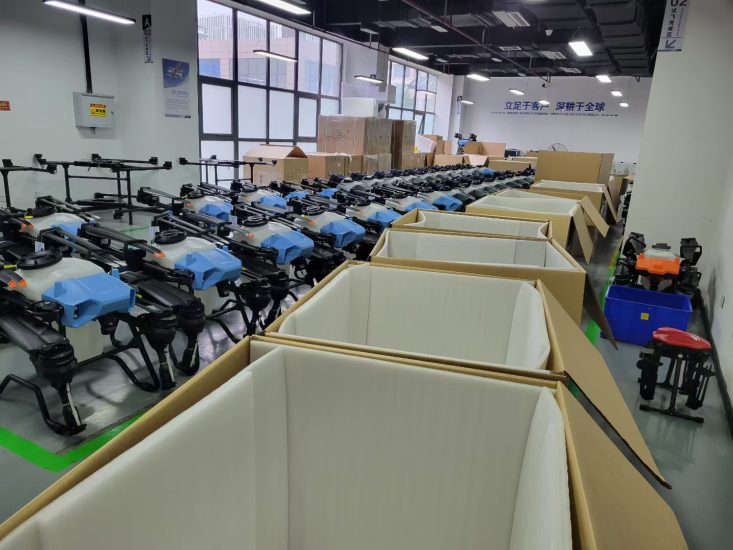
OEM Corn Spraying Drone Manufacturing
International distributors and agricultural equipment companies may require customized agricultural drones.
Depending on the project, OEM/ODM services can include:
-
Custom logo
-
Custom product color
-
Customized packaging
-
Controller language
-
User manuals
-
Tank configuration
-
Battery configuration
-
Spray system configuration
-
Spare parts packages
-
Software localization
A manufacturer should confirm technical requirements before accepting an OEM order.
The target country is also important because agricultural drone operation, pesticide application, radio equipment, batteries, and aviation requirements may differ between markets.
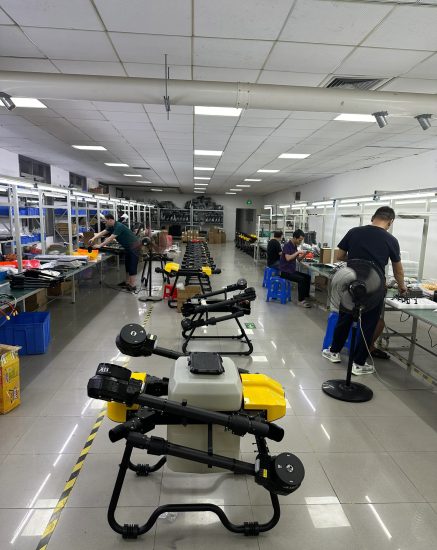
Quality Control
Professional agricultural drone manufacturing should include multiple inspection stages.
Structural Inspection
Check the frame, arms, landing gear, motor mounts, and other structural components.
Electrical Inspection
Check wiring, connectors, batteries, power systems, and communication components.
Spray System Testing
Test the tank, pump, filters, pipes, nozzles, and flow-control system.
Flight Testing
Perform controlled testing of takeoff, hovering, movement, route functions, landing, and safety features.
Final Inspection
Confirm that accessories, spare parts, charger, controller, manuals, and packaging are complete before shipment.
What Should Buyers Ask a Corn Spraying Drone Manufacturer?
Before purchasing, buyers should request detailed information about:
-
Tank capacity
-
Maximum payload
-
Recommended operating payload
-
Pump flow range
-
Nozzle specifications
-
Spray width
-
Flight endurance under load
-
Battery capacity
-
Charging method
-
Navigation system
-
Obstacle detection
-
Maintenance requirements
-
Spare parts availability
-
Warranty
-
Training
-
Technical support
-
OEM capability
-
Export packaging
A professional manufacturer should explain how these specifications work together in actual field operations.
Why After-Sales Support Matters
Agricultural drones are working machines rather than simple consumer electronics.
During operation, customers may need help with:
-
Nozzle replacement
-
Pump maintenance
-
Flow calibration
-
Battery management
-
Controller settings
-
Software updates
-
Flight planning
-
Spare parts
-
Troubleshooting
For commercial users, access to replacement parts can directly affect business continuity.
A manufacturer should therefore have a practical after-sales support system rather than only providing a product at the time of purchase.
Final Thoughts
A corn spraying drone can provide farmers and agricultural service providers with a flexible aerial method for crop protection.
However, the quality of spraying depends on the complete system.
A reliable solution should combine:
-
Stable aircraft performance
-
Suitable payload capacity
-
Consistent liquid flow
-
Proper nozzle selection
-
Accurate route planning
-
Appropriate flight parameters
-
Reliable batteries
-
Regular maintenance
-
Operator training
-
Safe and legal agricultural practices
The best corn spraying drone is not necessarily the drone with the biggest tank or the highest advertised speed. It is the model that matches the customer’s field size, crop conditions, application requirements, operating environment, and long-term maintenance capabilities.
FAQ
1. What is a corn spraying drone?
A corn spraying drone is an agricultural UAV equipped with a liquid tank, pump, nozzles, navigation system, and flight-control system for aerial crop protection and other approved agricultural applications.
2. Can a spraying drone be used on mature corn?
Yes, depending on the crop stage, agricultural product, application requirements, weather, and local regulations. Mature corn has a denser and taller canopy, so spray parameters may need to be adjusted.
3. What can a corn spraying drone apply?
Depending on local approval and the agricultural product label, a drone may be configured for herbicides, insecticides, fungicides, or certain foliar fertilizers.
4. What tank size is suitable for corn spraying?
The appropriate tank size depends on field size, application volume, battery capacity, refill facilities, and daily operating requirements. Larger capacity reduces refill frequency but increases payload.
5. How much area can a corn spraying drone cover per hour?
There is no universal number. Productivity depends on tank capacity, spray width, flight speed, application volume, battery changes, refilling time, field layout, and weather conditions.
Manufacturers publish different working-area figures because their test conditions and equipment configurations vary. For example, available commercial specifications show that operating area can vary substantially between different drone configurations.
6. Does a corn spraying drone replace a tractor?
Not necessarily. A spraying drone is another crop-management tool. It can be particularly useful when ground access is difficult, but tractors and other agricultural machines remain important for many other farming operations.
7. Can the same drone spray wheat, rice, and corn?
Many agricultural drone platforms are designed for multiple crops. However, application parameters may need to be changed for each crop and agricultural product.
8. Does a larger spray width always mean better performance?
No. A larger theoretical width does not automatically provide better deposition. Effective spray width depends on nozzle configuration, altitude, airflow, droplet characteristics, route spacing, and environmental conditions.
9. Is RTK required?
RTK is not mandatory for every agricultural spraying operation, but it can improve route positioning and repeatability. The appropriate navigation system depends on the aircraft and the customer’s field requirements.
10. How should the drone be cleaned after spraying?
The tank, pump, filters, pipes, and nozzles should be cleaned according to the manufacturer’s procedures and the agricultural product instructions. The aircraft should also be inspected for chemical residue.
11. Can the drone be customized for my brand?
OEM customization may include logo, colors, packaging, controller language, documentation, and selected hardware configurations, depending on order quantity and technical requirements.
12. What information should I provide for a quotation?
Provide your destination country, estimated quantity, preferred tank capacity, intended corn application, battery requirements, OEM requirements, and delivery destination. This allows the manufacturer to recommend a suitable configuration instead of quoting a generic agricultural drone.
THE END


No comments yet