

Uneven spraying is one of the most common concerns among agricultural drone operators. Missing crop areas, inconsistent droplet coverage, over-application, or chemical waste can reduce efficiency and negatively affect crop health.
In many cases, the problem is not caused by the drone itself. Spraying performance depends on several factors including flight speed, nozzle condition, altitude, weather, calibration, crop structure, and operator settings.
Understanding why uneven spraying happens helps farmers and agricultural service providers improve efficiency, reduce chemical waste, and achieve more consistent crop protection.
What Does Uneven Spraying Look Like?
Uneven spraying can appear in different ways during field operations:
-
Some crop areas receive too much liquid
-
Certain rows or sections are missed completely
-
Crop growth appears inconsistent after spraying
-
Pest or disease control results vary across the field
-
Fertilizer or pesticide distribution becomes irregular
In large farms, these problems may not become visible until days or weeks later when crop performance begins to differ between treated zones.
Incorrect Flight Height
One of the most common causes of uneven spraying is unstable flight altitude.
When the drone flies too high, droplets may drift away due to wind or disperse too widely before reaching crops.
If the drone flies too low, spraying concentration may become excessive in specific areas, increasing chemical waste or even damaging crops.
Different crops require different spraying heights.
For example:
-
Rice fields often require relatively stable low-altitude spraying for consistent coverage
-
Fruit trees require adjusted height based on canopy structure
-
Tall crops need terrain-following capability for better consistency
Maintaining a stable height improves droplet penetration and spraying accuracy.
Flight Speed Is Too Fast
Many operators try to increase efficiency by flying faster.
However, excessive speed can reduce spray coverage quality.
If the drone moves too quickly:
-
Droplets may not reach intended targets evenly
-
Coverage becomes inconsistent
-
Chemical deposition decreases
Professional operators typically balance productivity with application quality rather than simply maximizing speed.
A slightly slower and stable flight path often produces better spraying consistency.
Blocked or Worn Nozzles
Nozzles are small components, but they directly affect spraying performance.
Blocked, damaged, or worn nozzles can create:
-
Uneven droplet size
-
Different spray pressure between sides
-
Inconsistent liquid distribution
Over time, residue from pesticides or fertilizers may partially clog nozzles.
Regular inspection and cleaning are essential.
Before each operation, check:
-
Spray pressure consistency
-
Nozzle cleanliness
-
Visible wear or leakage
-
Uniform liquid output
Simple maintenance can prevent expensive crop mistakes.
Incorrect Flow Rate Settings
Many spraying problems happen because settings are not calibrated correctly.
The relationship between flow rate, flight speed, and spraying width must remain balanced.
For example:
If a drone increases speed without adjusting flow rate, crop coverage may become insufficient.
If flow rate is too high during slow flight, over-spraying may occur.
Calibration should always match:
-
Crop type
-
Chemical recommendation
-
Target application volume
-
Weather condition
-
Flight speed
Professional drone operators regularly test and optimize spraying parameters rather than relying only on factory settings.
Weather Conditions Are Ignored
Even a well-calibrated drone can spray unevenly under poor weather conditions.
Wind is especially important.
Strong wind may:
-
Push droplets off target
-
Create uneven chemical distribution
-
Increase drift risk
-
Reduce spraying precision
High temperature and low humidity can also affect evaporation and droplet performance.
Many experienced operators spray during calmer periods, such as early morning or late afternoon, to improve consistency.
Terrain and Crop Density Challenges
Not every field is flat.
Hills, slopes, orchards, and dense crop canopies create additional spraying challenges.
For example:
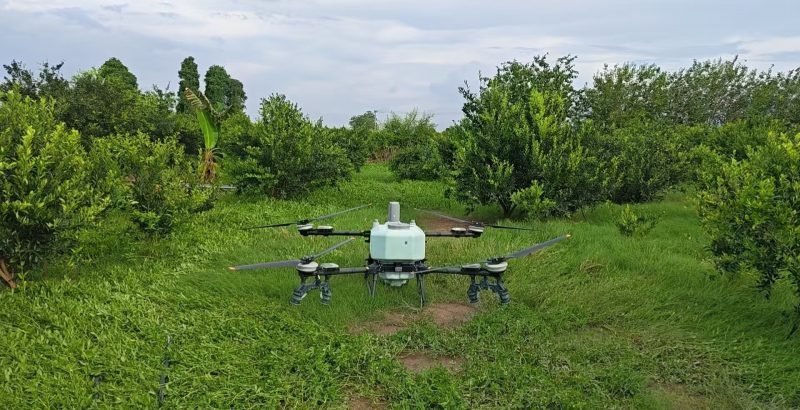
In orchards, dense leaves may block liquid penetration if flight paths are poorly adjusted.
In uneven farmland, altitude variation may reduce spraying uniformity.
Advanced agricultural drones with terrain-following systems help improve consistency by maintaining stable height across changing landscapes.
Poor Route Planning
Another overlooked factor is route overlap.
Too little overlap may create untreated gaps.
Too much overlap may cause over-application and chemical waste.
Professional route planning helps maintain:
-
Stable spraying width
-
Consistent overlap ratio
-
Better field coverage
-
Reduced missed areas
Automated flight planning systems are especially valuable for large-scale farms.
Regular Maintenance Matters
Uneven spraying often develops slowly over time.
Routine inspection can prevent many problems before they affect crop performance.
A basic maintenance checklist includes:
-
Cleaning nozzles after spraying
-
Checking pumps and hoses
-
Monitoring battery performance
-
Updating software when necessary
-
Inspecting spraying pressure consistency
Preventive maintenance improves reliability during peak farming seasons.
Improving Spraying Accuracy in Real Farming Conditions
The goal of agricultural drone spraying is not simply finishing faster.
The real objective is consistent crop coverage, reduced chemical waste, and better productivity.
When uneven spraying happens, the solution usually comes from adjusting operational details rather than replacing equipment.
Stable flight settings, correct nozzle maintenance, proper calibration, weather awareness, and crop-specific planning all contribute to better spraying performance.
FAQ
Why is my agricultural drone missing crop areas?
Common reasons include excessive flight speed, poor route overlap, incorrect altitude, nozzle blockage, or unstable weather conditions.
How often should drone nozzles be cleaned?
Nozzles should be checked before and after spraying operations to prevent clogging and maintain consistent liquid flow.
Does wind affect drone spraying accuracy?
Yes. Wind can significantly influence droplet drift and reduce spraying uniformity, especially during high-speed operations.
Can uneven spraying damage crops?
In some cases, yes. Over-application may stress crops, while under-application can reduce pest or disease control effectiveness.
How can I improve spraying consistency?
Focus on proper calibration, stable flight height, nozzle maintenance, suitable weather timing, and optimized flight planning.
THE END


No comments yet