
Mountain orchards can be difficult to manage with traditional spraying equipment. Steep slopes, narrow paths, uneven ground, and limited vehicle access can make manual spraying slow, expensive, and physically demanding.
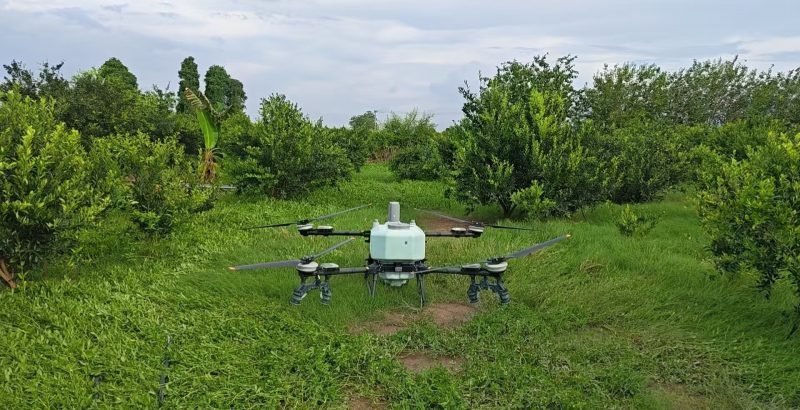
Orchard spraying drones provide an alternative because they can fly directly over trees without requiring heavy equipment to travel through the orchard.
But can a spraying drone really work effectively on steep and complex terrain?
The answer is yes, in many situations, but the drone must be properly selected and operated.
Why Are Mountain Orchards Difficult to Spray?
Mountain orchards can have several challenges:
-
Steep slopes
-
Uneven ground
-
Narrow planting rows
-
Large differences in elevation
-
Dense tree canopies
-
Limited vehicle access
-
Power lines and other obstacles
-
Strong or changing winds
Traditional tractors and ground sprayers may have difficulty operating safely in these conditions.
Workers using backpack sprayers may be able to reach more areas, but the work can require considerable time and physical effort.
A drone can avoid many of these ground-access problems.
How Does a Spraying Drone Operate on Slopes?
A spraying drone does not need to drive up and down the slope.
Instead, it can fly above the orchard and follow a planned route.
Depending on the aircraft and terrain, the system may use positioning and terrain-sensing technologies to maintain an appropriate flight path.
The operator can plan routes based on:
-
Orchard boundaries
-
Tree rows
-
Elevation
-
Obstacles
-
No-fly areas
-
Takeoff and landing locations
This makes drones particularly useful for areas where ground machinery is difficult to use.
1. Terrain Following Is Important
One of the most useful features for mountain orchards is terrain following.
On a flat orchard, maintaining a fixed height is relatively simple.
On a slope, the ground and trees can rise or fall continuously.
If the drone does not properly account for terrain changes, the distance between the aircraft and the crop can vary.
Terrain-following technology can help maintain a more consistent relative height.
This may improve operational consistency and reduce the need for constant manual altitude adjustments.
However, buyers should ask the manufacturer how the terrain-following system actually works and request field-test data for similar terrain.
2. Positioning Accuracy Matters
Accurate positioning is particularly important in mountain orchards.
The drone needs to know where it is relative to:
-
Orchard rows
-
Slopes
-
Obstacles
-
Boundaries
-
Previous flight paths
A reliable positioning system can help improve route repeatability.
For commercial operations, ask the manufacturer about positioning performance under tree canopies and in areas where satellite signals may be affected.
3. Obstacle Detection Is Essential
Mountain orchards can contain many obstacles.
Examples include:
-
Tree branches
-
Utility poles
-
Power lines
-
Buildings
-
Irrigation equipment
-
Fences
-
Other agricultural machinery
An obstacle-sensing system can provide an additional layer of safety.
However, operators should never assume that obstacle avoidance can detect every obstacle.
Thin wires and certain branches can be difficult for sensors to detect.
Before spraying, the operator should inspect the flight area and identify potential hazards.
4. Wind Is a Major Factor
Mountain terrain can create complicated wind conditions.
Wind can change direction and speed around:
-
Hills
-
Valleys
-
Ridges
-
Buildings
-
Dense vegetation
Strong wind can affect both drone stability and spray deposition.
It can also increase spray drift.
Therefore, operators should monitor actual weather conditions and follow the pesticide label and applicable local regulations.
If conditions become unsafe, the operation should be stopped.
5. Choose the Right Payload Capacity
A common mistake is to assume that the largest tank is always best for mountain orchards.
A large tank provides greater liquid capacity, but it also increases aircraft weight.
A heavier aircraft can require more energy and may be less convenient to transport between remote orchard sections.
A general starting point is:
Capacity
|
Possible Application
|
5–10 L
|
Small mountain orchards
|
10–16 L
|
Small and medium farms
|
16–25 L
|
Medium commercial orchards
|
25–40 L
|
Large professional operations
|
The actual choice should depend on the orchard size, terrain, tree density, battery system, and daily workload.
6. Battery Management Becomes More Important
Mountain operations can require more careful battery planning.
The drone may need to fly more slowly or make more route adjustments.
Operators should consider having multiple batteries available.
A practical workflow can be:
Battery A — operating
Battery B — charging
Battery C — ready for replacement
This can reduce downtime.
The charging equipment should also be suitable for the location of the orchard.
For remote mountain farms, transportation and power availability can become important considerations.
7. How Much Does a Mountain Orchard Spraying Drone Cost?
Price depends on payload capacity, sensors, flight-control systems, batteries, chargers, and other equipment.
A general equipment budget may be:
Drone Type
|
Indicative Price Range
|
5–10 L
|
US$2,000–5,000
|
10–16 L
|
US$3,500–7,000
|
16–25 L
|
US$5,000–10,000
|
25–40 L
|
US$8,000–15,000+
|
Professional customized systems
|
US$15,000–25,000+
|
These are indicative ranges rather than fixed quotations.
The final price can change according to:
-
Number of batteries
-
Charger
-
Remote controller
-
Obstacle sensors
-
Terrain-following system
-
Spray system
-
Spare parts
-
OEM customization
-
Shipping
-
Import duties
-
Local certification
International buyers should request a complete quotation that clearly identifies what is included.
8. Can Drones Replace Manual Spraying?
A drone can reduce the need for workers to physically carry spraying equipment through steep terrain.
However, it does not eliminate the need for personnel.
An operator may still need to:
-
Prepare the equipment
-
Load the spraying solution
-
Operate the aircraft
-
Monitor the flight
-
Change batteries
-
Refill the tank
-
Inspect the drone
-
Clean the spray system
Therefore, the main benefit is usually reducing physical spraying labor and improving access, rather than completely eliminating labor.
9. Can Drones Spray Very Steep Slopes?
This depends on the specific drone and operating conditions.
The drone may be physically capable of flying over steep terrain, but safe operation depends on:
-
Wind
-
Positioning
-
Terrain
-
Obstacles
-
Communication
-
Battery condition
-
Operator skill
-
Local aviation regulations
A manufacturer should not simply say that a drone can “fly anywhere.”
Ask for actual field-test results from orchards with similar slopes and tree conditions.
10. How to Improve Safety
Before operating in a mountain orchard:
Inspect the Orchard
Identify:
-
Power lines
-
Buildings
-
Tall trees
-
Towers
-
Roads
-
People
-
Animals
-
Other aircraft hazards
Plan the Route
Create a flight route that follows the orchard layout while maintaining appropriate clearance from obstacles.
Check Weather
Avoid unsafe wind and weather conditions.
Check the Battery
Do not start a difficult flight with an insufficiently charged or damaged battery.
Maintain Communication
Ensure the remote-control and positioning systems are functioning correctly.
Follow Local Regulations
Agricultural drone operations may be subject to aviation, pesticide, environmental, and local agricultural regulations.
FAQ
Can agricultural drones spray mountain orchards?
Yes. They can be particularly useful where tractors and ground spraying equipment have difficulty accessing steep terrain.
What is the most important feature for a mountain orchard?
Terrain-following capability, reliable positioning, obstacle awareness, stable flight control, and appropriate battery capacity are all important.
Is a large 40 L drone necessary for mountain orchards?
Not necessarily. A smaller drone may be easier to transport and maneuver in difficult terrain. The correct capacity depends on the orchard size and daily workload.
Can drones replace workers completely?
No. Operators are still required for flight control, preparation, refilling, battery management, inspection, and safety monitoring.
How much does a mountain orchard spraying drone cost?
Depending on capacity and configuration, an agricultural spraying drone can range from approximately US$2,000 to more than US$25,000. Actual prices depend heavily on the equipment configuration and market.
Conclusion
Mountain orchards are one of the applications where agricultural spraying drones can provide significant advantages.
They can fly over slopes without requiring tractors or other heavy equipment to travel through difficult terrain.
However, successful operation requires more than simply purchasing a drone.
The system should provide suitable terrain following, positioning, obstacle awareness, flight stability, battery capacity, and spray control.
For buyers, the most important step is to evaluate the actual orchard before choosing the drone. Consider the slope, tree height, row spacing, canopy density, obstacles, daily spraying area, and local weather conditions.
A drone that works well in a flat orchard may not provide the same performance in a steep mountain orchard. The best choice is the model that has been properly tested for your specific terrain and operating conditions.
THE END
Support it if you like it




No comments yet