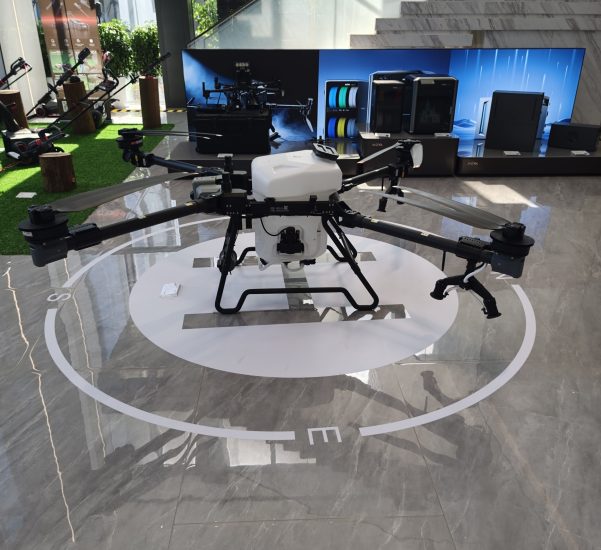



Pesticide costs are an important part of orchard management. When spraying is uneven or excessive, farmers may spend more money without necessarily achieving better crop protection.
This is why many orchard owners are interested in agricultural spraying drones and precision spraying technology.
A properly configured drone can help improve application consistency, reduce unnecessary overlap, and make difficult orchard areas easier to treat. However, a drone does not automatically reduce pesticide use. The application rate must be determined according to the crop, pest or disease, pesticide label, and local agricultural requirements.
1. Why Does Pesticide Waste Happen in Orchards?
Orchards are three-dimensional growing environments.
Unlike flat farmland, fruit trees have branches and leaves at different heights and depths.
Pesticide waste can occur because of:
- Excessive application
- Overlapping flight paths
- Incorrect flight speed
- Incorrect spray width
- Poor nozzle selection
- Wind drift
- Spraying outside the target area
- Incorrect flight altitude
- Inconsistent manual spraying
For example, if a drone repeatedly sprays the same section because the flight route is not properly planned, part of the chemical may be applied unnecessarily.
Precision route planning can help reduce this type of overlap.
2. How Can a Spraying Drone Improve Precision?
Modern agricultural spraying drones can combine several technologies, including:
- Accurate positioning
- Automated flight routes
- Adjustable spray flow
- Terrain following
- Obstacle sensing
- Digital field mapping
- Automatic speed control
These functions can help the operator maintain a more consistent relationship between:
Flight speed + spray flow + spray width + application rate
The result can be a more controlled spraying operation.
3. Automatic Route Planning Can Reduce Overlap
One of the simplest ways to waste agricultural chemicals is excessive overlap.
If an operator manually flies the drone without a clear route, the aircraft may repeatedly pass over the same area.
An automated route can be planned according to:
- Orchard boundaries
- Tree rows
- Spray width
- Obstacles
- No-spray areas
The drone can then follow the planned path.
This can improve consistency and potentially reduce unnecessary overlap.
4. Variable Spray Flow Can Improve Application Consistency
Flight speed can change during operation.
For example, the drone may slow down near an obstacle and accelerate again after passing it.
If spray flow remains constant while speed changes significantly, the application rate per unit area may also change.
A suitable flow-control system can adjust liquid delivery according to operating conditions.
The objective is not simply to spray less.
The objective is to apply the appropriate amount to the intended target.
5. Why Flight Speed Matters
Suppose a drone is configured for a particular spray flow and operating width.
If it flies too quickly, the application rate may become lower than intended.
If it flies too slowly without adjusting flow, the application rate may become higher than intended.
Therefore, the operator should calibrate:
Flight speed + spray flow + spray width
before beginning commercial spraying.
Calibration should follow the pesticide manufacturer’s instructions and applicable agricultural regulations.
6. Nozzle Selection Can Affect Waste
Nozzles have a major influence on spray characteristics.
Different nozzle configurations can produce different droplet sizes and spray patterns.
Factors affecting nozzle selection include:
- Crop type
- Canopy structure
- Application requirements
- Weather
- Product label
- Required application rate
The goal is to produce an appropriate spray pattern while minimizing unnecessary drift.
Operators should always use equipment and application methods that comply with the pesticide label and local regulations.
7. Terrain Following Can Help Reduce Uneven Application
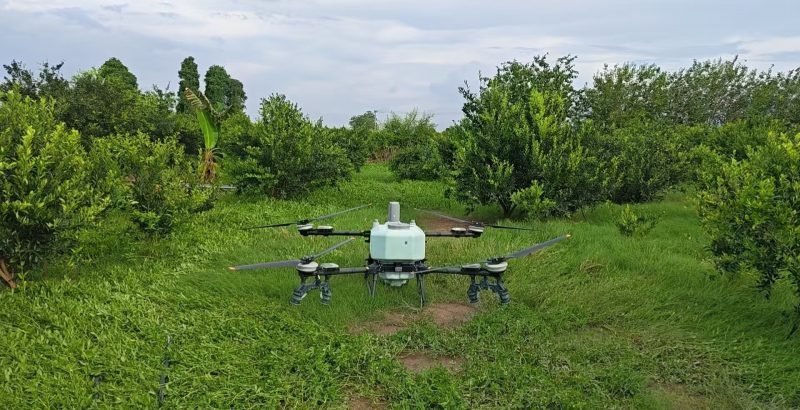
Mountain orchards can have significant elevation changes.
If the drone flies too far from the canopy in one area and too close in another, spray distribution may become inconsistent.
Terrain-following technology can help maintain a more appropriate relative flight height.
This can be particularly useful for:
- Hillside citrus orchards
- Mountain apple orchards
- Mango plantations
- Avocado orchards
- Other sloped fruit farms
However, terrain-following performance varies between drone models, so buyers should request actual field-test information.
8. Obstacle Avoidance Can Help Protect the Target Area
Orchards often contain:
- Branches
- Tree trunks
- Power lines
- Poles
- Buildings
- Irrigation equipment
Avoiding obstacles can prevent sudden route changes and reduce the possibility of uncontrolled spraying.
However, obstacle detection systems are not perfect.
Operators should always inspect the orchard and identify potential hazards before operation.
9. How Much Does an Orchard Spraying Drone Cost?
Agricultural spraying drones come in different sizes and configurations.
A general equipment budget may look like this:
| Tank Capacity | Indicative Price Range |
|---|---|
| 5–10 L | US$2,000–5,000 |
| 10–16 L | US$3,500–7,000 |
| 16–25 L | US$5,000–10,000 |
| 25–40 L | US$8,000–15,000+ |
| Professional/customized systems | US$15,000–25,000+ |
These figures are indicative price ranges, not fixed quotations.
The final price can vary according to:
- Drone configuration
- Battery quantity
- Charger
- Spray system
- Sensors
- Remote controller
- Spare parts
- OEM customization
- Shipping
- Import duties
- Local certification
Buyers should request a complete quotation that clearly lists all included equipment.
10. Can Precision Spraying Reduce Pesticide Costs?
Potentially, yes—but this should not be assumed automatically.
If a farm previously had substantial:
- Overlapping spraying
- Poor route planning
- Uneven application
- Excessive application
- Spray drift
then better control may reduce unnecessary chemical consumption.
However, the target application rate must still be maintained.
The goal is:
Less waste, not less effective treatment.
Farmers should never reduce pesticide dosage simply because a drone is being used unless the application is specifically supported by the product label, agronomic recommendations, or applicable regulations.
11. How to Measure Whether You Are Actually Saving Pesticide
The best approach is to record actual operating data.
Before using the drone, record:
- Pesticide volume per acre/hectare
- Total pesticide cost
- Labor cost
- Spraying time
- Orchard area
- Number of spraying operations
After introducing the drone, record the same information.
Then compare:
Chemical cost per acre
Labor cost per acre
Total spraying cost per acre
This provides a much more accurate measurement than relying on advertising claims.
12. Use Test Areas Before Large-Scale Spraying
Before treating an entire orchard, perform a controlled test.
Select a small representative area and evaluate:
- Spray coverage
- Canopy penetration
- Application uniformity
- Drift
- Flight stability
- Actual liquid consumption
Appropriate spray-coverage assessment tools, such as water-sensitive cards, can help determine where droplets are reaching.
If coverage is inadequate, adjust the operating parameters before expanding the operation.
13. Pesticide Cost vs. Drone Operating Cost
It is important to separate these two costs.
Pesticide Cost
This depends on:
- Product
- Application rate
- Orchard size
- Treatment frequency
Drone Operating Cost
This includes:
- Equipment depreciation
- Batteries
- Electricity
- Maintenance
- Labor
- Transportation
A drone may reduce labor and operational waste without necessarily reducing the required pesticide application rate.
This distinction is important when calculating return on investment.
FAQ
Can an orchard spraying drone reduce pesticide waste?
It can potentially reduce waste caused by excessive overlap, poor route planning, and inconsistent application. However, results depend on calibration, weather, canopy structure, and operator skill.
Does using a drone mean I can use less pesticide?
Not automatically. The correct application rate should follow the pesticide label, agronomic recommendations, and local regulations.
What drone features are useful for precision spraying?
Important features can include accurate positioning, automated route planning, adjustable spray flow, terrain following, obstacle sensing, and reliable flight control.
How can I know whether the drone is actually saving money?
Record pesticide consumption, labor, operating time, maintenance, and total spraying costs before and after adopting the drone.
How much does an orchard spraying drone cost?
A general equipment budget can range from approximately US$2,000 to more than US$25,000, depending on capacity and configuration.
Conclusion
Orchard spraying drones can help farmers improve spraying efficiency and potentially reduce unnecessary pesticide waste.
The biggest benefits usually come from combining:
Accurate positioning + planned flight routes + appropriate spray flow + correct nozzles + suitable flight speed + proper altitude
However, technology alone cannot guarantee lower pesticide consumption.
The most important principle is to apply the correct amount to the correct target at the correct time.
Before purchasing an orchard spraying drone, buyers should request real-world field-test data, calculate operating costs, and test the equipment under their own orchard conditions.
For commercial fruit growers, a properly calibrated spraying drone can become a useful tool for improving labor efficiency, application consistency, and overall orchard management.


No comments yet