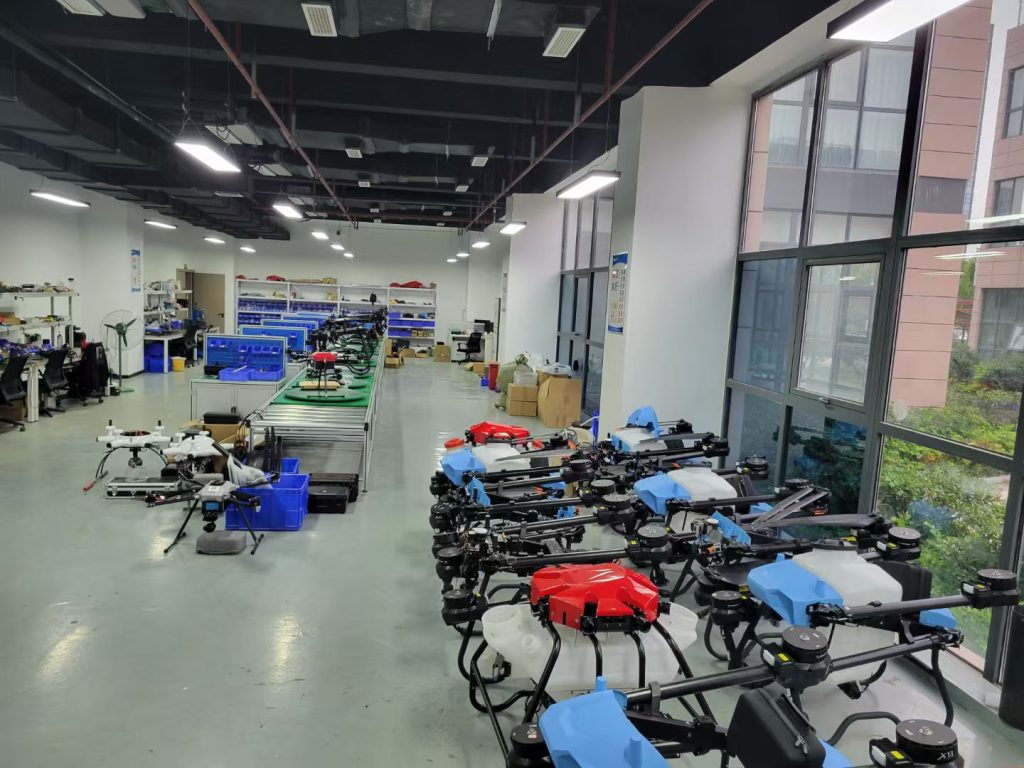
Agricultural drones are increasingly being used for aerial seeding, particularly where conventional ground equipment is difficult to operate or where farmers need a flexible way to distribute seed across large areas.
However, not every crop is suitable for drone seeding.
The most important factors are seed size, seed weight, application rate, soil condition, required planting depth, wind conditions, and the type of spreading equipment installed on the drone.
Some crops can be broadcast directly from the air, while others require accurate placement into the soil. This distinction is important because most agricultural seeding drones are designed primarily for surface broadcasting, rather than conventional mechanical planting at a controlled depth.
This guide explains which crops can be planted by drone, which drone configurations are suitable, typical technical specifications, estimated equipment prices, operating considerations, and the limitations buyers should understand before investing in a seeding drone.
Which Crops Can Be Planted by Drone?
Depending on the spreading system, agricultural drones can be used for a range of seeds and granular agricultural materials.
Common applications include:
-
Rice
-
Wheat
-
Rapeseed
-
Grass seed
-
Pasture seed
-
Cover crops
-
Some cereal grains
-
Selected small seeds
-
Granular fertilizer
The suitability of a crop depends less on its name and more on the physical characteristics of the seed.
Important properties include:
-
Seed diameter
-
Seed weight
-
Bulk density
-
Shape
-
Surface texture
-
Moisture content
-
Flowability
-
Required seeding rate
A seed that flows smoothly through a metering system can usually be controlled more easily than a lightweight or irregular seed.
1. Rice Seeding by Agricultural Drone
Rice is one of the most suitable applications for aerial direct seeding when the local cultivation system allows broadcast or precision aerial seeding.
A major advantage is the ability to operate without driving a heavy machine directly through wet paddy soil.
Rice fields may contain:
-
Muddy soil
-
Standing water
-
Soft ground
-
Narrow access roads
-
Irregular field boundaries
A drone can fly above the field while distributing seed from the hopper.
Rice Seeding Requirements
A rice-seeding configuration normally needs:
-
Stable seed metering
-
Appropriate feeder size
-
Controlled spreading rate
-
RTK positioning
-
Consistent flight height
-
Good distribution uniformity
Rice seed is heavier than many grass seeds, so the spreading system can normally handle a relatively higher material flow.
However, different rice varieties can have different seed dimensions and weights. Calibration should therefore be performed using the actual seed before full-scale operation.
Typical Rice Seeding Drone Configuration
Parameter
|
Typical Range
|
Payload
|
20–80 kg
|
Hopper volume
|
30–150 L
|
Working width
|
4–10 m
|
Operating speed
|
3–8 m/s
|
Flight time under load
|
5–15 min
|
Positioning
|
GNSS / RTK
|
Feeder
|
Motorized auger or gate
|
Spreading method
|
Centrifugal or controlled outlet
|
Recommended use
|
Paddy fields and direct broadcasting
|
A larger drone is useful when the farm area is large because it reduces the number of hopper refills.
2. Wheat Seeding by Drone
Wheat can also be distributed by agricultural drones when aerial broadcasting is compatible with the local production method.
The biggest consideration is the required seed rate.
Wheat seed is relatively dense, which means the spreading system needs to deliver a substantial amount of material over the field.
For example, if the target rate is:
150 kg/ha
A 100-hectare farm would require:
150 × 100 = 15,000 kg
or:
15 tonnes of seed
This creates a significant logistical requirement.
For large wheat farms, the drone’s hopper capacity and loading efficiency become particularly important.
Recommended Wheat Drone Configuration
A 30–80 kg payload drone can be considered depending on field size.
Parameter
|
Recommended Range
|
Payload
|
30–80 kg
|
Hopper
|
50–150 L
|
Spreading width
|
5–10 m
|
Flight speed
|
4–8 m/s
|
Positioning
|
RTK/GNSS
|
Feeder
|
Heavy-duty metering system
|
Seed type
|
Wheat and similar grains
|
The aircraft should be tested at the intended application rate because a system designed for low-volume seed may not be appropriate for high-rate wheat broadcasting.
3. Rapeseed Seeding by Drone
Rapeseed can be more challenging than heavier grains because individual seeds are small.
The metering system needs to control relatively small particles without excessive leakage or clogging.
A suitable system should provide:
-
Fine metering control
-
Stable low-rate output
-
Small-particle compatibility
-
Adjustable spreading width
-
Consistent flight speed
Rapeseed is particularly suitable for applications where the farmer wants to reduce ground traffic.
Typical Rapeseed Configuration
Parameter
|
Typical Range
|
Payload
|
10–50 kg
|
Hopper
|
20–70 L
|
Working width
|
3–8 m
|
Flight speed
|
3–7 m/s
|
Application rate
|
Low to medium
|
Feeder
|
Fine metering system
|
Positioning
|
GNSS / RTK
|
The operator should not use a high-flow fertilizer setting for small seeds.
The feeder should be calibrated specifically for the seed.
4. Grass Seed
Grass seed is one of the more interesting applications for agricultural drones.
Grass seeds can be extremely lightweight compared with agricultural grains.
This creates a major challenge:
Wind drift.
A drone may maintain a stable flight path while lightweight seeds are carried sideways by air movement.
Therefore, grass-seed operations should pay particular attention to:
-
Wind direction
-
Wind speed
-
Flight height
-
Spreading-disc speed
-
Seed weight
-
Effective spreading width
Suitable Drone Configuration
A small or medium agricultural drone can often be sufficient.
Parameter
|
Typical Range
|
Payload
|
10–30 kg
|
Hopper
|
20–50 L
|
Spreading width
|
3–7 m
|
Flight speed
|
3–6 m/s
|
Feeder
|
Fine-control feeder
|
Positioning
|
GNSS / RTK
|
A larger payload is not necessarily an advantage for grass seed because the material may be lightweight.
5. Pasture Seed
Pasture renovation is another possible application.
Large grazing areas can be difficult to access with conventional machinery.
A drone can distribute seed across:
-
Grassland
-
Slopes
-
Open pasture
-
Remote farmland
-
Areas with limited vehicle access
The major challenge is achieving adequate seed-to-soil contact.
Broadcasting seed from the air does not guarantee germination.
After seeding, soil moisture, rainfall, soil preparation, seed depth, grazing management, and other agricultural factors still affect establishment.
Therefore, farmers should evaluate the complete production system rather than the drone alone.
6. Cover Crop Seeding
Cover crops are particularly suitable for aerial broadcasting in some farming systems.
The drone can distribute seed after the main crop has been harvested or during a suitable stage of the production cycle.
Potential cover crops include various:
-
Cereal grasses
-
Legumes
-
Small grains
-
Soil-protection mixtures
The main benefit is reducing the need to drive a tractor across the field.
This can be especially useful when the soil is too wet for heavy equipment.
Typical Cover Crop Drone
Parameter
|
Typical Range
|
Payload
|
20–50 kg
|
Hopper
|
30–80 L
|
Working width
|
4–8 m
|
Flight speed
|
4–8 m/s
|
Positioning
|
RTK/GNSS
|
Feeder
|
Adjustable granular feeder
|
The correct configuration depends heavily on the cover-crop mixture.
If several seed types are mixed together, differences in density and particle size can cause separation during handling and spreading.
7. Cereal Grains
Some cereal grains can be broadcast from agricultural drones.
Potential materials include:
-
Barley
-
Oats
-
Rye
-
Other suitable grains
However, the farmer should confirm that the seed dimensions and application rate are compatible with the spreading equipment.
A large grain requires a different feeder configuration from a small seed.
Which Crops Are Difficult to Plant by Drone?
Not every crop is a good candidate for aerial seeding.
Drone broadcasting can be difficult when the crop requires:
-
Precise planting depth
-
Precise row spacing
-
Individual seed placement
-
Seed covering
-
Furrow placement
-
Strong soil contact
For example, some crops are normally established by placing seed several centimeters below the soil surface.
A standard broadcasting drone cannot reproduce the same planting process as a mechanical seed drill.
This is one of the most important limitations buyers should understand.
Broadcasting vs Precision Drone Seeding
There are two broad approaches.
Aerial Broadcasting
Seeds are released from the drone and distributed over a relatively wide area.
Advantages:
-
Simple system
-
High operating flexibility
-
Large coverage area
-
Suitable for many granular materials
Disadvantages:
-
Distribution can be affected by wind
-
Seed placement is less controlled
-
Overlap must be managed
-
Soil contact may be inconsistent
Precision Aerial Seeding
A more advanced system attempts to control where seeds are released, for example through narrow strips, points, or controlled sections.
Advantages:
-
Better placement control
-
Reduced overlap
-
Potentially lower seed waste
-
More consistent planting patterns
Disadvantages:
-
More complex equipment
-
Higher cost
-
More demanding calibration
-
Greater dependence on positioning accuracy
For buyers who need true precision planting, the spreading mechanism should be evaluated as carefully as the aircraft.
Agricultural Seeding Drone Models by Configuration
Instead of focusing on a particular brand, commercial buyers can compare drones according to payload class.
Model A: SD-20
A lightweight 20 kg-class configuration.
Specification
|
SD-20
|
Maximum payload
|
20 kg
|
Hopper capacity
|
25–35 L
|
Working width
|
3–6 m
|
Flight speed
|
3–7 m/s
|
Flight time
|
8–15 min
|
Positioning
|
GNSS / RTK
|
Feeder
|
Fine metering
|
Suitable crops
|
Grass, rapeseed, small grains
|
This type of aircraft is suitable for smaller farms and low-volume applications.
Estimated price
US$3,000–8,000
depending on battery quantity, RTK equipment, charger, spreading system, and accessories.
Model B: SD-30
A medium 30 kg configuration.
Specification
|
SD-30
|
Maximum payload
|
30 kg
|
Hopper capacity
|
35–50 L
|
Working width
|
4–8 m
|
Flight speed
|
4–8 m/s
|
Flight time
|
7–14 min
|
Positioning
|
RTK/GNSS
|
Feeder
|
Motorized auger
|
Obstacle detection
|
Optional
|
Suitable crops
|
Rice, wheat, pasture, cover crops
|
Estimated price
US$5,000–11,000
This configuration provides a good balance between payload and purchase cost.
Model C: SD-50
A 50 kg commercial agricultural configuration.
Specification
|
SD-50
|
Maximum payload
|
50 kg
|
Hopper capacity
|
60–80 L
|
Working width
|
5–9 m
|
Flight speed
|
4–9 m/s
|
Flight time
|
6–12 min
|
Positioning
|
RTK
|
Feeder
|
Heavy-duty auger
|
Obstacle detection
|
Radar/vision
|
Suitable crops
|
Rice, wheat, grains, cover crops
|
Estimated price
US$8,000–18,000
This class is more appropriate for farms where the drone will operate regularly.
Model D: SD-80
An 80 kg heavy-duty agricultural configuration.
Specification
|
SD-80
|
Maximum payload
|
80 kg
|
Hopper capacity
|
100–150 L
|
Working width
|
7–10 m
|
Flight speed
|
5–10 m/s
|
Flight time
|
5–9 min
|
Positioning
|
High-precision RTK
|
Feeder
|
Heavy-duty metering auger
|
Obstacle detection
|
Multi-directional radar
|
Suitable crops
|
Rice, wheat, grains, high-volume materials
|
Estimated price
US$18,000–35,000+
This configuration is designed for large commercial operations.
How Much Seed Can a Drone Carry?
The payload required depends on the application rate.
Consider a 100-hectare farm.
If the seed rate is:
20 kg/ha
Total requirement:
100 × 20 = 2,000 kg
A 20 kg drone requires:
2,000 ÷ 20 = 100 loads
A 50 kg drone requires:
2,000 ÷ 50 = 40 loads
An 80 kg drone requires:
2,000 ÷ 80 = 25 loads
The larger drone therefore significantly reduces loading cycles.
However, the aircraft also costs more and requires a larger battery system.
How Much Does Agricultural Drone Seeding Cost?
Indicative equipment prices:
Drone Class
|
Approximate Price
|
10–20 kg
|
US$3,000–8,000
|
20–30 kg
|
US$5,000–11,000
|
30–50 kg
|
US$8,000–18,000
|
50–70 kg
|
US$13,000–28,000
|
70–80+ kg
|
US$18,000–35,000+
|
A complete professional package can cost more.
Additional equipment may include:
-
3–6 batteries
-
High-power charger
-
Generator
-
RTK equipment
-
Spare propellers
-
Spare motors
-
Extra feeder
-
Maintenance tools
-
Transport cases
A complete commercial setup can therefore reach approximately:
US$15,000–40,000+
depending on configuration.
How to Select a Drone Based on Crop Type
Crop
|
Suggested Payload
|
Main Requirement
|
Rice
|
30–80 kg
|
Stable metering
|
Wheat
|
50–80 kg
|
High material flow
|
Rapeseed
|
10–30 kg
|
Fine metering
|
Grass
|
10–30 kg
|
Wind control
|
Pasture
|
20–50 kg
|
Terrain adaptability
|
Cover crops
|
20–50 kg
|
Flexible spreading
|
Cereal grains
|
30–80 kg
|
High-capacity feeder
|
These are general equipment recommendations. Actual selection should be based on the physical properties of the seed and required application rate.
How Does Seed Size Affect Drone Selection?
Seed size affects almost every part of the spreading system.
Small Seed
Small seeds usually require:
-
Smaller feeder opening
-
Fine metering
-
Lower material flow
-
Careful calibration
Medium Seed
Medium-size grains can generally use a standard granular spreading system.
Large Seed
Large seeds require:
-
Larger feeder openings
-
Higher motor torque
-
Larger material channels
-
Stronger spreading mechanisms
The buyer should therefore provide an actual seed sample or detailed seed specifications before ordering a custom spreading system.
How Does Seed Density Affect Hopper Capacity?
Two materials can occupy the same hopper volume but have very different weights.
For example:
Material A:
0.4 kg/L
Material B:
0.8 kg/L
A 100-liter hopper could theoretically contain:
Material A:
40 kg
Material B:
80 kg
Therefore, a buyer should never compare agricultural drones based on hopper volume alone.
The important specifications are:
Hopper volume + maximum payload + material density.
How Important Is RTK?
RTK positioning can improve flight-path accuracy and reduce unnecessary overlap.
This is particularly useful when:
-
Fields are large
-
The same field is treated repeatedly
-
Narrow flight paths are required
-
Field boundaries are irregular
-
Precise route planning is important
However, RTK does not automatically make the seed distribution uniform.
Seed distribution also depends on:
-
Feeder accuracy
-
Spreading-disc design
-
Flight height
-
Wind
-
Flight speed
-
Seed characteristics
RTK solves the positioning problem; it does not solve every spreading problem.
How Does Wind Affect Different Crops?
Wind sensitivity varies considerably.
Wheat
Relatively heavy seeds are less sensitive to wind.
Rice
Moderate sensitivity depending on seed characteristics.
Rapeseed
Small seeds can be more sensitive.
Grass Seed
Very lightweight material can experience significant drift.
Therefore, the same drone settings should not be used for every crop.
How to Calibrate the Drone for Different Seeds
A professional calibration process should include:
1. Weigh the Seed
Determine the weight of a known volume.
2. Check Particle Size
Measure the approximate seed diameter.
3. Determine the Target Rate
For example:
30 kg/ha
4. Perform a Feeder Test
Measure how much material is discharged in a fixed period.
5. Adjust Flight Speed
The drone speed must match the required material flow.
6. Test the Spreading Pattern
Collect samples at different positions across the working width.
7. Adjust the Working Width
Do not use a maximum width if the distribution becomes uneven.
8. Conduct a Small Field Trial
Only after the test results are satisfactory should the operator begin full-scale seeding.
What Is the Best Drone Size for Different Farms?
10–50 Hectares
Recommended:
10–20 kg class
Advantages:
-
Lower purchase cost
-
Easy transportation
-
Lower battery requirements
-
Simple maintenance
50–200 Hectares
Recommended:
20–50 kg class
Advantages:
-
Better payload
-
Fewer refills
-
Higher productivity
-
More suitable for commercial use
200–1,000 Hectares
Recommended:
50–80 kg class
Advantages:
-
Large hopper
-
High material capacity
-
Fewer loading cycles
-
Better suitability for continuous operation
More Than 1,000 Hectares
Instead of automatically buying the largest drone, consider a fleet.
For example:
2 × 50 kg drones
may provide greater operational flexibility than:
1 × 80 kg drone
because two aircraft can work in different fields simultaneously and provide backup if one machine requires maintenance.
Can One Drone Plant Multiple Crops?
Yes, if the spreading system is designed for different materials.
However, changing from wheat to grass seed or from rice to rapeseed requires recalibration.
The operator may need to change:
-
Feeder settings
-
Auger
-
Outlet opening
-
Disc speed
-
Flight speed
-
Spreading width
-
Application rate
A modular spreading system can therefore be valuable for farms growing several crops.
What Are the Main Advantages of Drone Seeding?
Lower Soil Disturbance
The drone does not drive over the field.
Better Access
It can reach wet or difficult terrain.
Flexible Operation
The same aircraft can potentially perform multiple agricultural tasks.
Reduced Ground Labor
Aerial operation can reduce the amount of manual broadcasting required.
Fast Deployment
A drone can move quickly between fields without requiring a tractor to drive between them.
What Are the Main Limitations?
Drone seeding is not perfect.
The main limitations include:
-
Wind sensitivity
-
Battery limitations
-
Hopper capacity
-
Seed drift
-
Surface broadcasting
-
Limited seed-depth control
-
Need for calibration
-
Weather dependence
-
Operator training
-
Local flight regulations
Farmers should consider these limitations before replacing conventional equipment.
FAQ
What crops can be planted by agricultural drones?
Common applications include rice, wheat, rapeseed, grass seed, pasture seed, cover crops, and selected cereal grains.
The seed must be physically compatible with the drone’s spreading system.
Can drones plant rice?
Yes. Rice is one of the more established applications for aerial direct seeding.
The appropriate drone depends on field size, rice variety, seed rate, and soil or water conditions.
Can drones plant wheat?
Yes, but wheat often requires a relatively high seed application rate.
For large wheat farms, a 50–80 kg payload system may be more practical than a small drone.
Can drones plant grass seed?
Yes.
However, grass seed is often lightweight, so wind conditions and spreading width need to be carefully controlled.
Can drones plant rapeseed?
Yes. Rapeseed requires accurate low-rate metering because the seeds are relatively small.
A fine-control spreading system is recommended.
What size drone is best for rice seeding?
For commercial rice production, a 30–80 kg payload class can be considered.
Smaller drones may be suitable for smaller farms.
What size drone is best for wheat?
A 50–80 kg class can be more efficient for large wheat farms because wheat can require a high seeding rate.
How much does a seeding drone cost?
Typical equipment prices range from approximately US$3,000 to US$35,000+.
Complete commercial systems can cost US$15,000–40,000+ depending on batteries, chargers, RTK, spreading equipment, and accessories.
Can the same drone seed different crops?
Yes, provided the spreading system supports the different materials.
However, each crop should be calibrated separately.
Does a drone put seeds into the soil?
Most agricultural seeding drones broadcast seeds from the air.
They generally do not provide the same controlled seed depth as a conventional seed drill.
What is the most important specification?
For seeding applications, the most important factors are:
-
Metering accuracy
-
Seed compatibility
-
Application-rate range
-
Effective spreading width
-
Payload
-
Battery endurance
-
Positioning accuracy
-
Field automation
Maximum flight speed should not be the only purchasing criterion.
Can drone seeding replace a tractor?
Not in every application.
Drone seeding is particularly useful for aerial broadcasting and difficult terrain, while conventional seed drills remain better for crops requiring precise depth and row placement.
How much area can one drone seed?
Actual productivity depends on payload, application rate, flight speed, spreading width, battery changes, refilling, field shape, and weather.
A practical field test is more reliable than using a theoretical maximum area-per-hour figure.
Is drone seeding cheaper?
It can reduce labor and ground-equipment costs in suitable situations, but the complete cost must include:
-
Drone depreciation
-
Batteries
-
Electricity
-
Maintenance
-
Operator labor
-
Seed loading
-
Transportation
The correct comparison is cost per hectare, not simply the purchase price of the drone.
Final Recommendation
There is no single agricultural drone that is ideal for every crop.
For rice, prioritize stable material metering and good performance in wet fields.
For wheat and cereal grains, prioritize payload and high-volume material flow.
For rapeseed and small seeds, prioritize low-rate metering accuracy.
For grass and pasture seed, prioritize wind management and accurate distribution.
For cover crops, prioritize flexible operation, reliable route planning, and efficient field coverage.
A practical purchasing strategy is to first determine:
Crop → Seed characteristics → Seeding rate → Farm area → Required daily capacity → Drone payload → Spreading system → Battery configuration → Total operating cost.
For most commercial agricultural operations, a 30–50 kg drone provides a reasonable balance between payload and investment, while 50–80 kg systems become more attractive for large farms with high daily workloads.
The aircraft itself is only one part of the system. The real performance of a seeding drone comes from the combination of accurate metering, appropriate spreading width, stable flight, correct calibration, suitable seed characteristics, efficient battery management, and proper field planning.
When those factors are matched correctly, agricultural drones can provide a practical alternative for aerial seeding in crops and field conditions where conventional ground equipment is less efficient.
THE END
Support it if you like it









No comments yet