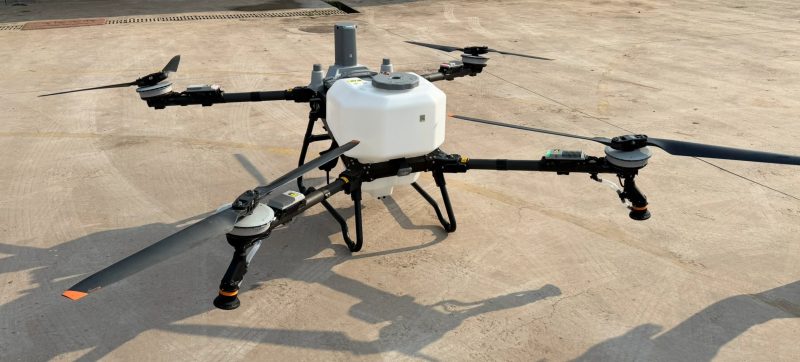



A 100KG payload agricultural spraying drone is a heavy-duty unmanned aerial system designed for large-scale agricultural applications. Compared with smaller agricultural drones, a 100KG-class platform can carry a larger working load, making it suitable for demanding spraying and spreading operations.
Modern agricultural drones are no longer limited to pesticide spraying. Depending on the configuration, they can also be used for fertilizer application, seed spreading, orchard management, forestry operations, and other agricultural tasks.
However, the actual applications depend on the drone’s payload capacity, tank or hopper configuration, pump system, spreading system, flight-control technology, and local regulations.
This guide explains the major applications and benefits of a 100KG payload agricultural drone.
1. Large-Scale Crop Spraying
The primary application of agricultural drones is crop spraying.
A 100KG-class drone can potentially be configured for high-capacity liquid spraying, allowing operators to carry a substantial amount of agricultural solution per flight.
Potential applications include:
- Insecticide spraying
- Fungicide spraying
- Herbicide application
- Foliar fertilizer
- Plant-growth regulators
- Biological crop-protection products
The exact application rate should always follow the product label and applicable agricultural requirements.
Why Use a Drone for Crop Spraying?
A drone can fly above the crop without requiring wheels to pass through the field.
This can be particularly useful when:
- Crops are tall
- Fields are wet
- Soil is soft
- Ground access is difficult
- Tractor traffic could damage plants
For large farms, reducing the number of ground passes can also help improve operational flexibility.
2. Rice Field Spraying
Rice cultivation is an important application for agricultural drones.
Traditional ground equipment can encounter difficulties in flooded or muddy rice fields.
A drone can operate above the field without driving through the water or soft soil.
Potential benefits include:
- Reduced soil disturbance
- Less crop damage
- Better access to wet fields
- Reduced dependence on field roads
- Faster response during certain crop-protection operations
A high-payload drone can be especially useful when large areas need to be treated within a limited operating window.
3. Wheat Spraying
Wheat farms can use agricultural drones for selected crop-protection applications.
Potential applications include:
- Fungicide
- Insecticide
- Foliar nutrition
- Other approved agricultural treatments
Large fields can benefit from automatic route planning and repeatable flight paths.
For wheat production, the operator should select the correct application rate, droplet characteristics, flight altitude, and speed for the intended treatment.
4. Corn Field Applications
Corn fields can become increasingly difficult for ground equipment to access as plants grow.
Aerial spraying can reduce the need for machinery to travel directly through the crop.
Potential applications include:
- Pest control
- Disease management
- Foliar fertilizer
- Crop-protection treatments
The exact suitability depends on crop height, field conditions, product requirements, and local regulations.
5. Soybean Applications
Soybean farms can also benefit from aerial agricultural operations.
A 100KG-class drone may be configured for:
- Liquid spraying
- Fertilizer application
- Certain biological treatments
Large-scale operations can use automated flight routes to cover defined field boundaries.
The operator should monitor weather conditions carefully because wind can affect aerial spray deposition and drift.
6. Cotton Field Spraying
Cotton production often requires repeated crop-protection operations.
A drone can provide an aerial application option when ground access becomes difficult.
Potential benefits include:
- Reduced crop contact
- Flexible field access
- Rapid deployment
- Reduced soil disturbance
A high-payload platform may be useful for commercial cotton farms with large treatment areas.
7. Vegetable Crop Applications
Vegetable farms may use agricultural drones for certain crop-protection and foliar application tasks.
Potential crops include:
- Lettuce
- Cabbage
- Onions
- Potatoes
- Tomatoes
- Peppers
- Leafy vegetables
However, vegetable crops vary considerably in plant structure and application requirements.
The appropriate drone configuration should be selected according to:
- Crop height
- Row spacing
- Application rate
- Required droplet characteristics
- Field size
8. Orchard Spraying
Orchards are another important application for agricultural drones.
Ground machinery can have difficulty operating in some orchards because of:
- Narrow rows
- Slopes
- Muddy ground
- Dense vegetation
- Limited access
A drone can fly over orchard rows without requiring a tractor to pass through every section.
Potential applications include:
- Fruit-tree disease management
- Insect control
- Foliar nutrition
- Other approved treatments
For orchard spraying, buyers should pay particular attention to:
- Flight altitude
- Spray pattern
- Droplet characteristics
- Air movement
- Tree canopy density
- Terrain following
9. Vineyard Applications
Vineyards can have steep slopes and narrow access paths.
These conditions can make traditional machinery difficult to operate.
Agricultural drones may provide an alternative aerial application method.
Potential benefits include:
- Access to sloped terrain
- Reduced soil disturbance
- Reduced crop contact
- Flexible operation
- Automated route planning
However, vineyards require careful application management because canopy structure and terrain can vary significantly.
10. Tea Plantation Applications
Tea plantations often feature hilly terrain and narrow working areas.
A drone can fly above areas that may be difficult for tractors and other ground machinery to access.
Potential applications include:
- Crop protection
- Foliar fertilizer
- Disease management
- Pest management
Terrain-following capabilities can be particularly valuable in hilly plantations.
11. Forestry Applications
Agricultural drones can also be adapted for certain forestry applications.
A heavy-duty drone may be used for selected:
- Pest-control operations
- Disease-management treatments
- Fertilizer applications
- Large-area vegetation management
Forestry environments can be challenging because of trees, terrain, and obstacles.
A drone used in forestry should therefore have appropriate navigation, sensing, and safety capabilities.
12. Fertilizer Spreading
Not every agricultural drone is limited to liquid spraying.
Some 100KG-class platforms can be equipped with a granular spreading system.
Potential materials include:
- Granular fertilizer
- Seeds
- Certain agricultural granules
- Other approved agricultural materials
A spreading system should be evaluated based on:
- Hopper capacity
- Spreading width
- Distribution uniformity
- Material compatibility
- Maximum spreading rate
- Flow control
13. Seed Spreading
Depending on the configuration, agricultural drones can also be used for certain seeding applications.
Potential applications include:
- Cover crops
- Grass seed
- Rice seed
- Other suitable agricultural seeds
The spreading system must be matched to seed size, weight, shape, and application requirements.
Uniform distribution is particularly important.
14. Biological Agriculture
Agricultural drones may also be used for certain biological crop-protection applications.
Depending on the product and local regulations, applications can include:
- Biological pesticides
- Microbial products
- Foliar biological treatments
- Other approved biological agricultural materials
The spraying equipment must be compatible with the product.
Operators should follow the manufacturer’s application instructions and applicable agricultural regulations.
15. Difficult Terrain
One of the biggest advantages of a drone is its ability to reach areas that are difficult for ground vehicles.
Potential locations include:
- Mountains
- Hills
- Slopes
- Terraced fields
- Wet fields
- Narrow fields
- Areas without roads
A drone does not require a physical road through the crop.
This can make it particularly valuable for farms with challenging terrain.
16. Wet and Waterlogged Fields
Wet soil can severely restrict tractor operations.
Heavy ground machinery can:
- Become stuck
- Damage soil structure
- Create deep tracks
- Damage crops
Aerial drones avoid direct ground contact.
For this reason, agricultural drones can be particularly useful after rainfall or in fields that naturally retain water.
However, drone operation still depends on weather and wind conditions.
17. Mature Crops
When crops become tall or dense, ground machinery may cause crop damage.
Aerial spraying can reduce direct contact with plants.
This can be useful for crops such as:
- Corn
- Cotton
- Sugarcane
- Certain vegetables
- Mature rice
- Other tall crops
The actual suitability depends on crop structure and the required treatment.
18. Spot Treatment
A drone can also be used for targeted applications.
For example, an operator may identify a specific section of a field that requires treatment.
With appropriate route planning, the drone can focus on the defined area instead of treating the entire field.
Potential benefits include:
- Reduced unnecessary application
- Faster response
- Flexible operation
- Better use of agricultural inputs
However, the effectiveness of spot treatment depends on accurate field information and appropriate application planning.
19. Emergency Crop Protection
Agricultural problems can sometimes appear quickly.
For example:
- Pest outbreaks
- Disease outbreaks
- Sudden crop stress
A drone can potentially be deployed quickly without waiting for ground machinery to enter difficult fields.
For large commercial farms, rapid deployment can be valuable when timing is important.
20. Agricultural Contractors
A 100KG agricultural drone can also be useful for professional agricultural service providers.
Contractors may provide spraying or spreading services to multiple farms.
A high-capacity platform can potentially help contractors:
- Increase daily service capacity
- Reduce manual labor
- Access difficult fields
- Offer multiple agricultural services
For contractors, equipment utilization is particularly important.
The drone should therefore be evaluated according to:
Hectares per day + operating cost per hectare + downtime + maintenance cost
21. Agricultural Equipment Distributors
A 100KG drone can also be suitable for agricultural equipment distributors.
Distributors may look for:
- Reliable manufacturing
- Stable supply
- OEM support
- Private labeling
- Spare parts
- Technical training
- Marketing support
When selecting a Chinese manufacturer, distributors should verify production capacity and after-sales support before committing to a large order.
22. Benefits of a 100KG Payload Platform
A high-payload agricultural drone can offer several potential advantages.
Higher Payload Capacity
Compared with smaller drones, a 100KG-class platform can carry a larger working load.
This may reduce the number of refilling operations.
Large-Area Operations
The higher payload can be useful for commercial farms and agricultural contractors.
Difficult Terrain Access
The aircraft does not need roads or direct ground access.
Reduced Crop Contact
The drone flies above the crop rather than driving through it.
Flexible Applications
Depending on configuration, the same platform may support spraying and spreading.
23. Important Limitations
A 100KG agricultural drone also has limitations.
Battery Consumption
Heavy payloads require substantial energy.
Weather Sensitivity
Wind and adverse weather can affect drone operation.
Refilling Requirements
Even with a large tank, the drone may need regular refilling.
Battery Management
Commercial operations require adequate batteries and charging infrastructure.
Operator Training
Large agricultural drones require trained operators.
Regulatory Requirements
Drone operations may be subject to aviation and agricultural regulations.
Therefore, buyers should evaluate both advantages and limitations before purchasing.
24. How to Choose the Right Configuration
The best configuration depends on the intended application.
For Large Open Fields
Prioritize:
- High field efficiency
- Large usable payload
- Long working flight time
- Efficient route planning
For Orchards
Prioritize:
- Terrain following
- Obstacle detection
- Stable hovering
- Appropriate spray characteristics
For Rice Fields
Prioritize:
- Wet-field accessibility
- Stable flight
- High productivity
- Reliable spraying system
For Fertilizer Spreading
Prioritize:
- Hopper capacity
- Spreading width
- Flow control
- Distribution uniformity
25. How to Estimate Daily Productivity
Daily productivity is more important than maximum payload alone.
A simplified calculation is:
Daily Coverage = Effective Coverage Rate × Working Hours
However, actual productivity must account for:
- Refilling
- Battery changes
- Charging
- Takeoff and landing
- Transportation
- Field setup
- Maintenance
- Weather
Therefore, when comparing manufacturers, ask for actual field data.
Useful questions include:
How many hectares can the drone treat per day?
and:
What is the average number of flights required per hectare?
26. What Should You Check Before Buying?
Before purchasing a 100KG agricultural drone, evaluate:
- Maximum payload
- Recommended working payload
- Tank capacity
- Hopper capacity
- Pump flow rate
- Spray width
- Flight time with payload
- Battery capacity
- Charging time
- RTK
- Radar
- Obstacle detection
- Terrain following
- Software
- Spare parts
- Warranty
- Technical support
Also check whether the supplier can provide OEM or private-label services if required.
Final Conclusion
A 100KG payload agricultural spraying drone can be used for much more than conventional pesticide spraying.
Depending on its configuration, it may support:
- Crop spraying
- Fertilizer application
- Granular spreading
- Seed spreading
- Rice-field operations
- Orchard applications
- Vineyard operations
- Tea plantations
- Forestry
- Difficult terrain
- Wet fields
- Mature crops
- Agricultural contracting
Its biggest advantage is the combination of high payload capacity and aerial access.
For large farms, the most important purchasing criteria are not simply maximum payload or maximum flight time.
Instead, evaluate:
Working payload + hectares per flight + hectares per day + spraying consistency + battery efficiency + reliability + operating cost
A properly configured 100KG agricultural drone can become an important part of a modern farm’s equipment system, particularly where conventional ground machinery has limitations.
However, operators should always follow applicable aviation regulations, pesticide labels, agricultural safety requirements, and manufacturer operating instructions.
FAQ
What can a 100KG agricultural drone be used for?
Depending on its configuration, it can be used for liquid spraying, fertilizer application, granular spreading, seed spreading, orchard operations, rice-field spraying, forestry applications, and other agricultural tasks.
Can a 100KG drone spray pesticides?
Yes, if the specific model is equipped with a suitable spraying system. The application rate, droplet characteristics, and operating conditions should comply with the agricultural product label and local requirements.
Can it spread fertilizer?
Some models can be equipped with a granular spreading system. Buyers should check hopper capacity, spreading width, flow control, and material compatibility.
Can a 100KG drone be used for rice fields?
Yes. Drones can be particularly useful in wet or flooded rice fields because they do not need to drive through the field.
Are 100KG drones suitable for orchards?
They can be useful in orchards, especially where terrain or ground access is difficult. Obstacle detection, terrain following, flight control, and spray characteristics are important considerations.
Can it be used for forestry?
Certain heavy-duty agricultural drones can be configured for selected forestry applications, such as pest or disease management and other approved treatments. Forestry operations require careful route planning and attention to obstacles and terrain.
Is a 100KG agricultural drone suitable for small farms?
It depends on the farm size and workload. Smaller farms may not fully utilize the capacity of a 100KG-class platform, while large farms and agricultural contractors may benefit more from its higher payload.
How many hectares can it spray per day?
There is no universal number. Daily coverage depends on application rate, tank capacity, flight time, spray width, flight speed, battery changes, refilling, terrain, weather, and operator efficiency.
What is the biggest advantage of a 100KG agricultural drone?
Its main advantage is the combination of high payload capacity and aerial field access, which can be especially valuable for large farms, wet fields, mature crops, steep terrain, orchards, and areas that are difficult for ground machinery to reach.
What should I ask a manufacturer before buying?
Ask for the recommended working payload, actual flight time under load, tank capacity, pump flow rate, spray width, battery specifications, hectares per flight, hectares per day, navigation system, safety features, warranty, spare-parts availability, and technical support.







No comments yet