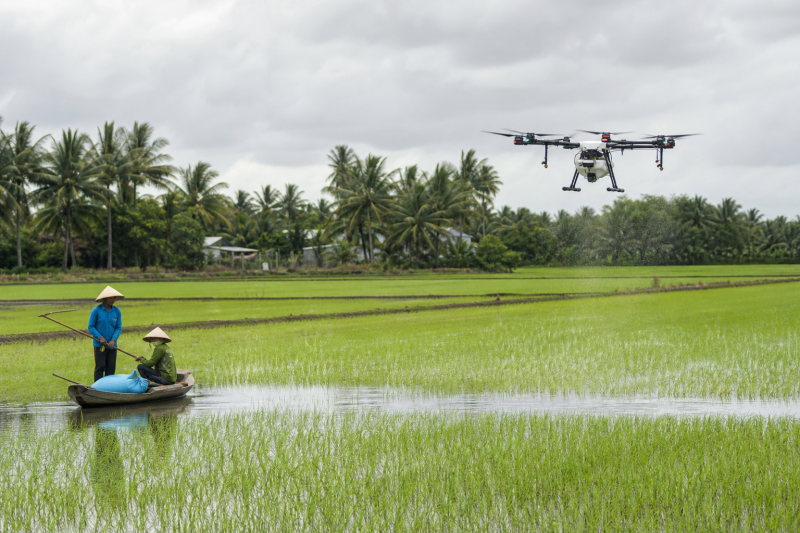


In Vietnam’s Mekong Delta, the argument for agricultural drones is no longer a trade-show video. It is a cooperative flight team, a 50-hectare OM18 rice block, and a cost sheet. Vietnam Agriculture News reported that in the 2026 summer-autumn crop, the An Giang Agricultural Extension Center and Tan Hau A2 Agricultural Cooperative in Tan An Commune ran a “3-in-1” drone model: seeding, fertilizing, and spraying crop-protection products with the same unmanned workflow.
The demonstration’s economics were unusually complete. Total investment was about 21.5 million VND per hectare, more than 3.1 million VND per hectare below the control — nearly 13 percent lower. Yield averaged 6.55 tons per hectare, about 0.5 tons above traditional fields. At a harvest price around 6,500 VND per kilogram for OM18, revenue topped 50 million VND per hectare. The write-up summarized the package as costs down nearly 13 percent, yield up over 8 percent, and profit up over 25 percent.
Those results include cultivation protocols, not only rotors. MSOEN will say that out loud. Drones did not walk into the paddy and invent SRP standards, IPM, straw management, or fertilizer timing. They made those protocols cheaper to execute when labor is short.
Why “3-in-1” is a factory specification, not a slogan
Seeding, broadcasting fertilizer, and spraying liquids are three different flow problems. Seed wants a hopper and a spinner or venturi that does not crack grains. Granular fertilizer wants corrosion-aware plastics and a calibration that does not stripe the field. Liquid plant protection wants a pump, nozzles, and a leak-free tank that can be rinsed before the next chemical.
A cooperative that buys three unrelated machines will triple training and triple spare parts. A cooperative that buys one MSOEN airframe family with swap-out spreading and spraying modules can keep one pilot syllabus. That is what “3-in-1” should mean in a quotation: documented changeover time, two calibration charts, and a rinse procedure. If a vendor only means “our catalog has three SKUs,” you do not yet have a model. You have a brochure.
Mr. Nguyen Van Lach, farming two hectares in the model, said drones cut sown seed, reduced pest pressure, and cut the number of fertilizer and pesticide passes. Stands looked more uniform. That uniformity is the agronomic engine behind fewer sprays: a dense, even canopy is easier to scout and harder for some pests to exploit. Over-sowing is a common Mekong habit when labor is uncertain. Aerial seeding with a measured rate attacks that habit directly.
The five-person flight team is the real product
Tan Hau A2 formed a five-member flight team trained by the extension center on operation, maintenance, and UAV rules. Cooperative representative Tran Chau Phuong Tuan said the point was to stop depending on outside service companies and to keep high-tech skills inside the membership.
MSOEN has watched this pattern across Southeast Asia. The bottleneck is not always the aircraft. It is whether a commune can keep two people who understand batteries, two who mix chemicals, and one who logs flights. A 20-liter MSOEN spraying drone without a local team is a crate. A 10-liter drone with five trained members can cover a 50-hectare block in a campaign if batteries and mixing keep up.
The model received 50 percent support on seed, 50 percent on fertilizer, 30 percent on crop-protection products, and 50 percent on drone investment, plus stage-by-stage training. Buyers outside a subsidy window should not copy the profit percentage blindly. They should copy the staffing: a named flight team, a maintenance person, and a production log. Vietnam’s 1 million hectare high-quality, low-emission rice program is the policy backdrop. Equipment that cannot record what was applied will struggle to stay inside that story.
Regulations still sit above the paddy
Vietnam has tightened civilian drone rules in the last two years, including registration and defense-ministry flight permits for many operations, with agricultural permits that can run for months rather than days. MSOEN aircraft ship with serial identification and payload data that importers can put on a permit file. We do not issue Vietnamese flight permission. Distributors who skip that step strand cooperatives after the first inspection.
Chemical labels and local plant-protection guidance still decide what may be applied by air. A drone that can physically spray a product is not the same as a product approved for aerial application. Extension staff in An Giang combined IPM with the aircraft. That combination is the compliance path, not a firmware feature.
Choosing payload for Delta cooperatives
Fifty hectares is a serious but not gigantic block. A 10-liter MSOEN drone can work it with more refill cycles; a 20-liter class machine matches many Vietnamese service teams; a 30-liter platform helps when several cooperatives share one crew and want fewer mixing stops. Fragmented fields and power lines still favor the smaller, more agile airframe.
For 3-in-1 work, ask MSOEN for:
- A spreading kit rated for rice seed and for the fertilizer granule size you actually buy
- A spray kit with a flow range that can do both low-volume insecticide and higher-volume foliar work if your protocol needs it
- Enough batteries for a tropical day, including heat derating — Mekong afternoons punish packs that looked fine in a catalog
- Spare pumps, propellers, and hopper gates in the first container, not in a later “maybe” order
OEM branding for a provincial cooperative is possible. The flight team will still judge the machine by whether the hopper empties evenly and whether the nozzle boom survives muddy dikes. That is the MSOEN standard we will be measured on in An Giang and everywhere else rice is the cash crop.
FAQ
What does “3-in-1” mean on an MSOEN quotation?
It should mean one airframe family with documented spray and spread swap kits, two calibration charts, and a rinse procedure. If it only means three separate catalog photos, keep asking. Tan Hau A2’s model only works if changeover is a practiced job, not a guess.
Can a five-person cooperative team run a 50-hectare rice block?
Yes, if mixing, batteries, and maintenance are assigned roles. The aircraft is not the whole team. MSOEN recommends naming a maintenance person before the first seeding flight, not after a pump fails at panicle initiation.
Will my farm see a 25 percent profit increase without subsidies?
The An Giang write-up included seed, fertilizer, chemical, and drone-investment support plus SRP and IPM. Copy the flight team and the logs. Do not copy the profit percentage onto an unsubsidized field without a new cost sheet.
Is a 10L drone enough for Mekong rice, or do I need 30L?
A 10L MSOEN drone can work fragmented paddies with more refills. A 20L class machine is the usual service-team balance. A 30L platform helps shared crews on larger, open blocks. Power lines and small plots still favor the smaller airframe.
How do Vietnamese flight permits affect delivery time for imported drones?
Permits are an importer and operator task, including registration and defense-related flight permission where required. MSOEN provides serials and payload data. We do not issue Vietnamese airspace approval. Plan that file before the season, not after the container lands.
Can the same hopper handle rice seed and fertilizer granules?
Only if the kit is rated for both sizes and you recalibrate. Seed damage and fertilizer striping are different failures. Ask MSOEN for the hopper spec and a calibration method for each material.
Why did the model still bother with IPM if the drone sprays?
Because fewer, better-timed passes beat more product. Uniform seeding reduced some pest pressure. A drone that sprays on a bad schedule is just a faster way to waste chemistry. Extension protocols remain the agronomy.
What spare parts should arrive in the first container to An Giang?
Pumps, propellers, hopper gates, nozzles, and extra batteries derated for heat. Muddy dikes punish landing gear. MSOEN would rather over-pack parts than explain a grounded flight team during heading.
Conclusion
Tan Hau A2’s summer-autumn 2026 model showed a Mekong cooperative using drones for seed, fertilizer, and plant protection while cutting cost and lifting yield — inside a trained five-person team and a wider technical package.
MSOEN’s takeaway is to sell 3-in-1 as hardware plus people: modular 10L–30L platforms, tropical battery counts, and parts on the first boat. Profit headlines fade. A cooperative that can seed on Monday and spray on Thursday with the same crew is the durable result.






