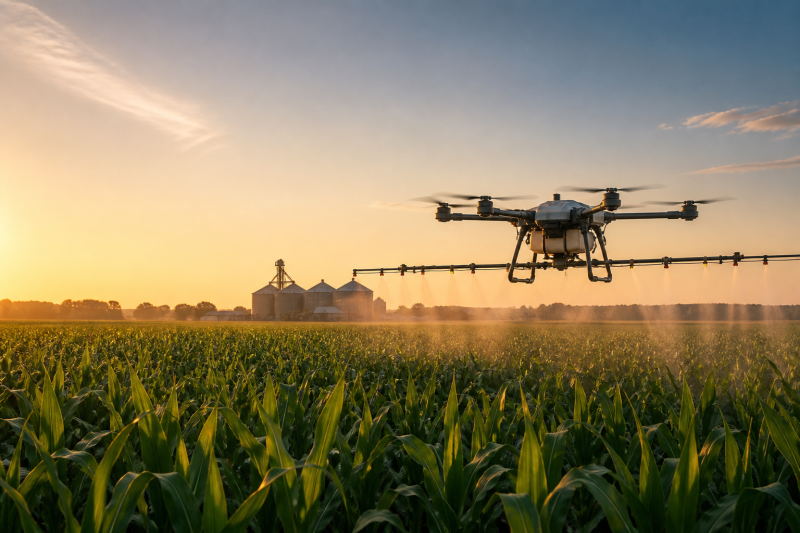


US agricultural drone buyers are entering a more expensive and more uncertain procurement cycle. In August 2026, a White House proclamation added new tariffs on foreign-made drones and components, with the heaviest rates aimed at aircraft above 55 pounds — the weight class that includes most commercial spray drones used on US farms.
For distributors, OEM partners, and farm service operators, this is not only a customs story. It changes how spraying fleets are specified, how spare parts are stocked, and which factories can still supply a complete agricultural UAV system at a workable cost. MSOEN has been watching the same shift from the manufacturing side: payload, battery, pump, and radar are now treated as strategic hardware, not as interchangeable accessories.
What the new tariff structure actually does
According to reporting by Michigan Farm News, the proclamation applies 100% tariffs to many foreign drones exceeding 55 pounds, and 25% to lighter aircraft. Some trading partners, including the European Union, Taiwan, and Japan, are described as receiving lower rates. The same announcement also targets core parts — motors, electronic speed controllers, flight controllers, and radar — so that importing a kit of Chinese components and assembling a “US-built” spray drone is no longer a simple workaround.
That matters because an empty DJI Agras T50 already weighs more than 110 pounds, and an empty XAG P150 is above 115 pounds. In other words, the aircraft that US growers actually use for pesticide and fertilizer work sit in the highest tariff band. Aerosol drones used for spraying and seeding were explicitly named as affected products in industry comments.
The policy is being justified on national-security grounds. The White House fact sheet frames drones as dual-use systems and argues that heavy dependence on foreign UAS components creates supply-chain and cybersecurity risk. Commercial agriculture is therefore being pulled into a defense-industrial argument, even when the end user is a Midwestern custom applicator rather than a military program.
This sits on top of FCC restrictions, not instead of them
Tariffs are arriving after a separate Federal Communications Commission process. In December 2025, the FCC added certain foreign-made drones and critical components to its Covered List, limiting new equipment authorization. Follow-on action has targeted rebadged versions of restricted platforms. Operators can generally keep flying aircraft they already own, but the same model may become difficult or impossible to buy as a new unit.
The practical result for a farm business is a two-layer constraint:
- Radio and equipment authorization can block a new import even before customs duty is calculated.
- If the aircraft can still enter, a 25% or 100% tariff can erase the price advantage that made Chinese spray drones competitive in the first place.
MSOEN’s view is that buyers should treat FCC authorization and tariff classification as two different checklists. One is about whether the aircraft is allowed onto the US market. The other is about how much landed cost the same aircraft will carry if it is allowed.
Why US growers feel the shortage first
Demand is not falling. The American Spray Drone Coalition’s 2025 Impact Survey reported that US operators treated 16.4 million acres of cropland in 2025, a jump of nearly 59% from 2024. That growth happened on fleets that still depend on imported heavy-lift spray platforms and on batteries, pumps, and sensors that are concentrated in a few Asian supply chains.
US dealers have already said that a 100% American-made spray drone is extremely difficult. Lithium batteries, in particular, remain hard to source entirely outside China. Companies are working toward more domestic content, but a complete homegrown bill of materials is not a near-term substitute for the aircraft currently covering those 16 million acres.
That is why tariff news moves quickly from Washington into dealer quotes. If a 40-liter class spray drone is the only practical way to cover a corn or soybean contract in a short weather window, a doubled import cost does not wait for a future US factory to catch up. Growers either pay more, delay fleet expansion, or look for remaining legal channels — including partners in countries with lower duty rates, or factories that can document origin, spare-parts policy, and after-sales support more clearly than a grey-market listing.
What international manufacturers should change in 2026
MSOEN’s recommendation to overseas distributors is to stop selling “a drone” and start selling a documented system:
- Weight class and payload. Be explicit about empty weight versus operational weight. Many commercial spray drones will remain in the over-55-pound band even after a tank is emptied.
- Origin of critical parts. Motors, ESCs, flight controllers, GNSS, and radar should be listed, because those items are now political as well as technical.
- Spare parts and batteries. A banned or tariffed airframe is painful; a banned battery and pump pipeline is worse, because it grounds the fleet the grower already paid for.
- Local compliance path. US customers still need FAA registration, Part 137 agricultural aircraft authority or the relevant exemption, and radio authorization. Factory support should include the paperwork pack, not only a shipping crate.
MSOEN already builds agricultural spraying and spreading platforms across a wide payload range, with modular tanks and OEM/ODM options for distributors who need private-label supply. In a tighter US market, that kind of factory documentation — configuration list, spare-parts catalog, and after-sales channel — is becoming as important as the sticker price.
What buyers should ask before placing an order
If you are importing or specifying spray drones for 2026–2027, ask the factory these questions in writing:
- What is the empty weight and the maximum takeoff weight of the exact configuration being quoted?
- Which components are of Chinese origin, and which can be substituted?
- Is there a current equipment-authorization path for the radio system in the destination country?
- How many batteries, chargers, pumps, and nozzles are included, and how fast can replacements ship if the airframe policy changes?
- Can the manufacturer support training, warranty, and crash-repair parts for at least one full spraying season?
MSOEN’s position is straightforward. Precision spraying still reduces overlap, labor, and chemical waste when the aircraft is calibrated correctly. Policy does not cancel that agronomic case. It does change who can deliver a legal, serviceable aircraft at a price a farm contractor can finance.
Conclusion
The US is trying to onshore more of the drone stack while US farms are already scaling aerial application. Those two facts are in tension. Until domestic heavy-lift spray platforms and batteries are truly available at volume, landed cost, authorization, and spare-parts security will decide which factories remain relevant to American agriculture.
MSOEN will continue to supply agricultural UAV platforms and OEM configurations for markets where import rules still allow professional spraying equipment to move. Buyers who need a factory quote, a spare-parts list, or a payload configuration for their crop should treat 2026 procurement as a compliance project, not as a simple price comparison.







No comments yet