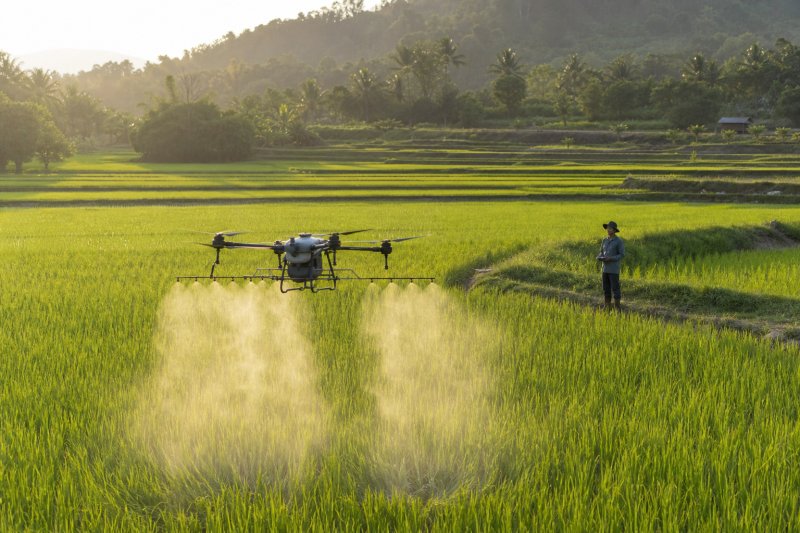


Thailand is not waiting for a single national “drone moment.” It is training people, measuring plots, and treating agricultural UAVs as a labor tool. Nation Thailand reported that Aeronautical Radio of Thailand’s “Safe Agricultural Drones: Nakhon Phanom Model” used a 22-rai demonstration of Kor Khor 22 glutinous rice in Tha Uthen district. Drone-assisted farming cut rice seed use by 52 percent, fertilizer use by 25 percent, and labor costs by 41 percent. Average yield reached 1,100 kilograms per rai — 250 kilograms more than the conventional comparison — and net income was about 5,254 baht per rai, 2,509 baht higher than traditional practice.
Those figures belong to that demonstration, that variety, and that season. MSOEN will not pretend every Thai farm will reprint them. The direction is still clear. AEROTHAI said farm-drone use is growing more than 20 percent a year, with more than 200,000 agricultural drones already working in rice, orchards, and other crops. When a country talks in hundreds of thousands of aircraft, the factory question is no longer “Will farmers try drones?” It is “Who will train the next operator and who will stock the next pump?”
Three fronts at once: field, school, and license
The National Research Council of Thailand and the Radio Control Airplane Modeler Sport Association have been opening drone technology learning centers at vocational colleges. Centers listed for 2026 include Sena Industrial and Community Education College in Ayutthaya, Chiang Rai Technical College, Srisamrong Industrial and Community Education College in Sukhothai, and Lampang Technical College. The brief is broader than a weekend hobby class: basic operation, then local innovation, then a path into service work.
The Department of Agricultural Extension ran a “Drones for Agriculture” workshop at Saen Palm Training Home in Kamphaeng Saen, Nakhon Pathom. One hundred twenty farmers, four groups of 30, each on a two-day course between 24 and 31 May 2026. The syllabus covered law and permits, maintenance, and responsible flying. Director-General Anchalee Suvachittanont said the goal is not only on-farm use. It is to grow community service providers who can sell spraying and knowledge to neighbors.
MSOEN has seen this pattern in other Southeast Asian markets. The first wave is custom application: a few skilled pilots treat many small paddies. The second wave is farmer-owned 10-liter to 16-liter aircraft for the family’s own fields. The third wave is cooperatives that want 20-liter and 30-liter machines plus a spare-parts locker. Thailand is funding all three at once. A manufacturer that only ships a 50-liter flagship will miss the vocational student who will be next year’s operator.
What the Nakhon Phanom numbers actually imply for equipment
A 52 percent cut in seed is a seeding-drone story as much as a spraying-drone story. Uniform broadcasting from the air can reduce the urge to over-sow “just in case.” A 25 percent fertilizer cut points to placement and timing, not to a magic tank. Labor down 41 percent is the number that sells in a tight rural workforce: fewer people walking with backpacks in wet fields.
MSOEN spreading systems and spraying systems are often modular on the same airframe family. A Thai cooperative that wants “one aircraft, three jobs” should ask for a quick-swap hopper and a leak-tested spray boom, not two unrelated toys. Granules and liquids need different flow calibration. If the learning center teaches only spraying, the seed savings in Nakhon Phanom will not travel.
Twenty-two rai is a demonstration scale — a little over 3.5 hectares. Daily productivity claims should be built from tank size, swath, and battery count, not from one plot’s yield. For small and fragmented paddies, a 10-liter MSOEN drone is easier to move between bunds. For larger commercial rice in the Central Plains, a 20-liter or 30-liter platform reduces refill walks along the dike. Orchards — durian, longan, citrus — need obstacle sensing more than they need the largest tank.
Regulation is part of the training syllabus
Thai commercial operators have been moving under a tighter Civil Aviation Authority of Thailand framework in 2026, including registration and licensing pathways that did not exist in the same form a decade ago. MSOEN cannot fly the CAAT portal for you. We can ship aircraft with identifiable serials, bilingual manuals, and a weight-and-payload sheet that matches what a registrar will ask. If your importer cannot explain insurance and flight-plan rules, the learning-center graduate still cannot work.
Training centers also create a spare-parts market. Students break landing gear. Farmers wear out nozzles in abrasive mixes. The factory that wins Thailand is the factory that puts propellers, pumps, and seals in Bangkok or a regional hub, not the factory that wins a single tender and disappears.
How MSOEN would kit a Thai distributor in 2026
Offer three layers:
- A 10-liter to 16-liter spraying drone for smallholders and first-time students, with a simple charger that runs on common farm power.
- A 20-liter class workhorse for service teams, with RTK if the customer maps paddies and returns to the same lines.
- A spreading kit for seed and fertilizer on the same airframe family, so the Nakhon Phanom “cut seed, cut fertilizer” story can be attempted with one pilot team.
Add a training pack: a laminated pre-flight card in Thai, a nozzle chart, and a recommended battery rotation for an eight-hour day. If the Department of Agricultural Extension is teaching 120 farmers at a time, those farmers will compare notes. The aircraft that needs a secret password for every calibration will lose to the aircraft that a vocational instructor can demonstrate twice.
MSOEN can OEM the airframe in the distributor’s colors and still keep the same powertrain. Local branding helps when a province wants “Thai-facing” service. The flight controller still needs the same spare ESC. Do not confuse a sticker with a service network.
FAQ
Can a Thai smallholder copy the Nakhon Phanom 52 percent seed saving on day one?
Treat those figures as a managed demonstration, not a guarantee. Seed savings need a calibrated spreading drone and a disciplined rate. MSOEN will help you spec a hopper; agronomy and training still decide the result.
What tank size fits fragmented Thai rice paddies?
A 10L or 16L MSOEN spraying drone is usually easier to carry across bunds. Larger 20L–30L machines help when fields are open and a service team wants fewer refills. Match the aircraft to the dike, not to a YouTube clip.
Does Thailand need spreading drones or only sprayers?
The Nakhon Phanom story cut seed and fertilizer as well as labor. Ask for a modular MSOEN platform that swaps spray and spread kits. Three unrelated machines triple spare parts.
Are vocational drone centers a reason to buy cheaper uncertified aircraft?
No. Students become operators who will be inspected. Serial numbers, weight sheets, and CAAT-facing documentation matter. MSOEN ships identifiable airframes; cheap clones become classroom liabilities.
How many farmers can one two-day course really prepare?
A short course starts safety and law. It does not replace season-long mentoring. Distributors should plan follow-up, not only a graduation photo. MSOEN manuals and pre-flight cards are meant for that second week in the field.
What charger should I specify for Thai farm power?
Ask for a kit that runs on the voltage the shop actually has. Do not assume three-phase. Heat and humidity also cut battery performance. Quote extra packs for tropical afternoons.
Is a 30L drone the right demo machine for a learning center?
Often a 10L–16L MSOEN trainer is safer and cheaper to crash-learn on. Keep the 30L for commercial service teams that already have mixing and transport. Training and production are different payloads.
Do I still need insurance if the government is promoting farm drones?
Yes. Promotion is not a waiver. CAAT rules, local permits, and liability cover remain the operator’s job. MSOEN can provide spec sheets for underwriters; we cannot underwrite the flight.
Conclusion
Thailand is scaling agricultural drones through plots, colleges, and extension courses at the same time. The Nakhon Phanom demonstration put seed, fertilizer, labor, and income on one page. Growth above 20 percent a year, with a large installed base, means the market is already operational.
MSOEN’s takeaway is to kit distributors in layers: a small trainer, a 20L workhorse, a spread-and-spray module set, and parts in-country. Train for permits as well as sticks. The aircraft that wins is the one a Kamphaeng Saen graduate can maintain after the two-day class ends.






