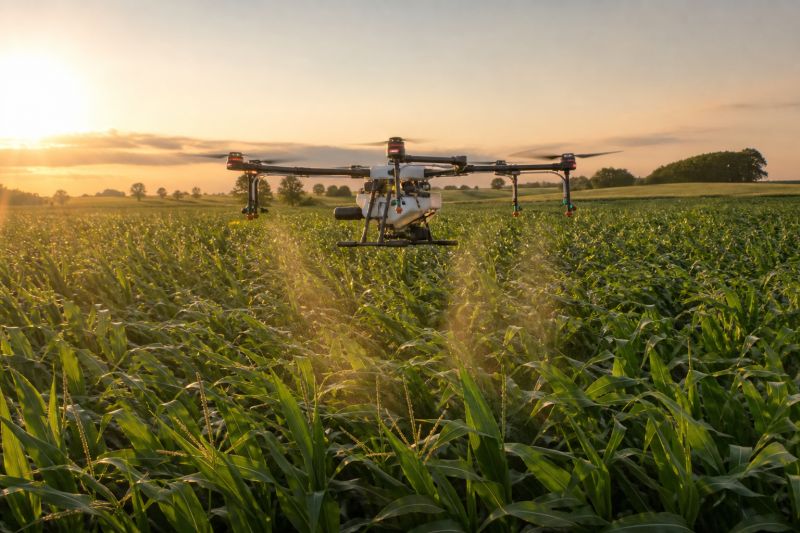


Farmers who once treated a drone as a weekend gadget are now parking one next to the pickup as a working machine. That shift is not because a spray drone magically replaces a self-propelled boom. It is because the aircraft can treat a crop at the moment the crop actually needs it — after a rain when weeds are vulnerable, at night when uptake is better than a hot afternoon airplane pass, or when the ground is too wet for a 3,000-gallon rig.
That is the return-on-investment story coming out of U.S. row-crop country in 2026. Missouri-based Agri Spray Drones founder Taylor Moreland told DTN/Progressive Farmer that growers are no longer buying toys. They are buying a way to apply fungicides, insecticides, biologicals, and foliar nutrition when a custom applicator or a crop-duster cannot arrive on the same day. MSOEN sees the same conversation from distributors: buyers do not ask “Can a drone spray?” They ask “When does a drone make more money than waiting?”
A drone is not a small boom sprayer
Moreland’s most useful warning is also the one manufacturers should repeat. A spray drone is closer to a low-volume aerial applicator than to a ground rig. Typical drone rates in the U.S. Midwest are often discussed around 2 gallons per acre. If the job truly needs high water volume, a ground sprayer is usually the better tool. If the job is a timely, low-volume pass into a tall canopy, the drone has a job that the boom cannot do without crushing rows.
MSOEN builds agricultural spraying drones with tank options that commonly range from about 10 liters to 50 liters and above, depending on the model and the legal takeoff weight in the destination country. A larger tank does not automatically produce a better ROI. A 30-liter aircraft that sits in the shed because nobody has batteries, nozzles, or a refill plan will lose to a 16-liter aircraft that flies every morning at 5 a.m.
The rotor downwash is part of the agronomy, not a marketing slogan. The downward column of air can push droplets into a tall corn canopy, including the underside of leaves, without driving a machine through the rows. University of Missouri work has also shown that ground sprayers can beat drones on herbicide coverage, uniformity, and off-target movement in some tests. That is not a contradiction. It means operators should match the tool to the product: systemic fungicides and many insecticides often tolerate a drone’s deposition pattern; contact herbicides may not.
Where the money actually shows up
Timeliness is the first ROI driver. If a grower waits three days for a plane or a custom applicator, disease or insects do not wait. A farm-owned drone can fly the same afternoon the scout finds the problem, provided the operator already holds the required certificates and the product label allows aerial application.
The second driver is access. Tyler Ediger, farming near Meade, Kansas, told DTN that a wet August left the ground rig idle just as sorghum needed desiccation. The family sprayed a full section — 640 acres — with the drone, 28 feet at a time, rather than compact the soil. That is not a laboratory claim. It is a field decision: yield and soil structure versus hours of extra flying.
The third driver is targeted work. A mapping flight can mark weedy patches, nutrient-deficient spots, or field borders. The spray aircraft then flies those polygons instead of the whole field. You save product, you save time, and you do not run over the crop. The same narrow swath is useful for on-farm product trials, where a grower wants strip-to-strip comparison without a 120-foot boom.
Night and early-morning windows are a fourth driver. Ediger noted better plant intake than a midday airplane pass. Cooler air, lower wind, and less evaporation help deposition. Operators still have to respect lighting, visibility, and local rules. A factory that ships aircraft without a reliable lighting package and a clear night-operation checklist is not serving commercial users.
What U.S. operators must budget besides the airframe
The sticker price of a popular spray drone is a fraction of a new ground sprayer. That comparison is incomplete. In the United States, commercial spraying generally requires:
- An FAA Part 107 Remote Pilot Certificate
- A Part 137 Agricultural Aircraft Operator Certificate
- A Section 44807 exemption when the aircraft weighs 55 pounds or more at takeoff, which most loaded spray drones do
- A commercial pesticide applicator license with the aerial category where the state requires it
- Liability insurance written for agricultural UAV work
MSOEN’s advice to U.S. importers is to treat those items as part of the capital plan, not as paperwork after the crate arrives. Training time also has a cost. Moreland pointed out that bringing a drone onto the farm usually adds a job the family used to hire out — and that job lands in the middle of summer, when people are already busy.
Battery logistics decide daily acres more than tank size. A professional kit typically needs multiple intelligent batteries and a high-power charger so one set flies while another charges. If a charger needs three-phase power for the advertised eight-minute cycle, a farm shop on single-phase power will not match the brochure numbers. Ask the factory for full-load flight time, charge time, and how many batteries are included before comparing “price per drone.”
How MSOEN would spec a farm that is buying for ROI, not for a photo
Start with the crop and the product, not with the largest tank on the website.
For fragmented fields, terraces, pivot corners, and tree lines, a 10-liter to 16-liter MSOEN spraying drone is often the practical first aircraft: easier to transport, easier to fly near obstacles, lower battery demand. For medium commercial work — several hundred acres of timely fungicide — a 20-liter class machine is the common balance between refill frequency and handling. For large, open blocks where refill time dominates the day, a 30-liter or larger platform can reduce cycles, but only if the operator has the truck, mixing, and charging to keep it in the air.
Ask for a configuration sheet, not a slogan:
- Empty weight and maximum takeoff weight
- Effective spray width at the recommended height and speed
- Pump flow range and nozzle options
- Full-load endurance with the batteries in the quote
- Radar or vision obstacle avoidance, especially for orchard edges and power lines
- Spare parts list: propellers, pumps, nozzles, landing gear, and a second battery set
MSOEN can OEM or ODM those packages for distributors who need local branding, English manuals, and a spare-parts carton that arrives with the first aircraft. A farm that cannot replace a pump in 48 hours does not have an ROI story. It has a grounded machine during the only week the disease window is open.
What not to expect
Do not expect a drone to match a ground rig on high-volume herbicide in a University of Missouri-style coverage test. Do not expect fully autonomous, unattended spraying as a legal default in the next season. Moreland’s five-year comment about regulations catching up with autonomy is a forecast, not a shipping date. Visual-line-of-sight rules, waivers, and product labels still sit between the aircraft and the field.
Do not invent a payback period from a brochure. Calculate it from missed application days, custom applicator rates, compaction risk, and the acres you can actually treat with the battery set you will buy. If those numbers are thin, keep the drone in a scout-and-spot-spray role and let the boom do the rest.
FAQ
Is a spray drone a cheaper replacement for a self-propelled boom sprayer?
Usually no. MSOEN treats a spray drone as a low-volume aerial tool for timely, targeted, or wet-field work. High-volume herbicide jobs still often belong on a ground rig. Compare missed spray days and compaction risk, not only the sticker price of the airframe.
Which products give the best return on a farm-owned spray drone?
Fungicides, many insecticides, biologicals, and foliar nutrition are the usual candidates because timing and canopy penetration matter. Contact herbicides can disappoint if coverage is uneven. Always follow the product label for aerial application.
Do I need Part 137 and a 44807 exemption for an MSOEN spray drone in the United States?
If you dispense crop-protection products, Part 137 generally applies. Most loaded spray drones weigh 55 pounds or more and also need a Section 44807 exemption plus a Part 107 certificate. Budget licenses and insurance before the crate arrives.
Can I spray at night with an agricultural drone?
Some U.S. growers do, because cooler air can improve uptake. You still need legal lighting, visibility, and certificate conditions. MSOEN can supply lighting packages; we cannot waive FAA rules.
How many batteries should I buy with a 20L agricultural drone?
Plan a rotation: flying, charging, and cooling. A single pack will not support a commercial day. Ask MSOEN how many intelligent batteries and what charger input power are in the quoted kit.
Will rotor downwash always beat a ground sprayer on coverage?
No. Downwash can help in tall corn. University tests have also shown ground sprayers winning some herbicide coverage comparisons. Put water-sensitive cards in your own canopy before you change the whole farm’s program.
Is a 30L MSOEN drone automatically better ROI than a 10L model?
Only if you have acres, mixing, and charging to use the extra tank. On broken fields, a 10L or 16L aircraft can treat more hours with less handling. ROI is treated hectares per day, not liters on the brochure.
Conclusion
The 2026 U.S. spray-drone conversation has matured. Growers are buying aircraft to hit a timing window, to fly when the ground is wet, and to treat edges a boom or a plane handles badly. They are not buying a miniature 120-foot sprayer.
MSOEN’s practical takeaway is to spec the mission first: product type, legal stack, battery count, and a speed-and-height setting you can verify on cards. Choose a 10L, 20L, or 30L MSOEN platform against that mission. The farm that calculates missed days and compaction will see ROI. The farm that only compares catalog prices will not.






