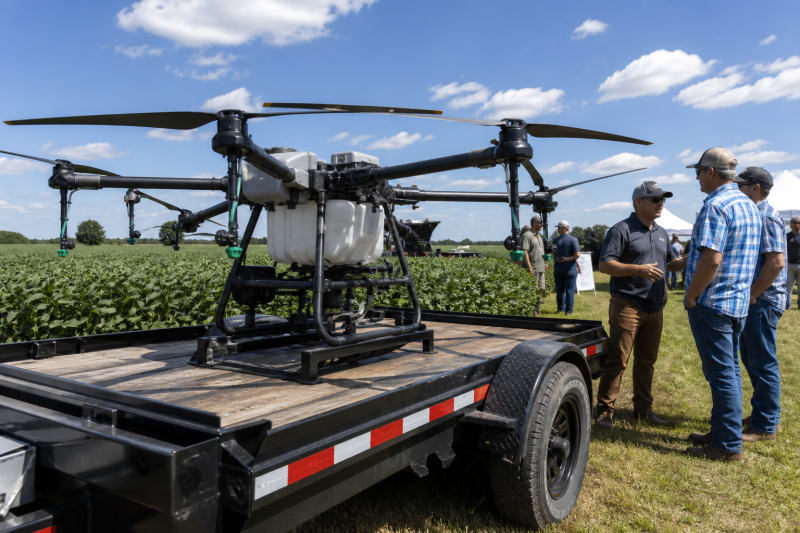


Minnesota Farmfest is not a gadget show. It is where southern Minnesota growers walk past grain carts, planters, and spray booms and decide what they will actually park in the yard. In late August 2026, five unmanned-aircraft vendors set up in Redwood County and treated spray drones as ordinary crop-protection tools: Drone Nerds, CRK Aerial, Frontier Precision Agriculture, Mountain View Ag, and TerraXplore.
That mix matters to a manufacturer such as MSOEN. The people on those booths were not only selling airframes. They were selling flight instruction, seasonal parts, and a story about edges, power lines, and canopy deposition that a 120-foot boom cannot tell. If you are choosing a factory partner for the U.S. Midwest, Farmfest is a useful snapshot of how the channel really works.
Dealers, not just aircraft, are the product
Daniel Nelson, owner of Mountain View Ag in Mountain Lake, told the Journal that 2026 is year one for the company name, after about four years in the spray business. The shop now covers Mountain Lake, Morris, and Olivia. The pitch is blunt: sell the drone, teach the farmer to fly it, then stay on the phone when a pump, propeller, or software question appears mid-season. Nelson said the firm has about 80 aircraft active in the region.
That is the after-sales model MSOEN recommends to export distributors. A crate of drones without a local parts shelf becomes a liability during a 10-day fungicide window. Mountain View Ag’s booth staffing — a long list of technicians and sales people at a single farm show — is itself a signal. Midwest growers expect a person they can call, not a ticket queue in another time zone.
CRK Aerial, based in Hancock, brought heavy-lift spray and spreading machines, including models shown as the Ceres Air Black Betty and the XAG P150 Max USA. Dustin Schluter, a Wood Lake farmer who also does custom work, said more neighbors still hire custom spray, but more farmers are buying their own aircraft. Fungicide is the wedge: airplanes still cover a lot of acres, he said, but drones take a growing share when the job is local, timely, and close to obstacles.
TerraXplore attended as an Iowa-based DJI Agras dealer emphasizing parts and post-sale support. Frontier Precision Agriculture, with a Morris location, put spray aircraft next to mapping and precision-ag services. Drone Nerds brought a broader enterprise lineup that also covers public safety. The pattern is the same: agriculture is no longer a side SKU. It is a full product line with training attached.
Why growers say they care about edges and downwash
Nelson’s agronomic argument is the one MSOEN hears from orchard and rice buyers as well. A multi-rotor holds a more consistent height than a crewed airplane on a short field. It can treat corners, tree lines, and ground under power lines that a boom or a plane handles poorly. Rotor downwash then pushes spray into the canopy instead of leaving a film on the top leaves.
Schluter cited Beck’s Practical Farm Research comparisons of ground rigs, airplanes, and multi-rotor drones. In those trials, he said, drones showed better coverage than both the plane and the ground rig when pilots flew them correctly. Independent trial brands are not MSOEN laboratory data, and operators should read the actual PFR write-up for crop, rate, and weather. The manufacturer takeaway is still fair: coverage is a function of height, speed, nozzle, and pilot discipline, not of the word “drone” on the box.
The hidden spec: batteries, chargers, and farm power
CRK Aerial’s Clint Ditterman described a typical complete package as six heavy-duty batteries and two chargers so the aircraft can rotate all day. He said a battery can recharge in about eight minutes on the right charger, and that operators often empty the tank before they empty the battery — unless they are spraying around two gallons per acre, when liquid lasts longer and energy becomes the limit.
Those eight minutes assume industrial power. Ditterman noted that three-phase charging is faster; single-phase works but slower. This is the sort of detail a factory quote should print in large type. An MSOEN 20-liter or 30-liter spraying drone that looks inexpensive on Alibaba becomes expensive if the buyer must add a generator, a three-phase panel, or a second charger after the first week of harvest-season humidity.
MSOEN configurations for commercial export usually include intelligent lithium batteries, a matching charger, and a recommended rotation: while one pair flies, another pair charges, and a third pair cools. Ask how many cycles the cells are rated for, what the charger input voltage is, and whether the remote controller and radar are in the same crate. Farmfest buyers were not shopping for a single aircraft. They were shopping for a day’s worth of acres.
Licenses on the booth table
Schluter walked visitors through the U.S. stack: Part 107 for the remote pilot, a commercial applicator license with the aerial category for custom spray, and an FAA exemption to fly aircraft over 55 pounds. That is the same stack MSOEN prints in U.S. buyer guides. A dealer who hides it will lose trust the first time a grower Googles “44807.”
Software updates are part of the same conversation. Schluter said improvements arrive almost weekly. That is both a benefit and a support cost. Distributors need a technician who can walk a farmer through a firmware update without bricking a machine the night before a spray day. MSOEN’s factory support is built around that: English documentation, remote diagnosis, and spare pumps and ESCs that can ship with the next sea freight, not six months later.
What a China OEM should learn from a Minnesota farm show
First, the Midwest channel is local. Growers buy from people who already spray corn and soybeans, not from a website screenshot. If you want MSOEN aircraft in Minnesota, you need a dealer who can train, stock nozzles, and roll a service trailer.
Second, the comparison set is airplanes and ground rigs, not other toy drones. Your spray width, flow rate, and downwash story have to survive a conversation next to a 90-foot boom.
Third, the package is batteries plus power plus licenses. Quote the kit that can work a full day. A 10-liter MSOEN drone can still be the right machine for small or broken fields; a 30-liter class machine is the right conversation for custom applicators who live on refill time. Neither sale is complete without charging infrastructure and a parts promise.
Fourth, mapping dealers and spray dealers are standing next to each other. Frontier Precision’s presence is a reminder that some farms will buy a scout aircraft first and a sprayer second. MSOEN already builds both spraying and spreading platforms; pairing a survey workflow with a spray workflow is how you stay in the same farm account for more than one season.
FAQ
Why do Midwest dealers sell training with the drone instead of just the aircraft?
Because a spray drone without a local technician is idle during the fungicide window. MSOEN designs export kits for dealers who can teach Part 107 flying, stock nozzles, and answer radio questions at 5 a.m. The airframe is only half of what Farmfest buyers were shopping for.
How many batteries come in a typical U.S. commercial spray-drone package?
Dealers at Farmfest described kits with about six heavy-duty batteries and two chargers so the aircraft can rotate all day. Confirm the count in your MSOEN quotation. Brochure flight time means little if you have one pack.
Does a spray drone really cover field edges better than an airplane?
A multi-rotor can hold a steady height in corners, along tree lines, and near power lines where a crewed aircraft is awkward. That is a handling advantage, not a promise of higher yield. Swath, speed, and nozzles still decide deposition.
Do I need three-phase power to charge agricultural drone batteries?
Fast chargers often prefer three-phase. Single-phase usually works more slowly. Ask MSOEN for charger input voltage before you assume an eight-minute cycle in a farm shop.
What FAA papers did Minnesota custom applicators mention at Farmfest?
Part 107 for the remote pilot, a state commercial applicator license with the aerial category for hire work, and an exemption to fly aircraft over 55 pounds. MSOEN will list those requirements; we do not issue the certificates.
Should a first-time Minnesota grower start with a 30L drone?
Not automatically. Smaller 10L–16L MSOEN models are easier to trailer and to fly around obstacles. Custom applicators who live on refill time are the usual 20L–30L buyers, and only with a real charging plan.
Is mapping worth buying if I already want a spray drone?
Often yes. Spot-spray maps and scouting pay for themselves when you do not treat the whole field. MSOEN can support spray and spread platforms; a light scout aircraft or a dealer mapping service can feed those jobs.
Conclusion
Farmfest 2026 showed southern Minnesota treating spray drones as farm iron: sold with lessons, batteries, and a parts counter. Coverage and downwash stories sat next to license talk and three-phase chargers.
MSOEN’s takeaway for U.S. distributors is to arrive as that kind of dealer. Quote a day-long battery kit, print the FAA stack, and match tank size to fields and power — 10L for broken ground, 20L or 30L for commercial refill economics. The show winner is not the loudest hexacopter. It is the brand still answering the phone in August.