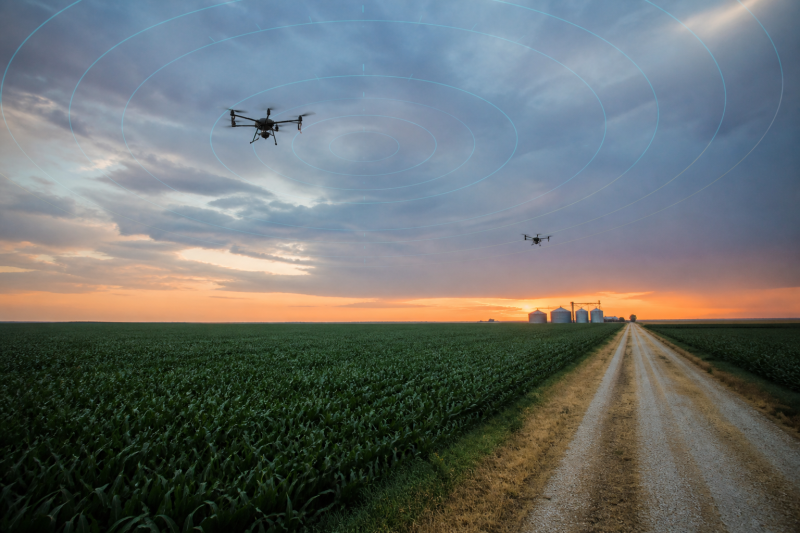


Most agricultural drones today still fly under visual line of sight. A remote pilot watches the aircraft, a spotter stands in the field, and the spray job stops at the edge of what a person can see. That model works for a 20-hectare orchard block. It does not scale cleanly across Kansas wheat country.
In late August 2026, Thales and Kelly Hills Unmanned Systems said they would deploy a beyond-visual-line-of-sight (BVLOS) network in Kansas for farm operations. The project is backed by a USD 3 million contract awarded by the Kansas Legislature in February, and it is being developed with the Kansas Department of Agriculture. For a manufacturer such as MSOEN, this is the kind of airspace news that eventually shows up in customer specifications: longer routes, fewer observers, and more pressure on detect-and-avoid hardware.
What the Kansas network is trying to prove
According to Unmanned Airspace, the initial use cases are the jobs growers already understand: crop spraying, scouting, fertilizing, and seeding. The difference is not the payload. The difference is that the aircraft is expected to work over extended distances without a person keeping it in direct sight.
Thales is contributing airspace-management infrastructure through its TopSky platform, which the company says is used in more than 100 countries and handles a large share of global air traffic. Kelly Hills brings commercialization experience in agricultural unmanned systems. Together they are positioning Kansas as a test bed that could later be copied in other US states, building on Thales work with North Dakota’s Vantis BVLOS system and a secure FAA data enclave for UAS flight data.
That combination — state agriculture department plus an air-traffic vendor plus a local unmanned-systems company — is more interesting than a single demo flight. It treats spraying drones as traffic in shared airspace, not as gadgets flown in an empty field.
Why BVLOS is the bottleneck for commercial spraying
A spray drone’s tank is only useful if the aircraft can keep moving. Visual-line-of-sight rules force operators to break large farms into small visual bubbles. Each bubble needs people, vehicles, and radio coverage. On a 1,000-acre farm, labor for watching the sky can cost more than the chemical in the tank.
BVLOS is supposed to invert that cost structure:
- One operations center can supervise multiple aircraft.
- Flight plans can follow field boundaries instead of the observer’s walking path.
- Refill points can be placed for logistics, not for line of sight.
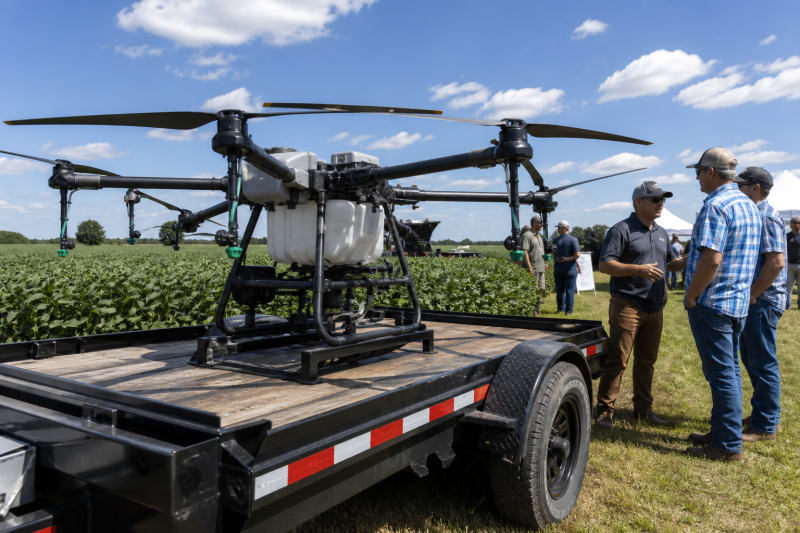
MSOEN platforms are already designed around that operational logic even when the local rule still requires a visual observer. Modular spray and spread tanks, route planning, terrain following, and obstacle sensing exist because the aircraft has to repeat a pattern without the pilot “hand flying” every pass. BVLOS does not replace those functions. It demands that they work when the pilot is no longer standing in the next field.
What factories should expect buyers to ask next
If Kansas-style networks spread, distributors will stop asking only about tank size. They will ask whether the aircraft can participate in a managed airspace system. MSOEN’s engineering checklist for that conversation looks like this:
- Reliable command and telemetry. Long-range links, lost-link behavior, and return-to-home that does not overfly people or livestock unpredictably.
- Detect and avoid. The Kansas project explicitly includes detect-and-avoid support around people, property, and other aircraft. A spray drone that can only see a tree in front of the camera is not enough.
- Repeatable mission files. Field boundaries, no-spray zones, and refill points must be stored and reused. BVLOS without a stable mission file is just a longer way to get lost.
- Swarm or multi-aircraft sequencing. Large farms will want more than one aircraft on adjacent lines. That requires timing, geofencing, and a ground station that can show more than a single map pin.
- Maintenance that matches flight hours. If the aircraft flies farther, pumps, nozzles, and batteries cycle harder. Spare-parts lead time becomes a safety issue, not only a commercial one.
MSOEN already supplies agricultural UAVs with GPS navigation, automated route planning, and modular spraying/spreading hardware for OEM and ODM partners. The Kansas announcement is a reminder that those features are no longer “nice to have” marketing lines. They are the minimum language a BVLOS operator will put in a tender.
What this does not change
BVLOS does not cancel pesticide labels, weather limits, or the need to calibrate spray flow against ground speed. A longer flight path with the wrong nozzle still wastes chemical. MSOEN’s field recommendation stays the same: match flow, speed, height, and droplet size to the crop, then test with water-sensitive cards before treating the whole farm.
It also does not automatically make every country ready for the same operations. Kansas is building on a specific US state contract and FAA-facing infrastructure. Buyers in Southeast Asia, Africa, or Latin America still need local aviation approval. The useful export of the Kansas project is the architecture — airspace service, agricultural use case, and detect-and-avoid — not a copy-paste of US law.
Conclusion
Visual-line-of-sight spraying built the first generation of agricultural drone businesses. BVLOS is how the second generation will cover whole counties instead of single fields. The Thales and Kelly Hills network in Kansas is an early, well-funded attempt to make that shift concrete.
MSOEN’s role in that shift is the aircraft and the factory support behind it: payload options from small orchard units to heavy spray platforms, modular tanks, and OEM customization for distributors who will have to prove that their fleet can live inside a managed sky. Operators who are planning 2027 spraying capacity should ask not only “how many liters” but “how far can this aircraft work when nobody is standing in the next row.”


No comments yet