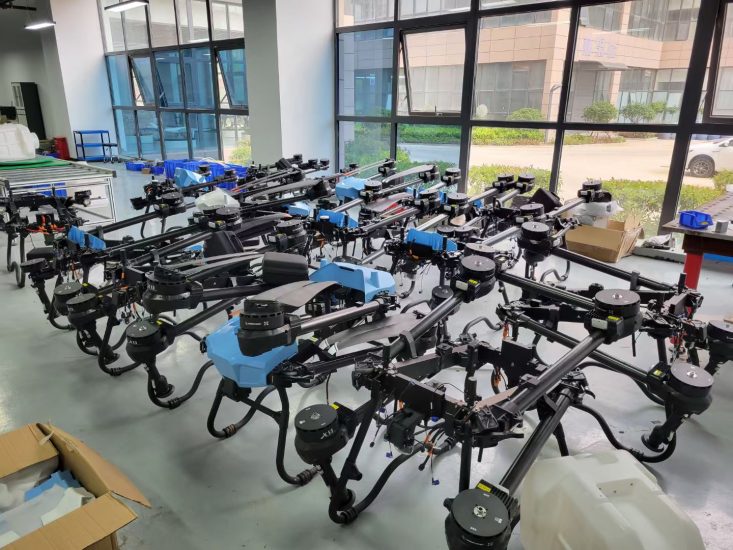


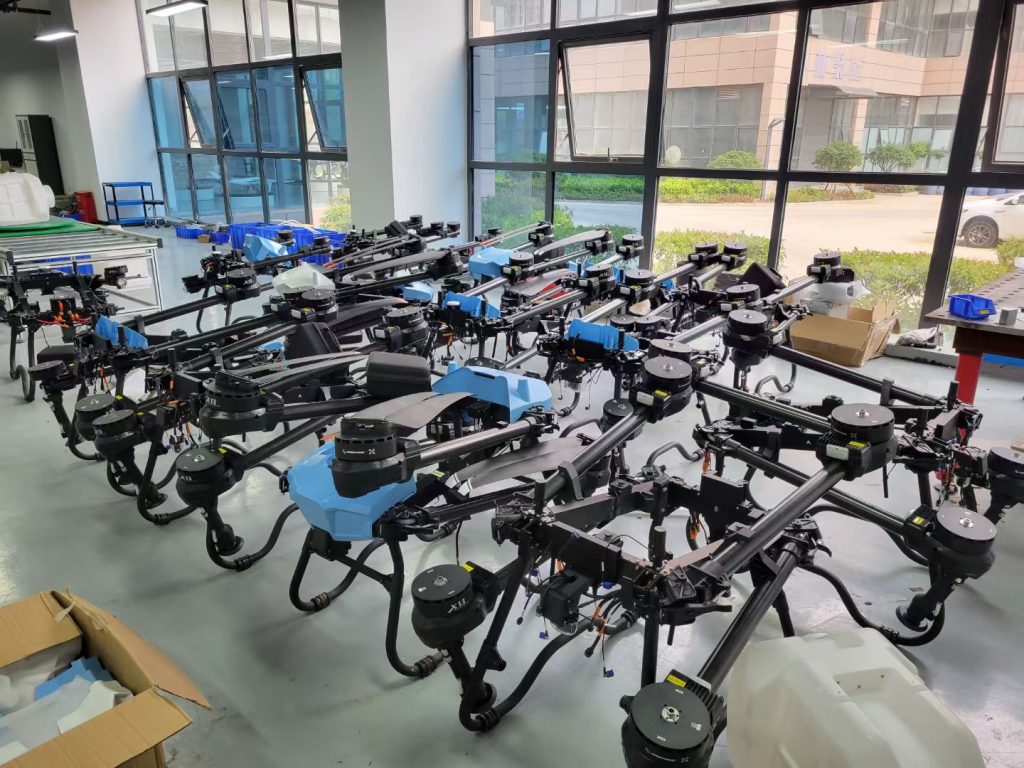
Agricultural drones are becoming a practical tool for fertilizer application, particularly on farms where conventional spreaders are difficult to use. Uneven terrain, wet fields, fragmented farmland, steep slopes, and labor shortages can all make traditional fertilizer spreading expensive or inefficient.
However, choosing a fertilizer application drone is not simply a matter of buying the aircraft with the largest payload. A drone that carries 50 kg of fertilizer is not automatically a better choice than a 30 kg model. The right machine depends on the type of fertilizer, crop, field size, application rate, flight conditions, battery system, spreading mechanism, and the operator’s working routine.
For farmers, distributors, and agricultural equipment buyers, understanding these factors before purchasing can prevent a costly mismatch between the drone and the actual farming operation.
What Is an Agricultural Fertilizer Drone?
An agricultural fertilizer drone is an unmanned aircraft equipped with a hopper and spreading system designed to distribute solid granular or powdered agricultural materials over crops and farmland.
Unlike spraying drones, which normally use liquid tanks and pumps, fertilizer drones use a dry-material spreading system. A typical system includes:
-
Flight controller and navigation system
-
Battery and power system
-
Fertilizer hopper
-
Electric or mechanical spreading mechanism
-
Motors and propellers
-
Radar or obstacle-sensing equipment
-
Remote controller
-
Positioning system
-
Automatic flight-planning software
The spreading system is particularly important. Even if the aircraft has a high payload capacity, poor material control can result in uneven fertilizer distribution.
For this reason, buyers should evaluate the complete spreading system, rather than looking only at the advertised payload.
Step 1: Determine the Fertilizer You Actually Need to Spread
Before comparing drone models, identify the fertilizer materials used on your farm.
Common materials include:
-
Granular compound fertilizer
-
Urea
-
Nitrogen fertilizer
-
Potassium fertilizer
-
Phosphate fertilizer
-
Rice fertilizer
-
Seed and fertilizer mixtures
-
Some pelletized agricultural materials
Different materials have different particle sizes, densities, moisture levels, and flow characteristics.
For example, dry granular fertilizer generally flows more easily through a hopper than material that has absorbed moisture and formed lumps. If the fertilizer bridges inside the hopper, the spreading rate can become inconsistent.
Ask the manufacturer:
-
What particle size does the spreading system support?
-
What is the recommended material density?
-
Can the hopper handle fertilizer with different flow characteristics?
-
How is the spreading rate adjusted?
-
Can the spreading system be calibrated before operation?
A good fertilizer drone should allow the operator to adjust the application rate according to the material being used.
Step 2: Choose the Payload According to Your Farm
Payload capacity is one of the most visible specifications of a fertilizer drone, but it should not be the only specification used for comparison.
Typical agricultural fertilizer drones may be available in different payload classes, such as 20 kg, 30 kg, 40 kg, 50 kg or larger configurations.
A larger hopper can reduce the number of refills required during a working day. However, a larger payload also means greater aircraft weight and higher power consumption.
The practical question is:
How much fertilizer do you need to spread per hectare, and how many hectares do you want to cover per day?
For example, suppose a farm applies 30 kg of fertilizer per hectare.
A 30 kg hopper theoretically carries enough fertilizer for approximately one hectare per load.
A 50 kg hopper could carry enough material for more than one hectare per load under the same application rate.
But actual coverage depends on the spreading width, flight speed, battery endurance, field shape, refill time, and operating conditions.
Therefore, payload should be evaluated together with the entire workflow.
Step 3: Pay Attention to Spreading Accuracy
For fertilizer application, uniform distribution is often more important than maximum flight speed.
If too much fertilizer is deposited in one area while another area receives too little, crop growth can become uneven and fertilizer costs can increase.
A useful fertilizer drone should provide stable material flow and controllable spreading parameters.
Important factors include:
Spreading width
The effective spreading width depends on the fertilizer, spreading mechanism, rotor configuration, flight altitude, and environmental conditions.
Manufacturers may quote a maximum spreading width, but buyers should ask whether that figure represents the practical working width or only a laboratory or ideal-condition result.
Application rate
The operator should be able to adjust the fertilizer output according to the crop and field requirements.
For example, an application may require 20 kg/ha in one field and 40 kg/ha in another. The drone’s control system needs to maintain an appropriate material flow at different flight speeds.
Flight speed
Flying faster can increase theoretical productivity, but excessive speed can affect application uniformity.
A professional system should coordinate:
flight speed + hopper output + spreading mechanism + route planning
rather than simply allowing the drone to fly as fast as possible.
Step 4: Check the Hopper and Feeding System
The hopper is a critical component that is sometimes overlooked during purchasing.
A practical fertilizer hopper should be easy to fill, inspect, clean, and remove when necessary.
The feeding mechanism should also minimize blockages.
When evaluating a drone, ask about:
-
Hopper capacity
-
Hopper material
-
Hopper opening size
-
Feeding mechanism
-
Anti-blocking design
-
Cleaning procedure
-
Spreader motor
-
Material compatibility
-
Calibration method
Fertilizer can be corrosive, especially when moisture is present. Components that regularly come into contact with fertilizer should therefore be designed with appropriate materials and protection.
After operation, the spreading system should be cleaned according to the manufacturer’s instructions. Leaving fertilizer residue inside the mechanism can cause corrosion, blockage, or inaccurate application during the next operation.
Step 5: Compare Battery Capacity and Charging Options
Battery performance directly affects daily productivity.
A fertilizer drone may have a large hopper, but if the battery cannot support practical flight cycles, the operator may spend more time waiting for batteries than spreading fertilizer.
A professional setup should be evaluated as a complete system:
Drone + batteries + charger + generator or power source + spare batteries
Important questions include:
-
How long can the drone operate under a normal fertilizer payload?
-
How long does one battery take to charge?
-
How many batteries are recommended for continuous operation?
-
Is a fast charger available?
-
Is a generator required in remote fields?
-
What is the expected battery service life?
-
How does payload affect flight time?
Advertised flight time is normally measured under specific conditions. Real operating time can be shorter when the drone is carrying a full fertilizer load, flying against wind, or operating at higher temperatures.
Therefore, buyers should ask manufacturers for flight-time data under realistic working payloads, not just unloaded flight time.
Step 6: Consider the Type of Farm and Terrain
A fertilizer drone becomes particularly useful when traditional ground equipment has difficulty entering the field.
Examples include:
-
Rice paddies
-
Wet agricultural land
-
Mountain farms
-
Orchards
-
Fields with narrow access roads
-
Fragmented farmland
-
Areas with soft soil
-
Fields where crops are too tall for ground machinery
For wet rice fields, for example, a ground vehicle may cause soil compaction or become difficult to operate after rainfall. A drone can apply fertilizer from above without physically driving through the field.
However, drones are not necessarily the best solution for every farm.
If a large, flat farm already has efficient tractor-mounted spreading equipment and good field access, the economic advantage of a drone may be smaller.
The correct decision depends on the cost and productivity of the entire farming operation.
Step 7: Evaluate Navigation and Flight Automation
Modern agricultural drones can use positioning systems and automated flight routes to improve operational consistency.
Useful functions may include:
-
Automatic route planning
-
Boundary mapping
-
Automatic return-to-home
-
Obstacle detection
-
Terrain-following functions
-
Positioning assistance
-
Low-battery warnings
-
Abnormal-condition alerts
For irregular fields, route planning is especially useful because manually controlling every flight path can result in missed areas or excessive overlap.
Before purchasing, check which navigation functions are included as standard equipment and which require additional hardware or software.
How Much Area Can a Fertilizer Drone Cover?
There is no single answer because working efficiency depends on several variables.
A simplified productivity calculation can be expressed as:
Effective capacity = spreading width × flight speed × field efficiency
Field efficiency accounts for time lost during:
-
Fertilizer refilling
-
Battery replacement
-
Turning
-
Takeoff and landing
-
Route changes
-
Equipment checks
-
Moving between fields
For example, a drone may theoretically cover a large area based on its spreading width and flight speed, but actual daily productivity can be substantially lower if the operator has to frequently return for fertilizer or battery changes.
This is why buyers should request real-world hectares per hour or hectares per day, rather than relying only on theoretical flight specifications.
How to Calculate the Required Payload
Consider a farm that needs to apply 25 kg of fertilizer per hectare.
If the drone carries 25 kg per load, one full hopper theoretically covers one hectare at that application rate.
If the farm requires 100 hectares of treatment, approximately:
100 × 25 kg = 2,500 kg of fertilizer
would be required.
A 50 kg hopper would require roughly 50 full loads under ideal conditions.
A 30 kg hopper would require approximately 84 loads.
The actual number will vary because the operator may not always fill the hopper completely, and application rates may differ between fields.
This simple calculation helps buyers understand why hopper capacity, refill logistics, and spreading rate need to be considered together.
What About Fertilizer Drones for Orchards?
Orchards create a different challenge from open-field crops.
Trees can interfere with airflow and make distribution more complicated. The required flight height, route, and spreading pattern may also differ from those used in rice or wheat fields.
Buyers looking for orchard applications should ask specifically whether the drone’s spreading system has been tested for their crop structure.
A drone designed primarily for open-field granular fertilizer application may not provide the same performance in dense orchards.
The same principle applies to other specialized crops: choose the spreading system based on the crop, not simply the drone’s payload.
Should You Buy a 30 kg or 50 kg Fertilizer Drone?
There is no universal winner.
A 30 kg drone may be suitable when:
-
Fields are relatively small
-
Transportability is important
-
Operators prefer a lighter aircraft
-
Fertilizer demand per operation is moderate
-
Battery and equipment costs need to be controlled
A 50 kg-class drone may be more attractive when:
-
Large fields are being treated
-
Higher application rates are common
-
Refilling time is a major bottleneck
-
The operation requires high daily productivity
-
Suitable transport and battery infrastructure are available
The larger drone is not automatically more economical. If the operator spends significantly more on batteries, maintenance, transport, and replacement parts, the higher payload may not compensate for those costs.
What Should You Ask a Chinese Agricultural Drone Manufacturer?
If you are sourcing fertilizer drones from China, do not ask only for a product catalog and price.
A better supplier inquiry should include:
1. Payload:
What is the rated fertilizer payload?
2. Material:
What fertilizer types and particle sizes are supported?
3. Application rate:
What is the adjustable spreading range?
4. Working width:
What is the practical spreading width for the buyer’s fertilizer?
5. Productivity:
What is the actual hectares-per-hour performance under a specified fertilizer load?
6. Battery:
What battery capacity is used, and how many batteries are recommended?
7. Charging:
What charger or generator is required for continuous operation?
8. Navigation:
What positioning and automatic flight functions are included?
9. Spare parts:
Which parts should be purchased with the first order?
10. After-sales support:
Does the manufacturer provide remote technical support, manuals, training, and replacement parts?
These questions produce much more useful information than simply asking, “How much is a fertilizer drone?”
What Is the Cost of a Fertilizer Drone?
Prices vary considerably depending on payload, motors, batteries, positioning systems, sensors, controller, charger, spreading mechanism, software, and after-sales package.
A low-priced drone may look attractive initially, but the purchase price is only one part of the total cost.
The buyer should calculate:
Total operating cost = aircraft + batteries + charger + spare parts + maintenance + labor + fertilizer handling + transport
For commercial agricultural operations, cost per hectare is often a more useful metric than the initial purchase price.
If a more expensive drone reduces refill time, improves application consistency, and increases daily coverage, it may have a lower operating cost over its service life.
Common Mistakes When Buying a Fertilizer Drone
Mistake 1: Choosing based only on payload
A large hopper does not guarantee good spreading performance.
Mistake 2: Believing maximum flight time
Flight time without a realistic payload is not necessarily representative of fertilizer operations.
Mistake 3: Ignoring fertilizer characteristics
Different fertilizers behave differently inside the hopper and spreading system.
Mistake 4: Comparing theoretical working area
Real productivity includes refilling, battery replacement, turning, and field movement.
Mistake 5: Forgetting spare batteries
One battery may not be enough for continuous commercial operation.
Mistake 6: Buying without checking local regulations
Agricultural drone operation may be subject to aviation, agricultural, radio, licensing, registration, or operator requirements depending on the country.
The buyer should verify local requirements before importing and operating the aircraft.
A Practical Buying Checklist
Before placing an order, confirm the following:
Item |
What to Check |
|---|---|
Payload |
Rated payload under normal operating conditions |
Hopper |
Capacity and material compatibility |
Spreader |
Adjustable output and practical spreading width |
Fertilizer |
Supported particle size and density |
Battery |
Capacity and expected loaded flight time |
Charger |
Charging time and power requirements |
Navigation |
Positioning and automatic route functions |
Sensors |
Obstacle or terrain-related functions |
Productivity |
Real hectares/hour under defined conditions |
Spare Parts |
Motors, propellers, pumps/spreaders and other wear parts |
Software |
Route planning and application control |
Support |
Training, manuals and technical assistance |
Compliance |
Import and operating requirements in the destination country |
Final Recommendation
The right agricultural drone for fertilizer application is not necessarily the one with the biggest payload, longest advertised flight time, or lowest purchase price.
A better approach is to start with the farming operation.
Determine the fertilizer type, application rate, field size, crop, terrain, required daily capacity, battery infrastructure, and local operating requirements. Then compare drones based on their ability to perform that specific job consistently.
For most buyers, the most important specifications are spreading accuracy, material compatibility, practical payload, battery workflow, application-rate control, and real operating productivity.
If you are purchasing from a manufacturer in China, ask for detailed technical specifications, fertilizer compatibility information, test data, spare-parts availability, and a complete quotation that includes the drone, batteries, charger, controller, spreading system, and necessary accessories.
A properly matched fertilizer drone can reduce dependence on ground equipment, improve access to difficult fields, and make fertilizer application more flexible. But its value comes from how well the entire system fits the farm—not from a single number printed on a product brochure.
THE END




No comments yet