

Choosing an agricultural drone manufacturer in China requires more than comparing product prices or reading a supplier’s website. For international buyers, the more important question is whether a manufacturer can provide the right equipment, maintain consistent quality, supply spare parts, support the product after delivery, and cooperate effectively over the long term.
Agricultural drones are working machines. They are expected to operate in fields, orchards, plantations, and other demanding environments where reliability and practical performance matter. A supplier that looks attractive because of a low quotation may not necessarily be the right manufacturing partner.
For importers, distributors, agricultural equipment dealers, and commercial farming businesses, a structured supplier evaluation can significantly reduce purchasing risks.
This guide explains how to evaluate and select a reliable agricultural drone manufacturer in China, what technical and factory information to request, which questions to ask before ordering, and how to compare manufacturers more effectively.
Why Manufacturer Selection Matters
An agricultural drone is more than an aircraft.
A complete system can include:
- Airframe
- Motors
- Propellers
- Flight-control system
- Remote controller
- Battery
- Charger
- Pump
- Nozzles
- Spray tank
- Spreading system
- Sensors
- Software
- Communication equipment
If one important component performs poorly, the entire operation can be affected.
For example, insufficient battery performance can reduce operating time. An unsuitable pump can affect spraying consistency. Poorly configured flight-control parameters can make operation more difficult. Limited spare-parts availability can also create long periods of downtime.
This is why buyers should evaluate the manufacturer as a complete supplier rather than judging a drone only by its appearance or advertised payload.
1. Determine What Type of Agricultural Drone You Need
Before comparing manufacturers, define the actual application.
Different agricultural operations require different drone configurations.
Spraying
If the primary purpose is crop protection or liquid application, pay attention to:
- Tank capacity
- Flow rate
- Spray width
- Nozzle configuration
- Pump performance
- Droplet characteristics
- Flight speed
- Working height
Fertilizer Spreading
For granular applications, consider:
- Hopper capacity
- Spreading width
- Material compatibility
- Distribution consistency
- Feed mechanism
- Payload
- Control accuracy
Orchard Operations
Orchards can present different challenges from open fields because of:
- Trees
- Narrow operating areas
- Uneven terrain
- Canopy density
- Obstacles
The drone configuration and operating method should therefore be appropriate for the environment.
Heavy-Payload Operations
If you require a higher payload, examine not only maximum takeoff weight but also the manufacturer’s recommended operating payload.
A useful comparison should include:
Payload + flight time + battery capacity + motor configuration + operating conditions.
A drone with a large advertised payload may not provide the same practical performance under continuous agricultural operation.
2. Verify That the Supplier Is Actually a Manufacturer
One of the first questions international buyers should ask is:
Who actually manufactures the drone?
Some businesses sell products manufactured by other companies. This is not automatically a problem, but buyers should understand the supply relationship before making a large purchase.
Ask questions such as:
- Where is the drone assembled?
- Where is the factory located?
- Which production processes are performed internally?
- Which components are sourced externally?
- Is product testing performed at the factory?
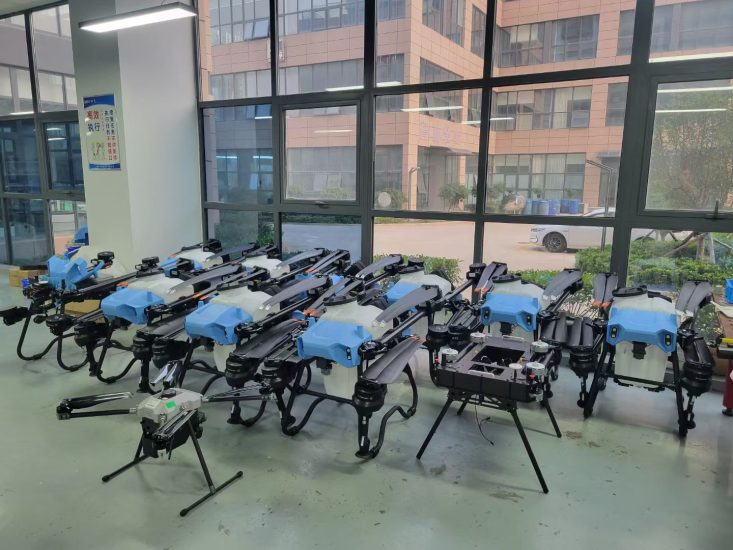
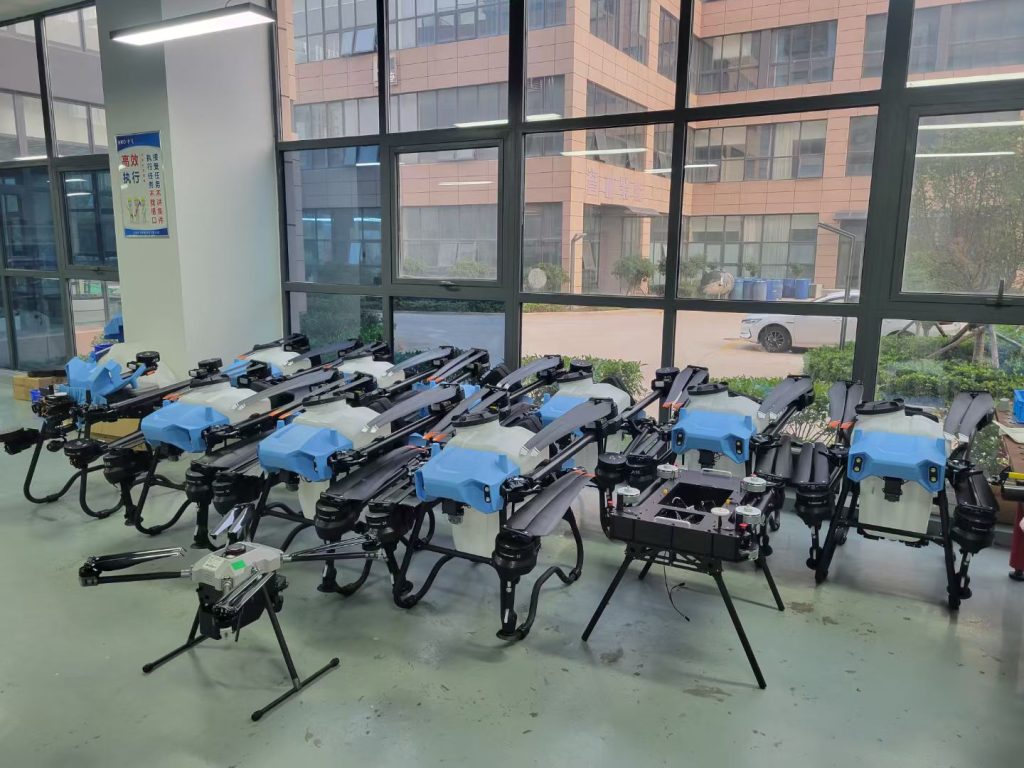
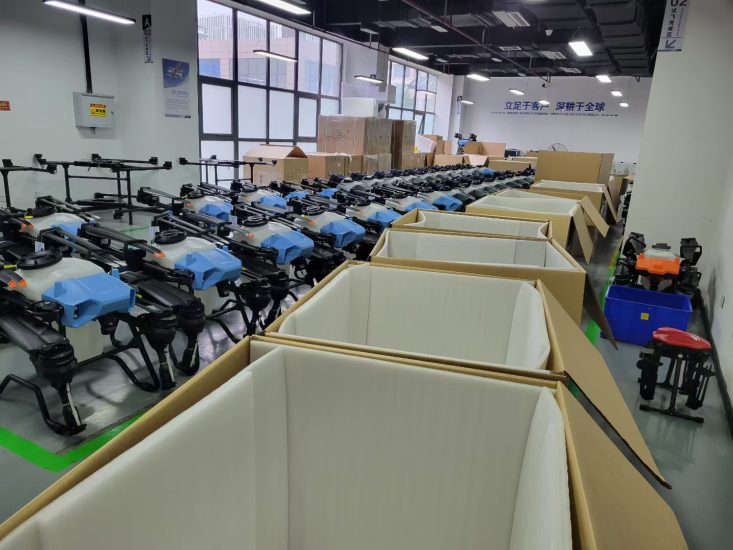
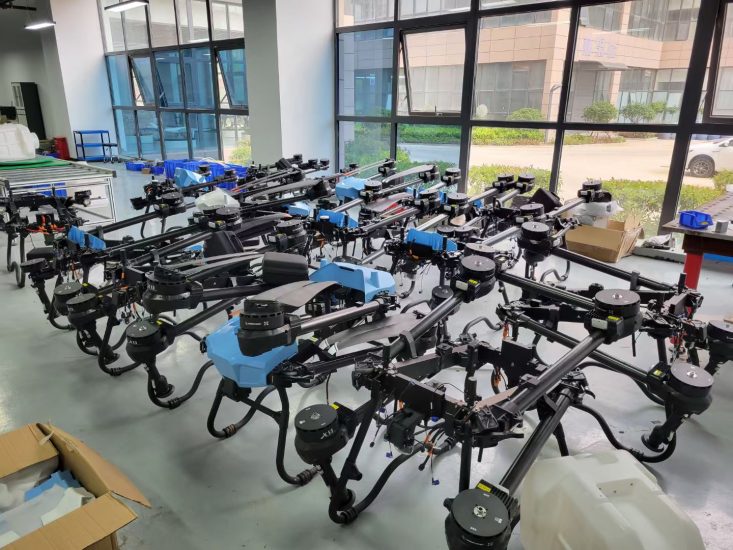
- Can the supplier provide factory photographs or production information?
- Can technical staff communicate directly with buyers?
A manufacturer should be able to explain its production process clearly.
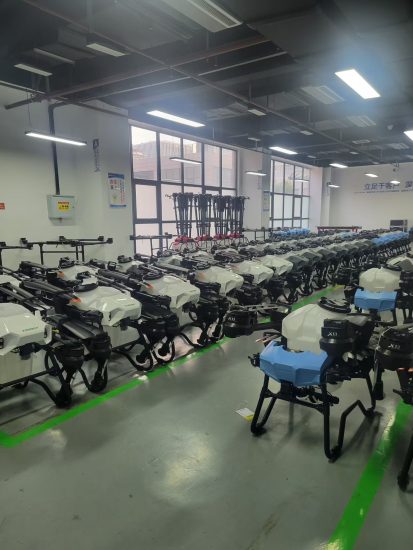
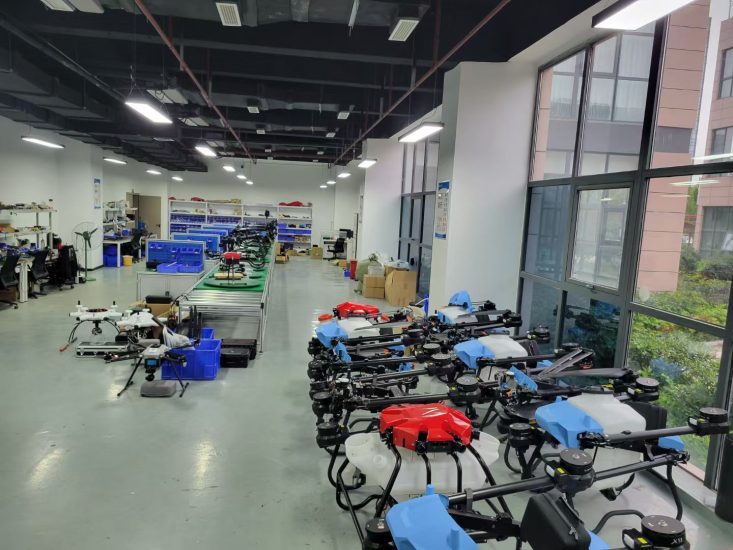
Factory Evidence Matters
A credible manufacturer should be able to provide practical information about:
- Production facilities
- Assembly areas
- Testing equipment
- Quality-control procedures
- Finished-product inspection
- Packaging
- Product development
The goal is not simply to see impressive factory photographs.
The important question is whether the factory information is consistent with the products being sold.
3. Examine Product Specifications Carefully
A professional buyer should never compare agricultural drones using only one number.
For example, comparing two drones only by:
30 kg payload
does not provide enough information.
A proper comparison should include multiple technical factors.
| Specification | Why It Matters |
|---|---|
| Payload | Determines practical carrying capacity |
| Tank capacity | Important for spraying operations |
| Hopper capacity | Important for spreading operations |
| Flight time | Affects field productivity |
| Battery capacity | Influences operating duration |
| Charging time | Affects daily utilization |
| Spray width | Influences coverage efficiency |
| Flow rate | Affects application performance |
| Spreading width | Important for granular materials |
| Operating speed | Influences productivity |
| Wind resistance | Important in outdoor operation |
| Controller range | Affects operating flexibility |
| Weight | Influences transportation and operation |
The manufacturer should also explain the conditions under which the specifications were measured.
4. Ask How Flight Time Is Measured
Flight time is one of the most commonly misunderstood specifications.
A manufacturer may advertise a certain maximum flight time, but that figure may be measured under specific conditions.
For example, actual operating time can change depending on:
- Payload
- Battery condition
- Weather
- Wind
- Flight speed
- Operating altitude
- Temperature
- Spraying or spreading activity
Therefore, ask:
“What is the expected flight time under normal operating payload?”
This is more useful than simply asking for maximum flight time.
5. Evaluate Battery and Charging Systems
Battery performance is particularly important for agricultural drones because field operations can involve repeated flights throughout the day.
Ask the manufacturer about:
- Battery capacity
- Battery voltage
- Battery weight
- Charging time
- Recommended charging method
- Battery cycle expectations
- Storage requirements
- Replacement availability
- Safety protection
- Charger specifications
Also determine whether additional batteries and chargers can be purchased separately.
For international distributors, reliable access to replacement batteries can be an important part of after-sales planning.
6. Examine the Spraying System
If the drone will be used for spraying, the aircraft itself is only part of the system.
The spraying system should also be evaluated.
Important factors include:
Tank
Check:
- Capacity
- Material
- Structural design
- Filling method
- Drainage
Pump
Check:
- Flow rate
- Pressure
- Power requirements
- Replacement availability
Nozzles
Check:
- Nozzle type
- Quantity
- Spray characteristics
- Replacement availability
- Compatibility with the intended application
Control
Determine whether spraying output can be adjusted according to operating requirements.
The objective is not simply to maximize liquid output.
The system should provide controllable and consistent application appropriate to the intended agricultural use.
7. Evaluate the Fertilizer Spreading System
For spreading applications, buyers should examine the complete material-delivery system.
Important questions include:
- What materials can the hopper handle?
- What is the hopper capacity?
- How is material fed into the spreading mechanism?
- Can spreading output be adjusted?
- What is the practical spreading width?
- How consistent is material distribution?
- How easy is the system to clean?
- Are replacement components available?
A high-capacity hopper is useful only if the spreading mechanism can distribute material consistently.
8. Check Manufacturing Quality Control
Ask the manufacturer to explain its quality-control process.
A structured process may include:
Incoming inspection → assembly inspection → system testing → software configuration → functional testing → flight testing → final inspection
The exact process will differ between manufacturers.
However, the supplier should be able to explain how defective components are identified and how finished drones are inspected.
Why Flight Testing Matters
Agricultural drones need to operate safely and consistently.
Testing may include:
- Motor operation
- Propeller installation
- Flight-controller response
- Hover performance
- Takeoff
- Landing
- Remote-controller communication
- Spraying operation
- Spreading operation
- Battery performance
Buyers should ask whether every finished aircraft is tested or whether testing is performed only on selected samples.
9. Look at Spare-Parts Availability
A drone purchase does not end when the shipment arrives.
Agricultural operations can require replacement parts over time.
Commonly needed components may include:
- Propellers
- Motors
- Pumps
- Nozzles
- Hoses
- Controllers
- Batteries
- Chargers
- Landing components
- Electronic modules
Before placing an order, ask:
Can spare parts be purchased separately?
Also ask:
How quickly can commonly required replacement parts be supplied?
For distributors, creating a spare-parts inventory can help reduce downtime for end customers.
10. Evaluate Technical Support
A reliable manufacturer should be able to provide technical communication after the sale.
Depending on the supplier, support may include:
- Installation guidance
- Product manuals
- Remote troubleshooting
- Software guidance
- Operating instructions
- Maintenance recommendations
- Spare-parts support
- Training materials
International buyers should clarify how technical problems will be handled when the customer is located thousands of kilometers from the factory.
Language Support
For international business, communication is also important.
The supplier should be able to clearly communicate:
- Product specifications
- Operating procedures
- Troubleshooting steps
- Warranty conditions
- Spare-parts requirements
- Shipping information
Poor communication can create problems even when the product itself is technically suitable.
11. Examine OEM and ODM Capability
If you are purchasing agricultural drones for distribution under your own brand, ask whether the manufacturer provides OEM or ODM services.
OEM
OEM cooperation may involve:
- Brand logo
- Product labeling
- Packaging
- Manuals
- Product configuration
- Accessories
ODM
ODM can involve deeper customization, such as:
- Structural design
- Product appearance
- Spraying configuration
- Spreading system
- Battery system
- Controller
- Software
- Special functions
OEM and ODM requirements should be discussed before production begins.
Important commercial details include:
- Minimum order quantity
- Development cost
- Sample requirements
- Development timeline
- Testing procedure
- Intellectual-property arrangements
- Packaging requirements
12. Ask About Certifications and Compliance
Agricultural drones may be subject to different requirements depending on the destination market.
Before importing, buyers should determine which regulations apply to their intended market.
Ask the manufacturer for relevant documentation where applicable, such as:
- Product specifications
- Battery documentation
- Test reports
- Applicable certificates
- User manuals
- Safety documentation
- Export documents
Do not assume that a certificate applicable in one country automatically satisfies the requirements of another country.
The buyer and manufacturer should confirm destination-market requirements before shipment.
13. Evaluate Export Experience
A manufacturer may produce a good drone but still have limited experience with international orders.
For overseas buyers, ask whether the supplier can support:
- Export packaging
- Commercial invoices
- Packing lists
- Shipping documentation
- Product documentation
- Battery-related shipping requirements
- Customs information
Also confirm the agreed trade terms and destination responsibilities before production.
14. Compare Total Cost Instead of Product Price
A low factory quotation does not necessarily mean a low total cost.
Consider:
Drone price + batteries + chargers + spare parts + packaging + shipping + duties + maintenance + technical support
For example, if one manufacturer provides a lower initial price but replacement batteries and spare parts are expensive, the long-term cost may be higher.
A more useful comparison is the expected total cost of ownership.
15. Request a Detailed Quotation
A professional quotation should identify the actual product configuration.
Instead of accepting a quotation that simply says:
Agricultural Drone — USD XXXX
ask for a detailed list.
For example:
| Item | Required Information |
|---|---|
| Drone model | Exact model |
| Payload | Recommended and maximum |
| Tank/hopper | Capacity |
| Battery | Quantity and specification |
| Charger | Type and quantity |
| Controller | Included or optional |
| Spraying system | Included configuration |
| Spreading system | Included configuration |
| Spare parts | Included items |
| Packaging | Standard or customized |
| OEM | Available options |
| Warranty | Terms |
| Production time | Estimated lead time |
| Shipping | Available methods |
This makes supplier comparison much more accurate.
16. Consider Ordering a Sample
For distributors and commercial buyers, a sample order can be a practical way to evaluate a manufacturer.
During testing, evaluate:
- Build quality
- Flight stability
- Battery performance
- Controller operation
- Spraying performance
- Spreading performance
- Ease of maintenance
- Documentation
- Technical support
If the sample performs well, the buyer can then discuss larger quantities.
A sample also provides an opportunity to identify configuration problems before mass production.
17. Check Whether the Manufacturer Can Support Long-Term Cooperation
A good agricultural drone supplier should be evaluated as a potential long-term partner.
Ask yourself:
- Can the manufacturer supply the same configuration consistently?
- Can replacement parts remain available?
- Can the supplier support future product upgrades?
- Can technical staff communicate effectively?
- Can production capacity handle larger orders?
- Can the manufacturer support OEM or ODM requirements?
- Can quality remain consistent as order volume increases?
These questions are especially important for distributors who plan to build a local agricultural drone business.
A Practical Agricultural Drone Manufacturer Checklist
Before selecting a manufacturer, buyers can use this checklist:
Product
- [ ] Correct drone type
- [ ] Suitable payload
- [ ] Appropriate tank or hopper
- [ ] Suitable battery
- [ ] Suitable spraying/spreading system
- [ ] Clear technical specifications
Factory
- [ ] Production capability verified
- [ ] Assembly process understood
- [ ] Quality control explained
- [ ] Flight testing confirmed
- [ ] Product documentation available
After-Sales
- [ ] Spare parts available
- [ ] Battery replacements available
- [ ] Technical support available
- [ ] Warranty terms confirmed
- [ ] Maintenance information provided
International Trade
- [ ] Export documentation
- [ ] Packaging requirements
- [ ] Shipping arrangements
- [ ] Destination-market requirements
- [ ] Commercial terms
OEM/ODM
- [ ] Branding
- [ ] Packaging
- [ ] Custom configuration
- [ ] Development capability
- [ ] Minimum order quantity
- [ ] Development timeline
Common Mistakes When Choosing an Agricultural Drone Manufacturer
Choosing the Lowest Price
Price matters, but it should not be the only selection criterion.
A low-quality aircraft can create additional costs through repairs, replacement parts, downtime, and customer complaints.
Comparing Only Payload
Two drones with the same advertised payload can have very different flight characteristics and operating performance.
Ignoring Spare Parts
A distributor that cannot obtain replacement parts quickly may struggle to support customers.
Not Asking About Test Conditions
Specifications without test conditions are difficult to compare.
Ordering Large Quantities Too Early
For a new supplier, a sample or small initial order may be a safer approach.
Focusing Only on Factory Photographs
Photographs can provide useful information, but technical documentation, product testing, communication, and actual product performance are more important.
How to Select the Right Manufacturer Step by Step
A practical selection process can be divided into seven stages.
Stage 1 — Define Your Requirements
Identify:
- Application
- Crop
- Payload
- Tank/hopper capacity
- Quantity
- Destination
- Branding requirements
Stage 2 — Shortlist Manufacturers
Look for manufacturers whose products match the intended application.
Stage 3 — Request Technical Information
Ask for detailed specifications rather than only a price.
Stage 4 — Verify Manufacturing Capability
Review factory information, production processes, quality control, and testing.
Stage 5 — Compare Total Cost
Include accessories, batteries, spare parts, shipping, and other relevant costs.
Stage 6 — Test the Product
Where practical, order a sample or arrange a demonstration.
Stage 7 — Start Long-Term Cooperation
After confirming product performance and supplier reliability, negotiate larger orders and potential OEM or ODM cooperation.
Why Direct Communication With the Manufacturer Matters
Technical agricultural equipment requires more communication than ordinary consumer products.
When buyers can communicate directly with the manufacturing team, it becomes easier to discuss:
- Technical specifications
- Product modifications
- Performance questions
- Spare parts
- Production schedules
- Quality requirements
- Troubleshooting
This can be particularly valuable for distributors and agricultural equipment businesses that expect continuing cooperation.
Choosing a China Agricultural Drone Manufacturer for Long-Term Growth
The best manufacturer is not necessarily the one with the cheapest quotation or the largest number of products.
A more reliable evaluation focuses on whether the supplier can provide a combination of:
Suitable products + consistent manufacturing + quality control + testing + technical support + spare parts + export capability + customization.
For international buyers, this combination can create a much stronger foundation for long-term cooperation.
If you are sourcing agricultural drones from China, begin with your actual operating requirements rather than starting with price. Define the required payload, application, battery configuration, spraying or spreading system, destination market, and expected order volume.
Then compare manufacturers using the same technical and commercial criteria.
This approach makes it easier to distinguish between a supplier that simply sells agricultural drones and a manufacturing partner capable of supporting a long-term business relationship.
FAQ
How do I find a reliable agricultural drone manufacturer in China?
Start by defining your technical requirements, then compare manufacturers based on product specifications, factory capability, quality control, testing, spare parts, technical support, export experience, and OEM/ODM capability.
How can I verify whether an agricultural drone supplier is a real manufacturer?
Ask where the products are assembled, which production processes are performed internally, how finished products are tested, and whether the supplier can provide detailed factory and manufacturing information.
What should I compare between agricultural drone manufacturers?
Compare payload, flight time under working conditions, battery system, tank or hopper capacity, spraying or spreading performance, quality control, spare parts, warranty, technical support, production capacity, and total cost.
Is the cheapest agricultural drone manufacturer the best choice?
Not necessarily. A lower purchase price can be offset by higher maintenance costs, limited spare parts, poor technical support, or shorter product life.
Should I order a sample before a large agricultural drone order?
For a new supplier, a sample or product demonstration can reduce risk by allowing you to evaluate the actual product before placing a larger order.
What is the difference between OEM and ODM agricultural drones?
OEM generally involves using an existing product with agreed branding or configuration changes. ODM normally involves deeper product customization or development.
What information should I request from a manufacturer?
Request detailed technical specifications, product configuration, battery information, accessories, warranty terms, spare-parts information, production time, packaging details, applicable documentation, and OEM/ODM options.
How important are spare parts for agricultural drones?
They are very important because agricultural drones operate under demanding conditions. Easy access to batteries, motors, propellers, pumps, nozzles, and other replacement components can reduce operational downtime.
How do I compare agricultural drone flight time?
Ask how the manufacturer measures flight time and whether the figure includes a working payload. Compare flight time under similar payload, battery, weather, and operating conditions.
Can Chinese agricultural drone manufacturers provide customized products?
Many manufacturers can offer some level of customization, but the available options vary. Buyers should discuss branding, packaging, hardware, software, spraying or spreading systems, and minimum order requirements before production.
What should I consider when importing agricultural drones from China?
Consider the product configuration, battery and shipping requirements, export documents, packaging, customs requirements, destination-market regulations, shipping terms, spare parts, and after-sales support.
How can I build a long-term relationship with an agricultural drone manufacturer?
Start with clear technical requirements, verify the supplier, test the product, establish quality and commercial terms, maintain clear communication, and develop a spare-parts and after-sales support plan as order volume grows.


No comments yet