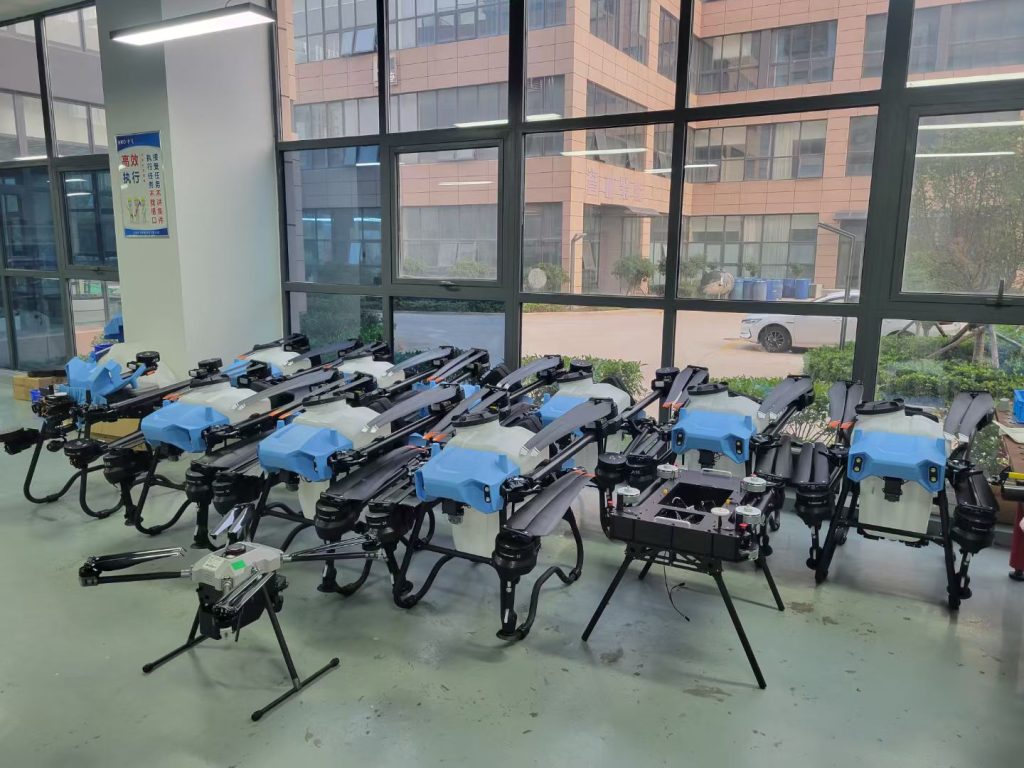
Choosing an agricultural seeding drone for a large farm is not simply a matter of buying the aircraft with the largest hopper. A professional seeding system needs to match the seed type, application rate, field size, battery capacity, spreading width, flight endurance, and daily operating workload.
A drone that carries 20 kg may be more economical for a small farm, while a 50 kg or 80 kg system may be more suitable for commercial agricultural operations covering hundreds of hectares.
The most important point is that the drone must be able to distribute seed consistently. High payload capacity is useful, but accurate metering and a stable spreading pattern are often more important than maximum carrying capacity.
This guide explains how to select an agricultural seeding drone, what specifications to compare, realistic equipment price ranges, common configuration levels, operating costs, and the questions buyers should ask before placing an order.
What Is an Agricultural Seeding Drone?
An agricultural seeding drone is an unmanned aircraft equipped with a dry-material hopper and controlled spreading mechanism.
The aircraft carries seeds above the field and releases them through a metering system. A rotating spreading disc or similar distribution mechanism then distributes the seeds across the target area.
A complete seeding system normally includes:
-
Agricultural drone
-
Seed hopper
-
Metering mechanism
-
Spreading disc
-
Flight controller
-
GNSS positioning
-
RTK positioning
-
Remote controller
-
Intelligent batteries
-
Battery charger
-
Flight-planning software
-
Obstacle detection system
-
Seed-flow monitoring system
Some platforms can use interchangeable modules, allowing the same aircraft to perform several agricultural tasks.
Why Are Seeding Drones Used on Large Farms?
Large farms often have thousands of hectares of agricultural land. Moving tractors and seeders across every field can require substantial labor, fuel, and transportation.
A drone provides a different operating method.
Instead of driving through the field, the aircraft flies above the crop or soil and broadcasts seed from the air.
This can provide several advantages.
Reduced Soil Compaction
Heavy agricultural machinery can compact soil, particularly when fields are wet.
A drone does not need to place its weight on the field surface.
Access to Wet Areas
Some fields become difficult for tractors after rainfall.
Aerial seeding can allow farmers to continue working without sending heavy machinery into soft soil.
Difficult Terrain
Drones can be useful in:
-
Sloped farmland
-
Wetland
-
Narrow fields
-
Irregular fields
-
Areas with limited road access
-
Fields surrounded by obstacles
Reduced Ground Labor
One trained operator can control the aircraft while another worker handles seed loading and batteries.
The actual labor requirement depends on the size of the operation and the level of automation.
The Most Important Specification: Payload
Payload is the amount of seed the drone can carry during one flight.
Typical commercial configurations can be divided into several classes.
Drone Class
|
Maximum Payload
|
Recommended Farm Size
|
10–20 kg
|
10–20 kg
|
Small farms
|
20–30 kg
|
20–30 kg
|
Small to medium farms
|
30–50 kg
|
30–50 kg
|
Medium farms
|
50–70 kg
|
50–70 kg
|
Large farms
|
70–80+ kg
|
70–80+ kg
|
Commercial operations
|
Payload should be considered together with flight endurance.
A drone that carries 80 kg but can only remain airborne for a short period may not necessarily outperform a 50 kg drone with better battery efficiency and faster loading cycles.
Model 1: 20 kg Agricultural Seeding Drone
A 20 kg-class drone is suitable for smaller agricultural operations.
Typical configuration
Specification
|
Typical Range
|
Maximum payload
|
20 kg
|
Hopper volume
|
25–35 L
|
Effective spreading width
|
3–6 m
|
Operating speed
|
3–7 m/s
|
Full-load flight time
|
8–15 min
|
Battery voltage
|
Approximately 44–52 V
|
Battery capacity
|
20–30 Ah
|
Positioning
|
GNSS / optional RTK
|
Metering
|
Electric feeder
|
Spreading system
|
Centrifugal disc
|
The main advantage is lower purchase and operating cost.
The main disadvantage is frequent refilling when working on large farms.
For example, if a farm requires 2,000 kg of seed:
2,000 ÷ 20 = 100 loads
That means approximately 100 full hopper cycles.
Model 2: 30 kg Agricultural Seeding Drone
The 30 kg class is a useful middle-level configuration.
It provides more carrying capacity without reaching the size and cost of a large heavy-lift agricultural aircraft.
Typical configuration
Specification
|
Typical Range
|
Maximum payload
|
30 kg
|
Hopper volume
|
35–50 L
|
Effective spreading width
|
4–8 m
|
Operating speed
|
4–8 m/s
|
Full-load flight time
|
7–14 min
|
Battery capacity
|
25–35 Ah
|
Positioning
|
GNSS + RTK
|
Obstacle detection
|
Optional radar
|
Feeder
|
Motorized auger
|
Spreading mechanism
|
Centrifugal disc
|
This class can be suitable for:
-
Rice
-
Wheat
-
Pasture
-
Cover crops
-
Grass seed
-
Granular fertilizer
Model 3: 50 kg Agricultural Seeding Drone
For commercial farming, the 50 kg class is often a more practical configuration.
The larger hopper reduces the number of refilling cycles.
Typical configuration
Specification
|
Typical Range
|
Maximum payload
|
50 kg
|
Hopper volume
|
60–80 L
|
Effective spreading width
|
5–9 m
|
Operating speed
|
4–9 m/s
|
Full-load flight time
|
6–12 min
|
Battery voltage
|
Approximately 52 V
|
Battery capacity
|
30–40 Ah
|
Positioning
|
RTK/GNSS
|
Obstacle detection
|
Radar + vision
|
Feeder
|
High-torque auger
|
Spreading system
|
Centrifugal disc
|
For a farm requiring 5,000 kg of seed:
5,000 ÷ 50 = 100 loads
Compared with a 20 kg system:
5,000 ÷ 20 = 250 loads
The 50 kg system therefore reduces the number of loading cycles substantially.
Model 4: 70 kg Agricultural Seeding Drone
A 70 kg-class aircraft is designed for high-volume agricultural work.
Typical configuration
Specification
|
Typical Range
|
Maximum payload
|
60–70 kg
|
Hopper volume
|
90–120 L
|
Effective spreading width
|
6–10 m
|
Operating speed
|
5–10 m/s
|
Full-load flight time
|
5–10 min
|
Battery capacity
|
35–50 Ah
|
Positioning
|
High-precision RTK
|
Obstacle detection
|
Multi-directional radar
|
Feeder
|
Heavy-duty auger
|
Material weighing
|
Optional/standard depending on configuration
|
The advantage is productivity.
The disadvantage is the higher cost of:
-
Batteries
-
Chargers
-
Motors
-
Propellers
-
Maintenance
-
Transportation equipment
This class makes more sense when the drone will be used frequently.
Model 5: 80 kg Agricultural Seeding Drone
An 80 kg-class aircraft is intended for large-scale agricultural operations.
Typical configuration
Specification
|
Typical Range
|
Maximum payload
|
80 kg
|
Hopper volume
|
100–150 L
|
Effective spreading width
|
7–10 m
|
Operating speed
|
5–10 m/s
|
Full-load flight time
|
5–9 min
|
Battery capacity
|
40–55 Ah
|
Positioning
|
RTK
|
Obstacle detection
|
Radar + vision
|
Feeder
|
Heavy-duty metering auger
|
Spreading system
|
High-capacity centrifugal disc
|
Material monitoring
|
Load sensor
|
An 80 kg system is appropriate when minimizing refill frequency is a priority.
For example, if the required seed quantity is 8,000 kg:
8,000 ÷ 80 = 100 loads
An equivalent 20 kg system would require:
8,000 ÷ 20 = 400 loads
The larger system therefore has a major logistical advantage.
What Hopper Capacity Should You Choose?
Hopper capacity and payload are related but are not always identical.
For example, a hopper may physically hold a large volume, but the aircraft may have a lower maximum payload because of its lifting capacity.
Seed density also matters.
Consider two materials:
Material A: 0.5 kg/L
Material B: 0.8 kg/L
A 100-liter hopper could theoretically contain:
Material A:
100 × 0.5 = 50 kg
Material B:
100 × 0.8 = 80 kg
Therefore, buyers should not evaluate hopper capacity in liters alone.
Always ask for:
Maximum payload in kilograms + hopper volume in liters + recommended material density.
How Important Is Spreading Width?
Spreading width determines how many passes are needed to cover a field.
Typical effective working widths are:
-
Small drone: 3–5 m
-
Medium drone: 5–8 m
-
Large drone: 6–10 m
A wider pattern can increase theoretical productivity.
However, maximum width does not automatically mean better seeding.
If the seed distribution becomes uneven at the outer edges, the operator may need to reduce the working width.
For commercial seeding, the effective uniform width is more useful than the manufacturer’s maximum width.
What Seeds Can a Drone Spread?
Agricultural spreading systems can potentially handle:
-
Rice seed
-
Wheat seed
-
Grass seed
-
Pasture seed
-
Cover-crop seed
-
Small grains
-
Coated seed
-
Granular fertilizer
The actual compatibility depends on the material.
Before purchasing, provide the supplier with:
-
Seed diameter
-
Seed weight
-
Bulk density
-
Moisture level
-
Shape
-
Required application rate
A test should be conducted if the seed is unusually light, irregular, sticky, or large.
Why Metering Accuracy Matters
The metering system controls how much seed leaves the hopper.
A basic system may use a gate.
A more advanced system may use an electrically driven auger.
An auger system can provide more precise control over the material flow, especially at lower application rates.
The operator needs to match:
Seed flow + flight speed + spreading width = target application rate
For example:
Target rate:
25 kg/ha
Working width:
6 m
Flight speed:
5 m/s
The required material flow must be calculated according to the actual operating parameters.
The system should then be tested rather than relying only on theoretical calculations.
How to Calibrate a Seeding Drone
Calibration should be performed whenever the material changes.
Step 1
Fill the hopper with a known quantity of seed.
Step 2
Operate the feeder for a fixed period.
Step 3
Collect and weigh the discharged seed.
Step 4
Calculate the discharge rate.
Step 5
Adjust the feeder speed or opening.
Step 6
Perform a short flight test.
Step 7
Measure seed distribution across the working width.
Step 8
Adjust the flight speed and spreading-disc speed.
This process helps prevent over-seeding in one area and under-seeding in another.
How Much Does a Seeding Drone Cost?
Indicative equipment price ranges are:
Configuration
|
Approximate Price
|
10–20 kg
|
US$3,000–8,000
|
20–30 kg
|
US$5,000–11,000
|
30–50 kg
|
US$8,000–18,000
|
50–70 kg
|
US$13,000–28,000
|
70–80+ kg
|
US$18,000–35,000+
|
These figures are general purchasing ranges rather than fixed quotations.
The final price can change depending on:
-
Number of batteries
-
Charger
-
Generator
-
RTK system
-
Radar
-
Camera
-
Hopper
-
Spreading mechanism
-
Remote controller
-
Spare parts
-
Packaging
-
Shipping
-
Taxes
-
Local certification
-
Training
A buyer comparing two prices should therefore compare the complete package, not only the aircraft.
How Much Does a Complete Drone Seeding Package Cost?
A commercial package may include:
Drone
-
Spreading hopper
-
3–5 batteries
-
High-power charger
-
Generator
-
Remote controller
-
RTK system
-
Spare propellers
-
Spare feeder components
-
Maintenance tools
A complete package can therefore cost approximately:
US$15,000–40,000+
depending on the aircraft class and equipment configuration.
For large farming operations, investing in additional batteries may provide better productivity than spending the entire budget on a larger aircraft.
How Many Batteries Does a Large Farm Need?
A single battery is rarely ideal for continuous commercial operation.
A practical setup may include:
3 batteries: Basic operation
4 batteries: Better rotation
5–6 batteries: Suitable for longer working periods
The exact number depends on:
-
Flight time
-
Charging speed
-
Working hours
-
Distance between fields
-
Seed loading speed
-
Available electrical power
Battery rotation should be planned together with seed loading.
There is little benefit in having many batteries if the operator spends most of the day waiting for seed.
How to Calculate Daily Productivity
Suppose a 50 kg drone has:
Effective working width: 7 m
Average operating speed: 6 m/s
Theoretical field capacity is:
7 × 6 × 3.6 = 151.2 hectares/hour
This is only a mathematical maximum.
Real productivity must account for:
-
Turning
-
Refilling
-
Battery replacement
-
Charging
-
Transportation
-
Field boundaries
-
Obstacles
-
Wind
-
Operator actions
If the actual field efficiency is only 20–30% of the theoretical figure, the real productivity could be approximately:
30–45 hectares/hour
Even this should be treated only as an example because actual performance varies significantly.
For a real farm, the best approach is to conduct a one-hour field test and calculate actual hectares completed.
What Is the Ideal Flight Height?
The correct height depends on the spreading system and seed.
Flying too low may produce an excessively narrow pattern.
Flying too high may increase drift and reduce accuracy.
A practical starting point is to follow the equipment manufacturer’s recommended operating height and then perform a field distribution test.
The correct height should be determined using:
-
Seed type
-
Spreading disc
-
Flight speed
-
Wind
-
Desired width
-
Field conditions
There is no universal height that works for every seed.
How Does Wind Affect Drone Seeding?
Wind is one of the biggest factors affecting aerial seed distribution.
Lightweight seed is particularly sensitive.
Strong crosswinds can cause:
-
Uneven distribution
-
Off-target seed
-
Narrower effective width
-
Increased overlap
-
Seed accumulation at field edges
A drone may remain physically stable in wind while the seed itself is still being carried sideways.
Therefore, operators should consider the aerodynamic behavior of the material rather than only the aircraft’s wind-resistance specification.
Is Drone Seeding Better Than Tractor Seeding?
Not always.
Drone seeding has advantages in situations where:
-
Soil is too wet
-
Terrain is difficult
-
Ground access is limited
-
Soil compaction must be minimized
-
Large areas need rapid broadcasting
Traditional mechanical seeders remain advantageous when the crop requires:
-
Precise row spacing
-
Controlled seed depth
-
Soil covering
-
Mechanical seed placement
Therefore, drone seeding should be considered another agricultural tool rather than a universal replacement for conventional machinery.
Estimated Operating Cost
A simple calculation can help buyers compare equipment.
Suppose:
Drone investment: US$20,000
Expected useful operating time: 1,500 hours
Estimated depreciation:
US$20,000 ÷ 1,500 = US$13.33/hour
Add:
Labor: US$10/hour
Energy: US$5/hour
Maintenance: US$6/hour
Estimated operating cost:
US$34.33/hour
If actual field productivity is 10 hectares/hour:
US$34.33 ÷ 10 = US$3.43/hectare
This is only a planning example.
Real operating cost depends on local labor, electricity, battery replacement, maintenance, transportation, aircraft utilization, and actual field efficiency.
What Should Large Farms Ask a Supplier?
Before purchasing, request detailed answers to these questions:
Aircraft
-
What is the empty weight?
-
What is the maximum takeoff weight?
-
What is the maximum payload?
-
What is the normal operating speed?
-
What is the full-load flight time?
Hopper
-
What is the hopper volume?
-
What is the maximum seed weight?
-
What seed diameter is supported?
-
What is the minimum application rate?
-
What is the maximum application rate?
Spreading
-
What is the effective spreading width?
-
How is the material metered?
-
Is the feeder interchangeable?
-
Is there a load sensor?
-
Can the system maintain a stable application rate at different speeds?
Navigation
-
Does it support RTK?
-
Does it have terrain-following capability?
-
What obstacle detection system is included?
-
Does it support automatic return-to-home?
-
Can the operator plan an entire field route automatically?
Battery
-
What is the battery capacity?
-
How long does charging take?
-
How many cycles is the battery designed for?
-
How many batteries are recommended?
Maintenance
-
How often should motors be inspected?
-
How often should the spreading system be cleaned?
-
Are spare parts available?
-
How long is the warranty?
-
Is technical training included?
FAQ
What is the best seeding drone for a large farm?
There is no universal best model. A 50–80 kg class drone is generally more suitable for large-scale operations than a 10–20 kg system because the larger hopper reduces refill frequency.
However, the final choice should be based on actual field size, seed rate, battery availability, and daily workload.
How much does a professional agricultural seeding drone cost?
A professional system can cost approximately US$8,000–35,000+, depending on payload and configuration.
A complete commercial package with multiple batteries, charger, generator, RTK and spare parts can exceed US$40,000.
Is a 20 kg drone suitable for commercial farming?
Yes, but it may become inefficient when the farm is very large.
A 20 kg drone can be practical for small and medium farms, demonstration projects, and specialized agricultural work.
Is an 80 kg drone better than a 50 kg drone?
Not automatically.
An 80 kg drone carries more material per load, but it also requires more powerful batteries, charging equipment, and maintenance.
For some farms, several 50 kg drones may provide better operational flexibility than one 80 kg aircraft.
How wide can a seeding drone spread?
Depending on the aircraft and spreading system, approximately 3–10 meters can be a practical range.
The effective uniform width is more important than the maximum advertised width.
Can agricultural drones seed wheat?
Yes, if the seed is compatible with the metering and spreading system.
The operator should calibrate the feeder according to wheat seed density and the desired seeding rate.
Can agricultural drones seed rice?
Yes, aerial broadcasting can be used for rice in suitable agricultural systems.
The actual application method depends on the local rice-growing process and field conditions.
Can a drone spread fertilizer and seed?
Many agricultural platforms can be configured for both applications.
However, the metering system should be recalibrated when changing from fertilizer to seed.
How accurate is drone seeding?
Accuracy depends on:
-
Metering system
-
Seed characteristics
-
Flight speed
-
Flight height
-
Spreading width
-
Wind
-
Calibration
A well-calibrated system can provide consistent distribution, but no drone can eliminate the effects of poor calibration or unsuitable weather.
How long can a seeding drone fly?
A fully loaded agricultural drone may have approximately 5–15 minutes of practical flight time depending on aircraft size, payload, battery, weather, and operating conditions.
Larger payloads generally reduce endurance.
How many hectares can one drone seed per day?
There is no fixed number.
A practical calculation should include flight time, refilling, battery rotation, charging, field transportation, and field shape.
Large commercial operations can improve productivity by using multiple batteries and organizing seed-loading stations close to the field.
What is more important: payload or spreading accuracy?
For professional seeding, both are important, but spreading accuracy should not be sacrificed simply to obtain a larger payload.
A drone that carries more seed but distributes it unevenly can create higher seed costs and poor crop establishment.
Should I buy one large drone or several smaller drones?
For large farms, the answer depends on logistics.
One large drone provides high payload capacity.
Several smaller drones provide:
-
Redundancy
-
Flexible deployment
-
Easier transportation
-
Multiple-field operation
-
Less dependence on one aircraft
A fleet calculation should compare total cost per hectare rather than aircraft purchase price alone.
Final Buying Recommendation
For most agricultural buyers, the selection process should begin with the farm workload, not the drone model.
Calculate:
Total hectares × Seed rate = Total seed required
Then determine:
Total seed required ÷ Payload per flight = Number of loads
After that, evaluate:
Flight time + loading time + battery charging time + transportation time
This gives a much more realistic picture of the drone’s productivity.
For small operations, a 10–20 kg class drone can reduce the initial investment.
For medium farms, a 20–50 kg class system provides a reasonable balance between payload and operating cost.
For large commercial farms, a 50–80 kg class aircraft can significantly reduce loading cycles and improve daily productivity.
The most important specifications to compare are not simply maximum payload and maximum speed. A professional buyer should focus on metering accuracy, effective spreading width, seed compatibility, battery turnaround, RTK positioning, field automation, spare-parts availability, and total operating cost per hectare.
A properly selected agricultural seeding drone should be treated as a complete farming system rather than simply an aircraft with a hopper. When the aircraft, spreading mechanism, seed characteristics, batteries, software, and field workflow are properly matched, drone seeding can become a practical solution for large-area agricultural operations.
THE END
Support it if you like it






No comments yet