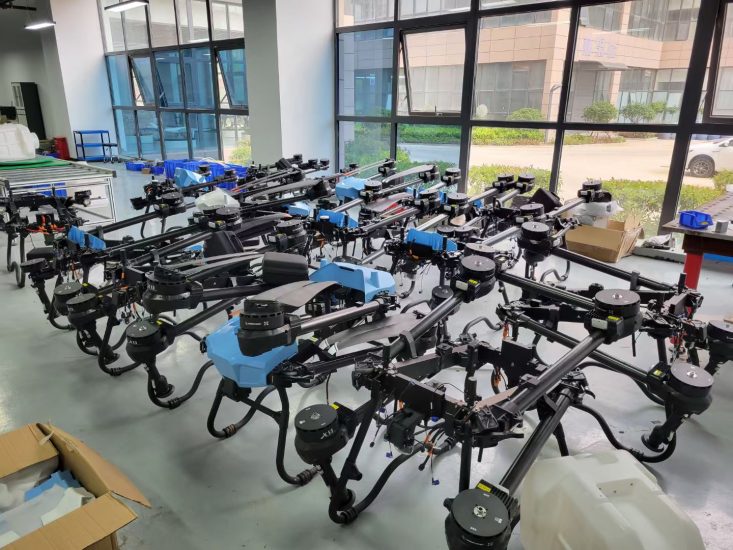


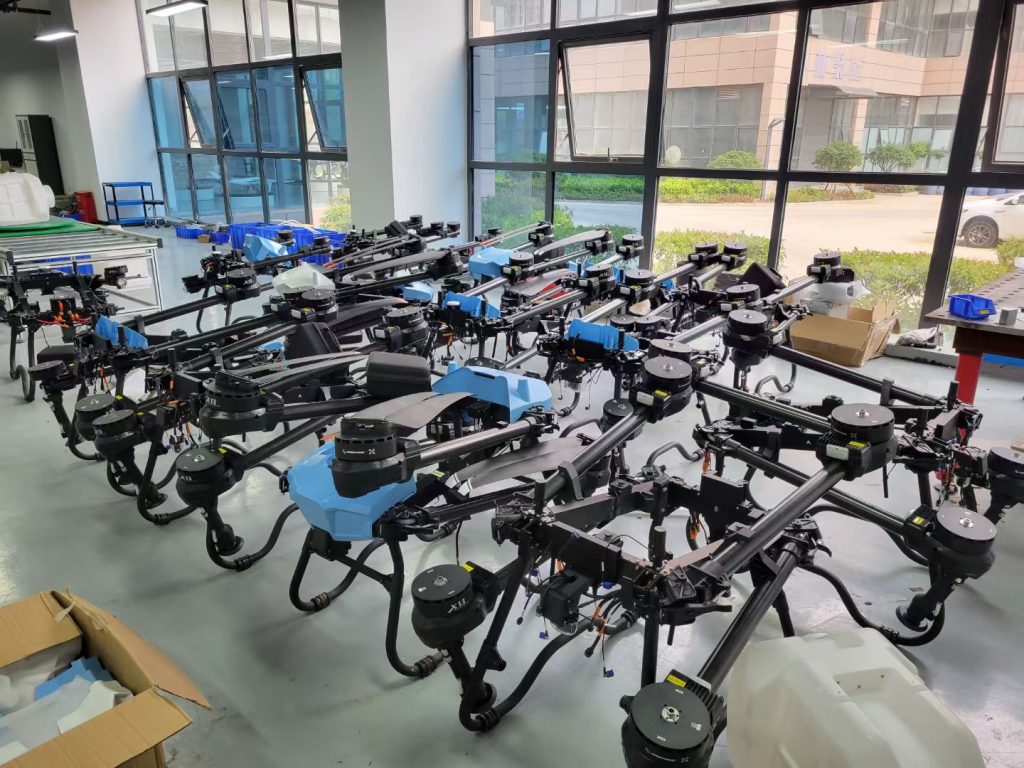
Choosing the right agricultural drone manufacturer in China is an important decision for distributors, importers, agricultural companies, and professional farming operations. The manufacturer you select can directly affect product quality, delivery time, after-sales support, spare parts availability, and long-term operating costs.
China has become one of the major manufacturing centers for agricultural drones, offering a wide range of spraying, spreading, mapping, and customized UAV solutions. However, not every supplier has the same manufacturing capabilities.
This guide explains what international buyers should check before selecting a reliable agricultural drone manufacturer in China.
1. Check Whether the Supplier Is a Real Manufacturer
The first step is to determine whether you are dealing with a factory, an engineering company, or simply a trading company.
A reliable agricultural drone manufacturer should be able to provide information about:
-
Factory location
-
Production facilities
-
Assembly lines
-
R&D capabilities
-
Quality-control procedures
-
Flight testing
-
Product development
-
Spare parts supply
-
OEM and ODM capabilities
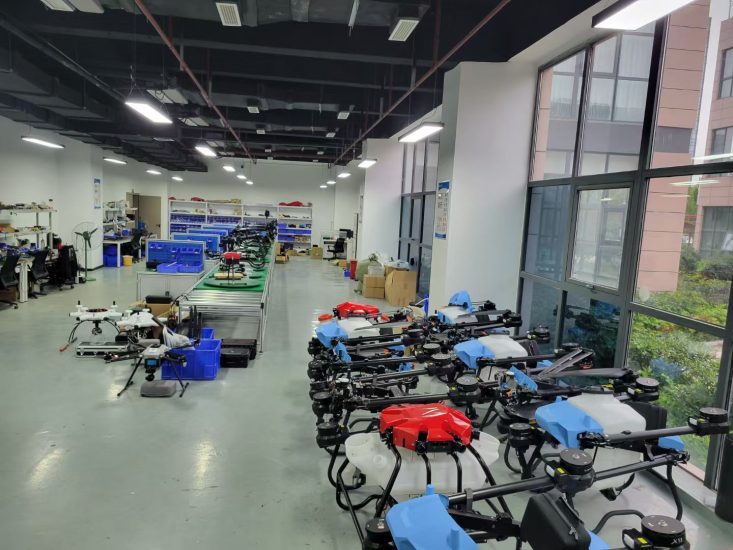
Ask the supplier for current factory photos and videos. If possible, request a live factory video call so you can see the production and testing process.
A professional manufacturer should be able to explain how the drone is assembled, tested, packaged, and prepared for international shipment.
2. Evaluate Agricultural Drone Specifications
Do not select a supplier based only on the advertised payload.
Different agricultural drones can have very different performance even when they have similar tank capacities.
Important specifications include:
Specification |
What to Check |
|---|---|
Tank Capacity |
10L, 20L, 30L, 40L, 50L or more |
Payload |
Maximum liquid or solid payload |
Flight Time |
Actual operating flight time |
Spray Width |
Effective spraying coverage |
Flow Rate |
Liters per minute |
Battery |
Voltage, capacity and cycle life |
Charging |
Charging time and charger type |
Flight Speed |
Operating speed during spraying |
Protection |
Water and dust resistance |
Navigation |
GNSS, RTK and positioning options |
Obstacle Avoidance |
Sensors and detection range |
Remote Controller |
Range and control functions |
For commercial farming, the actual working performance is usually more important than a single specification such as maximum payload.
3. Ask for Real Spraying Performance
One of the most important questions is:
How many acres or hectares can the drone actually cover per hour?
The answer depends on several factors, including:
-
Drone tank capacity
-
Spray width
-
Flight speed
-
Application rate
-
Crop type
-
Field conditions
-
Refilling time
-
Battery replacement time
-
Operator experience
For example, a drone may have a large tank but still have relatively low productivity if the battery requires frequent replacement or the refilling process is slow.
Therefore, ask the manufacturer for real-world test data rather than relying only on marketing claims.
4. Compare Battery and Charging Systems
The battery system is one of the most important components of an agricultural drone.
Professional buyers should ask about:
-
Battery voltage
-
Battery capacity
-
Battery weight
-
Expected cycle life
-
Charging time
-
Fast-charging capability
-
Intelligent battery management
-
Battery communication
-
Replacement cost
For commercial agricultural operations, it is often necessary to purchase multiple batteries so that one battery can be charging while another is being used.
The total battery ecosystem should therefore be considered when calculating the operating cost of the drone.
5. Check the Manufacturer’s Spray System
The spraying system directly affects application accuracy.
A reliable agricultural spraying drone may use:
-
Centrifugal nozzles
-
Pressure spraying systems
-
Multiple spray nozzles
-
Flow-rate control
-
Automatic spraying control
-
Variable-rate application
Buyers should ask the manufacturer about the recommended application rate and available nozzle configurations.
It is also important to check whether spare pumps, nozzles, pipes, filters, and other spraying components are readily available.
6. Examine Flight Control and Navigation
Modern agricultural drones rely on sophisticated flight-control systems.
Depending on the model, buyers may need:
-
GNSS positioning
-
RTK positioning
-
Automatic route planning
-
Terrain following
-
Obstacle avoidance
-
Automatic return-to-home
-
Low-battery protection
-
Loss-of-signal protection
-
Smart flight planning
For large farms and professional operators, accurate positioning and automatic flight planning can significantly improve operating efficiency.
Before purchasing, ask the manufacturer to demonstrate these functions in a real flight.
7. Verify Quality Control
A professional agricultural drone manufacturer should have a defined quality-control process.
Important testing stages may include:
Incoming component inspection → Assembly → Electrical testing → Motor testing → Flight-controller testing → Spray-system testing → Flight testing → Final inspection → Packaging
Ask the manufacturer how each drone is inspected before shipment.
You can also ask whether the factory records serial numbers and maintains production inspection records.
These details become especially important when purchasing multiple units.
8. Ask About OEM and ODM Services
If you are a distributor or agricultural equipment company, OEM and ODM capabilities may be important.
OEM services can include:
-
Custom logo
-
Custom packaging
-
Custom manuals
-
Product labeling
-
Customized software
-
Color customization
-
Distributor branding
ODM may involve deeper cooperation, such as modifying the aircraft structure, spraying system, battery configuration, or control system.
Before placing an OEM order, confirm the manufacturer’s minimum order quantity, development costs, production lead time, and intellectual-property arrangements.
9. Check Spare Parts Availability
Agricultural drones operate in demanding environments.
Components can eventually require replacement, including:
-
Motors
-
Propellers
-
Arms
-
Pumps
-
Nozzles
-
Batteries
-
Chargers
-
Landing gear
-
Flight controllers
-
Electronic modules
A manufacturer with a stable spare-parts supply can help reduce downtime.
Ask whether spare parts can be purchased separately and how quickly they can be shipped internationally.
10. Evaluate After-Sales Support
Price is only one part of the purchasing decision.
International buyers should also consider technical support.
A reliable manufacturer should provide:
-
Installation instructions
-
User manuals
-
Flight-operation guidance
-
Troubleshooting support
-
Remote technical assistance
-
Spare-parts support
-
Warranty terms
-
Software updates when applicable
For overseas distributors, multilingual documentation and remote technical training can be particularly valuable.
11. Understand Agricultural Drone Pricing
Agricultural drone prices vary considerably depending on specifications and configuration.
The final cost may include:
-
Aircraft
-
Flight controller
-
Remote controller
-
Batteries
-
Charger
-
Spraying system
-
Spreading system
-
RTK equipment
-
Obstacle-avoidance system
-
Spare parts
-
Packaging
-
OEM customization
A very low initial quotation does not necessarily mean the product has the lowest total cost.
For example, a drone with a lower purchase price may have more expensive batteries, limited spare-parts availability, or weaker after-sales support.
A better approach is to compare the total cost of ownership.
12. Ask About Export Experience
International logistics can be complicated because agricultural drones contain electronic components and lithium batteries.
An experienced manufacturer should understand the export requirements for different markets and be able to provide appropriate commercial documentation.
Ask whether the supplier regularly exports to your target country or region.
You should also confirm:
-
Commercial invoice
-
Packing list
-
Product specifications
-
Battery information
-
Shipping requirements
-
Warranty documentation
-
Certificates where applicable
The buyer should independently verify the import requirements of the destination country before placing an order.
13. Request a Sample or Demonstration
For a large purchase, it is often better to test one unit before ordering a larger quantity.
A practical evaluation should include:
-
Assembly
-
Battery installation
-
Takeoff
-
Flight stability
-
Navigation accuracy
-
Spraying performance
-
Tank emptying
-
Battery endurance
-
Emergency functions
-
Cleaning and maintenance
If possible, conduct testing under conditions similar to your actual application.
14. Questions to Ask an Agricultural Drone Manufacturer
Before requesting a quotation, prepare a clear list of questions.
For example:
Product
-
What is the tank capacity?
-
What is the maximum payload?
-
What is the spraying width?
-
What is the typical flight time?
-
What is the recommended application rate?
Battery
-
What is the battery capacity?
-
How long does charging take?
-
What is the expected battery cycle life?
-
What is the replacement cost?
Manufacturing
-
Are you a factory or trading company?
-
Do you support OEM?
-
What is the MOQ?
-
What is the normal production lead time?
After-sales
-
What is the warranty period?
-
Are spare parts available?
-
Do you provide remote technical support?
-
Can you provide operation training?
A manufacturer that provides clear and consistent answers is generally easier to work with over the long term.
15. Red Flags to Watch For
International buyers should be cautious when a supplier:
-
Refuses to provide factory information
-
Cannot explain basic product specifications
-
Provides inconsistent technical data
-
Cannot demonstrate the drone
-
Has no spare-parts system
-
Offers unusually low prices without explanation
-
Cannot provide clear warranty terms
-
Uses copied product photographs without technical information
-
Avoids questions about production capacity
None of these points alone proves that a supplier is unreliable, but several warning signs together deserve additional verification.
16. Build a Long-Term Manufacturer Relationship
For distributors and agricultural equipment companies, choosing a manufacturer should not be based solely on the first purchase.
A good manufacturing partner should be able to support future growth.
As your business expands, you may need:
-
Additional drone models
-
Larger payload options
-
OEM branding
-
Spare-parts inventory
-
Technical training
-
Product customization
-
New market configurations
-
Stable production capacity
A long-term manufacturer relationship can make procurement and after-sales management much easier.
FAQ
What should I look for in an agricultural drone manufacturer in China?
Look at manufacturing capability, product specifications, quality control, flight testing, spare-parts availability, OEM capability, export experience, warranty, and technical support.
How can I verify whether a Chinese agricultural drone supplier is a real factory?
Ask for factory information, production photos, videos, business documentation, and a live factory video call. You can also request a factory visit or third-party inspection for larger orders.
What agricultural drone capacity should I choose?
It depends on your crops, farm size, application rate, terrain, operating conditions, and budget. Smaller drones may be suitable for smaller farms, while higher-capacity drones can improve productivity for large commercial operations.
Is a larger agricultural drone always better?
No. Payload capacity is only one factor. Battery endurance, spraying efficiency, flight stability, refill time, maintenance, and operating costs are also important.
Can agricultural drones be customized?
Many manufacturers offer OEM and ODM services, depending on the model and order quantity. Customization may include branding, packaging, configuration, and selected hardware or software functions.
How many batteries should I buy?
The number depends on the operating schedule, charging speed, and daily workload. Commercial operators often need multiple batteries to maintain continuous operations.
How can I compare two agricultural drone manufacturers?
Create a comparison sheet covering price, payload, tank capacity, flight time, spraying width, battery cost, spare parts, warranty, production capacity, OEM support, and after-sales service.
Should I buy directly from a factory?
Buying directly from a capable manufacturer can provide better communication and customization opportunities, but the most important factor is the supplier’s actual manufacturing and support capability rather than simply whether it calls itself a factory.
Final Checklist
Before selecting an agricultural drone manufacturer in China, confirm these points:
-
[ ] Real manufacturing capability
-
[ ] Clear product specifications
-
[ ] Demonstrated flight performance
-
[ ] Reliable spraying system
-
[ ] Stable battery and charging system
-
[ ] Quality-control process
-
[ ] Spare-parts availability
-
[ ] OEM/ODM capability if required
-
[ ] Export experience
-
[ ] Clear warranty terms
-
[ ] Technical support
-
[ ] Competitive total cost of ownership
Choosing an agricultural drone manufacturer is a long-term purchasing decision. Instead of selecting a supplier based only on the lowest quotation, evaluate the complete combination of product performance, manufacturing quality, technical support, spare parts, customization, delivery capability, and total operating cost.
For international buyers looking for agricultural spraying drones from China, a detailed supplier evaluation before placing an order can significantly reduce purchasing risks and help build a more reliable long-term supply chain.
THE END




No comments yet