


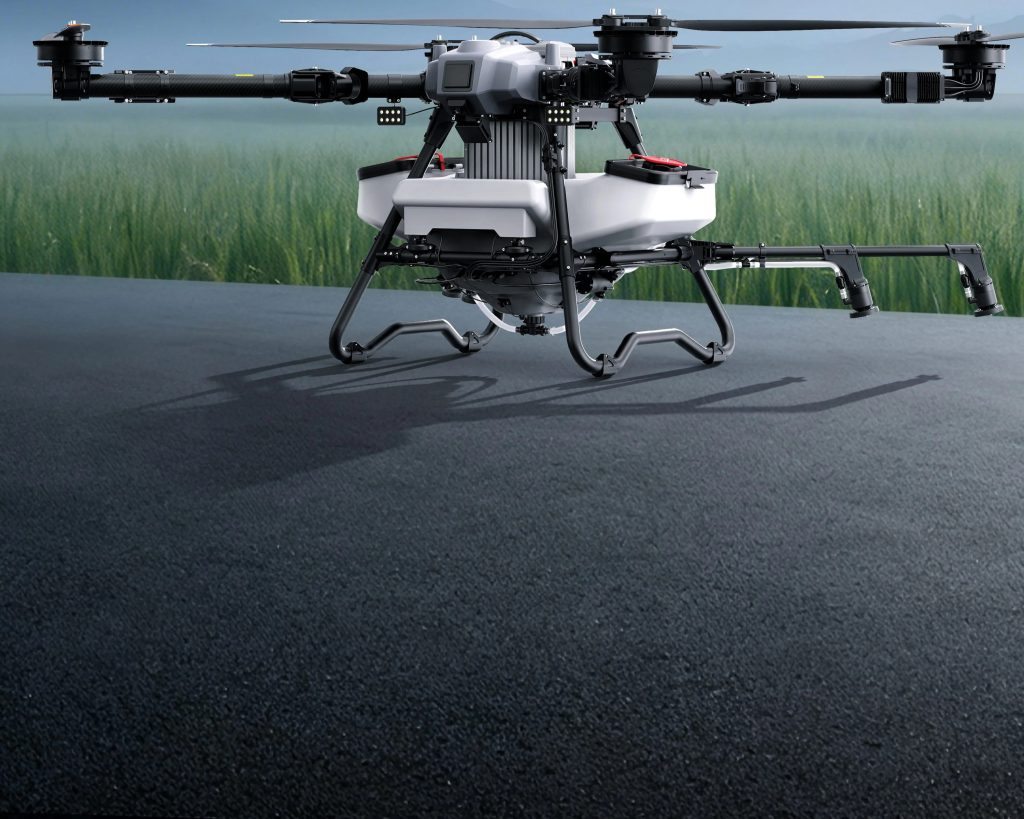
Large-scale farming operations are constantly looking for ways to reduce labor costs, improve crop protection efficiency, and complete agricultural spraying more precisely. A 100KG payload agricultural spraying drone is designed for demanding agricultural operations where conventional spraying equipment may be too slow, difficult to access, or expensive to operate.
However, choosing a 100KG-class agricultural drone is not simply a matter of selecting the drone with the largest payload. Buyers need to evaluate the spraying system, flight time, battery capacity, pump performance, flight stability, terrain adaptability, safety functions, maintenance requirements, and total operating cost.
This guide explains what large farms should consider before purchasing a 100KG payload agricultural spraying drone.
What Is a 100KG Payload Agricultural Spraying Drone?
A 100KG payload agricultural spraying drone is a heavy-duty unmanned aerial vehicle designed to carry a substantial agricultural payload during field operations.
Depending on the specific configuration, the payload may include:
-
Liquid pesticide or fertilizer
-
Granular fertilizer
-
Seeds
-
Biological crop-protection products
-
Other agricultural materials
For spraying applications, the actual liquid tank capacity may be lower than the drone’s maximum structural payload rating. Buyers should therefore distinguish between maximum payload, recommended working payload, and spray tank capacity.
For example, a drone advertised as having a 100KG payload does not necessarily mean that it should continuously operate at exactly 100KG under every environmental condition.
Wind speed, altitude, battery condition, temperature, terrain, flight speed, and takeoff requirements can all affect the practical payload.
Why Are 100KG Agricultural Drones Used on Large Farms?
Large farms often manage hundreds or thousands of hectares. Traditional ground-based spraying equipment can encounter several problems.
1. Difficult Terrain
Wet fields, steep slopes, muddy ground, orchards, and areas with poor road access can make tractors and other ground equipment difficult to operate.
An agricultural drone can fly over these areas without physically driving through the field.
2. Reduced Crop Damage
Ground machinery can potentially damage crops by driving between rows.
Aerial spraying avoids direct contact between wheels and crops, which can be especially useful for mature crops and high-value agricultural fields.
3. Faster Field Operations
A high-capacity agricultural drone can carry more liquid or agricultural material per flight than smaller drones.
This can reduce the number of refilling operations required during a working day.
4. Lower Labor Requirements
Agricultural drone operations can reduce the amount of manual labor required for spraying and spreading tasks.
This can be particularly valuable in regions where agricultural labor costs are increasing or seasonal labor is difficult to find.
7 Key Factors to Consider Before Buying
1. Check the Real Working Payload
The first specification to evaluate is payload capacity.
Do not look only at the headline number.
Ask the manufacturer for information about:
-
Maximum payload
-
Recommended continuous payload
-
Empty drone weight
-
Spray tank capacity
-
Maximum takeoff weight
-
Payload under different battery configurations
-
Payload performance in windy conditions
A drone may technically lift 100KG under specific test conditions, but its practical operating payload can vary.
For commercial agricultural operations, stable working performance is generally more important than the maximum theoretical payload.
2. Evaluate the Spraying System
The spraying system directly affects field productivity.
Important specifications include:
-
Pump flow rate
-
Number of spray nozzles
-
Spray width
-
Droplet size
-
Spray pressure
-
Flow control
-
Anti-drip system
-
Nozzle replacement options
-
Automatic flow adjustment
A high-capacity tank is not useful if the pump cannot deliver enough liquid for the required application rate.
For example, if a farm needs a relatively high application volume per hectare, the drone needs sufficient pump capacity and spray width to maintain reasonable operating efficiency.
3. Look at Actual Flight Time
Flight time is another critical factor.
A manufacturer may advertise a maximum flight time under ideal conditions. Real agricultural operations can produce different results.
Actual flight time can be affected by:
-
Payload
-
Battery capacity
-
Wind
-
Flight speed
-
Temperature
-
Flight altitude
-
Spray rate
-
Battery age
When comparing models, ask for flight time with a practical agricultural payload, rather than flight time with an empty drone.
A useful question for suppliers is:
How many minutes can the drone operate with a full working load under normal agricultural conditions?
This gives buyers a much more realistic comparison.
4. Battery and Charging System
A heavy-duty agricultural drone consumes considerable energy.
The battery system therefore has a major impact on productivity.
Consider:
-
Battery voltage
-
Battery capacity
-
Battery weight
-
Charging time
-
Number of batteries supplied
-
Battery cycle life
-
Fast-charging capability
-
Battery monitoring
-
Battery replacement cost
For commercial farms, it is often better to have multiple battery sets so that one set can be charging while another is operating.
The charging infrastructure should also match the farm’s available electrical supply.
5. Flight Control and Navigation
Large agricultural drones should have reliable navigation and flight-control systems.
Important features may include:
-
GNSS positioning
-
RTK positioning
-
Automatic route planning
-
Obstacle detection
-
Terrain following
-
Return-to-home
-
Low-battery return
-
Loss-of-signal protection
-
Automatic altitude control
-
Remote controller telemetry
For large farms, route planning can be particularly valuable because operators may need to manage large areas repeatedly.
RTK positioning can also improve flight-path accuracy where centimeter-level positioning is required.
6. Safety Features
A 100KG-class drone carries significantly more mass than a small agricultural drone.
Safety should therefore be a major part of the purchasing decision.
Ask about:
-
Motor redundancy
-
Flight controller redundancy
-
Battery protection
-
Overcurrent protection
-
Low-voltage protection
-
Signal-loss response
-
Emergency landing functions
-
Obstacle detection
-
Propeller protection
-
Waterproofing
-
Weather resistance
The drone should also be operated according to local aviation regulations and agricultural chemical safety requirements.
7. Spare Parts and After-Sales Support
A commercial agricultural drone is a working machine, not simply an electronic product.
Downtime during the spraying season can have a significant financial impact.
Before purchasing, ask whether the supplier can provide:
-
Motors
-
Propellers
-
Pumps
-
Nozzles
-
ESCs
-
Flight controllers
-
Batteries
-
Chargers
-
Landing gear
-
Remote controllers
-
Wiring components
It is also important to understand the warranty period and technical support process.
A slightly cheaper drone may become more expensive if replacement parts are difficult to obtain.
How Much Does a 100KG Agricultural Spraying Drone Cost?
The price of a 100KG payload agricultural drone can vary significantly depending on its configuration.
A general international market estimate for a heavy-duty agricultural spraying drone can be approximately:
Configuration |
Typical Price Range |
|---|---|
Basic heavy-duty drone |
US$15,000–25,000 |
Mid-range commercial system |
US$25,000–40,000 |
High-specification system |
US$40,000–60,000+ |
These are indicative equipment price ranges, not fixed quotations.
The final price may depend on:
-
Payload configuration
-
Battery quantity
-
Charger type
-
RTK system
-
Radar system
-
Obstacle avoidance
-
Spray system
-
Spreading system
-
Remote controller
-
Spare parts
-
Packaging
-
Shipping
-
Taxes and import duties
For international buyers, it is important to request a complete quotation that clearly separates the drone price from batteries, chargers, accessories, spare parts, shipping, and other costs.
What Area Can a 100KG Agricultural Drone Cover?
Field coverage depends on several variables.
A simplified calculation can be made using:
Coverage = Effective Working Width × Flight Speed × Working Efficiency
For example, if a drone has an effective spraying width of 8 meters and flies at 6 m/s:
8 × 6 × 3.6 = 172.8 hectares/hour theoretical coverage
However, this is only a theoretical calculation.
Actual field efficiency will be lower because of:
-
Turning
-
Refilling
-
Battery replacement
-
Takeoff and landing
-
Route adjustments
-
Obstacles
-
Terrain
-
Wind
-
Operator procedures
Therefore, buyers should ask manufacturers for real-world hectares per hour, not only theoretical flight performance.
Liquid Spraying vs. Granular Spreading
Some 100KG agricultural drones support multiple agricultural applications.
Liquid Spraying
Liquid spraying can be used for:
-
Crop protection
-
Fungicides
-
Insecticides
-
Herbicides
-
Foliar fertilizers
-
Certain biological products
The important specifications are tank capacity, pump flow, spray width, droplet size, and application-rate control.
Granular Spreading
A spreading system can potentially be used for:
-
Fertilizer
-
Seeds
-
Granular agricultural materials
For spreading applications, buyers should check:
-
Hopper capacity
-
Maximum spreading rate
-
Spreading width
-
Material compatibility
-
Distribution uniformity
-
Anti-bridging design
A drone designed for both spraying and spreading can provide greater flexibility for large agricultural operations.
What Crops Can a 100KG Agricultural Drone Serve?
The suitability depends on the crop, terrain, chemical application requirements, and local regulations.
Potential applications include:
-
Rice
-
Wheat
-
Corn
-
Soybeans
-
Cotton
-
Sugarcane
-
Vegetables
-
Orchards
-
Vineyards
-
Tea plantations
-
Fruit trees
-
Forestry areas
For orchards and vineyards, terrain-following and obstacle-detection capabilities can be particularly important.
For large open fields, route-planning efficiency and tank capacity may become more important.
What Should Large Farms Ask the Manufacturer?
Before placing an order, buyers should prepare a technical checklist.
Drone specifications
-
What is the maximum takeoff weight?
-
What is the recommended working payload?
-
What is the empty weight?
-
What is the maximum flight speed?
-
What is the normal working altitude?
Spraying system
-
What is the tank capacity?
-
What is the maximum pump flow rate?
-
What is the effective spray width?
-
What nozzle types are supported?
-
Can the flow rate be automatically controlled?
Battery system
-
What is the battery voltage?
-
What is the battery capacity?
-
How long does one battery take to charge?
-
How many batteries are recommended?
-
What is the expected battery cycle life?
Navigation
-
Does the drone support RTK?
-
Does it support automatic route planning?
-
Does it support terrain following?
-
What happens if the signal is lost?
Maintenance
-
Which spare parts are included?
-
How long is the warranty?
-
Are replacement batteries available?
-
Can remote technical support be provided?
How to Choose a Reliable 100KG Agricultural Drone Manufacturer
For large commercial purchases, the manufacturer is almost as important as the drone itself.
A professional supplier should be able to provide detailed technical specifications rather than only marketing images.
Look for evidence of:
-
Manufacturing capability
-
Product testing
-
Quality-control procedures
-
Agricultural application experience
-
Stable spare-parts supply
-
Technical documentation
-
Operator training
-
Warranty support
-
Export experience
It is also useful to request videos or records of the drone operating under realistic agricultural conditions.
If possible, buyers should evaluate an actual demonstration before purchasing a large fleet.
Should You Buy One Drone or a Fleet?
The answer depends on farm size and operational requirements.
For a smaller commercial operation, one drone may be sufficient for initial testing.
For large farms, multiple drones can provide advantages such as:
-
Higher daily capacity
-
Backup during maintenance
-
Multiple field operations
-
Reduced downtime
-
Better seasonal productivity
However, buying a fleet requires additional investment in batteries, chargers, operators, spare parts, and maintenance.
A sensible strategy is often to calculate the required hectares per day first and then determine how many drones are necessary.
Total Cost of Ownership
The purchase price is only one part of the investment.
A better calculation is:
Total Cost of Ownership = Drone + Batteries + Chargers + Spare Parts + Maintenance + Labor + Energy + Transportation
For commercial agricultural operations, buyers should calculate the cost per hectare rather than focusing only on the initial drone price.
For example:
Cost per hectare = Total operating cost ÷ Completed hectares
This provides a much better comparison with tractors, manned aircraft, backpack spraying, or other agricultural application methods.
Final Buying Checklist
Before purchasing a 100KG payload agricultural spraying drone, make sure you have checked:
-
✓ Actual working payload
-
✓ Maximum takeoff weight
-
✓ Tank capacity
-
✓ Pump flow rate
-
✓ Spray width
-
✓ Droplet-size control
-
✓ Real flight time with payload
-
✓ Battery capacity
-
✓ Charging time
-
✓ RTK navigation
-
✓ Obstacle detection
-
✓ Terrain following
-
✓ Safety functions
-
✓ Waterproofing
-
✓ Spare-parts availability
-
✓ Warranty
-
✓ Technical support
-
✓ Training
-
✓ Export documentation
-
✓ Total operating cost
The most important principle is simple: do not choose a 100KG agricultural drone based only on payload capacity.
A good commercial drone needs to combine payload capability with reliable flight performance, efficient spraying, battery management, accurate navigation, safety systems, and long-term after-sales support.
For large farms, the best model is the one that can consistently complete the required hectares per day at an acceptable operating cost—not necessarily the drone with the highest specification on paper.
FAQ
Is a 100KG payload agricultural drone suitable for large farms?
Yes. Its high payload capacity can make it suitable for large-scale spraying and spreading operations, particularly where frequent refilling would reduce the efficiency of smaller drones.
How much does a 100KG agricultural spraying drone cost?
Depending on specifications and configuration, a rough equipment price range can be around US$15,000 to US$60,000+. Batteries, chargers, spare parts, shipping, taxes, and optional systems can affect the final cost.
How long can a 100KG agricultural drone fly?
Actual flight time varies according to payload, battery configuration, weather, speed, altitude, and spraying conditions. Buyers should request flight-time data using the intended working payload.
Can a 100KG drone spray and spread fertilizer?
Some models support both liquid spraying and granular spreading. Buyers should confirm whether the specific model has interchangeable or integrated spraying and spreading systems.
Is RTK necessary?
RTK is not required for every application, but it can provide more accurate positioning and route repeatability. It can be particularly useful for large commercial farms and precision agricultural operations.
What is more important: payload or flight time?
Both are important, but neither should be evaluated independently. A drone with a large payload but very short operating time may require frequent battery changes. A drone with long flight time but a small payload may require frequent refilling.
The best choice depends on the farm’s required application rate, field size, terrain, and daily workload.
What should I request before placing a bulk order?
Request a complete technical datasheet, working-payload information, battery specifications, spraying parameters, warranty terms, spare-parts list, operator manuals, packaging details, and a complete commercial quotation.
For large orders, a real field demonstration or sample-unit test is strongly recommended before committing to a full fleet.
THE END







No comments yet