


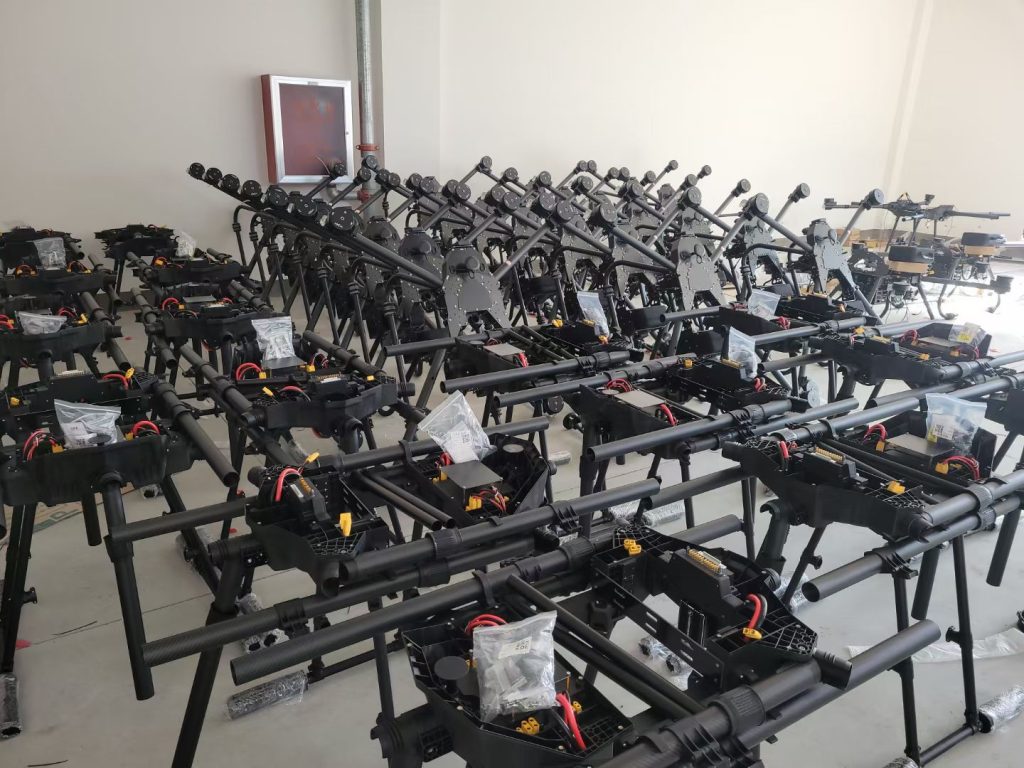
Choosing between a 30L agricultural spraying drone and a 50KG agricultural drone can be difficult for farmers, distributors, and agricultural service companies.
At first glance, the two models may appear similar because both are designed for professional agricultural operations. However, their payload capacity, spraying performance, battery requirements, operating efficiency, transportation needs, and purchase costs can be significantly different.
The right choice depends on your farm size, crop type, application rate, field conditions, operating schedule, and budget.
This guide compares 30L and 50KG agricultural drones to help international buyers select a suitable configuration.
30L vs 50KG: What’s the Difference?
The first important point is that 30L and 50KG are not necessarily equivalent specifications.
A 30L agricultural drone normally refers to a spraying tank capacity of approximately 30 liters.
A 50KG agricultural drone generally refers to an aircraft designed to carry a payload of approximately 50 kilograms.
Therefore, buyers should compare the complete specifications rather than the names alone.
Feature |
30L Agricultural Drone |
50KG Agricultural Drone |
|---|---|---|
Typical Application |
Spraying |
Spraying & spreading |
Capacity |
Around 30L |
Around 50KG payload |
Operating Scale |
Small to medium/large |
Medium to large |
Payload |
Lower |
Higher |
Battery Requirement |
Moderate |
Higher |
Refilling Frequency |
Higher |
Lower |
Transportation |
Easier |
More demanding |
Purchase Cost |
Generally lower |
Generally higher |
Operating Cost |
Generally lower |
Generally higher |
Productivity Potential |
High |
Very high |
Actual specifications vary by manufacturer and model.
What Is a 30L Agricultural Drone?
A 30L agricultural drone is designed around a liquid tank capacity of approximately 30 liters.
It can be suitable for:
-
Crop spraying
-
Herbicide application
-
Fungicide application
-
Liquid fertilizer
-
Rice-field operations
-
Vegetable farming
-
Orchard applications
-
Agricultural service businesses
The main advantage is the balance between payload capacity, aircraft size, operating flexibility, and cost.
Advantages of a 30L Drone
Lower Initial Investment
A 30L model generally requires less powerful motors and a smaller overall propulsion system than a heavier drone.
This can reduce the initial purchase cost.
Easier Transportation
A 30L drone may be easier to:
-
Transport between fields
-
Load into vehicles
-
Store
-
Assemble
-
Maintain
Lower Battery Demand
A smaller payload generally requires less energy than a fully loaded heavy-duty aircraft.
This can make battery management easier.
Suitable for Many Applications
A 30L configuration can provide a practical balance for many commercial farming operations.
What Is a 50KG Agricultural Drone?
A 50KG agricultural drone is a heavy-duty platform designed for higher payload operations.
Depending on configuration, it can support:
-
Liquid spraying
-
Fertilizer spreading
-
Seed spreading
-
Large-scale crop treatment
-
Commercial agricultural services
The major advantage is its higher payload capacity.
Advantages of a 50KG Drone
Higher Payload
The aircraft can carry a significantly greater agricultural load than a 30L system.
Fewer Refilling Cycles
When operating under similar application conditions, a higher-capacity aircraft may require fewer refills.
Higher Productivity Potential
Large agricultural operations may benefit from greater payload capacity because more material can be transported per flight.
Suitable for Professional Operations
A 50KG-class drone can be attractive for agricultural service providers and large commercial farms.
30L vs 50KG Spraying Capacity
Payload is only one factor determining spraying productivity.
The effective working area depends on:
-
Tank capacity
-
Spray width
-
Flow rate
-
Flight speed
-
Application rate
-
Battery endurance
-
Refilling time
-
Field layout
A simplified calculation is:
Working Area = Spray Width × Flight Speed × Operating Time
But actual field productivity is lower because of:
-
Turning
-
Takeoff
-
Landing
-
Refilling
-
Battery changes
-
Obstacles
-
Transportation between fields
Therefore, when comparing 30L and 50KG drones, request real field-test data.
Battery Comparison
Battery requirements are an important difference.
30L Drone Battery
A 30L drone generally requires a battery system capable of supporting its aircraft and normal operating payload.
The buyer should check:
-
Battery voltage
-
Capacity
-
Energy
-
Charging time
-
Cycle life
-
Replacement price
50KG Drone Battery
A 50KG drone generally requires a higher-performance battery system.
The battery must provide sufficient power for:
-
Larger motors
-
Higher payload
-
Longer or heavier operating cycles
-
Spraying equipment
-
Flight-control electronics
The battery cost can therefore represent a larger portion of the total investment.
Which Drone Has Longer Flight Time?
This question does not have a simple answer.
A manufacturer may advertise a maximum flight time under light-load conditions.
However, the actual working flight time depends on payload.
For example:
Empty aircraft flight time ≠ working flight time
When comparing models, ask manufacturers for:
-
Empty flight time
-
Half-load flight time
-
Full-load flight time
-
Spraying flight time
This provides a much more realistic comparison.
Spray Width Comparison
Spray width can have a major impact on productivity.
A 30L drone with an efficient spraying system may provide excellent coverage.
A 50KG drone may support a larger spraying system, but larger capacity alone does not guarantee a wider effective spray pattern.
Spray width depends on:
-
Nozzle configuration
-
Pump
-
Flow rate
-
Flight altitude
-
Flight speed
-
Droplet size
-
Wind
-
Crop conditions
Therefore, compare the actual recommended operating parameters.
Flow Rate
Flow rate refers to how much liquid the spraying system can distribute per minute.
A higher flow rate can support higher application volumes, but it must be matched to the spray width and flight speed.
For example, increasing flow rate without adjusting flight speed may result in excessive application.
The goal is consistent application rather than simply maximizing flow rate.
30L vs 50KG for Fertilizer Spreading
If fertilizer spreading is an important part of your operation, the 50KG class may offer an advantage.
A larger payload allows more granular material to be carried per flight.
However, buyers should evaluate:
-
Hopper capacity
-
Spreading width
-
Material flow rate
-
Spreading uniformity
-
Calibration
-
Battery consumption
A 30L liquid spraying drone may not automatically be suitable for solid fertilizer unless a compatible spreading system is available.
Which Drone Is Better for Rice Farming?
Both configurations can be suitable for rice farming.
A 30L drone can provide a balance between:
-
Mobility
-
Cost
-
Spraying capacity
-
Battery requirements
A 50KG drone may be more attractive for large-scale rice operations where higher productivity is important.
The final decision should be based on:
-
Total rice acreage
-
Field size
-
Distance between fields
-
Application rate
-
Daily operating target
-
Labor availability
Which Is Better for Orchards?
Orchard operations can be more complex because trees may create obstacles and different spray-coverage requirements.
Important factors include:
-
Airflow
-
Spray pattern
-
Droplet size
-
Flight altitude
-
Obstacle detection
-
Route planning
-
Terrain
A smaller drone may be easier to maneuver in certain orchard environments, while a larger platform may provide higher productivity in suitable conditions.
The crop environment should therefore be considered before selecting the capacity.
30L vs 50KG Purchase Price
Generally, a 50KG agricultural drone costs more than a 30L system because it requires a heavier aircraft structure and higher-capacity propulsion and battery systems.
The final price may include:
-
Aircraft
-
Batteries
-
Charger
-
Remote controller
-
Spraying system
-
Spreading system
-
RTK
-
Sensors
-
Spare parts
-
Packaging
-
OEM customization
When comparing prices, make sure both quotations have the same configuration.
Example of a Fair Price Comparison
Do not compare:
30L drone + 2 batteries
with:
50KG drone + 4 batteries + RTK + obstacle avoidance + spreading system
This is not an equal comparison.
Instead, create a detailed comparison sheet.
Total Cost of Ownership
The purchase price is only part of the total cost.
Consider:
Purchase Cost + Battery Cost + Charger + Spare Parts + Maintenance + Shipping + Taxes + Training + Downtime
For commercial operations, productivity should also be included.
A more expensive drone may produce a lower cost per hectare if it can operate more efficiently.
Which Drone Has Lower Operating Costs?
A 30L drone may have lower:
-
Battery cost
-
Transportation cost
-
Spare-parts cost
-
Maintenance cost
-
Initial investment
A 50KG drone may provide higher productivity, potentially reducing labor and refill time.
Therefore, “lower operating cost” depends on how the drone is used.
For large farms, productivity may be more important than the initial purchase price.
30L vs 50KG: Which One Should You Buy?
Choose a 30L Agricultural Drone If:
-
You operate small or medium-sized farms
-
Transportation flexibility is important
-
You want a lower initial investment
-
You primarily need liquid spraying
-
You want easier battery management
-
You operate fields with relatively tight access
Choose a 50KG Agricultural Drone If:
-
You manage large agricultural areas
-
High productivity is important
-
You need higher payload capacity
-
You provide commercial spraying services
-
Fertilizer spreading is important
-
You want fewer refilling cycles
-
Your operation can support larger batteries and charging equipment
Questions to Ask the Manufacturer
Before buying either model, ask:
Product
-
What is the maximum payload?
-
What is the recommended working payload?
-
What is the tank capacity?
-
What is the spray width?
-
What is the flow rate?
Battery
-
What is the battery capacity?
-
What is the full-load flight time?
-
How long does charging take?
-
How many cycles can the battery provide?
Performance
-
How many hectares can it cover per hour?
-
What application rate was used during testing?
-
What flight speed was used?
-
What spray width was used?
Support
-
What is the warranty?
-
Are spare parts available?
-
Is technical training included?
-
Is OEM customization available?
FAQ
Is a 50KG agricultural drone better than a 30L drone?
Not necessarily. A 50KG drone has a higher payload capacity, but a 30L drone may be more economical and easier to transport. The best choice depends on the operating environment.
Is a 30L drone suitable for commercial farming?
Yes. A 30L agricultural drone can be suitable for commercial spraying operations, depending on the farm size and required productivity.
Is a 50KG drone suitable for small farms?
It can be used, but the additional capacity may not be economically necessary for small farms.
Which drone has better spraying efficiency?
Efficiency depends on spray width, flow rate, flight speed, application rate, battery endurance, and refill time. Payload alone does not determine spraying efficiency.
Which drone costs more?
Generally, a 50KG-class drone costs more because it requires a heavier structure, stronger propulsion system, and higher-capacity battery configuration.
Which drone is easier to transport?
A 30L drone is generally easier to transport because of its smaller size and lower system weight.
Can a 50KG drone spread fertilizer?
Yes, if it is equipped with a suitable spreading system.
Does a larger tank always mean better productivity?
No. Productivity also depends on flight time, spray width, flow rate, battery changes, refill time, and field conditions.
Final Comparison Checklist
Before selecting a 30L or 50KG agricultural drone, compare:
-
[ ] Payload
-
[ ] Tank capacity
-
[ ] Full-load flight time
-
[ ] Spray width
-
[ ] Flow rate
-
[ ] Battery capacity
-
[ ] Charging time
-
[ ] Battery cycle life
-
[ ] RTK
-
[ ] Obstacle avoidance
-
[ ] Spraying system
-
[ ] Spreading system
-
[ ] Spare parts
-
[ ] Purchase price
-
[ ] Shipping cost
-
[ ] Maintenance cost
-
[ ] Warranty
-
[ ] Technical support
Conclusion
The choice between a 30L and 50KG agricultural drone depends on the scale and requirements of your farming operation.
A 30L agricultural drone can provide an attractive balance between capacity, cost, transportation, and operational flexibility.
A 50KG agricultural drone is more suitable when higher payload capacity and productivity are the priority.
Instead of choosing based only on tank capacity or advertised payload, compare real working flight time, spraying width, flow rate, battery performance, field productivity, total cost of ownership, and after-sales support.
For international buyers, requesting detailed performance data and a complete configuration-based quotation from the manufacturer is the best way to determine which agricultural drone provides the right value for your operation.
THE END







No comments yet