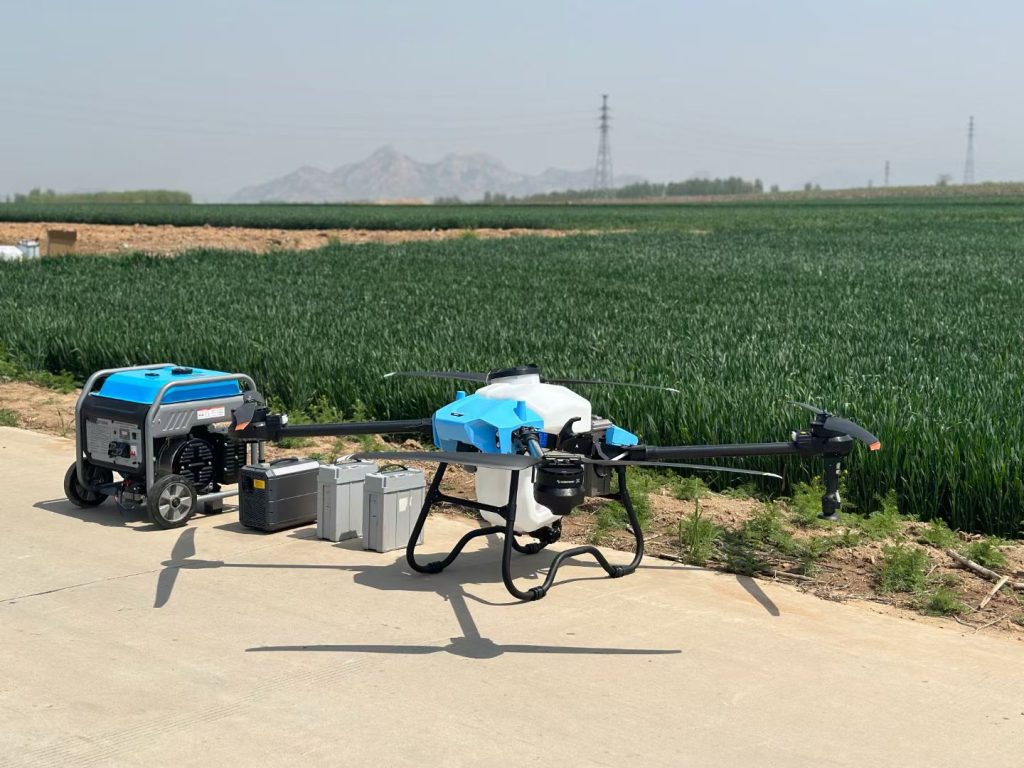
One of the first questions farmers ask before purchasing an agricultural seeding drone is simple:
How many hectares can a seeding drone cover in one hour or one day?
The answer is more complicated than looking at the drone’s maximum flight speed.
A seeding drone’s actual field capacity depends on several factors, including spreading width, flight speed, seed application rate, hopper capacity, battery endurance, loading time, battery replacement, field shape, wind, terrain, and the distance between the field and the seed-loading station.
A drone may have a theoretical coverage capacity of several dozen hectares per hour, but its actual daily output can be much lower after accounting for refilling, battery changes, turning, transportation, and other operational downtime.
For farmers and agricultural contractors, the more useful measurement is not the maximum number printed on a specification sheet. It is the actual hectares completed per hour and per working day under normal field conditions.
This article explains how to calculate drone seeding capacity, how different drone sizes compare, how flight planning affects productivity, and how to choose the right aircraft for a specific farm.
What Determines How Much Land a Seeding Drone Can Cover?
The most important factors are:
-
Effective spreading width
-
Flight speed
-
Seed application rate
-
Hopper capacity
-
Battery endurance
-
Battery charging speed
-
Seed loading time
-
Field shape
-
Wind conditions
-
Terrain
-
Obstacle density
-
Distance between the field and loading area
-
Operator efficiency
These factors work together.
A drone with a large hopper may carry more seed, but if its batteries take a long time to recharge, its daily productivity can still be limited.
Likewise, a very fast drone may not be efficient if its spreading pattern becomes uneven at high speed.
The Basic Formula for Theoretical Field Capacity
A simple theoretical formula is:
Area per hour = Spreading width × Flight speed × 3.6
The result is expressed in hectares per hour.
For example:
Spreading width: 6 meters
Flight speed: 5 meters/second
Calculation:
6 × 5 × 3.6 = 108 hectares/hour
This is a mathematical theoretical capacity and should not be interpreted as the actual field output.
The drone cannot spend 60 minutes every hour flying in a straight line without interruption.
It needs to:
-
Take off
-
Turn
-
Return for seed
-
Change batteries
-
Avoid obstacles
-
Adjust flight paths
-
Land
-
Reload
-
Deal with field boundaries
Therefore, actual field efficiency can be substantially lower.
Why Theoretical Capacity Is Different From Real Productivity
Consider a drone with a theoretical capacity of 100 hectares per hour.
During actual operation, the workflow may look like this:
Flight: 40 minutes
Turning and positioning: 5 minutes
Battery replacement: 3 minutes
Seed loading: 7 minutes
Transportation and adjustment: 5 minutes
That means only part of the hour is spent actively spreading seed.
This is why professional agricultural operators should measure:
Actual completed hectares ÷ total operating time
rather than:
Theoretical hectares ÷ flight time
The second calculation can make equipment appear much more productive than it really is.
Model 1: 20 kg Seeding Drone
A 20 kg payload drone is suitable for small and medium farms.
Typical specifications
Parameter
|
Typical Range
|
Maximum payload
|
20 kg
|
Hopper volume
|
25–35 L
|
Effective spreading width
|
3–6 m
|
Operating speed
|
3–7 m/s
|
Full-load flight time
|
8–15 min
|
Battery capacity
|
20–30 Ah
|
Positioning
|
GNSS / RTK
|
Feeder
|
Motorized auger
|
Spreading system
|
Centrifugal disc
|
Assume:
Working width: 5 m
Flight speed: 5 m/s
Theoretical capacity:
5 × 5 × 3.6 = 90 hectares/hour
Again, this is only a theoretical figure.
If the actual field efficiency is 20%, practical output would be approximately:
90 × 20% = 18 hectares/hour
If field efficiency reaches 30%:
90 × 30% = 27 hectares/hour
Actual results depend heavily on the farm’s operating conditions.
Model 2: 30 kg Seeding Drone
A 30 kg configuration provides more payload while remaining relatively easy to transport.
Typical specifications
Parameter
|
Typical Range
|
Maximum payload
|
30 kg
|
Hopper volume
|
35–50 L
|
Effective spreading width
|
4–8 m
|
Operating speed
|
4–8 m/s
|
Full-load flight time
|
7–14 min
|
Battery capacity
|
25–35 Ah
|
Positioning
|
RTK/GNSS
|
Obstacle detection
|
Optional radar
|
Feeder
|
Motorized auger
|
Spreading system
|
Centrifugal
|
Example:
Spreading width: 7 m
Flight speed: 6 m/s
Theoretical capacity:
7 × 6 × 3.6 = 151.2 hectares/hour
With 20% field efficiency:
151.2 × 20% = 30.2 hectares/hour
With 30% field efficiency:
151.2 × 30% = 45.4 hectares/hour
These numbers are examples for understanding the calculation, not guaranteed field performance.
Model 3: 50 kg Seeding Drone
A 50 kg-class drone is more appropriate for large agricultural operations.
Typical specifications
Parameter
|
Typical Range
|
Maximum payload
|
50 kg
|
Hopper volume
|
60–80 L
|
Effective spreading width
|
5–9 m
|
Operating speed
|
4–9 m/s
|
Full-load flight time
|
6–12 min
|
Battery capacity
|
30–40 Ah
|
Positioning
|
RTK
|
Obstacle detection
|
Radar / vision
|
Feeder
|
Heavy-duty auger
|
Spreading system
|
Centrifugal disc
|
Suppose:
Working width: 8 m
Flight speed: 7 m/s
Theoretical capacity:
8 × 7 × 3.6 = 201.6 hectares/hour
At 20% field efficiency:
40.3 hectares/hour
At 30% field efficiency:
60.5 hectares/hour
The actual number may be significantly different depending on the seed rate and loading cycle.
Model 4: 80 kg Seeding Drone
An 80 kg-class system is designed for high-volume commercial operations.
Typical specifications
Parameter
|
Typical Range
|
Maximum payload
|
80 kg
|
Hopper volume
|
100–150 L
|
Effective spreading width
|
7–10 m
|
Operating speed
|
5–10 m/s
|
Full-load flight time
|
5–9 min
|
Battery capacity
|
40–55 Ah
|
Positioning
|
High-precision RTK
|
Obstacle detection
|
Multi-directional radar
|
Feeder
|
Heavy-duty metering auger
|
Spreading system
|
High-capacity centrifugal disc
|
Example:
Spreading width: 9 m
Flight speed: 8 m/s
Theoretical capacity:
9 × 8 × 3.6 = 259.2 hectares/hour
At 20% field efficiency:
51.8 hectares/hour
At 30% field efficiency:
77.8 hectares/hour
Again, these calculations illustrate the relationship between speed and width. They should not be used as a guaranteed commercial output.
Seed Application Rate Can Become the Real Limitation
One of the most important factors is the amount of seed required per hectare.
Suppose a drone can discharge:
80 kg of seed per minute
That sounds impressive.
But if the required application rate is:
80 kg/ha
then one minute of material flow only covers approximately:
1 hectare
If the application rate is:
20 kg/ha
the same material flow could theoretically cover:
4 hectares
Therefore, the seed rate can have a major impact on productivity.
This is why comparing drones by maximum spreading rate alone can be misleading.
Example: Rice Seeding
Assume:
Seed rate: 50 kg/ha
Farm size: 200 hectares
Total seed required:
50 × 200 = 10,000 kg
That equals:
10 tonnes
With a 20 kg drone:
10,000 ÷ 20 = 500 loads
With a 50 kg drone:
10,000 ÷ 50 = 200 loads
With an 80 kg drone:
10,000 ÷ 80 = 125 loads
The larger drone significantly reduces the number of loading cycles.
However, the operator also needs enough batteries and charging capacity to support the aircraft.
Example: Grass Seed
Now consider a lightweight grass seed application.
Suppose:
Application rate: 10 kg/ha
Farm size: 200 hectares
Total seed:
10 × 200 = 2,000 kg
A 20 kg drone requires:
2,000 ÷ 20 = 100 loads
A 50 kg drone requires:
2,000 ÷ 50 = 40 loads
An 80 kg drone requires:
2,000 ÷ 80 = 25 loads
The larger drone still reduces the number of refills, but there is another consideration.
Grass seed can be lightweight and more sensitive to wind.
Therefore, a smaller drone with a narrower spreading width may sometimes produce better distribution than a much larger aircraft.
Why Spreading Width Matters
Spreading width determines how much ground can theoretically be covered during each flight pass.
For example:
5-meter width
requires twice as many passes as:
10-meter width
when covering the same field.
However, wider is not always better.
A very wide spreading pattern may create:
-
Uneven distribution
-
Increased overlap
-
More wind drift
-
Poor edge control
-
Higher seed loss
The goal should be the widest uniform spreading pattern, not the widest possible pattern.
Effective Width vs Maximum Width
This is an important difference when comparing agricultural drones.
Maximum Width
The largest distance across which material can physically reach.
Effective Width
The width across which the seed distribution remains sufficiently uniform for the agricultural application.
For professional farming, effective width is the more useful number.
For example:
A drone may physically distribute material across 10 meters.
But testing may show that uniform distribution is acceptable only across 7 meters.
In that case:
7 meters
should be used for operational planning.
How Flight Speed Affects Seeding
Increasing flight speed can increase theoretical field capacity.
However, the material flow must increase proportionally.
If the drone doubles its speed but the seed output remains unchanged, the amount of seed per hectare will decrease.
For example:
At:
4 m/s
the target application rate may be:
30 kg/ha
If speed increases to:
8 m/s
the metering system may need to approximately double the material output to maintain the same application rate, assuming all other conditions remain constant.
Therefore:
Higher speed ≠ automatically higher productivity
The spreading system must be capable of matching the higher speed.
Battery Endurance and Field Productivity
Battery endurance is one of the most important factors in real-world operation.
A large agricultural drone may have only several minutes of useful flight time under a heavy payload.
This does not necessarily mean it is inefficient.
If the drone can:
-
Land quickly
-
Replace the battery quickly
-
Reload seed quickly
-
Take off again quickly
then the total operating cycle can still be efficient.
The key measurement is:
Flight time + landing + battery replacement + loading + takeoff
rather than flight time alone.
How Many Batteries Are Needed?
For commercial seeding operations, one battery is usually insufficient.
A practical configuration may include:
3 Batteries
Basic rotation.
4 Batteries
Better continuous operation.
5–6 Batteries
Suitable for longer working periods and larger farms.
The exact number depends on:
-
Battery charging time
-
Flight time
-
Number of daily working hours
-
Available electrical supply
-
Seed loading speed
If charging takes 10 minutes but a flight cycle takes 8 minutes, a small battery pool may be sufficient.
If charging takes 30 minutes, more batteries may be required.
Charging Infrastructure Can Limit Productivity
Imagine a drone that can complete a flight in:
8 minutes
but requires:
30 minutes
to recharge.
The drone will spend much more time waiting for energy than flying.
A professional setup may therefore use:
-
Multiple batteries
-
High-power charger
-
Generator
-
Battery cooling system
-
Separate charging area
The charging system should be planned at the same time as the aircraft.
Seed Loading Time Matters
A drone may have an 80 kg hopper, but if loading 80 kg takes 15 minutes, the advantage of the large hopper may be reduced.
Compare two systems:
System A
Payload: 50 kg
Loading time: 3 minutes
System B
Payload: 80 kg
Loading time: 12 minutes
The second drone carries more seed, but the complete operating cycle may not be proportionally faster.
This is why commercial operators should measure:
kg loaded per minute
rather than only:
maximum hopper capacity.
Field Shape Affects Efficiency
A large rectangular field is ideal for drone operations.
An irregular field containing many corners requires more turning and positioning.
For example:
Field A
100 hectares in one large rectangle.
Field B
100 hectares divided into 20 small fields.
The total area is the same.
However, Field B can require considerably more:
-
Takeoffs
-
Landings
-
Route changes
-
Transportation
-
Battery management
-
Positioning
Therefore, the same drone can have very different daily productivity on different farms.
Terrain and Obstacles
Trees, buildings, power lines, irrigation systems, and other obstacles can reduce effective working time.
An obstacle-free field allows long straight flight paths.
A field with frequent obstacles requires shorter passes.
This reduces:
time spent spreading
and increases:
time spent turning and repositioning.
For large farms, obstacle mapping should therefore be included in flight planning.
Wind Conditions
Wind affects both the drone and the seed.
The aircraft may remain stable while lightweight seed particles are pushed sideways.
This is particularly important for:
-
Grass seed
-
Small seeds
-
Lightweight coated seed
-
Fine granular materials
When wind increases, the operator may need to:
-
Reduce spreading width
-
Lower operating speed
-
Adjust flight height
-
Change flight direction
-
Stop the operation if distribution becomes unacceptable
A drone’s maximum wind-resistance specification should not be treated as the ideal wind condition for accurate seeding.
Flight Height and Coverage
Flight height affects spreading width.
Generally:
Higher flight height → wider distribution
but also potentially:
Higher drift risk
Lower altitude can provide better control but may reduce spreading width.
The correct height depends on:
-
Seed characteristics
-
Spreading mechanism
-
Wind
-
Desired width
-
Flight speed
A small test should be performed before full-scale operation.
How to Plan a Large Farm
A professional flight plan should divide the farm into manageable operating blocks.
For example:
Farm size: 500 hectares
Divide into:
10 × 50-hectare blocks
Each block can have:
-
Field boundary
-
Loading station
-
Battery station
-
Takeoff point
-
Emergency landing area
-
Flight route
This approach makes logistics easier.
Seed Loading Station Planning
The loading station should be as close to the operating area as practical.
If the drone has to travel several kilometers between the field and seed storage area, a significant amount of time can be lost.
A better system may use:
Main seed storage
↓
Mobile loading station
↓
Drone operating area
This can substantially reduce turnaround time.
Example of a 500-Hectare Operation
Assume:
Farm size: 500 hectares
Seed rate: 30 kg/ha
Total seed:
500 × 30 = 15,000 kg
A 50 kg drone requires:
15,000 ÷ 50 = 300 loads
An 80 kg drone requires:
15,000 ÷ 80 = 187.5 loads
The 80 kg drone therefore requires approximately 188 full-load equivalents.
However, the operator should also consider the number of batteries and charging capacity.
For a very large farm, two medium drones may provide better flexibility than one large drone.
One Large Drone vs Multiple Smaller Drones
One Large Drone
Advantages:
Higher payload
-
Fewer refills
-
Lower number of aircraft to maintain
-
Simple fleet management
Disadvantages:
-
Higher single-machine investment
-
Greater downtime if the drone fails
-
Larger battery requirements
Multiple Smaller Drones
Advantages:
-
Higher redundancy
-
Multiple fields can be operated simultaneously
-
Easier transportation
-
Easier replacement during maintenance
Disadvantages:
-
More batteries
-
More chargers
-
More operators may be required
-
More maintenance points
For farms above several hundred hectares, a fleet calculation is often more useful than simply choosing the largest drone.
Estimated Price by Drone Capacity
Indicative equipment price ranges:
Drone Class
|
Approximate Price
|
10–20 kg
|
US$3,000–8,000
|
20–30 kg
|
US$5,000–11,000
|
30–50 kg
|
US$8,000–18,000
|
50–70 kg
|
US$13,000–28,000
|
70–80+ kg
|
US$18,000–35,000+
|
A complete professional operating package may cost:
US$15,000–40,000+
depending on:
-
Number of batteries
-
Charger
-
Generator
-
RTK equipment
-
Spreading system
-
Spare parts
-
Transport equipment
-
Training
These are planning ranges, not fixed quotations.
Recommended Drone Models by Farm Size
SD-20 — 20 kg Class
Recommended for:
10–50 hectares
Typical specifications:
-
Payload: 20 kg
-
Hopper: 25–35 L
-
Width: 3–6 m
-
Speed: 3–7 m/s
-
Flight time: 8–15 min
-
RTK: Optional
Approximate price:
US$3,000–8,000
SD-30 — 30 kg Class
Recommended for:
30–150 hectares
Typical specifications:
-
Payload: 30 kg
-
Hopper: 35–50 L
-
Width: 4–8 m
-
Speed: 4–8 m/s
-
Flight time: 7–14 min
-
RTK: Standard or optional
Approximate price:
US$5,000–11,000
SD-50 — 50 kg Class
Recommended for:
100–500 hectares
Typical specifications:
-
Payload: 50 kg
-
Hopper: 60–80 L
-
Width: 5–9 m
-
Speed: 4–9 m/s
-
Flight time: 6–12 min
-
RTK: Standard
-
Radar: Optional/standard depending on configuration
Approximate price:
US$8,000–18,000
SD-80 — 80 kg Class
Recommended for:
300–1,000+ hectares
Typical specifications:
-
Payload: 80 kg
-
Hopper: 100–150 L
-
Width: 7–10 m
-
Speed: 5–10 m/s
-
Flight time: 5–9 min
-
RTK: Standard
-
Radar: Multi-directional
-
Feeder: Heavy-duty
Approximate price:
US$18,000–35,000+
How Much Land Can a Seeding Drone Cover in One Day?
A realistic daily estimate should use:
Daily capacity = Effective hourly capacity × actual operating hours
Suppose a drone achieves:
20 hectares/hour
and can work effectively for:
6 hours/day
Then:
20 × 6 = 120 hectares/day
This is much more useful than saying the aircraft has a theoretical capacity of 100 hectares per hour.
The six-hour operating period already needs to account for:
-
Battery changes
-
Loading
-
Field movement
-
Short breaks
-
Route adjustments
Longer working days may increase output, but daylight, weather, operator fatigue, battery temperature, and local regulations must also be considered.
How to Improve Daily Seeding Capacity
The easiest productivity improvements are often logistical rather than technological.
1. Prepare Seed in Advance
Pre-weigh seed into manageable loading quantities.
2. Use Multiple Batteries
Keep charged batteries ready.
3. Place Loading Stations Near the Field
Reduce transportation time.
4. Use Pre-Planned Flight Routes
Reduce manual route adjustments.
5. Maintain the Spreading System
A partially blocked feeder can reduce productivity and distribution quality.
6. Monitor Wind
Do not continue operating simply because the aircraft can fly.
The seed must still be distributed correctly.
7. Divide Large Fields Into Blocks
This simplifies route planning and logistics.
The Most Important Productivity Metric
For agricultural contractors, the most useful number is:
Actual hectares completed per working hour
not:
Maximum flight speed
and not:
Maximum spreading rate
A professional productivity report should include:
-
Total hectares
-
Total seed used
-
Total operating time
-
Number of flights
-
Number of battery changes
-
Number of refills
-
Average flight speed
-
Average spreading width
-
Weather conditions
This data can then be used to calculate the real cost per hectare.
FAQ
How many hectares can a seeding drone cover per hour?
It depends on spreading width, flight speed, seed rate, battery endurance, and field conditions.
Theoretical capacity can be calculated with:
Width × Speed × 3.6
However, actual field productivity is normally lower because of loading, battery changes, turning, and transportation.
How many hectares can a seeding drone cover per day?
A practical commercial operation may cover tens to hundreds of hectares per day depending on drone size and logistics.
For example, if actual productivity is 20 hectares/hour and the drone operates effectively for six hours:
20 × 6 = 120 hectares/day
Can an 80 kg drone cover 1,000 hectares?
It can potentially be used on a 1,000-hectare farm, but one aircraft may not be sufficient for a short operating window.
For very large farms, multiple aircraft can provide better capacity and backup.
Is a 50 kg drone enough for a large farm?
It can be.
A 50 kg drone may be a good balance between payload, purchase cost, battery consumption, and transportation.
The correct choice depends on seed rate and required daily output.
What is more important: flight speed or spreading width?
Both matter.
However, the combination must be evaluated.
A fast drone with a narrow spreading width may not be more productive than a slower drone with a wider uniform pattern.
Does seed application rate affect drone coverage?
Yes.
Higher seed rates require more material per hectare, meaning the hopper empties faster.
Lower seed rates can allow the same hopper load to cover more hectares.
How much seed can a 50 kg drone spread?
A 50 kg drone can carry up to approximately 50 kg per load under the assumed configuration.
The actual recommended payload can be lower depending on altitude, temperature, battery condition, and operating conditions.
How many batteries should I buy?
For commercial operations, 3–6 batteries can provide a practical starting range.
The correct number depends on flight time, charging speed, daily working hours, and operating logistics.
Can a drone work continuously all day?
The aircraft can potentially operate for extended periods with battery rotation, but continuous operation depends on:
-
Battery charging
-
Weather
-
Maintenance
-
Seed supply
-
Operator availability
-
Local regulations
Does a larger hopper always mean higher productivity?
No.
A large hopper reduces refill frequency, but loading time, battery endurance, field logistics, and spreading accuracy also affect productivity.
What is the best spreading width?
There is no universal answer.
A 5–8 meter effective width can be practical for many agricultural applications, while larger systems may use wider patterns.
The correct width is the one that provides acceptable distribution uniformity.
How does wind affect coverage?
Wind can reduce the useful spreading width and cause seed drift.
Light seeds are particularly sensitive.
If wind becomes too strong, reducing the width or stopping the operation may be necessary.
Is drone seeding cheaper than tractor seeding?
It can be cheaper in suitable situations, particularly where fields are wet, difficult to access, or labor is expensive.
However, the comparison should include:
-
Equipment depreciation
-
Battery cost
-
Energy
-
Labor
-
Maintenance
-
Seed loading
-
Transportation
The correct comparison is total cost per hectare.
Final Guide to Agricultural Drone Capacity
When choosing a seeding drone, do not start with the question:
“How fast can this drone fly?”
Start with:
“How many hectares do I need to seed, how much seed is required per hectare, and how many hectares must I complete each day?”
Then calculate:
Total seed required = Farm area × Seeding rate
Number of loads = Total seed required ÷ Drone payload
Theoretical field capacity = Spreading width × Flight speed × 3.6
Daily capacity = Actual field capacity × Effective operating hours
This method gives a much more realistic estimate.
For smaller farms, a 20 kg class drone can provide a lower-cost solution.
For medium agricultural operations, a 30–50 kg class system offers a useful balance between payload and operating cost.
For large farms, a 50–80 kg class drone can reduce loading cycles and improve operational efficiency.
However, the aircraft is only one part of the system.
The real productivity of agricultural drone seeding depends on the entire workflow:
Drone → Battery → Hopper → Seed Loading → Flight Planning → Spreading → Battery Replacement → Refilling → Field Logistics
A well-planned 50 kg system can outperform a poorly organized 80 kg system.
For commercial agriculture, the best purchasing decision is therefore based on actual hectares per hour, actual hectares per day, seed consumption per hectare, total operating cost, and long-term equipment utilization, rather than a single maximum specification.
THE END
Support it if you like it







No comments yet