

Battery performance is one of the most important factors when purchasing an agricultural spraying drone. The drone may have an excellent spraying system and large tank capacity, but insufficient battery endurance can reduce field productivity and increase operating costs.
Many buyers focus on the maximum flight time advertised by the manufacturer. However, maximum flight time and actual spraying flight time are not always the same.
The real operating time depends on payload, battery capacity, flight speed, weather, terrain, spraying settings, and battery condition.
This guide explains how to evaluate agricultural drone battery life, charging requirements, battery configuration, and replacement strategies.
1. How Long Can an Agricultural Spraying Drone Fly?
There is no universal flight-time figure for all agricultural spraying drones.
A drone’s actual flight time depends on several factors:
-
Battery capacity
-
Drone weight
-
Liquid payload
-
Flight speed
-
Wind conditions
-
Flight altitude
-
Terrain
-
Spray system
-
Battery age
-
Temperature
A manufacturer may provide a maximum flight time under unloaded or controlled test conditions. Actual spraying time with a full tank can be considerably shorter.
For commercial buyers, the most useful specification is therefore practical flight time under the intended operating load.
2. Maximum Flight Time vs. Working Flight Time
These two terms should not be confused.
Maximum Flight Time
This usually refers to how long the drone can remain in the air under specific test conditions, often with a light or no payload.
Working Flight Time
This refers to the actual operating time while carrying a spraying payload and performing agricultural operations.
Working flight time is more relevant when evaluating productivity.
For example, a drone may have a maximum flight endurance of a certain number of minutes, but carrying a full tank of liquid will increase total weight and energy consumption.
When requesting a quotation, ask the manufacturer to provide flight-time data under different payload conditions.
3. How Payload Affects Battery Life
Payload is one of the biggest factors affecting endurance.
A fully loaded spraying drone must generate more lift than an empty drone.
As payload increases:
-
Motor power demand increases
-
Battery consumption increases
-
Flight endurance can decrease
-
Maneuverability may change
-
Takeoff requirements increase
Therefore, a drone with a large tank should be evaluated together with its battery capacity and motor system.
A large tank does not automatically mean better productivity if the battery cannot support the payload efficiently.
4. Battery Capacity Is Only One Part of the Equation
Battery capacity is usually expressed in watt-hours (Wh) or, depending on the battery specification, through voltage and ampere-hours.
A simplified relationship is:
Energy capacity = Voltage × Ampere-hours
For example, a battery rated at 50 V and 30 Ah has a nominal energy capacity of approximately:
50 × 30 = 1,500 Wh
However, actual usable energy is influenced by operating conditions, battery management, discharge limits, temperature, and other factors.
Therefore, buyers should not compare batteries based solely on ampere-hours.
5. Why Voltage Matters
Agricultural spraying drones often use high-voltage battery systems because the motors require substantial power.
Higher system voltage can allow the same power to be delivered with lower current under ideal electrical conditions.
However, battery voltage should always be evaluated as part of the complete propulsion system.
When comparing drones, check:
-
Battery nominal voltage
-
Capacity
-
Energy rating
-
Maximum discharge capability
-
Weight
-
Charging requirements
-
Battery management system
-
Expected cycle life
6. How Many Batteries Do You Need?
The number of batteries required depends on your daily workload.
A small operator may use a limited number of batteries, while a commercial agricultural contractor may require several sets to maintain continuous operations.
A typical battery rotation could look like this:
Battery A → Flying
Battery B → Charging
Battery C → Ready
When Battery A is depleted, it can be replaced with Battery C while Battery A begins charging.
This reduces downtime and helps maintain continuous operations.
7. Battery Charging Time
Charging time is just as important as flight time.
A drone with long flight endurance but very slow charging may still experience significant downtime.
When comparing chargers, ask about:
-
Standard charging time
-
Fast charging time
-
Required input power
-
Charging voltage
-
Number of batteries supported
-
Charging temperature range
-
Safety monitoring
-
Portable charging options
For large agricultural operations, charging infrastructure should be planned before the drone is deployed.
8. Fast Charging Can Improve Productivity
Fast charging can reduce the time between flights.
However, fast charging should only be performed using an approved charger and battery configuration.
An appropriate charging system should monitor factors such as:
-
Voltage
-
Current
-
Temperature
-
Battery condition
-
Charging status
A professional battery management system helps reduce the risk of improper charging.
Operators should always follow the battery and charger manufacturer’s instructions.
9. Battery Temperature Matters
Battery performance can change with temperature.
Very high temperatures can increase battery stress and may reduce battery life.
Very low temperatures can also affect available power and charging performance.
For this reason, battery manufacturers often specify recommended operating and charging temperature ranges.
Before flying, operators should check battery condition and temperature according to the manufacturer’s instructions.
10. Battery Cycle Life
A battery does not maintain its original performance forever.
Repeated charging and discharging gradually reduces battery capacity.
Battery cycle life depends on:
-
Battery chemistry
-
Depth of discharge
-
Charging method
-
Operating temperature
-
Storage conditions
-
Load
-
Maintenance
A high-quality battery management system can help monitor battery health.
For commercial operators, battery replacement should be included in the long-term operating budget.
11. Intelligent Battery Management
Modern agricultural drone batteries may include intelligent battery management systems.
These systems can monitor:
-
Remaining capacity
-
Voltage
-
Current
-
Temperature
-
Charging status
-
Battery health
-
Cycle count
-
Abnormal conditions
This information can help operators determine when a battery requires inspection or replacement.
For fleet operators, centralized battery management can also make maintenance easier.
12. How to Calculate Practical Battery Requirements
Suppose an agricultural drone can spray for approximately 12 minutes under the intended operating load.
If a typical flight cycle requires:
-
10 minutes spraying
-
2 minutes returning and landing
then one battery can support approximately one complete operating cycle.
If charging takes 15 minutes, one battery alone may create downtime.
Adding additional batteries can allow the operator to continue working while depleted batteries are being charged.
The exact number should be calculated according to:
-
Required daily operating area
-
Flight time
-
Charging time
-
Refill time
-
Number of working hours
-
Available electrical power
13. Battery Configuration for Different Operators
Small Farms
A small farm may not require a large battery inventory.
A basic setup may be sufficient if operations are intermittent and charging facilities are nearby.
Medium-Sized Farms
Medium-sized operations may benefit from several batteries to reduce downtime.
A battery rotation system can provide better operational continuity.
Commercial Agricultural Contractors
Professional contractors covering large areas may need multiple battery sets and dedicated charging infrastructure.
The goal is to maintain a continuous workflow rather than waiting for batteries to recharge.
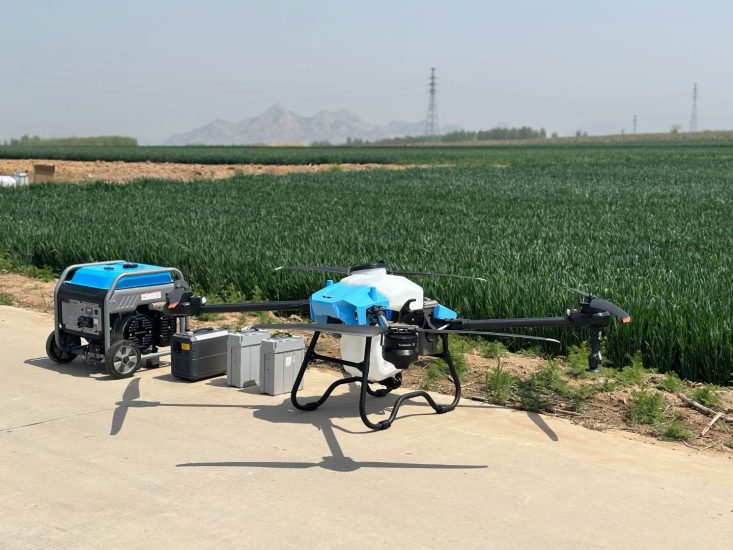
14. Generator and Mobile Charging Solutions
Some agricultural fields do not have convenient access to grid electricity.
In these situations, operators may consider an appropriate generator or mobile charging solution.
The power source must be compatible with the manufacturer’s charger requirements.
Before purchasing, verify:
-
Required input power
-
Voltage
-
Frequency
-
Charger power consumption
-
Generator capacity
-
Safety requirements
The charging system should never be improvised.
15. Battery Storage
Proper storage is important for maintaining battery performance.
Batteries should be stored according to the manufacturer’s recommended:
-
Temperature
-
Charge level
-
Humidity
-
Location
-
Safety conditions
Do not store damaged or swollen batteries.
If a battery shows abnormal heating, physical damage, swelling, leakage, or other unusual behavior, stop using it and follow the manufacturer’s safety procedures.
16. Battery Transportation
Agricultural drone batteries may contain high-energy lithium-ion cells.
Transportation regulations can apply depending on the battery type, capacity, shipping method, and destination.
For international shipments, buyers and exporters should confirm applicable dangerous-goods transportation requirements before shipping batteries.
Documentation and packaging requirements can vary depending on the transport mode and destination country.
17. How to Extend Agricultural Drone Battery Life
Several practices can help maintain battery performance.
Avoid Unnecessary Deep Discharge
Follow the manufacturer’s recommended operating limits.
Use the Correct Charger
Use only compatible charging equipment.
Avoid Extreme Temperatures
Operate and store batteries within the recommended temperature range.
Inspect Batteries Regularly
Check for physical damage and abnormal performance.
Monitor Battery Health
Record cycle count and battery condition when possible.
Store Batteries Correctly
Follow the manufacturer’s recommended storage charge and environmental conditions.
18. Battery Life and Total Cost of Ownership
Battery cost should be considered as part of the drone’s total cost of ownership.
The purchase price of the drone is only one component.
Long-term operating costs may include:
-
Replacement batteries
-
Electricity
-
Charging equipment
-
Generator fuel
-
Maintenance
-
Spare parts
-
Labor
-
Transportation
A drone with a slightly higher purchase price may provide better long-term value if its battery system offers improved durability, faster charging, and better operating efficiency.
19. Questions to Ask the Manufacturer
Before purchasing an agricultural spraying drone, ask the manufacturer:
-
What is the battery voltage?
-
What is the battery capacity?
-
What is the nominal energy rating?
-
What is the actual flight time with a full payload?
-
What is the recommended operating temperature?
-
How long does a full charge take?
-
Is fast charging supported?
-
How many batteries are recommended?
-
What is the expected cycle life?
-
Does the battery have an intelligent management system?
-
What charger is included?
-
What power source is required?
-
What is the warranty period?
-
How much does a replacement battery cost?
-
Are replacement batteries readily available?
These questions help buyers understand the real operating cost before purchasing.
20. How to Choose the Right Battery Configuration
The ideal battery configuration depends on your operating model.
For occasional farm use, a smaller battery inventory may be sufficient.
For intensive commercial spraying, multiple battery sets and a dedicated charging system can significantly improve productivity.
When selecting a drone, evaluate the complete system:
Drone + Battery + Charger + Power Supply + Spare Battery + Battery Management
This provides a more accurate picture of the equipment’s practical performance.
Conclusion
Agricultural spraying drone battery life depends on payload, battery capacity, flight conditions, temperature, terrain, flight speed, and the efficiency of the propulsion and spraying systems.
The maximum flight time shown in a product specification should not be treated as the expected spraying time under every condition.
For professional buyers, the most important information is actual flight endurance under the intended payload, charging time, battery cycle life, recommended battery quantity, and charging infrastructure.
A well-designed battery system can reduce downtime, improve daily spraying productivity, and lower long-term operating costs.
Before purchasing an agricultural spraying drone, request real-world battery performance data from the manufacturer and make sure the battery, charger, spare parts, and technical support are suitable for your intended market and operating environment.
THE END


No comments yet