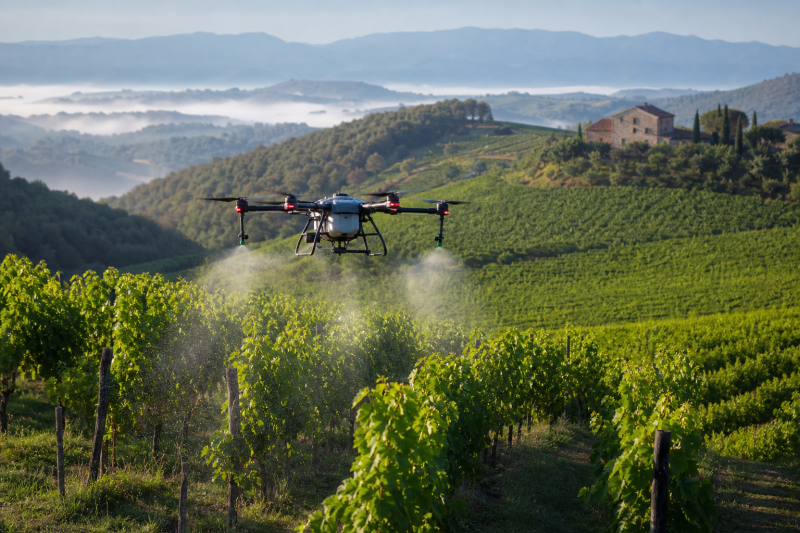


European farmers have been able to look at agricultural spraying drones for years. In most cases they have not been allowed to use them. A 2009 EU directive on the sustainable use of pesticides still treats aerial spraying as a high-risk activity designed around crewed crop-dusters, not around a 10- to 50-liter battery aircraft flying a planned grid two meters above a canopy.
That is starting to move. In May 2026 the EU Council agreed a negotiating position on the “Omnibus X” food and feed safety package that would make it easier for member states to authorize drone spraying. POLITICO later described the drone file as the least controversial part of an otherwise disputed pesticide package. For manufacturers such as MSOEN, Europe is shifting from a near-ban-with-exceptions market toward a rules-based spraying market — if the rest of the omnibus does not stall.
Why the old aerial-spraying ban never fitted drones
The Sustainable Use of Pesticides Directive bans aerial application to limit drift, contamination, and bystander exposure from airplanes and helicopters. Member states can grant derogations, usually where ground spraying is dangerous or impractical: terraced vineyards, steep orchards, or flooded fields where a tractor cannot enter and a worker with a backpack sprayer would take a higher dose.
Those derogations exist, but they are slow. A grower who wants to spray one hillside block may need a case-by-case file. Fifteen capitals, including Prague, asked the Commission in December 2024 for a dedicated drone proposal. The Czech agriculture ministry has argued that drones can reduce product volume, limit effects on non-target organisms, and still keep farms competitive — provided the risk is no greater than ground spraying.
That last phrase is the policy test. Europe is not saying “drones are always safer.” It is saying: if a member state can show equivalent or lower risk versus a boom sprayer, the aircraft should not be trapped in a rule written for a turbine airplane.
What the Council position would change
According to Eunews and the Council’s May 2026 mandate:
- The existing special-case derogation stays.
- An additional derogation is added for certain types of drones, even when the old “special case” conditions are not fully met.
- EFSA is expected to assess both the plant-protection products that may be applied by drone and the aircraft types, conditions of use, and associated risks.
- A delegated act identifying approved drone types is given a 30-month window.
- Until that act exists, member states may authorize drone use under transitional rules, then notify the Commission and EFSA within 30 days, including the risk assessment used for the authorization.
In plain language: national ministries get a faster on-ramp, while Brussels still wants a scientific list of which drones and which products are acceptable. Agriculture Commissioner Christophe Hansen has framed the same idea as part of digital agriculture — drones, satellites, and precision farming as tools to use inputs more efficiently, not only as a way to spray more hectares.
Knowledge gaps that still matter in the field
The Commission itself has admitted that important knowledge gaps remain, including how far droplets drift from small UAVs and which platforms deposit product most accurately. Environmental groups have used that uncertainty to argue for a slower authorization, and they also raise cost and data-privacy concerns for smaller farms.
MSOEN’s technical answer to those gaps is not a slogan. It is calibration:
- Spray flow must match ground speed and effective swath.
- Flight height above canopy should be validated on the actual crop, not copied from a brochure.
- Nozzle choice changes droplet spectrum and drift potential as much as tank size does.
- Wind, temperature, and humidity still decide whether a job should be postponed.
- A small water-sensitive-card trial is cheaper than a non-compliance case.
European buyers who contact MSOEN already ask these questions because a future EFSA or member-state file will ask them too. A factory that cannot state flow rate, swath, recommended height, and nozzle options will struggle in a regulated spraying market, even if the aircraft looks impressive at a trade fair.
What MSOEN can offer European and export buyers now
MSOEN manufactures agricultural spraying and spreading drones with payloads typically ranging from 5 L to 150 L, including modular systems that switch between liquid and granular work. For EU-facing distributors, the useful package is not only the airframe:
- A configuration sheet that lists empty weight, max takeoff weight, pump, nozzles, and positioning system.
- OEM/ODM options for local branding, manuals, and software language.
- Spare parts that can be stocked inside the EU so a blocked shipment does not stop a season.
- Training material that matches how member states will want operators to document risk.
Europe is not the only region watching this file. If Brussels creates a workable drone-spraying category, other regulators that copied the old aerial-spray ban will have a template. If the omnibus package fails because of unrelated pesticide-trade fights, drone rules could stall again, as they did when an earlier pesticide-reduction law collapsed in 2024. POLITICO noted that the Irish presidency still has to find a deal on the more contentious parts of the package. The drone chapter is popular; it is not yet independently guaranteed.
Conclusion
The EU is inching toward treating agricultural drones as precision tools rather than as miniature crop-dusters. That is the correct agronomic direction: targeted application, less overlap, and less operator exposure than a backpack sprayer on a steep vineyard.
MSOEN’s advice to European importers is to prepare the compliance file while the law is still moving. Ask for field-test data, nozzle charts, and a spare-parts plan now. When a member state opens a faster authorization window, the distributor who already has a documented aircraft will move first. The factory that only has a product photo will wait for the next political cycle.







No comments yet