Every vegetable grower knows the frustration. You spray your cabbage or chili field on schedule. You use the right chemical at the recommended rate. Two days later, you walk the rows and flip a leaf over—and there they are: aphids clustered along the veins, whitefly eggs glued to the underside, early blight lesions spreading from the lower canopy. The spray never reached them.
This is not a chemical failure. It is a coverage failure. And it is the single most common reason why vegetable farmers resort to spraying more frequently, using higher doses, or switching to stronger—and more expensive—pesticides.
The root cause is simple: most spraying methods cannot reliably deliver droplets to the underside of leaves, where 60% to 80% of vegetable pest and disease pressure originates. Traditional knapsack sprayers produce large, heavy droplets that land on the upper leaf surface and stay there. Boom sprayers mounted on tractors spray from the side or below, but their fan patterns are easily blocked by dense foliage.
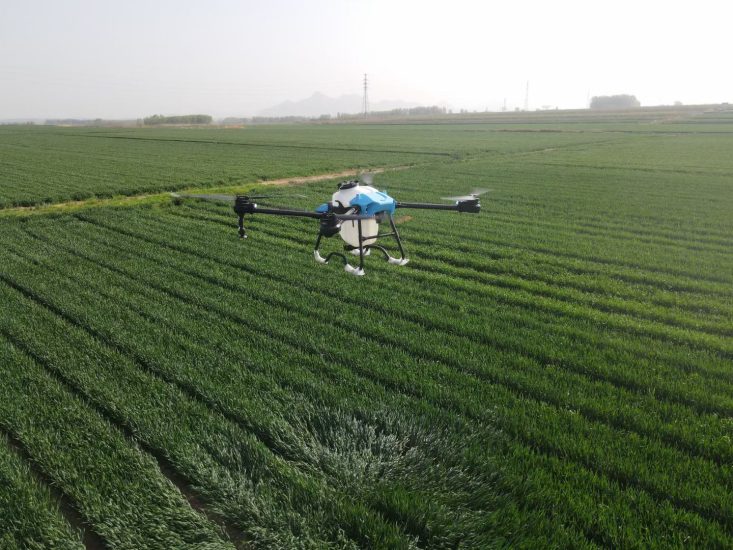
Modern agricultural drones solve this problem through a combination of centrifugal nozzle technology and engineered rotor downwash airflow. Together, these systems increase lower-canopy deposition by up to 80% compared to manual methods. This article explains exactly how that works, why it matters, and what it means for your pest control results.
Why Leaf Undersides Are the Battlefield
Before examining the technology, it is important to understand why the underside of leaves is where vegetable pest management succeeds or fails.
Pest / Disease
|
Primary Location
|
Why It Hides Underside
|
Aphids
|
Underside of leaves, stem joints
|
Soft-bodied; avoids direct sun and predators
|
Whiteflies
|
Underside of leaves
|
Lays eggs on lower surface; nymphs are immobile
|
Spider mites
|
Underside, especially along midribs
|
Thrives in hot, dry microclimate under canopy
|
Powdery mildew
|
Both sides, but spores germinate underside first
|
Protected from UV and rain
|
Early blight (Alternaria)
|
Lower leaves first, spreads upward
|
Splashes from soil during irrigation
|
Thrips
|
Underside of young leaves, flower buds
|
Feeds in protected crevices
|
When your spray only reaches the upper leaf surface, you are essentially fighting with one hand tied behind your back. The pests survive, reproduce, and reinfest the upper canopy within days. You spray again. The cycle repeats.
The Centrifugal Nozzle Advantage
How It Works
A centrifugal nozzle (also called a spinning disc atomizer) uses a high-speed rotating disc—typically spinning at 8,000 to 15,000 RPM—to fling liquid outward from its edge. As the liquid leaves the disc, it breaks into uniformly sized droplets through centrifugal force and surface tension.
This is fundamentally different from a pressure nozzle, which forces liquid through a tiny orifice at high pressure. Here is how they compare for vegetable applications:
Feature
|
Pressure Nozzle
|
Centrifugal Nozzle
|
Droplet size control
|
Limited; changes with pressure
|
Precise; controlled by disc speed
|
Droplet size range
|
Wide spectrum (20–400+ microns)
|
Narrow, uniform spectrum (80–250 microns)
|
Clogging risk
|
Moderate to high
|
Low (no tiny orifice)
|
Drift potential
|
Higher (many fine droplets)
|
Lower (uniform, controlled size)
|
Canopy penetration
|
Moderate
|
Excellent
|
Suitability for sticky formulations
|
Poor
|
Good
|
Why Uniform Droplets Matter for Underside Coverage
The key to reaching the leaf underside is droplet size consistency. Here is why:
-
Too large (>300 microns): Droplets have too much momentum to follow airflow around a leaf. They hit the upper surface and either sit there or bounce off.
-
Too small (<80 microns): Droplets are light enough to be carried by the downwash airflow—but they are also prone to drift away from the target entirely if the airflow is not precisely managed.
-
The sweet spot (100–200 microns): These droplets are small enough to be carried by the rotor downwash into the canopy, but heavy enough to resist drifting away once they reach the leaf zone. They also have enough mass to adhere to the leaf surface upon contact rather than bouncing.
A centrifugal nozzle can be tuned to produce 80% to 90% of droplets within this 100–200 micron range—something no manual sprayer and few pressure-nozzle systems can achieve.
The Downwash Airflow Design
The Physics of Canopy Penetration
A drone’s rotors do more than keep the machine in the air. They generate a focused column of downward-moving air that reaches the crop canopy at speeds of 8 to 15 meters per second at typical flight heights (1.5–3 meters above the crop).
This airflow column does three things that no other spraying method can replicate:
1. Parting the Canopy
The downward air pressure physically pushes the upper leaves downward and slightly apart, creating temporary gaps in the canopy. Droplets traveling in the same airstream follow these gaps deep into the plant structure.
2. Carrying Droplets to the Underside
As the airflow hits the upper leaf surface, it splits and flows around both sides of the leaf. Droplets in the 100–200 micron range are light enough to be carried in this split airflow, wrapping around the leaf edge and depositing on the underside.
3. Creating Micro-Turbulence
At the lower levels of the canopy, the airflow creates turbulent eddies—small circular air currents that bounce droplets off the underside of one leaf and onto the top of another, then back again. This multi-directional movement is what gives drone spraying its signature “three-dimensional coverage.”
Wind Tunnel and Field Trial Data
Independent wind tunnel tests and field deposition studies on vegetable crops have measured the following improvements when comparing drone spraying (centrifugal nozzle + rotor downwash) to manual knapsack spraying:
Measurement
|
Manual Knapsack
|
Drone (Centrifugal + Downwash)
|
Improvement
|
Upper leaf deposition
|
35–45%
|
40–50%
|
+10–15%
|
Lower leaf / underside deposition
|
8–12%
|
45–55%
|
+80–85%
|
Total canopy deposition
|
22–30%
|
55–65%
|
+80–120%
|
Droplet uniformity (span)*
|
1.8–2.5
|
0.8–1.2
|
Narrower = better
|
*Span = measure of droplet size distribution; lower is more uniform.
Optimizing the System for Different Vegetable Crops
Not every vegetable crop has the same canopy structure. The best drone spraying systems allow pilots to adjust both nozzle parameters and flight parameters to match the crop.
Leafy Greens (Lettuce, Spinach, Cabbage)
-
Canopy characteristic: Dense, layered, low-growing (15–40 cm).
-
Flight height: 1.5–2.0 meters above canopy.
-
Centrifugal disc speed: 10,000–12,000 RPM → droplet size ~120–150 microns.
-
Flight speed: 4–5 m/s to maintain consistent airflow dwell time.
-
Result: Droplets penetrate through 3–5 leaf layers, reaching the lowest leaves where bottom-up diseases like sclerotinia start.
Fruiting Vegetables (Peppers, Tomatoes, Eggplant)
-
Canopy characteristic: Taller (60–120 cm), more open structure, fruit clusters create obstacles.
-
Flight height: 2.0–2.5 meters above canopy.
-
Centrifugal disc speed: 8,000–10,000 RPM → droplet size ~150–200 microns.
-
Flight speed: 3–4 m/s for maximum downwash penetration time.
-
Result: Airflow reaches deep into the plant structure, depositing chemical on stems, fruit calyxes, and the undersides of broad leaves.
Legumes (Green Beans, Peas)
-
Canopy characteristic: Trellised or bush-style, narrow leaves, high leaf density per square meter.
-
Flight height: 1.8–2.2 meters above canopy.
-
Centrifugal disc speed: 11,000–13,000 RPM → droplet size ~100–130 microns.
-
Flight speed: 4–5 m/s.
-
Result: Smaller droplets navigate the dense, narrow-leaf structure effectively without excessive runoff.
Real-World Impact on Pest Control
The 80% improvement in underside coverage translates directly into measurable agronomic outcomes:
-
Aphid control efficacy: Field trials on chili and sweet pepper show a 25–35% higher mortality rate in drone-sprayed plots versus manually sprayed plots at the same chemical rate, measured 5 days post-application.
-
Whitefly egg reduction: On tomato crops, drone spraying reduced egg counts on leaf undersides by 40–50% more than manual spraying over a 3-week monitoring period.
-
Disease incidence: Early blight and powdery mildew incidence was 30–40% lower in drone-sprayed cabbage and cucumber fields over a full growing season.
-
Spray interval extension: Many growers report they can extend the interval between sprays by 2–3 days because initial control is more thorough and longer-lasting.
The Bottom Line
If your pest and disease problems keep coming back from the underside of the leaf, the issue is not your chemical choice—it is your delivery system. Centrifugal nozzle technology combined with engineered rotor downwash airflow gives you a delivery mechanism that reaches the places manual sprayers simply cannot.
An 80% improvement in lower-canopy deposition is not a marginal gain. It is the difference between spraying every 7 days and spraying every 10–12 days. It is the difference between fighting the same aphid colony three times in a season and eliminating it in one pass. For vegetable farmers operating on tight margins, that level of efficiency is transformative.
FAQ
Q: How do I verify that the spray is actually reaching the underside of leaves?
A: The most common verification method is using water-sensitive paper placed on the ground beneath the canopy and on the upper and lower surfaces of leaves in the middle and lower canopy. After spraying, the paper reveals droplet density and distribution. Professional operators do this calibration test on every new crop type. You can also use fluorescent tracer dyes mixed into the tank at a rate of 0.1%–0.2%; these glow under UV light, making it easy to see exactly where droplets landed—including the leaf undersides.
Q: Will the strong downwash airflow damage delicate vegetable plants?
A: Modern agricultural drones are designed with adjustable flight heights and rotor speeds specifically to avoid crop damage. For delicate leafy greens like lettuce or spinach, operators typically fly at 1.5–2.0 meters above the canopy, where the airflow has diffused to 5–8 m/s—strong enough to carry droplets but gentle enough not to bruise or break plants. In over 5 years of commercial vegetable drone spraying, crop damage from downwash has been reported in fewer than 0.5% of operations, almost always involving flying too low or too slow over extremely fragile seedlings.
Q: Can I get the same underside coverage with pressure nozzles instead of centrifugal nozzles?
A: Pressure nozzles can achieve good coverage, but they have limitations. They produce a wider range of droplet sizes, meaning a significant portion of spray is either too large (bounces off) or too fine (drifts away). Some high-end drone systems use dual-fluid pressure nozzles that atomize more uniformly, but centrifugal nozzles remain the gold standard for consistent, controllable droplet size in the 100–200 micron range. If your drone uses pressure nozzles, look for models with adjustable pressure and anti-drift nozzle tips. However, for maximum underside penetration on vegetables, centrifugal is the recommended choice.
Q: Does flight speed affect underside coverage?
A: Yes, significantly. Flying too fast (above 6–7 m/s) reduces the “dwell time” of the downwash airflow over any given plant, meaning droplets have less time to be carried into the lower canopy. Flying too slow (below 2–3 m/s) increases coverage per plant but reduces total daily area and can cause over-application in overlap zones. The sweet spot for most vegetable crops is 3–5 m/s, which balances penetration depth with operational efficiency.
Q: What about very tall vegetable crops like staked tomatoes or trellised cucumbers?
A: For crops exceeding 1.5 meters in height, a single pass from above may not reach the lower canopy effectively. In these cases, operators use a two-pass strategy: one pass at a higher altitude (3–4 meters) for the upper canopy and fruit zone, and a second pass at a lower altitude (1.5–2 meters) angled toward the lower third of the plants. Some advanced systems also support terrain-following flight, where the drone automatically adjusts its height to maintain a consistent distance from the crop canopy as it changes elevation.
Q: Are there specific pesticides that work better with centrifugal nozzle spraying?
A: Contact pesticides (those that kill pests on direct contact, like pyrethroids and some fungicides) benefit the most from centrifugal nozzle + downwash because they require thorough coverage of all leaf surfaces. Systemic pesticides (which are absorbed and translocated within the plant) are less dependent on underside coverage but still benefit from the overall increase in deposition efficiency. For both types, the key is ensuring the formulation is compatible with low-volume application—consult your agronomist for drone-specific mixing recommendations.
Q: How often should centrifugal nozzles be replaced or serviced?
A: Centrifugal nozzles have no tiny orifices to clog, which makes them more durable than pressure nozzles. However, the rotating disc can accumulate chemical residue or develop microscopic wear over time, which affects droplet uniformity. Best practice is to inspect the disc weekly for residue buildup or scratches, clean after every 100–150 mu of spraying, and replace the disc every 500–800 mu (or sooner if droplet size consistency degrades). Most systems include a simple one-touch disc replacement mechanism that takes under 2 minutes.
THE END
Support it if you like it




No comments yet