

How to Choose an Agricultural Drone for Crop Spraying
Choosing an agricultural drone for crop spraying is not simply a matter of selecting the aircraft with the largest tank or the longest advertised flight time. A suitable spraying drone needs to match the crop, field conditions, application requirements, operating scale, and local regulations.
For farmers, agricultural contractors, distributors, and equipment buyers, the most useful approach is to evaluate the complete operating system rather than one isolated specification.
Start With the Application
Before comparing drone models, determine what the aircraft will actually be used for.
Different applications can require significantly different configurations. Open-field crops may require long flight routes and efficient coverage, while orchards can require more precise flight control around trees and uneven terrain.
The first questions should therefore be:
- What crops will be treated?
- How large is the operating area?
- Is the terrain flat or irregular?
- How frequently will spraying be required?
- What type of agricultural formulation will be applied?
- Is the drone for personal farm use or commercial spraying services?
These answers provide a better starting point than choosing a model based only on its advertised payload.
Choose the Right Payload Capacity
Payload capacity is one of the most visible specifications of an agricultural drone, but the largest capacity is not necessarily the most appropriate.
A higher payload allows more liquid to be carried per flight, potentially reducing refill frequency. However, a heavier aircraft can require more battery power and may have different flight characteristics.
A buyer should compare:
- Maximum payload
- Recommended operating payload
- Tank capacity
- Battery capacity
- Flight time under load
- Pump performance
- Refill requirements
The important figure is the drone’s practical performance while carrying a realistic working load.
Consider Tank Capacity and Application Rate Together
Tank capacity tells you how much liquid the drone can carry, but it does not tell you how much area can be treated during one flight.
Application rate also matters.
If the required application rate is high, the tank may need to be refilled more frequently. If the application rate is lower, the same tank capacity may cover a larger area.
Therefore, buyers should calculate expected coverage using the actual application rate rather than assuming that a larger tank automatically means higher productivity.
Evaluate Flight Time Under Real Conditions
Advertised flight time can vary significantly from actual operating time.
A drone carrying a full agricultural payload consumes more energy than an empty aircraft. Wind, temperature, flight speed, altitude, battery condition, and route design can also influence endurance.
When requesting specifications from a manufacturer, ask for operating information under load.
For example:
- Flight time with working payload
- Typical battery consumption
- Recommended battery quantity
- Charging time
- Operating temperature
- Battery replacement procedure
This provides a more realistic picture of how the drone will perform in the field.
Pay Attention to the Spraying System
The spraying system directly affects application performance.
Important components include the pump, pipes, valves, filters, nozzles, and flow-control system.
Buyers should consider whether the system can maintain consistent flow and whether the spray configuration can be adjusted for different applications.
Nozzle selection is particularly important because droplet characteristics can influence how liquid reaches the crop.
A professional spraying drone should therefore be evaluated as an integrated aerial application system rather than simply as a flying platform carrying a tank.
Check Flight Control and Positioning Functions
Accurate flight control can make a significant difference when operating over agricultural land.
Useful functions may include:
- Automated route planning
- Precise positioning
- Return-to-home
- Obstacle detection
- Terrain awareness
- Altitude control
- Route recording
- Low-battery alerts
- Emergency procedures
The exact functions available depend on the aircraft configuration.
Buyers should determine which functions are included as standard equipment and which require additional hardware or software.
Think About the Field Environment
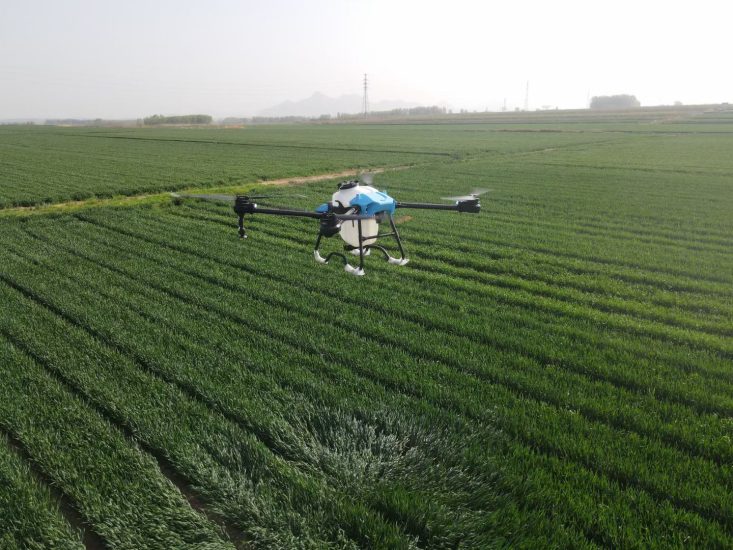
A drone that performs well over a large flat field may have different operating requirements in an orchard, hillside, or irregularly shaped agricultural area.
Open Fields
Open fields generally provide more room for route planning and turning.
Efficiency may depend heavily on flight speed, spray width, battery endurance, and refill logistics.
Orchards
Trees introduce additional obstacles and vertical structures.
A suitable system may require stronger positioning, altitude control, obstacle sensing, and carefully planned flight routes.
Hilly Areas
Uneven terrain creates additional challenges for maintaining a consistent operating height.
Terrain-following capabilities can be useful where available, although operators still need to understand the limitations of the system.
Calculate the Complete Operating Workflow
A common purchasing mistake is to look only at how long the drone can fly.
Actual productivity also depends on what happens before and after each flight.
A typical workflow may include:
- Preparing the agricultural formulation
- Filling the tank
- Installing a charged battery
- Planning the route
- Performing the spraying operation
- Returning to the refill area
- Replacing the battery
- Refilling the tank
- Inspecting the equipment
- Continuing the next flight
If battery replacement is fast but refilling takes a long time, the overall operation can still be limited by ground procedures.
For commercial users, the complete workflow is often more important than the theoretical flight time.
Consider Battery Logistics
Battery management becomes increasingly important as operating scale increases.
A small farm may be able to operate with a limited number of batteries. A commercial agricultural service provider may need several batteries and charging equipment to maintain continuous operations.
Before purchasing, calculate:
- Number of batteries required
- Charging time
- Expected battery cycles
- Battery replacement cost
- Charging infrastructure
- Transportation and storage requirements
The battery system should be considered part of the total cost of operating the drone.
Examine Spare Parts Availability
Agricultural equipment operates in demanding environments.
Pumps, nozzles, motors, propellers, landing components, batteries, and other parts can eventually require replacement.
For commercial buyers, spare-parts availability can be particularly important because extended equipment downtime can interfere with scheduled agricultural operations.
Ask the manufacturer which components are considered routine replacement parts and how they can be ordered.
Check Training and Technical Support
A technically advanced drone still requires proper operation.
Buyers should ask whether the manufacturer provides:
- Operating manuals
- Training materials
- Software instructions
- Maintenance guidance
- Troubleshooting information
- Spare-parts support
- Remote technical assistance
For distributors purchasing equipment for a new market, technical documentation can also make it easier to train local customers.
Understand Local Regulations Before Ordering
Drone regulations vary between countries and regions.
Depending on the location, operators may need to consider aircraft registration, pilot requirements, flight restrictions, radio-frequency regulations, agricultural chemical regulations, insurance, and operating permissions.
Import requirements may also apply to batteries, electronic equipment, and radio-control systems.
International buyers should verify the applicable requirements in the destination market before finalizing an order.
Consider OEM and ODM Requirements
Distributors and agricultural equipment businesses may have requirements that differ from individual farmers.
For example, a buyer may want:
- Custom branding
- Customized packaging
- A specific tank capacity
- Different battery specifications
- Customized spraying components
- Product documentation
- Distributor-oriented accessories
- Private-label production
OEM and ODM manufacturing can provide greater flexibility when a standard configuration does not match a particular market.
However, customization should be discussed in detail before production, including minimum order quantity, technical requirements, testing, certification, packaging, and delivery arrangements.
Compare Total Cost Instead of Purchase Price Alone
The initial purchase price is only one part of the cost.
A more useful calculation includes:
Total operating cost = equipment cost + batteries + charging equipment + spare parts + maintenance + transportation + labor + operating expenses
A lower-priced drone may not necessarily have lower long-term operating costs if its batteries have limited endurance, spare parts are difficult to obtain, or its operating workflow requires frequent interruptions.
Commercial buyers should compare the complete ownership and operating requirements.
Questions to Ask an Agricultural Drone Manufacturer
Before placing an order, buyers can request detailed answers to the following:
- What is the recommended payload?
- What is the tank capacity?
- What is the operating flight time with a normal payload?
- What is the effective spraying width?
- How is liquid flow controlled?
- What nozzle configurations are available?
- What positioning system is included?
- What obstacle-sensing functions are available?
- How long does the battery take to charge?
- How many batteries are recommended for continuous operation?
- Which spare parts are normally kept in stock?
- Is technical training available?
- Can the configuration be customized?
- Are OEM and ODM services available?
- What documentation is supplied with the aircraft?
A detailed answer to these questions can help buyers understand the actual capabilities of the equipment before making a purchasing decision.
Final Considerations
The right agricultural spraying drone depends on the relationship between the aircraft and the operation it needs to perform.
Payload capacity, tank size, battery endurance, spraying technology, positioning, terrain conditions, refill procedures, maintenance, and regulatory requirements should all be considered together.
For buyers planning to use agricultural drones commercially, it is also important to consider future requirements. A system that meets today’s needs but cannot support additional configurations, spare parts, software updates, or customized production may become restrictive as the business expands.
MSOEN provides agricultural drone solutions for different spraying applications and supports discussions around aircraft configuration, payload requirements, spraying systems, customization, and OEM/ODM manufacturing.


No comments yet