


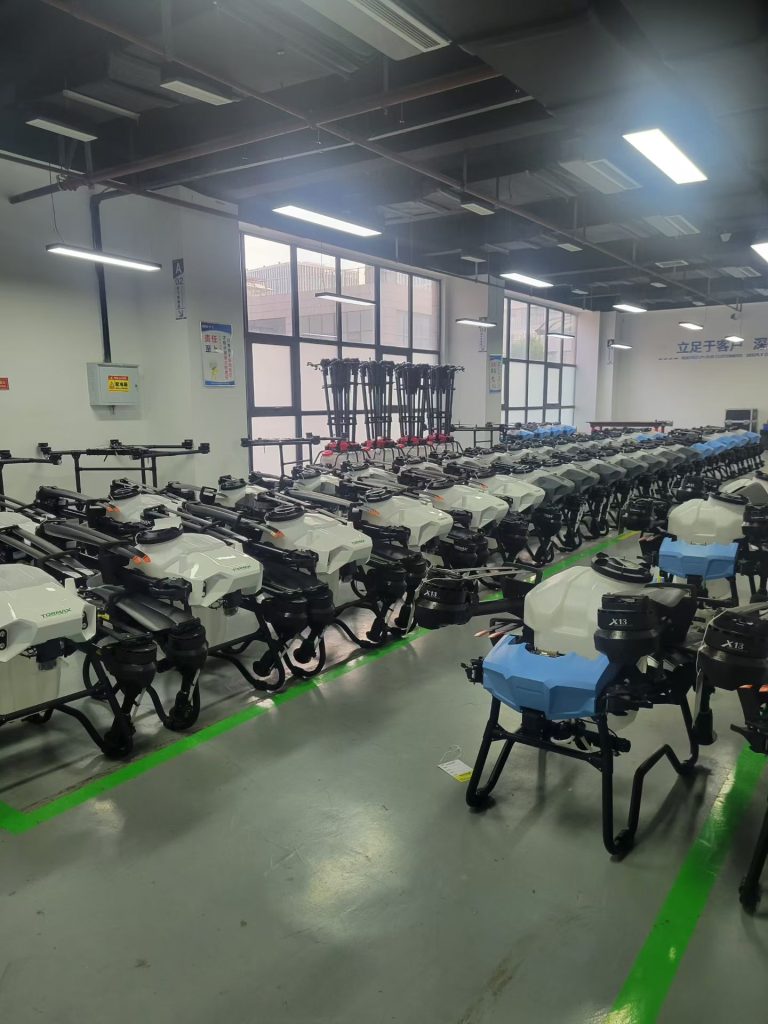
Agricultural seeding drones are becoming an important option for farmers and agricultural contractors who need to distribute seeds across large, wet, irregular, or difficult-to-access fields.
Unlike conventional ground seeders, an agricultural seeding drone can operate above the field without driving heavy equipment across the soil. This can be useful when ground access is difficult or when a large area needs to be covered within a limited operating window.
However, choosing the best agricultural drone for seeding requires more than comparing maximum payload.
A practical seeding drone must provide an appropriate combination of:
- Seed capacity
- Metering accuracy
- Spreading uniformity
- Flight time under load
- Battery capacity
- Flight speed
- Working width
- Positioning accuracy
- Route planning
- Hopper design
- Operating cost
- Maintenance requirements
MSOEN develops agricultural drone configurations for different seeding requirements, including lightweight systems for smaller farms and higher-capacity systems for commercial agricultural operations.
This guide explains how to compare agricultural seeding drones and how to select an MSOEN configuration according to farm size, crop type, seed rate, and operating requirements.
What Makes a Good Agricultural Seeding Drone?
A good seeding drone is not simply the aircraft with the largest hopper.
The most important factor is whether the complete system can deliver the required amount of seed evenly across the target field.
A professional agricultural seeding system should provide:
Accurate Metering
The feeder should deliver a predictable amount of material.
Consistent Spreading
The seed should be distributed reasonably evenly across the effective working width.
Stable Flight
The drone must maintain stable flight when carrying a significant payload.
Appropriate Payload
The hopper should hold enough seed to minimize unnecessary refilling without creating excessive aircraft weight.
Efficient Battery System
The battery should support practical field operations rather than only achieving a high no-load flight-time figure.
Route Planning
Automatic route planning can improve repeatability and reduce unnecessary overlap.
Easy Maintenance
Motors, propellers, feeders, batteries, connectors, and other wear components should be accessible for inspection and replacement.
MSOEN Agricultural Seeding Drone Models
MSOEN can offer different payload configurations according to the customer’s application.
The following models represent practical configuration levels for agricultural seeding.
MSOEN SD-20: Compact Agricultural Seeding Drone
The MSOEN SD-20 is designed for smaller farms, agricultural testing, specialty seeds, and operations where transportation flexibility is important.
Technical Specifications
| Parameter | MSOEN SD-20 |
|---|---|
| Maximum payload | 20 kg |
| Hopper capacity | 25–35 L |
| Effective spreading width | 3–6 m |
| Operating speed | 3–7 m/s |
| Loaded flight time | Approx. 8–15 min |
| Positioning | GNSS / Optional RTK |
| Feeder | Adjustable motorized feeder |
| Spreading mechanism | Centrifugal disc |
| Flight mode | Manual / Automatic |
| Recommended application | Small and medium fields |
The SD-20 is suitable when the operator values:
- Lower initial investment
- Easy transportation
- Simple field deployment
- Lower battery requirements
- Flexible operation
Estimated Price
US$3,000–8,000
A complete package with multiple batteries, charger, RTK, spare parts, and accessories may cost more.
MSOEN SD-30: Versatile Commercial Seeding Drone
The MSOEN SD-30 provides a higher payload capacity while maintaining relatively compact dimensions.
It can be used for a wider range of agricultural applications.
Technical Specifications
| Parameter | MSOEN SD-30 |
|---|---|
| Maximum payload | 30 kg |
| Hopper capacity | 35–50 L |
| Effective spreading width | 4–8 m |
| Operating speed | 4–8 m/s |
| Loaded flight time | Approx. 7–14 min |
| Positioning | GNSS / RTK |
| Feeder | Motorized auger |
| Spreading system | Centrifugal |
| Obstacle sensing | Optional radar |
| Route planning | Automatic |
| Application | Rice, wheat, pasture, cover crops |
The SD-30 can be a good compromise for operators who need more capacity than a 20 kg system but do not require an 80 kg platform.
Estimated Price
US$5,000–11,000
A more complete commercial configuration can be approximately:
US$8,000–15,000
MSOEN SD-50: Commercial High-Capacity Seeding Drone
The MSOEN SD-50 is designed for commercial farms and agricultural contractors.
Its 50 kg payload class reduces the number of refilling cycles compared with smaller aircraft.
Technical Specifications
| Parameter | MSOEN SD-50 |
|---|---|
| Maximum payload | 50 kg |
| Hopper capacity | 60–80 L |
| Effective spreading width | 5–9 m |
| Operating speed | 4–9 m/s |
| Loaded flight time | Approx. 6–12 min |
| Positioning | RTK |
| Feeder | Heavy-duty auger |
| Spreading system | High-capacity centrifugal |
| Obstacle detection | Radar |
| Route planning | Automatic |
| Recommended operation | Commercial agriculture |
The SD-50 is particularly suitable when daily productivity and reduced loading frequency are important.
Estimated Price
US$8,000–18,000
A complete commercial package can be approximately:
US$15,000–25,000+
depending on battery quantity and configuration.
MSOEN SD-80: Heavy-Duty Agricultural Seeding Drone
The MSOEN SD-80 is intended for large agricultural operations.
Its main advantage is its high material capacity.
Technical Specifications
| Parameter | MSOEN SD-80 |
|---|---|
| Maximum payload | 80 kg |
| Recommended working payload | 50–80 kg |
| Hopper capacity | 100–150 L |
| Effective spreading width | 7–10 m |
| Operating speed | 5–10 m/s |
| Loaded flight time | Approx. 5–9 min |
| Positioning | High-precision RTK |
| Feeder | Heavy-duty metering auger |
| Spreading system | High-capacity centrifugal |
| Obstacle detection | Multi-directional radar |
| Route planning | Automatic |
| Recommended operation | Large commercial farms |
Estimated Price
US$18,000–35,000+
A complete system can reach approximately:
US$25,000–40,000+
depending on batteries, charging equipment, RTK, spare parts, and optional equipment.
Which MSOEN Model Is Best?
There is no universal best model.
The correct choice depends on the operation.
| Farm Requirement | Recommended MSOEN Model |
|---|---|
| Small farm | SD-20 |
| Specialty seed | SD-20 / SD-30 |
| Medium farm | SD-30 |
| Commercial farm | SD-50 |
| Agricultural contractor | SD-50 / SD-80 |
| Large-scale operation | SD-80 |
| High-volume seeding | SD-50 / SD-80 |
The most important question is:
How many hectares need to be completed per day?
Seed Capacity Is One of the Most Important Factors
Suppose a farm requires:
40 kg of seed per hectare
and the farm area is:
100 hectares
Total seed requirement:
40 × 100 = 4,000 kg
Now compare the payload classes.
SD-20
4,000 ÷ 20 =
200 full loads
SD-30
4,000 ÷ 30 =
134 loads
SD-50
4,000 ÷ 50 =
80 loads
SD-80
4,000 ÷ 80 =
50 loads
This illustrates why larger payload capacity can be valuable for large farms.
However, the largest drone is not automatically the most economical option.
Spreading Accuracy Is More Important Than Maximum Width
A drone may advertise a large maximum spreading width.
But buyers should ask:
What is the effective uniform spreading width?
For example, a spreading system might physically distribute seed over 10 meters but produce uneven deposition at the edges.
If the center receives too much seed while the edges receive too little, the practical working width should be reduced.
Professional calibration should involve measuring actual discharge and checking the spread pattern with collection pans or equivalent test equipment.
Why Seed Type Changes Drone Performance
Seeds are not identical materials.
They vary in:
- Weight
- Shape
- Diameter
- Density
- Moisture
- Surface texture
- Flowability
This directly affects the feeder.
For example:
Rice
Usually requires relatively high material throughput.
Wheat
Can require substantial material flow depending on the target rate.
Rapeseed
Can require precise low-rate metering.
Grass Seed
Can be lightweight and more sensitive to wind.
Cover-Crop Mixtures
Can be difficult to meter uniformly when different seed types have substantially different physical characteristics.
Research and field guidance both emphasize that application rate and spreading pattern need to be checked for the specific material rather than assuming one calibration works for every seed.
How to Calculate Seeding Capacity
A simple theoretical field-capacity calculation is:
Field capacity = Working width × Flight speed × 0.36
where:
- Working width = meters
- Flight speed = meters/second
- Result = theoretical hectares/hour
For example:
Working width:
8 m
Flight speed:
6 m/s
Theoretical capacity:
8 × 6 × 0.36 = 17.28 hectares/hour
This is only a theoretical figure.
Actual field capacity will be lower because of:
- Turning
- Takeoff
- Landing
- Battery replacement
- Seed loading
- Field boundaries
- Obstacles
- Transportation
- Weather
Therefore, buyers should not calculate operating costs using maximum theoretical capacity alone.
Example of Realistic Daily Planning
Suppose an MSOEN SD-50 is used for a commercial operation.
Target field:
200 hectares
Target application rate:
30 kg/ha
Total seed:
6,000 kg
With a 50 kg payload:
6,000 ÷ 50 = 120 loads
If the operation can complete an average of 12 hectares per effective operating hour:
200 ÷ 12 ≈ 16.7 operating hours
This demonstrates why battery rotation, loading efficiency, and field logistics can be just as important as drone flight speed.
Battery Configuration
Battery planning is critical for commercial operations.
A drone may have excellent flight performance, but if the operator has too few batteries, field productivity can be limited by charging.
A commercial MSOEN configuration may use:
3–6 batteries
depending on:
- Daily working hours
- Charging speed
- Battery capacity
- Payload
- Temperature
- Flight conditions
A larger fleet may require additional battery sets.
Loaded Flight Time vs No-Load Flight Time
This is one of the most important questions buyers should ask.
A specification such as:
Maximum flight time: 20 minutes
does not necessarily mean:
20 minutes with a full hopper.
Payload changes:
- Power consumption
- Motor load
- Battery discharge
- Flight stability
- Practical endurance
Therefore, MSOEN customers should evaluate:
Flight time at actual working payload
rather than relying only on an empty-aircraft flight-time figure.
RTK Positioning for Seeding
RTK can improve route repeatability and positioning accuracy.
It can be useful for:
- Large fields
- Automatic routes
- Repeated passes
- Irregular boundaries
- Accurate route spacing
However, RTK does not automatically make the seed distribution uniform.
Spreading uniformity still depends on:
- Feeder calibration
- Disc speed
- Flight speed
- Flight height
- Seed characteristics
- Wind
- Route spacing
Positioning accuracy and spreading accuracy are separate performance factors.
Automatic Route Planning
Automatic route planning can reduce operator workload.
A typical workflow is:
- Map the field.
- Define the field boundary.
- Mark obstacles.
- Set route spacing.
- Select flight height.
- Set flight speed.
- Set material output.
- Start the mission.
- Monitor the aircraft.
- Check the remaining seed.
- Replace the battery when required.
- Continue the mission.
The operator should remain responsible for monitoring the aircraft and field conditions.
How to Reduce Operating Costs
The purchase price is only one part of the cost.
A better calculation includes:
- Drone depreciation
- Batteries
- Charger
- Electricity
- Maintenance
- Spare parts
- Operator labor
- Transportation
- Seed loading
- Downtime
A simple calculation is:
Cost per hectare = Total operating cost ÷ Completed hectares
For example:
If operating costs are:
US$2,400
and the operation covers:
200 hectares
then:
US$2,400 ÷ 200 = US$12/ha
This provides a more useful comparison than simply comparing drone purchase prices.
How to Choose Between SD-20, SD-30, SD-50 and SD-80
Choose MSOEN SD-20 if:
- Farm size is relatively small
- Lower initial investment is important
- Lightweight seeds are being applied
- Transportation flexibility matters
- Daily workload is moderate
Choose MSOEN SD-30 if:
- More capacity is required
- Several crop types are being handled
- Medium-size farms are being serviced
- The operator wants a balance between size and productivity
Choose MSOEN SD-50 if:
- Commercial operation is the main goal
- Large quantities of seed must be transported
- Reduced refilling is important
- Agricultural contracting is planned
Choose MSOEN SD-80 if:
- Large fields are the primary application
- High-volume seeding is required
- Multiple loading cycles would otherwise reduce productivity
- Commercial agricultural service is the main business
Agricultural Seeding Drone Price Comparison
| Model | Payload | Estimated Price |
|---|---|---|
| MSOEN SD-20 | 20 kg | US$3,000–8,000 |
| MSOEN SD-30 | 30 kg | US$5,000–11,000 |
| MSOEN SD-50 | 50 kg | US$8,000–18,000 |
| MSOEN SD-80 | 80 kg | US$18,000–35,000+ |
The actual quotation depends on the selected configuration.
Additional costs may include:
- Extra batteries
- High-power charger
- RTK equipment
- Spare propellers
- Spare motors
- Additional feeder
- Additional spreading disc
- Remote controller
- Transportation
- Packaging
What Should Buyers Check Before Purchasing?
Before placing an order, buyers should confirm:
Payload
Ask for maximum payload and recommended operating payload.
Hopper
Confirm actual hopper volume.
Feeder
Ask which seed sizes and materials the feeder can handle.
Spreading Width
Ask for effective working width rather than only maximum width.
Flight Time
Ask for loaded flight time.
Battery
Confirm battery capacity and expected cycle life.
Charging
Ask how long a complete charge takes.
RTK
Confirm whether RTK is included or optional.
Software
Check route planning and field mapping functions.
Spare Parts
Confirm availability of:
- Motors
- Propellers
- Feeders
- Bearings
- Seals
- Cables
- Connectors
Training
Commercial buyers should also confirm operator training and calibration guidance.
FAQ
What is the best MSOEN agricultural drone for seeding?
For small operations, the SD-20 is a practical starting configuration.
For medium operations, the SD-30 provides additional capacity.
For commercial agriculture, the SD-50 is a stronger option.
For large-scale operations, the SD-80 provides the highest payload among these configurations.
How much does an MSOEN seeding drone cost?
Indicative prices are:
- SD-20: US$3,000–8,000
- SD-30: US$5,000–11,000
- SD-50: US$8,000–18,000
- SD-80: US$18,000–35,000+
The final price depends on the equipment package.
Can MSOEN drones spread rice seed?
Yes. A suitable feeder and spreading configuration should be selected according to the rice seed and required application rate.
Can MSOEN drones spread wheat?
Yes. The SD-30, SD-50 and SD-80 can be considered for higher-volume wheat applications.
Can MSOEN drones spread grass seed?
Yes. Smaller configurations can be suitable, but grass seed may require more careful calibration because lightweight material can be affected by wind.
Does every seed require calibration?
Yes.
The actual output can change with seed size, density, moisture, shape, and other physical properties.
Is the largest MSOEN drone always the best choice?
No.
The correct model depends on field size, seed rate, required daily capacity, logistics, and total operating cost.
How many hectares can a seeding drone cover per hour?
Theoretical capacity depends on working width and flight speed.
Actual productivity is lower because of loading, battery changes, turning, obstacles, and other field operations.
Does RTK improve seeding accuracy?
RTK can improve route and position repeatability, but it does not by itself guarantee uniform seed distribution.
The feeder and spreading system still need to be calibrated.
How should the spreading width be determined?
The effective width should be verified through a spread-pattern test rather than relying only on the maximum advertised width.
How many batteries are recommended?
For commercial operations, approximately 3–6 batteries can be a practical starting configuration, depending on flight time, charging speed, workload, and operating conditions.
Can one MSOEN drone handle multiple seed types?
Yes, but each material should be calibrated separately.
Changing seed type without recalibration can result in an incorrect application rate.
Can agricultural drones replace conventional seeders?
Not for every crop.
Drone seeding is primarily a broadcasting method. Crops that require precise seed depth or row placement may still require ground-based equipment.
What is more important: payload or spreading accuracy?
Both are important, but a large payload does not compensate for poor spreading uniformity.
For commercial seeding, the ideal system combines adequate payload with reliable metering and a verified effective spreading width.
What is the biggest mistake when buying a seeding drone?
Choosing a drone based only on maximum payload or maximum flight time.
A better approach is to calculate:
Crop → Seed rate → Farm area → Daily workload → Required payload → Battery requirement → Effective spreading width → Operating cost
Final Buying Recommendation
The best agricultural seeding drone is not necessarily the drone with the biggest hopper.
The right machine is the one that matches the actual agricultural workload.
For smaller farms, MSOEN SD-20 offers a compact 20 kg payload configuration.
For medium operations, MSOEN SD-30 provides a balance between capacity and flexibility.
For commercial agriculture, MSOEN SD-50 provides higher seed capacity and fewer loading cycles.
For large agricultural operations, MSOEN SD-80 provides an 80 kg payload-class configuration designed for high-volume work.
Before purchasing, buyers should evaluate five core specifications:
Payload capacity
Effective spreading width
Loaded flight time
Metering accuracy
Total operating cost per hectare
A professional agricultural drone should also be tested with the actual seed before large-scale operation. Static flow calibration and field spread-pattern testing are important because manufacturer settings alone may not reflect the behavior of a particular seed or seed mixture.
For farmers, distributors, and agricultural contractors looking for a configurable seeding solution, MSOEN agricultural drones can be positioned around different payload levels and field requirements rather than a one-size-fits-all design.
MSOEN — Agricultural Drones for Seeding, Spreading and Commercial Field Operations.



No comments yet