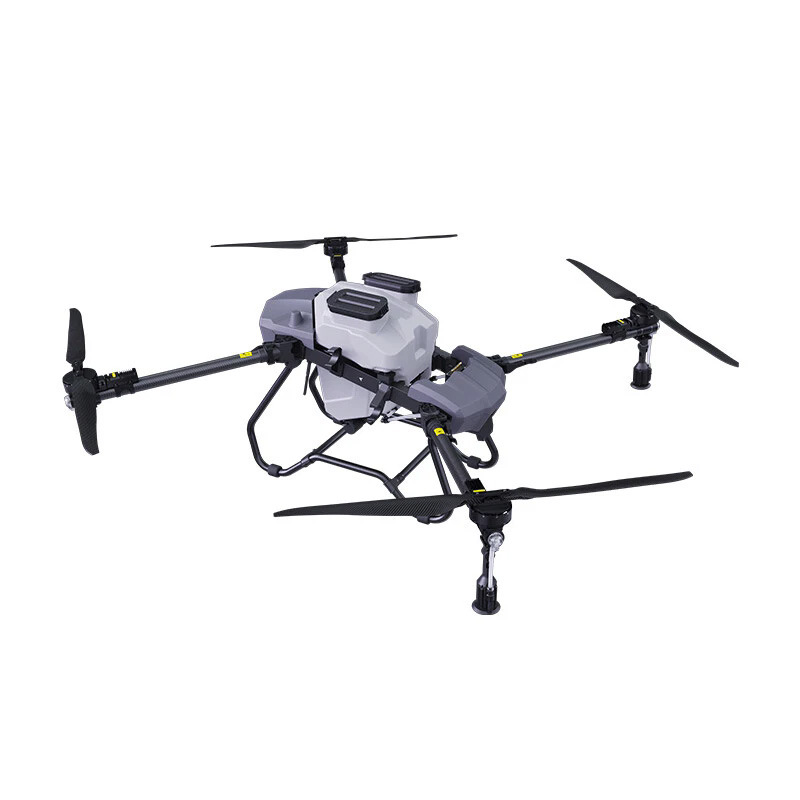
A Technical Reference for Procurement, Agronomy Teams, and Distribution Partners
1. The Operating Reality: Why 40L Exists (and Why It Isn’t Just a Bigger Tank)
The jump from 10L/16L/20L class machines to a 40L payload spraying drone isn’t a vanity play. It is a response to a specific set of economic constraints that dominate mid-to-large scale farming:
-
Field blocks are getting bigger (50–500 hectares per operator per day is the commercial target in many markets).
-
Labor for manual backpack spraying is vanishing — and remaining labor is expensive.
-
Chemical costs demand tighter application efficiency — over-application is money lost; under-application is efficacy lost.
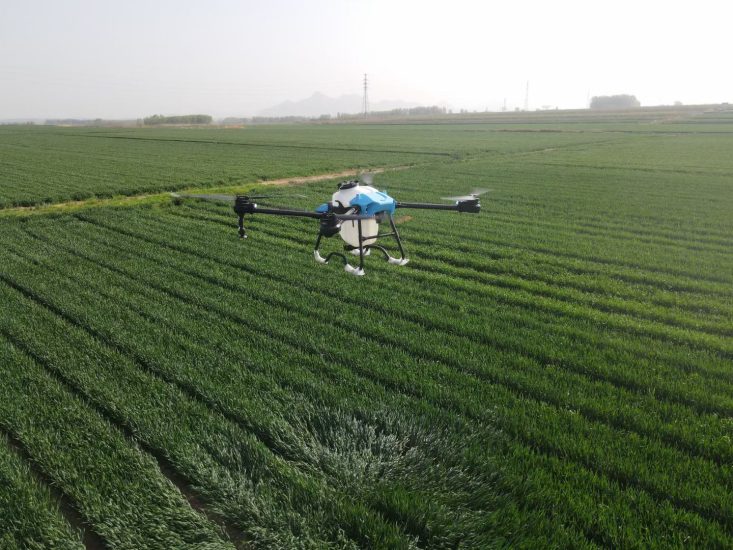
A 40L-class UAV shifts the economics from “flying a fancy sprayer” to “running an aerial application platform” with throughput closer to a tractor boom, without the soil compaction, crop damage, or access limitations.
But payload alone means nothing without the supporting systems: flow control, droplet physics, terrain clearance intelligence, and structural durability under corrosive chemistry.
2. System Architecture: What Actually Makes a 40L Sprayer Fly Reliably
2.1 Airframe & Propulsion Margin
A 40L liquid load plus the dry weight of booms, pumps, radar, battery, and airframe typically puts takeoff weight (MTOW) in the 85–120 kg range depending on material strategy.
Design Parameter
|
Why It Matters Commercially
|
Booms — folding, not fixed
|
Folding allows pickup-bed transport; fixed booms over ~4m wingspan become a logistics nightmare
|
Material — carbon arm tubes + reinforced polymer pods
|
Strength-to-weight, but watch stress risers at fold joints and landing gear mounts
|
Motor oversizing margin
|
You want ~1.5×–2× hover thrust at max takeoff; anything tighter and a gust or partial clog kills you
|
Landing gear height
|
Must clear crop canopy at full payload — a 40L machine flying in the wheat instead of over it slashes swath width and ruins uniformity
|
The honest spec: A well-designed 40L-class should hover at 55–65% throttle at MTOW. If someone claims it hovers at 40%, ask where the motor/ESC thermal margin went.
2.2 The Liquid System: Where Most Failures Happen
The spray system is not a glorified garden pump. It is a precision fluid-delivery loop under vibration, acceleration, and varying head pressure.
Subsystem
|
Technical Requirement
|
Failure Mode if Done Wrong
|
Tank & sump geometry
|
Baffled tank; low-point drain; no dead zones where slurry settles
|
Sludge clogs nozzle mid-pass; unbalanced loads shift CG mid-flight
|
Strainer / suction filter
|
80–120 mesh pre-pump; cleanable without tools
|
Clog = flow drop = streaky coverage
|
Pump type
|
Diaphragm (roller vane works but wears faster with abrasives)
|
Seal failure → chemical ingress → motor corrosion
|
Flow meter
|
Electromagnetic or turbine with <±3% error across range
|
Bad flow data = your “hectares/hour” claim becomes a lawsuit
|
Pressure regulator / PWM valves
|
Maintains atomization quality while modulating volume
|
Without regulation, slow flight = overdosing; fast flight = underdosing
|
Nozzles
|
Hollow-cone or twin-fluid tips sized to target DROPLET SPECTRUM, not just L/min
|
Wrong tip = drift or poor canopy penetration
|
Critical operational note: Many agricultural chemicals — especially suspensions (SC/WDG) and some adjuvants — are abrasive. Diaphragm pump lifecycles should be spec’d and priced into the maintenance schedule, not discovered at season peak.
2.3 Terrain Following Radar: The Feature That Changes Everything
This is the headline feature, so it deserves the deepest treatment.
What the radar actually does
A mmWave/80GHz terrain-following radar mounted on the belly measures slant range to canopy/ground several times per second. The flight controller uses that range data to adjust altitude in real time, maintaining a consistent AGL (Above Ground Level) clearance despite:
-
Rolling terrain
-
Sudden crop-height transitions (e.g., young corn → mature soy)
-
Levees, berms, irrigation furrows
-
Orchard rows with canopy rise/fall between rows
Why AGL consistency = spray quality
Spray deposition physics is brutally sensitive to nozzle-to-target distance.
Variable
|
Effect on Deposition
|
Swath height too high
|
Droplets lose momentum; drift ↑; coverage uniformity ↓
|
Swath height too low
|
Boom clips canopy → crop damage; wake turbulence disrupts pattern
|
Height oscillating ±40cm
|
You get stripes: heavy → light → heavy along flight lines
|
The radar’s job is keeping the boom in the sweet zone (typically 1.5–2.5 m AGL for field crops, higher for tree canopy tops depending on nozzle angle).
What “terrain following” is NOT
-
It is not a replacement for a proper flight plan with breaklines.
-
It does not see power lines, guy wires, or thin branches — radar sees bulk reflectivity, not thin obstacles.
-
It does not compensate for side-slope roll unless the IMU + GPS height agree on the correction (which they should, but the radar is primarily a vertical channel).
Spec to request:
Look for multi-point radar array (not just a single central puck) on wider booms, because a 4–5 meter swath with one radar point can heel on a side-slope and the left tip digs into canopy while the right is sky-high. Multi-point gives the FC a roll-compensated height reference.
3. Droplet Physics & Nozzle Strategy: The Part Everyone Underestimates
Customers buy “40 liters” but what they actually buy is uniform active ingredient per square meter. The tank size is just the fuel tank for that job.
3.1 The DPV (Droplet Particle Velocity) Problem
When a rotorcraft UAV flies low over crops, it generates:
-
Downwash → pushes droplets into canopy (good, when controlled)
-
Vortex ring / tip vortices → can lift fine droplets back up and carry them sideways (bad — drift + unevenness)
Droplet Size (VMD)
|
Pros
|
Cons
|
Fine (100–150 µm)
|
Excellent coverage on upper leaf surface
|
High drift risk; evaporates fast in heat
|
Medium (200–300 µm)
|
Best balance for most field crops
|
Needs correct boom height & wind window
|
Coarse (350–500+ µm)
|
Low drift, survives wind
|
Poor upper-surface adhesion unless surfactant package is dialed
|
The operator’s real lever: Nozzle selection + pressure + flight speed + boom height. Change any one, and the coverage map changes.
3.2 PWM (Pulse Width Modulation) Nozzle Control
Modern ag drones use PWM-enabled solenoid valves at each nozzle group so the FC can:
-
Keep pump pressure constant (preserving droplet size)
-
Modulate effective flow rate by changing duty cycle
-
Automatically compensate when the pilot slows down at a turn or flies into headwind
Without PWM (old-school fixed-orifice + pressure modulation), slowing down raises pressure → shrinks droplet size → increases drift. That is exactly backwards from safe practice.
4. Job Planning Math: Turning “40L” Into Hectares Per Day
Here is the realistic throughput model distributors and fleet buyers need:
4.1 Core formula
Variable
|
Typical Field-Crop Value
|
Swath width
|
4–6 m (depends on nozzle count & boom physical width)
|
Flight speed
|
4–7 m/s (soil/slope/wind dependent)
|
Application rate
|
10–30 L/ha (fungicide lower end, fertilizer/top-dress higher)
|
Usable endurance @ 40L
|
~8–12 min spray-on-target time per sortie
|
Sortie cycle
|
Fill + takeoff + spray + land + swap batteries ≈ 12–18 min
|
4.2 Throughput estimate (conservative)
At 20 L/ha and 5 m swath:
-
Each 40L sortie covers ≈ 2 hectares of actual sprayed area
-
With two battery sets and a field-side filler, a single airframe + one operator can do 40–80 ha/day depending on field shape, refill logistics, and wind
What kills those numbers in real life:
-
Long walks to refill (keep the tanker truck in the field)
-
Wind above 8–10 m/s → stop flying, not worth the drift
-
Nozzle clog from dirty water or mixed sediment → downtime
-
Terrain so broken that the radar can’t find a clean AGL floor → you fly higher → coverage drops
5. Chemical Compatibility & Corrosion Control
This is where “cheap” and “professional” diverge permanently.
Material Path
|
What to Verify
|
Fluid-wetted parts
|
Chemical-grade PTFE/PE/PP seals; 316 stainless or ceramic-coated pistons where possible; NO plain carbon steel in flow path
|
Spray booms
|
Anodized or polymer-coated aluminum; carbon fiber booms should have chemically resistant clear coat (urea/fertilizer salts eat raw resin fast)
|
Radar radome
|
Must be chemical-resistant polycarbonate or PEEK window; fogging/coating degradation blinds the radar mid-season
|
Flush procedure
|
Freshwater flush of entire loop (tank→pump→lines→nozzles) must be <2 minutes from landing, not “when we get back to shop”
|
Pro tip for distributor onboarding: Include a laminated Chemical Compatibility Card with every unit showing which seal families survive which active ingredient families. It saves you warranty claims.
6. The Terrain-Following Radar: Spec Sheet Decoder
When a buyer asks “how good is the radar,” give them real parameters:
Parameter
|
What to Ask For
|
Good Answer
|
Frequency band
|
76–81 GHz (mmWave) preferred
|
Optically 60GHz works, but mmWave tolerates dust/mist better
|
Update rate
|
≥ 50 Hz
|
Anything slower and you’re smoothing over real terrain edges
|
Beam pattern / footprint
|
Multi-point or at least dual-point
|
Single-point is OK on flat; risky on side-slopes
|
Minimum detection range
|
≤ 0.2 m
|
Needed for landing flare and very low AGL
|
Maximum range
|
15–30 m operational
|
More is not useful; you only care about the next 0–4 m AGL
|
Weather sensitivity
|
Heavy rain / wet crop reflectivity curve
|
Ask for performance envelope, not just “works in rain”
|
7. Maintenance & Total Cost of Ownership (the Distributor’s Real Margin Driver)
The smart distributor doesn’t just move hardware. They move uptime.
Wear Item
|
Typical Interval (working hours)
|
Commercial Impact
|
Nozzles / strainers
|
Every 50–100 ha of abrasive chems
|
Clogged nozzle = half-swath stripe → callback
|
Diaphragm pump rebuild
|
100–200 operating hours
|
Leak = contamination risk + pressure instability
|
Propellers / guards
|
Inspect every 20 flights
|
Crop strike chips CF; micro-cracks propagate
|
Battery health
|
300–500 cycles to 80% capacity
|
This is the single largest OpEx line item
|
Radar radome cleaning
|
Daily in dusty / sticky conditions
|
Mud smear = false height reading = AGL oscillation
|
Honest TCO framing for your buyers:
“A 40L spraying drone is not a capital expense. It is a seasonal production tool. Budget for pump rebuild kits, nozzle sets, battery refresh, and one spare boom folding actuator per season. The machine that flies is the machine that’s maintained, not the one with the fanciest brochure.”
8. FAQ: The Questions Serious Agronomy Buyers Ask
Q1: Can a 40L drone replace a tractor boom sprayer?
A: On flat, open, dry fields with good access — partially. But the drone’s real advantage is where the tractor can’t go or shouldn’t go: soft soils post-rain, levees, hillsides, orchards/vineyards, and fields segmented by terrain. The smartest operations run both, not either/or.
Q2: Does terrain-following radar work over standing water or wet clay pans?
A: Reflectivity changes. Over calm water the radar can lock onto the surface fine (sometimes too well — it sees the reflection, not the mud line). Over chop, readings jitter. The FC firmware needs to handle outlier rejection so the aircraft doesn’t porpoise. Ask your supplier how their Kalman filter handles this.
Q3: What wind speed should we stop flying?
A: For 40L class with 4–5m booms, practical cutoff is 8–10 m/s steady (≈ 30–36 km/h). Above that, droplet drift and lateral position error dominate. Don’t let operators chase hectares in unsafe wind; it burns reputation fastest.
Q4: How do we verify spray uniformity in the field?
A: Two quick methods: (1) Water-sensitive paper (WSP) cards laid across the swath — check dot density left/mid/right; (2) flow meter telemetry overlay on the flight log — if flow tracks speed perfectly and WSP is still uneven, your nozzle pattern or height is wrong, not the pump.
Q5: What’s the single upgrade that improves results most on a 40L platform?
A: Moving from fixed-orifice + pressure modulation to PWM constant-pressure nozzles and adding a second radar point (left/right reference) so the FC can correct roll on side-slopes. Those two changes are worth more than another 5 liters of tank capacity.
9. Closing: Selling the Platform, Not the Tank
A 40L agricultural spraying UAV only earns its keep when the buyer understands it as an integrated system:
Terrain radar → holds AGL → keeps nozzle distance honest → PWM holds droplet quality → flow metering proves it → maintenance keeps it flying next week.
If your pitch stops at “big tank, cheap price,” you’re competing on the wrong axis. The farms that pay professional rates care about uniformity, drift control, chemical compatibility, and uptime — and those come from engineering discipline, not sticker volume.
For qualified distributors and fleet buyers: we can provide a one-page Operations Spec Sheet (swath table, flow-rate matrix, nozzle chart, radar settings vs crop type, and pre-flight checklist) tailored to your target market’s dominant crops and chemistry. Tell us crop mix + average field size + preferred nozzle family, and we’ll tune the numbers.




No comments yet