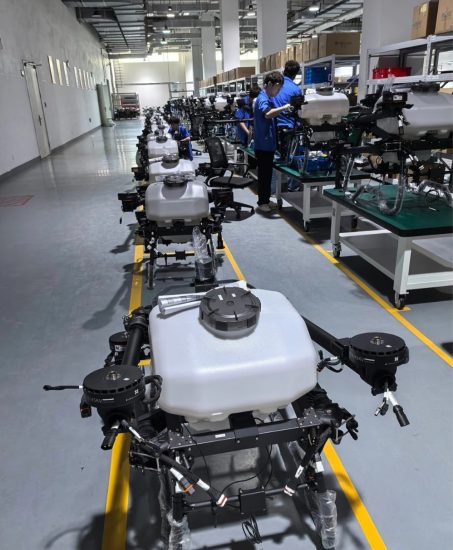


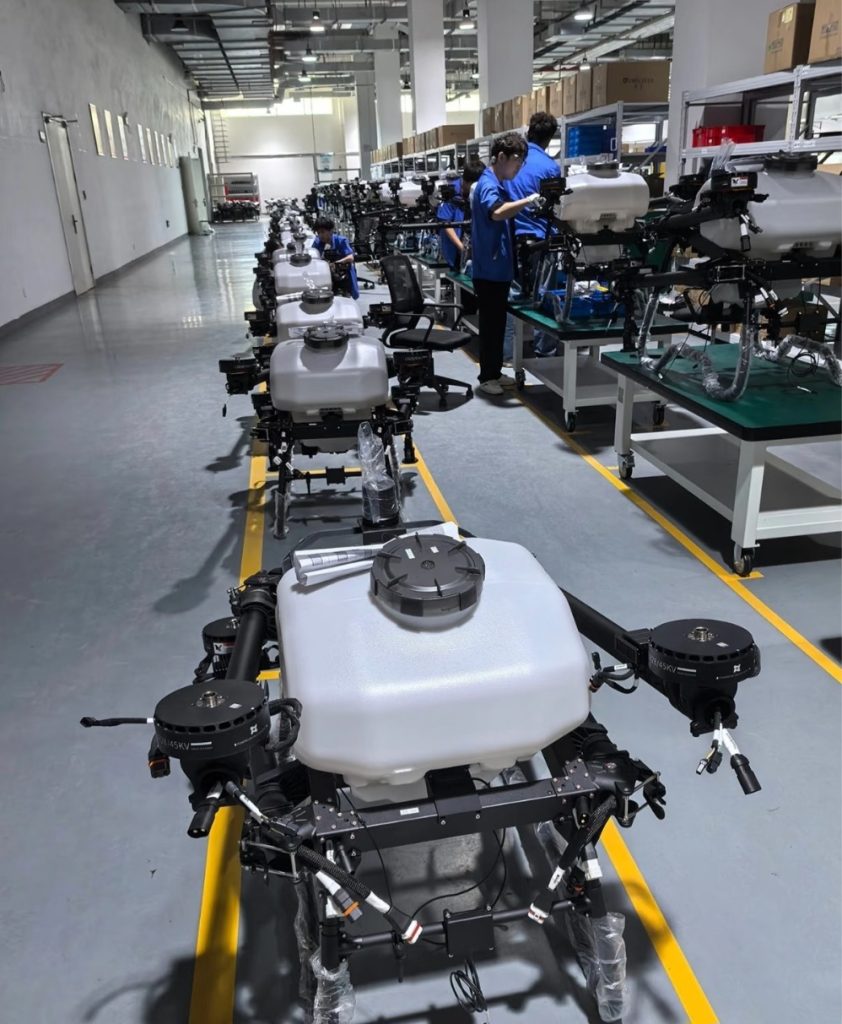
Agricultural pesticide spraying drones are becoming an important tool for modern crop protection. For farmers, agricultural service companies, distributors, and importers, drones can provide a flexible aerial application method for suitable agricultural operations while reducing dependence on manual spraying and ground equipment.
For buyers sourcing from China, the key question is not simply “How much does an agricultural spraying drone cost?” A professional purchasing decision should consider the complete system, including drone capacity, pump performance, nozzles, batteries, flight-control technology, spare parts, OEM capability, production quality, and after-sales support.
Choosing a factory-direct agricultural pesticide spraying drone supplier can make it easier for buyers to communicate directly about specifications, wholesale quantities, customization, and long-term supply.
What Is an Agricultural Pesticide Spraying Drone?
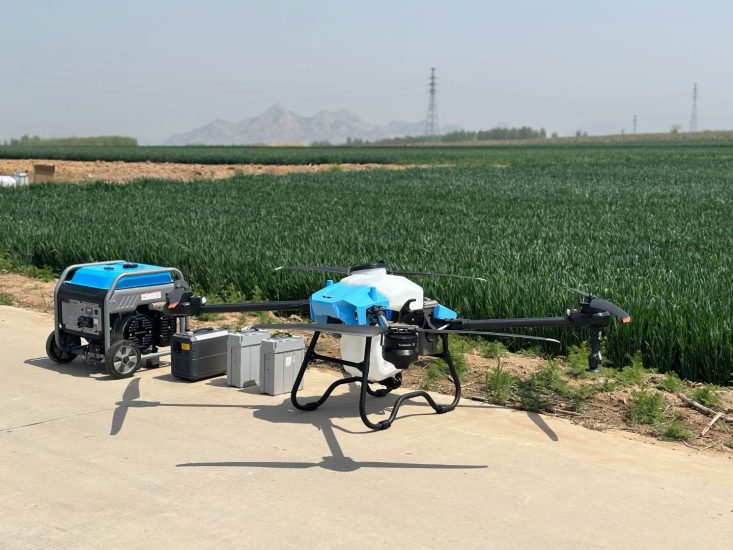
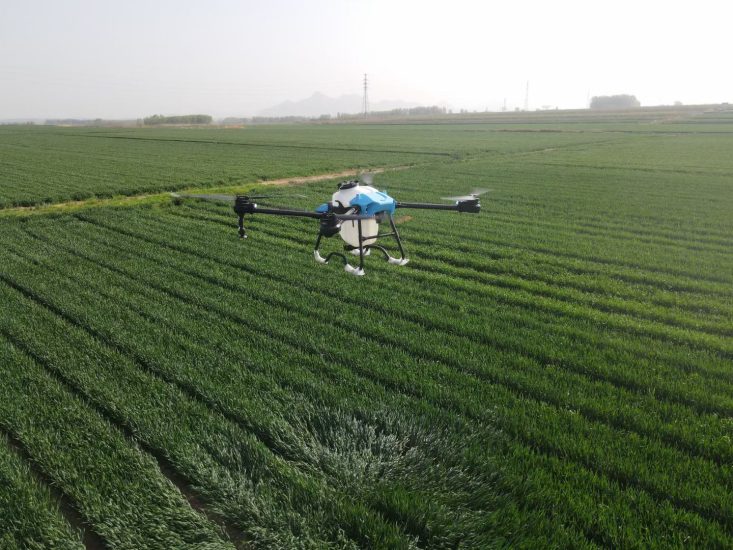
An agricultural pesticide spraying drone is an unmanned aerial vehicle equipped with a liquid spraying system for agricultural applications.
A typical system includes:
- Drone frame
- Motors
- Propellers
- Flight controller
- Navigation system
- Remote controller
- Liquid tank
- Pump
- Filter
- Pipes
- Valves
- Spray nozzles
- Battery
- Charger
The aircraft carries the liquid payload over the crop and applies it through the spraying system.
The appropriate application parameters depend on the crop, agricultural product, weather, terrain, nozzle configuration, and local regulations. Operators should always follow the applicable product label and agricultural regulations.
Why Buy Directly From a Chinese Factory?
China has a large supply chain for agricultural drones and related components.
Working directly with a factory can offer several advantages for international buyers.
Direct Product Communication
Buyers can communicate directly about:
- Technical specifications
- Tank capacity
- Battery configuration
- Spraying system
- Accessories
- OEM requirements
- Packaging
- Spare parts
This can reduce misunderstandings when compared with purchasing through multiple intermediaries.
Wholesale Pricing
Factory-direct pricing can be particularly relevant for buyers purchasing multiple units.
The final price can depend on:
- Drone model
- Order quantity
- Battery quantity
- Charger configuration
- Spare parts
- OEM requirements
- Packaging
- Shipping terms
Therefore, buyers should request a complete quotation rather than comparing only the base aircraft price.
Agricultural Pesticide Spraying Drone Capacity
Different markets require different drone configurations.
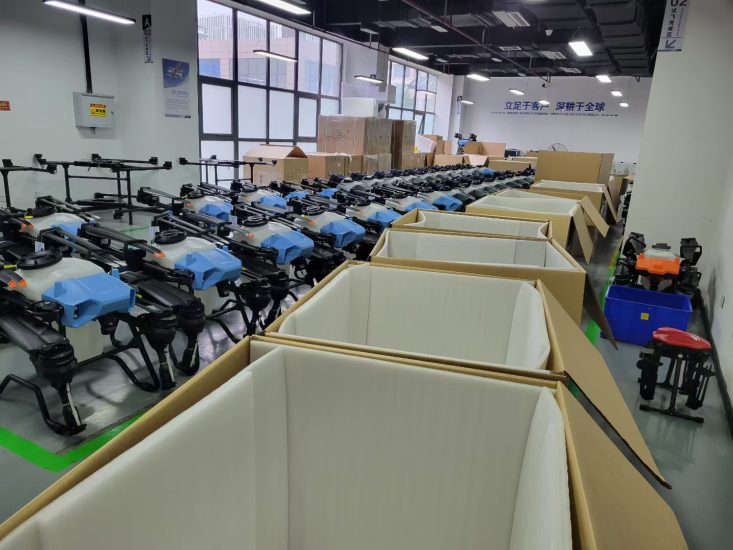
Commercial agricultural spraying drones are available in multiple capacities, with 20L and 30L platforms being common configurations buyers may consider.
20L Agricultural Spraying Drone
A 20L drone can provide a balance between liquid capacity and aircraft size.
It may be suitable for:
- Agricultural service companies
- Farms
- Distributors
- Orchards
- Rice fields
- Vegetable farms
The actual suitability depends on local operating conditions.
30L Agricultural Spraying Drone
A 30L model offers greater liquid capacity.
For professional operators, this may reduce the frequency of refilling during certain field operations.
However, the larger payload also increases the demands on:
- Motors
- Battery
- Frame
- Flight controller
- Pump
- Landing gear
Therefore, buyers should evaluate the complete aircraft system.
Do Not Compare Drones Only by Tank Capacity
Tank capacity is important, but it is only one specification.
A professional comparison should include:
| Specification | Why It Matters |
|---|---|
| Tank capacity | Determines liquid payload |
| Maximum takeoff weight | Indicates overall payload capability |
| Battery capacity | Influences operating endurance |
| Pump flow rate | Determines liquid delivery |
| Nozzle configuration | Affects spray distribution |
| Spray width | Influences field coverage |
| Flight speed | Affects operating efficiency |
| Positioning system | Supports flight accuracy |
| Spare parts | Affects long-term maintenance |
| Warranty | Reduces after-sales risk |
A drone with a larger tank is not automatically more productive if its battery, pump, or flight system is not properly matched to the payload.
Spraying System
The spraying system is one of the most important parts of an agricultural drone.
It normally consists of:
Tank → Filter → Pump → Pipe → Valve → Nozzle
Each component affects the overall application performance.
Pump
The pump controls the movement of liquid through the system.
Important specifications include:
- Flow rate
- Pressure
- Power consumption
- Control method
- Reliability
- Replacement availability
Nozzles
Nozzles determine how the liquid is distributed.
Buyers should ask about:
- Nozzle type
- Number of nozzles
- Flow rate
- Spray pattern
- Droplet characteristics
- Replacement parts
The appropriate nozzle and operating parameters depend on the intended agricultural application.
Battery and Charging System
Agricultural spraying drones operate under significant loads.
A full liquid tank adds considerable weight, which means the propulsion and battery system must be designed accordingly.
Before purchasing, ask the supplier about:
- Battery voltage
- Battery capacity
- Battery weight
- Charging time
- Expected cycle life
- Charger specifications
- Battery protection
- Replacement battery cost
For commercial fleets, multiple batteries can help reduce downtime.
How Long Can a Spraying Drone Fly?
There is no single flight-time figure that applies to every operation.
Actual flight time depends on:
- Payload
- Battery condition
- Wind
- Temperature
- Flight speed
- Flight route
- Aircraft configuration
When comparing manufacturers, ask whether their flight-time specification was measured with an empty tank or with a normal operating payload.
This is especially important when comparing 20L and 30L agricultural drones.
Flight Control System
A professional agricultural spraying drone may include functions such as:
- GPS positioning
- Automatic route planning
- Return-to-home
- Altitude control
- Automatic flight
- Obstacle detection
- Route recording
- Remote monitoring
The exact functions vary between models.
Buyers should request a complete specification sheet rather than assuming that every agricultural drone has identical intelligent functions.
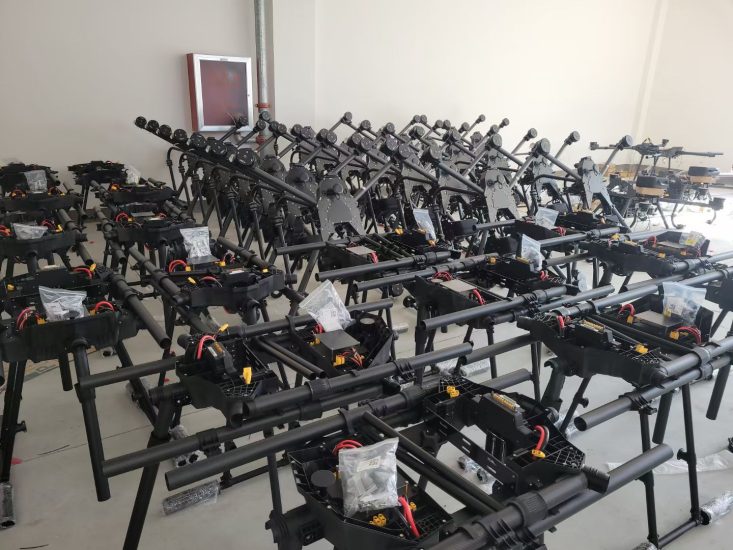
Factory Quality Control
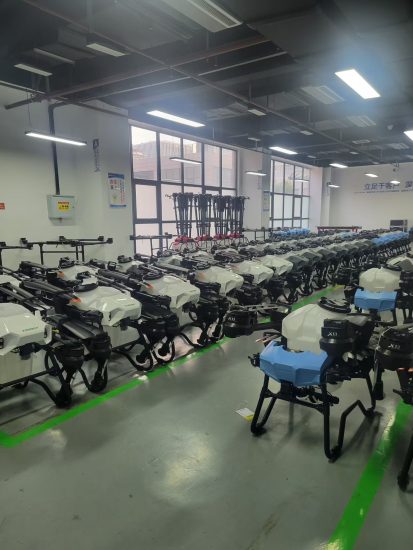
When purchasing directly from a manufacturer, quality control should be one of the main evaluation criteria.
A professional factory should have appropriate inspection procedures for:
Motors and Propellers
The propulsion system should be checked for correct operation.
Batteries
Battery systems should undergo appropriate inspection and testing.
Pumps
The pump should be tested for stable operation.
Spraying Components
The factory should check:
- Tank
- Pipes
- Filters
- Valves
- Nozzles
for correct assembly and operation.
Finished Aircraft
Completed drones should undergo appropriate functional and flight testing before shipment.
OEM Agricultural Pesticide Spraying Drones
For distributors and brand owners, OEM manufacturing can provide an opportunity to develop a private-label agricultural drone product.
Possible OEM services can include:
- Logo customization
- Product labels
- Packaging
- User manuals
- Accessories
- Selected product configurations
Before starting OEM production, confirm:
- MOQ
- Logo requirements
- Packaging requirements
- Sample approval
- Production lead time
- Customization costs
A written specification is recommended for bulk orders.
Wholesale Agricultural Drone Supply
Wholesale customers may include:
- Agricultural equipment distributors
- Drone dealers
- Farming service companies
- Regional importers
- Agricultural technology companies
- Large farms
These customers generally require more than the aircraft itself.
A complete wholesale package may include:
Drone + Batteries + Chargers + Spare Parts + Manuals + Technical Support
The exact configuration should be agreed before ordering.
Spare Parts and After-Sales Support
Agricultural drones operate in demanding outdoor environments.
Over time, components may require maintenance or replacement.
Common spare parts include:
- Propellers
- Motors
- Pumps
- Nozzles
- Filters
- Pipes
- Landing gear
- Batteries
- Chargers
- Electronic components
For distributors, reliable spare-parts availability is essential.
Before ordering, ask the factory for a recommended spare-parts package based on your planned fleet size.
How to Select a Reliable Factory-Direct Supplier
A supplier should be evaluated in several areas.
1. Manufacturing Capability
Determine whether the supplier has actual production and assembly capabilities.
2. Product Testing
Ask how the factory tests aircraft before shipment.
3. Production Capacity
For large orders, confirm whether the factory can meet your required quantity and delivery schedule.
4. OEM Capability
If you require your own brand, confirm the exact customization options.
5. Spare Parts
Check whether replacement components can be supplied continuously.
6. Technical Support
Ask how international customers receive troubleshooting assistance.
7. Warranty
Clarify warranty coverage and the process for handling defective components.
How to Request Factory-Direct Pricing
One of the easiest ways to receive a useful quotation is to provide detailed purchasing requirements.
For example:
Product: Agricultural Pesticide Spraying Drone
Capacity: 20L / 30L
Quantity: 20 units
Destination: [Country]
Brand: OEM
Batteries: 2–3 per unit
Chargers: Required
Spare Parts: Required
Packaging: Customized
Shipping: Air / Sea
Then request:
- Unit price
- MOQ
- OEM cost
- Battery cost
- Charger cost
- Spare-parts cost
- Production lead time
- Warranty
- Shipping options
This gives you a much more useful comparison between factories.
Why Sample Testing Is Important
Before purchasing a large quantity, buyers should consider testing a sample.
The sample can be evaluated for:
Flight Stability
Check basic flight control and stability.
Battery Performance
Check charging and operating performance.
Spraying System
Test the pump, nozzles, pipes, filters, and liquid distribution.
Assembly Quality
Inspect the frame, connectors, landing gear, and other components.
Maintenance
Determine how easily common components can be inspected and replaced.
The approved sample should then be used as a reference for bulk production.
International Shipping Considerations
Agricultural spraying drones may contain lithium batteries and radio communication equipment.
International transportation requirements can therefore differ depending on:
- Battery type
- Battery quantity
- Shipping method
- Destination country
- Airline or carrier requirements
- Import regulations
Before shipment, the buyer and supplier should confirm the required transportation documentation and packaging.
Agricultural Drone Regulations
Importing a drone and operating a drone are not necessarily subject to the same requirements.
Depending on the destination market, buyers may need to consider:
- Drone registration
- Pilot/operator requirements
- Flight restrictions
- Radio-frequency regulations
- Agricultural spraying rules
- Pesticide application requirements
- Insurance
- Import certification
The buyer should verify current local requirements before placing a commercial order.
Common Mistakes When Buying Agricultural Spraying Drones
Mistake 1: Choosing Only the Lowest Price
The cheapest unit price does not necessarily result in the lowest operating cost.
Consider the complete ownership cost:
Drone + Battery + Charger + Spare Parts + Maintenance + Downtime
Mistake 2: Believing Every Advertised Specification
Ask how specifications such as flight time and spray width were measured.
Mistake 3: Ignoring Spare Parts
A drone without accessible replacement components can become difficult to operate commercially.
Mistake 4: Ordering Too Many Units Initially
Testing samples before large-scale procurement can reduce sourcing risk.
Mistake 5: Ignoring Local Regulations
Always verify the rules applicable to the destination market before importing or operating agricultural spraying drones.
FAQ
Can I buy agricultural pesticide spraying drones directly from a Chinese factory?
Yes. International importers and distributors can source agricultural spraying drones directly from Chinese manufacturers, subject to the supplier’s commercial terms and destination-country requirements.
What is the difference between a supplier and a manufacturer?
A manufacturer produces or assembles the product, while “supplier” can refer to either a manufacturer or another company supplying the product. Buyers interested in factory-direct purchasing should verify the supplier’s actual manufacturing capabilities.
Can I order 20L and 30L agricultural drones wholesale?
Yes. Wholesale orders can be discussed with manufacturers, with pricing and MOQ depending on the model, quantity, OEM requirements, batteries, chargers, and accessories.
Can I use my own brand?
Many manufacturers offer OEM services, including logo and packaging customization. The exact options and MOQ should be confirmed before production.
What should I include in a quotation request?
Include the desired capacity, quantity, destination country, OEM requirements, battery quantity, charger requirements, spare parts, packaging, and shipping preference.
How can I compare two agricultural drone factories?
Compare manufacturing capability, product specifications, spraying system, battery, quality control, OEM capability, spare parts, warranty, technical support, production capacity, and total cost.
Conclusion
Finding the right agricultural pesticide spraying drone supplier in China requires a complete evaluation of the product and supplier rather than focusing only on factory-direct pricing.
For importers, distributors, and agricultural service companies, the strongest sourcing strategy is to evaluate:
Product Quality + Spraying Performance + Battery System + OEM Capability + Spare Parts + Technical Support + Factory Capacity
A professional factory-direct supplier should be able to support the buyer from sample testing and OEM customization through bulk production, shipping, spare-parts supply, and after-sales service.
For serious wholesale buyers, providing detailed requirements when requesting a quotation is one of the best ways to obtain an accurate price and identify a supplier capable of supporting long-term cooperation.


No comments yet