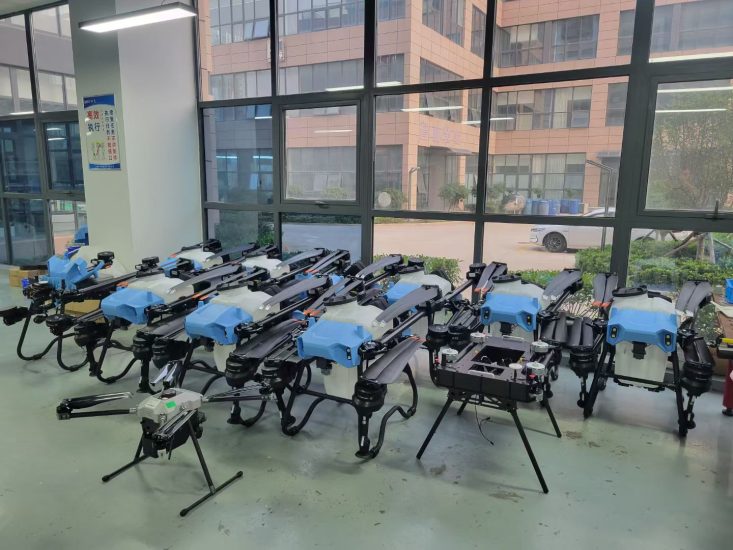


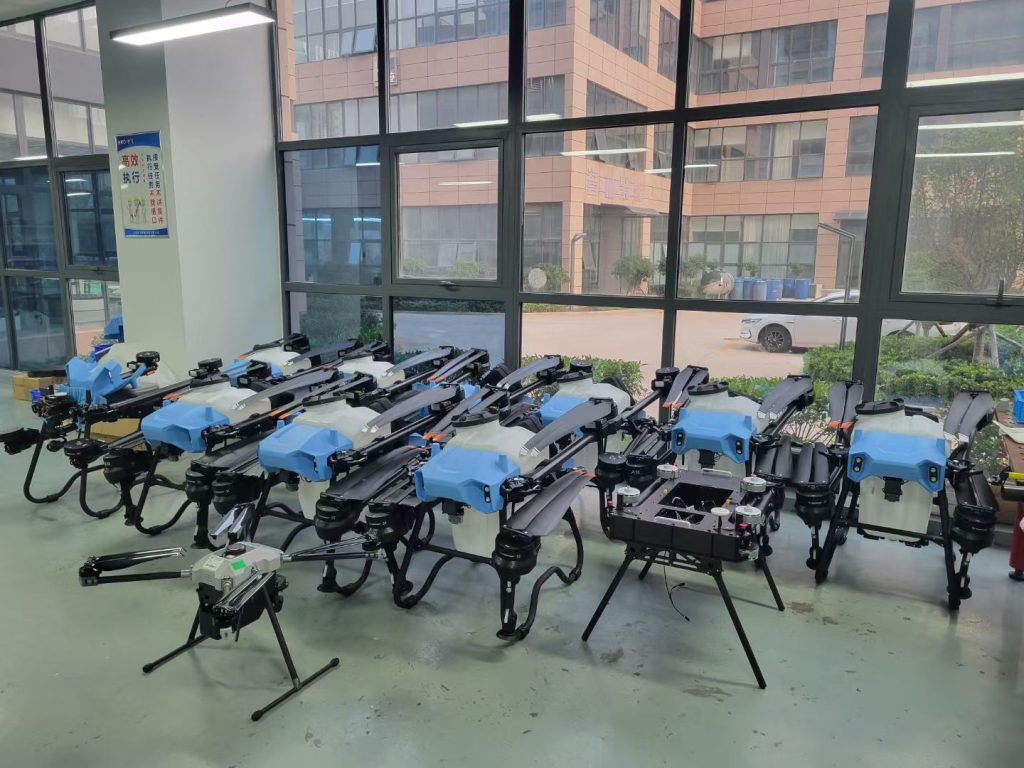
Fertilizer application has always been a balance between speed, accuracy, labor, and cost. Traditional methods can work well on large, accessible fields, but they become less convenient when farmland is wet, fragmented, steep, or difficult for machinery to reach.
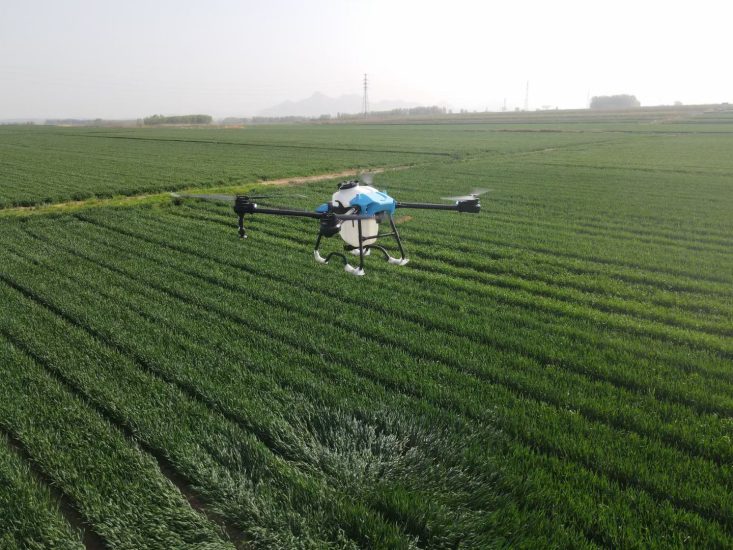
Agricultural fertilizer drones offer another approach. Instead of driving a spreader through the field, an unmanned aircraft carries granular fertilizer and distributes it from the air. This allows farmers to treat areas that may be difficult or costly to access with conventional equipment.
But does a fertilizer drone actually make a farm more efficient?
The answer depends on how the drone is used. A well-matched system can reduce labor requirements, shorten application time, avoid soil compaction, and make fertilizer application more flexible. However, the benefits depend heavily on payload capacity, spreading accuracy, battery management, refill logistics, field conditions, and operator experience.
What Is an Agricultural Fertilizer Drone?
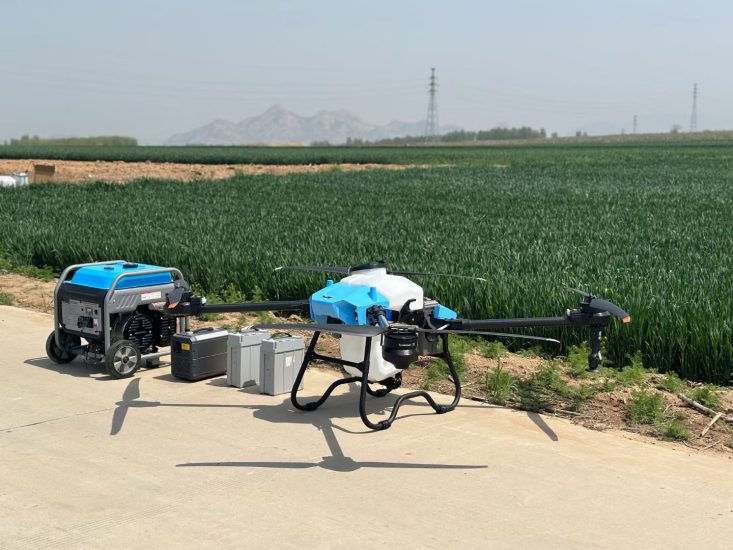
An agricultural fertilizer drone is an unmanned aerial vehicle equipped with a hopper and granular spreading system.
Unlike crop-spraying drones, which normally carry liquid and use pumps and spray nozzles, fertilizer drones are designed to handle dry agricultural materials.
The basic operating process is relatively simple:
-
The operator fills the hopper with fertilizer.
-
The drone takes off from a suitable location.
-
A planned flight route is followed over the field.
-
The spreading system releases fertilizer at a controlled rate.
-
The drone returns when the hopper is empty or the battery needs attention.
-
The operator refills the hopper or replaces the battery.
-
The next flight begins.
Modern systems can automate much of the route-planning and navigation process, allowing the operator to concentrate more on monitoring the operation rather than manually controlling every movement.
How Do Fertilizer Drones Improve Farm Efficiency?
The biggest advantage is not simply that a drone can fly.
The real advantage is that the drone changes how fertilizer reaches the crop.
Traditional spreading equipment usually requires a vehicle, suitable field access, and a relatively firm surface. A drone does not need to drive through the crop or across the soil.
This creates several potential efficiency improvements.
1. Less Dependence on Manual Labor
Fertilizer application can require several workers when performed manually, especially on small or irregular fields.
Workers may need to carry fertilizer bags, walk through the field, operate equipment, and repeatedly move fertilizer from storage to the application area.
A drone does not eliminate labor completely. Someone still needs to:
-
Prepare fertilizer
-
Load the hopper
-
Manage batteries
-
Plan flight routes
-
Monitor the aircraft
-
Refill fertilizer
-
Clean equipment
-
Perform routine maintenance
However, one trained operator can potentially manage a much larger area than a worker manually broadcasting fertilizer.
This becomes particularly valuable when agricultural labor is expensive or difficult to find during peak farming periods.
2. Faster Access to Difficult Fields
Some farmland is difficult for tractors and other ground equipment.
Examples include:
-
Wet rice fields
-
Mountain slopes
-
Terraced farmland
-
Soft soil
-
Narrow plots
-
Fragmented farms
-
Fields with limited road access
-
Crops that are too tall for ground vehicles
A drone can operate from a nearby takeoff area and reach the field without requiring a vehicle to drive through it.
This can reduce the amount of time spent preparing access routes or moving heavy machinery between separate plots.
For farms with many small fields, this flexibility can be more valuable than maximum aircraft speed.
3. Less Soil Compaction
Heavy agricultural machinery can compress soil, particularly when fields are wet.
Soil compaction can affect:
-
Soil structure
-
Water movement
-
Root development
-
Air circulation
-
Crop growth
A fertilizer drone distributes material without placing wheels or tracks on the cultivated area.
This is especially useful for crops grown in wet conditions or fields where ground access is limited.
The benefit is not merely operational. Avoiding unnecessary traffic through the field can help preserve the condition of the growing area.
4. More Flexible Fertilizer Timing
Weather can create a narrow window for fertilizer application.
After rainfall, a field may become too wet for tractors but still be accessible from the air.
This gives farmers another option when ground machinery cannot enter safely or efficiently.
Timing matters because fertilizer application is often connected to crop growth stages. Delaying an application because equipment cannot access the field may create additional management problems.
A drone cannot solve every weather-related problem. Strong winds, heavy rain, poor visibility, and other unsafe conditions can still prevent flight.
But under suitable conditions, aerial application provides greater operational flexibility.
5. Adjustable Application Rates
Modern fertilizer drones can control the amount of material released by the spreading system.
This allows the operator to adjust application rates according to the crop and farming plan.
For example, different fields may require different fertilizer rates because of differences in:
-
Crop variety
-
Growth stage
-
Soil condition
-
Previous fertilizer application
-
Target yield
-
Nutrient requirements
The important point is that the drone should not simply release fertilizer at a fixed rate.
The spreading system needs to coordinate fertilizer output with flight speed.
If the drone flies faster while maintaining the same material output, the amount applied per unit area decreases. If the drone slows down without reducing output, application rates can increase.
Therefore, proper calibration is essential.
6. Reduced Overlap and Missed Areas
Manual fertilizer spreading can produce uneven coverage, especially when workers are trying to judge distance visually.
GPS-based route planning can help create more consistent flight paths.
Depending on the drone and software, the operator may be able to define:
-
Field boundaries
-
Flight lines
-
Working width
-
Flight altitude
-
Speed
-
Application parameters
The system can then follow a planned route.
This does not guarantee perfect distribution. Wind, fertilizer particle characteristics, spreading mechanism design, and field conditions still affect the final result.
Nevertheless, automated route planning can reduce unnecessary overlap and missed sections compared with completely manual operation.
Does a Bigger Fertilizer Drone Mean Higher Efficiency?
Not necessarily.
Payload capacity is important, but it should be considered alongside the entire operating cycle.
Suppose two drones are available:
-
Drone A: 30 kg payload
-
Drone B: 50 kg payload
If the application rate is 25 kg/ha, Drone A carries approximately enough fertilizer for one hectare per full load, while Drone B carries enough for approximately two hectares under the same theoretical conditions.
At first glance, the 50 kg drone appears more efficient.
But consider the rest of the operation.
The larger drone may require:
-
Larger batteries
-
More expensive charging equipment
-
Higher transport capacity
-
More powerful motors
-
More expensive replacement components
If the farm consists of many small fields, the larger aircraft may also be less convenient to transport between plots.
Therefore, payload should be matched to the farm rather than selected simply because the number is larger.
How Battery Management Affects Productivity
Battery management is one of the most important practical issues in drone-based agriculture.
A drone cannot continue working simply because fertilizer remains available. It also needs sufficient battery capacity.
A commercial operation therefore needs to consider the entire battery cycle:
Flight → Landing → Battery replacement → Charging → Next flight
If the drone spends too much time waiting for batteries to charge, theoretical flight performance does not translate into actual field productivity.
For continuous operations, buyers should ask manufacturers:
-
How long does a fully loaded flight normally last?
-
How long does battery replacement take?
-
How long does charging take?
-
How many batteries are recommended?
-
Is a fast charger available?
-
Is a generator or other power source required?
-
What happens to flight time at maximum payload?
The last question is particularly important.
A manufacturer’s maximum flight time may be measured under conditions that do not represent a fully loaded fertilizer operation.
Real productivity should be evaluated using the actual working payload.
Fertilizer Refill Time Can Be a Bigger Problem Than Flight Time
Many buyers focus on how long a drone can fly but overlook fertilizer handling.
Imagine a drone that can remain in the air for a relatively long period but has a small hopper.
The aircraft may have to return frequently for refilling.
If fertilizer loading takes several minutes each time, the operator may spend a significant part of the working day on the ground.
For commercial farming, productivity is therefore determined by:
Flight time + spreading capacity + refill time + battery replacement time
not flight time alone.
A well-designed fertilizer operation should place the fertilizer supply as close as practical to the field’s working area.
This reduces unnecessary travel between the field and the loading point.
How Fertilizer Type Affects Drone Performance
Not every granular fertilizer behaves in exactly the same way.
Important characteristics include:
-
Particle size
-
Particle shape
-
Density
-
Moisture content
-
Flowability
-
Tendency to form lumps
Dry, free-flowing granules are generally easier to handle than fertilizer that has absorbed moisture and become sticky.
If material does not flow consistently through the hopper, the drone may distribute fertilizer unevenly.
For this reason, farmers should test the actual fertilizer they intend to use.
A manufacturer should ideally provide information about compatible materials and recommended calibration procedures.
Urea
Urea is commonly used as a nitrogen fertilizer and can be suitable for granular spreading systems, but storage and moisture conditions matter.
Moisture can affect flow characteristics and cause material to stick or form clumps.
Compound Fertilizer
Compound fertilizers can have different particle sizes and densities depending on their formulation.
The spreading mechanism should be calibrated for the specific product rather than assuming that all compound fertilizers behave identically.
Potassium and Other Granular Fertilizers
Higher-density granules may have different ballistic characteristics after leaving the spreader.
This can affect practical spreading width and uniformity.
For commercial use, field testing is more useful than relying solely on a specification sheet.
Fertilizer Drones in Rice Farming
Rice farming is one of the situations where aerial fertilizer application can make practical sense.
Rice fields are often wet, and conventional vehicles may cause soil disturbance or become difficult to operate.
A drone can fly over the crop and distribute fertilizer without entering the field.
This can be particularly useful during periods when the field surface is unsuitable for heavy machinery.
However, the drone still needs to be operated under appropriate weather and wind conditions.
The farmer should also ensure that the spreading pattern is suitable for the particular rice-growing method being used.
Fertilizer Drones for Large Open Fields
Large, relatively flat fields can also benefit from drone application, especially where labor availability is limited.
However, the economic calculation is different.
Large farms may already use tractor-mounted fertilizer spreaders with high ground productivity.
In such cases, the drone’s main advantages may come from:
-
Wet-field access
-
Reduced soil traffic
-
Rapid deployment
-
Reduced manual labor
-
Ability to operate when ground equipment is unavailable
A farmer should compare the drone with the existing equipment rather than assuming that aerial application is automatically cheaper.
Fertilizer Drones for Mountain and Sloped Farmland
Mountain farms present a different challenge.
Transporting fertilizer by vehicle can be difficult, while manually carrying bags uphill can consume significant labor.
A drone can move fertilizer from a suitable loading point to areas that are difficult for workers or vehicles to reach.
This can reduce physical labor and make fertilizer application more practical on steep or fragmented land.
However, terrain can also create stronger wind conditions and more complicated flight paths.
A drone intended for mountainous agricultural operations should therefore have reliable positioning, appropriate obstacle awareness, and stable flight performance.
Does Drone Fertilization Save Money?
It can, but the answer depends on the operation.
The economic benefit comes from several possible sources:
Lower labor requirements
Fewer workers may be needed for field application.
Less machinery movement
There may be less need to move tractors and spreading equipment between fragmented fields.
Lower soil-related costs
Avoiding unnecessary field traffic can reduce soil compaction and crop damage.
Faster application
A shorter application window can be valuable when fertilizer needs to be applied at a particular crop stage.
Better material management
Accurate application can reduce excessive fertilizer use in areas that do not require it.
However, drone ownership also creates costs.
These include:
-
Initial aircraft purchase
-
Batteries
-
Chargers
-
Spare parts
-
Maintenance
-
Operator training
-
Transport
-
Software or positioning services where applicable
-
Insurance or regulatory costs where required
Therefore, the correct question is not:
“Is a fertilizer drone cheap?”
It is:
“What is the cost per hectare compared with my current fertilizer application method?”
A Simple Cost-per-Hectare Calculation
Suppose a farm spends $8,000 per season on labor and equipment for fertilizer application.
After introducing a drone, its annual operating cost might include:
-
Battery replacement
-
Electricity or fuel
-
Maintenance
-
Operator labor
-
Spare parts
If those costs total $5,000, the potential difference is $3,000.
But the calculation should also include the drone’s purchase cost and expected service life.
For example:
Annualized drone cost + operating cost ÷ annual hectares treated = estimated drone cost per hectare
This provides a more useful comparison than looking only at the purchase price.
What Makes a Fertilizer Drone Efficient?
A practical fertilizer drone should have a balanced combination of several characteristics.
Factor |
Why It Matters |
|---|---|
Payload capacity |
Determines how much fertilizer can be carried per flight |
Spreading system |
Controls how material is distributed |
Application-rate control |
Helps maintain the required fertilizer rate |
Battery capacity |
Determines practical flight cycles |
Charging speed |
Affects continuous operation |
Navigation |
Reduces unnecessary overlap and missed areas |
Working width |
Influences theoretical coverage |
Flight stability |
Helps maintain consistent operation |
Hopper design |
Affects refill speed and material flow |
Spare parts |
Determines ease of maintenance |
Software |
Supports route planning and operational control |
Operator training |
Strongly affects real-world performance |
No single specification determines efficiency.
The best-performing drone is the one where these components work together.
What Should Buyers Look for When Sourcing from China?
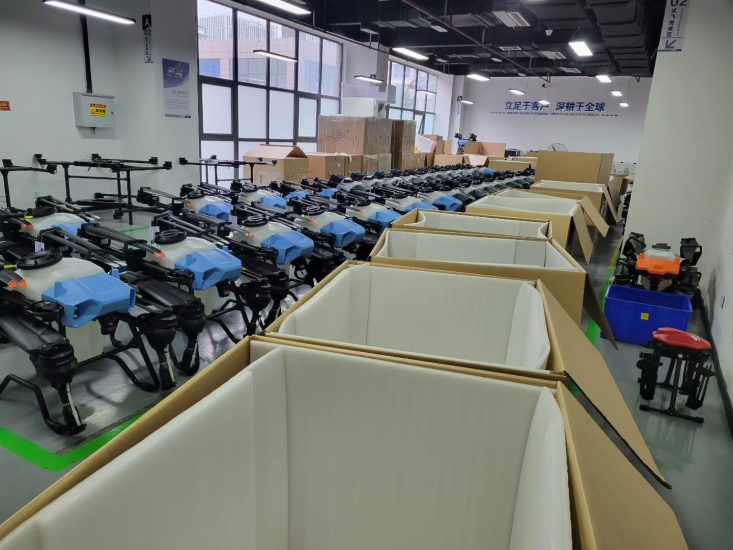
China has a large agricultural drone manufacturing sector, so overseas buyers may encounter many suppliers offering similar payload capacities.
Do not compare suppliers solely on price.
Ask for a complete specification sheet covering:
-
Aircraft payload
-
Empty weight
-
Battery type and capacity
-
Number of batteries
-
Charger specifications
-
Fertilizer hopper capacity
-
Spreading mechanism
-
Adjustable application rate
-
Recommended fertilizer particle size
-
Working width
-
Recommended flight speed
-
Navigation system
-
Obstacle sensing
-
Remote-controller specifications
-
Spare parts list
-
Warranty terms
-
Technical support
More importantly, ask for operating data under defined conditions.
For example:
What is the practical hectares-per-hour capacity when carrying 30 kg of granular fertilizer at an application rate of 25 kg/ha?
That question is much more useful than simply asking:
How many hectares can the drone cover?
The first question forces the supplier to provide assumptions behind the performance figure.
Request a Demonstration Before a Large Order
If possible, buyers should request a demonstration using the fertilizer they actually intend to apply.
The test should examine:
-
Material flow
-
Spreading uniformity
-
Actual working width
-
Application rate
-
Battery consumption
-
Refill time
-
Ease of cleaning
-
Operator workload
A short field demonstration can reveal problems that are impossible to identify from a product catalog.
For distributors, importers, and agricultural equipment dealers, this is especially important because poor field performance can create warranty issues and customer complaints later.
Regulatory Requirements Matter
Agricultural drones are aircraft, so buyers should not assume that a drone can be imported and operated without restrictions.
Requirements vary by country and may involve:
-
Aircraft registration
-
Operator certification
-
Remote identification
-
Radio equipment requirements
-
Flight restrictions
-
Agricultural-use regulations
-
Insurance
-
Import documentation
Before purchasing, the buyer should check the rules in the destination country.
A manufacturer or exporter can provide technical and shipping documentation, but the buyer remains responsible for ensuring that the equipment can legally be operated in the intended market.
Maintenance Is Part of Farm Efficiency
Agricultural environments are hard on equipment.
Fertilizer dust and residue can enter mechanical components, while moisture and chemicals can accelerate corrosion.
After each operation, the operator should follow the manufacturer’s cleaning and maintenance procedures.
Typical maintenance may include:
-
Cleaning the hopper
-
Cleaning the spreading mechanism
-
Checking motors
-
Inspecting propellers
-
Checking battery condition
-
Inspecting connectors
-
Checking fasteners
-
Updating software where required
-
Inspecting the aircraft frame
Regular maintenance helps prevent small problems from becoming expensive downtime during critical fertilizer application periods.
FAQ
Can agricultural drones spread fertilizer?
Yes. Fertilizer drones are specifically designed to distribute granular agricultural materials through a hopper and spreading mechanism. The suitable fertilizer types depend on the particular drone and spreading system.
Are fertilizer drones better than tractors?
Not in every situation. Drones are particularly useful for wet fields, steep terrain, fragmented farmland, and situations where labor or ground access is limited. Large flat farms with efficient existing machinery may still find conventional spreaders more economical.
How much fertilizer can an agricultural drone carry?
Commercial agricultural drones are available in different payload classes. Common configurations include approximately 20 kg, 30 kg, 40 kg, and 50 kg, although actual models vary. Payload should be selected according to field size, application rate, and operating conditions.
How accurate is drone fertilizer spreading?
Accuracy depends on the spreading mechanism, fertilizer characteristics, calibration, flight speed, altitude, wind, and route planning. A properly calibrated system can provide controlled application, but no drone can guarantee perfect uniformity under all conditions.
Can a fertilizer drone work in rice fields?
Yes. Rice fields are one of the practical applications because drones can distribute fertilizer without driving through wet soil. Weather and wind conditions still need to be suitable for safe operation.
How long can a fertilizer drone operate?
There is no universal flight time. Payload, battery capacity, weather, flight speed, and operating conditions all affect endurance. Buyers should request flight-time data under realistic loaded conditions.
Is a 50 kg fertilizer drone better than a 30 kg model?
Not automatically. A 50 kg drone can reduce the number of refill cycles, but it may also require more expensive batteries, charging equipment, and transportation. The best payload depends on the farm’s actual requirements.
Can fertilizer drones replace manual fertilizer spreading?
For many operations, they can substantially reduce manual field spreading. However, workers are still required for fertilizer preparation, loading, battery management, flight supervision, maintenance, and other tasks.
What is the most important specification when buying a fertilizer drone?
There is no single most important specification. Payload, spreading accuracy, fertilizer compatibility, battery performance, practical productivity, application-rate control, and after-sales support should all be considered together.
Final Thoughts
Agricultural fertilizer drones can improve farm efficiency, but their value comes from solving specific operational problems rather than simply replacing a tractor or a worker.
They are particularly attractive when farms face high labor costs, difficult terrain, wet soil, fragmented fields, narrow application windows, or limited access for conventional machinery.
For buyers, the best approach is to calculate the entire application cycle:
fertilizer loading → flight → spreading → battery replacement → refill → maintenance
Then compare the total cost and productivity with the existing method.
A drone with a large payload but poor spreading control may not deliver good results. Likewise, a drone with a long advertised flight time may have limited practical productivity if its hopper is too small or batteries take too long to recharge.
The right agricultural fertilizer drone is therefore the one that matches the fertilizer, crop, field conditions, application rate, daily workload, and local operating environment.
For farmers and agricultural equipment distributors, evaluating these factors before purchasing can lead to a more reliable investment and a much clearer understanding of the drone’s real value per hectare.
THE END


No comments yet