

Agricultural Drone Price: What Affects the Total Cost?
Agricultural drone prices can vary significantly depending on aircraft size, tank capacity, flight performance, spraying technology, battery systems, navigation functions, manufacturing configuration, and purchasing quantity.
For farmers, agricultural service providers, distributors, and importers, looking only at the advertised price of an agricultural drone can lead to an incomplete purchasing decision. The actual cost of owning and operating a drone includes the aircraft, batteries, chargers, spare parts, transportation, maintenance, training, labor, and other operating expenses.
A professional purchasing evaluation should therefore consider both the initial purchase price and the total cost of ownership.
This article explains the main factors that influence agricultural drone prices and provides a practical framework for comparing different configurations.
1. Why Agricultural Drone Prices Vary
Agricultural drones are not a single standardized product category.
Different models can have significant differences in:
- Tank capacity
- Maximum payload
- Flight time
- Spray width
- Pump performance
- Number of nozzles
- Battery capacity
- Charging system
- Navigation functions
- Obstacle detection
- Mapping capabilities
- Aircraft structure
- Manufacturing materials
- Control system
- Accessories
A small agricultural drone designed for limited operations naturally has different manufacturing and operating requirements from a high-capacity commercial spraying drone.
Therefore, price comparisons should always be made between products with similar specifications.
2. Tank Capacity Is a Major Price Factor
Tank capacity directly influences the size and design of the aircraft.
For example, a 20-liter drone and a 50-liter drone do not have the same payload requirements.
A larger-capacity aircraft may require:
- Larger frame components
- Higher-performance motors
- Larger propellers
- More powerful batteries
- Higher-capacity pumps
- Stronger landing structures
- More robust liquid systems
As a result, tank capacity is often an important factor in the final equipment price.
However, buyers should not assume that a larger tank is automatically more economical.
The correct capacity should match the actual agricultural workload.
3. Battery Cost Has a Significant Impact
Agricultural drone batteries are an important part of the overall purchasing cost.
A commercial drone normally requires more than one battery if it is expected to operate continuously.
Battery cost depends on factors such as:
- Capacity
- Voltage
- Energy density
- Battery chemistry
- Protection system
- Expected cycle life
- Charging requirements
Buyers should calculate the number of batteries required for their expected daily operation.
For example, if one battery is used for one flight cycle and the charging process is relatively long, several batteries may be needed to maintain continuous operation.
Therefore, comparing the aircraft price without considering batteries can produce an unrealistic budget.
4. Charging Equipment Adds to the Initial Investment
The battery system requires appropriate charging equipment.
Depending on the configuration, buyers may need:
- Battery chargers
- Charging cables
- Power equipment
- Additional charging units
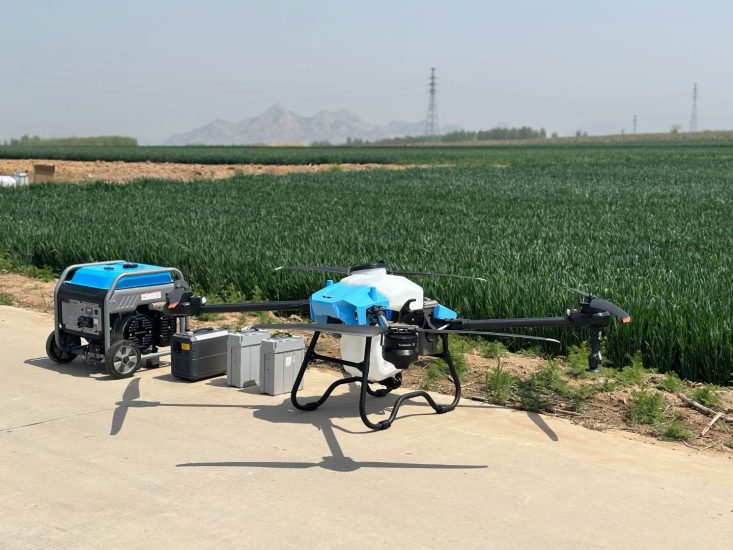
- Portable power systems
- Other electrical accessories
Commercial operators should calculate charging capacity according to the number of flights expected per day.
If several drones are operated simultaneously, charging requirements become even more important.
5. Spray System Configuration Affects Price
The spraying system is another important component.
A complete agricultural spraying system can include:
- Tank
- Pump
- Filters
- Pipes
- Nozzles
- Flow-control components
- Spray-control electronics
Different pump capacities and nozzle configurations can affect the final product price.
A more sophisticated spray-control system may provide more precise control of liquid flow and application parameters.
However, buyers should evaluate whether additional functions are actually useful for their intended operation.
6. Flight-Control and Navigation Technology
Modern agricultural drones can include various navigation and flight-control functions.
Depending on the configuration, these may include:
- Satellite positioning
- Automated route planning
- Field mapping
- Altitude control
- Obstacle detection
- Automatic return functions
- Flight-record management
- Precision positioning
These systems can increase the overall equipment cost.
For professional agricultural operations, advanced navigation functions may provide operational benefits, but the buyer should evaluate the actual requirements of the farm before paying for unnecessary features.
7. Obstacle Detection Can Affect the Configuration
Obstacle-detection systems can require additional sensors and processing hardware.
Depending on the system, sensors may monitor the aircraft’s surroundings and provide information to the flight-control system.
The cost of such a system can vary according to:
- Sensor type
- Detection range
- Number of sensors
- Processing system
- Software functions
Buyers should ask about the practical limitations of obstacle detection rather than evaluating it only as a marketing specification.
No obstacle-detection system eliminates the need for responsible operation and proper field inspection.
8. Aircraft Materials and Structural Design
The aircraft frame needs to support the propulsion system, battery, tank, pump, electronics, and payload.
Material selection can affect:
- Weight
- Strength
- Durability
- Manufacturing cost
- Maintenance requirements
A lightweight but sufficiently strong structure can help balance payload and energy efficiency.
Buyers should therefore consider the relationship between structural design and actual operating performance rather than focusing only on the material name.
9. Motor and Propeller Configuration
The propulsion system is one of the most important parts of an agricultural drone.
It must generate enough thrust to support the aircraft and its working payload.
Motor performance can affect:
- Maximum payload
- Flight endurance
- Takeoff performance
- Energy consumption
- Operating stability
Larger agricultural drones may require higher-performance propulsion systems, which can increase manufacturing costs.
Propeller size and design also influence the aircraft’s lifting efficiency and operating characteristics.
10. Payload Capacity Influences the Total Price
A drone designed to carry a heavier working payload generally requires a stronger overall system.
The relationship can be summarized as:
Higher Payload → Higher Structural and Propulsion Requirements → Potentially Higher Manufacturing Cost
However, payload should be evaluated according to actual agricultural needs.
If a farm normally operates with a relatively low liquid volume per hectare and has convenient refill facilities, a very large payload may not provide enough additional value to justify the higher investment.
11. Manufacturing Quantity Can Affect Unit Cost
The purchasing quantity can influence the commercial price of agricultural drones.
A single unit may have a different price structure from:
- Small batch orders
- Distributor orders
- Fleet purchases
- Large commercial orders
- OEM projects
Larger orders can sometimes provide better manufacturing and logistics efficiency, although the actual commercial terms depend on product configuration and order requirements.
Importers should therefore request quotations based on their realistic purchasing quantity.
12. OEM and ODM Customization Can Change the Price
Standard agricultural drones generally have a different cost structure from customized products.
Customization may involve:
- Brand name
- Logo
- Product labels
- Packaging
- User manuals
- Accessories
- Product configuration
- Software interface
- Special market requirements
OEM and ODM projects may require additional engineering, testing, packaging development, and minimum order quantities.
Buyers should request a detailed quotation that separates standard product costs from customization costs.
13. Spare Parts Should Be Included in the Budget
The purchase price of the aircraft is not the only equipment-related expense.
Commercial users may eventually need:
- Propellers
- Motors
- Pumps
- Nozzles
- Filters
- Pipes
- Batteries
- Chargers
- Sensors
- Electronic components
The expected spare-parts cost depends on usage intensity, operating environment, maintenance quality, and equipment design.
For professional operations, maintaining commonly required spare parts can reduce downtime.
14. Transportation Costs Affect the Landed Price
For international buyers, the factory quotation is only one part of the final cost.
The landed cost may include:
Product Cost + Packaging + Inland Transportation + Export Charges + International Freight + Insurance + Import Duties + Local Charges
Depending on the destination and shipping method, additional costs may apply.
Buyers should therefore compare the final landed cost rather than comparing factory prices alone.
15. Battery Transportation Requires Special Attention
Agricultural drone batteries can have different transportation requirements from the aircraft itself.
International transportation may involve specific requirements related to:
- Battery type
- Packaging
- Documentation
- Labeling
- Transport method
- Carrier requirements
Before placing an order, importers should confirm the applicable transportation requirements for the destination and selected shipping method.
16. Training Can Be Part of the Total Cost
Agricultural drones require trained operators.
Training requirements may include:
- Aircraft operation
- Flight planning
- Spray-system setup
- Battery management
- Maintenance
- Cleaning
- Safety procedures
- Troubleshooting
If an operator requires external training or additional travel, these expenses should be included in the overall deployment budget.
For distributors, training can also become an important part of the customer-support system.
17. Maintenance Affects Long-Term Cost
Agricultural drones operate in environments where they can be exposed to:
- Dust
- Water
- Agricultural chemicals
- Fertilizer residue
- Vibration
- High temperatures
- Frequent flight cycles
Routine maintenance can help reduce unexpected failures.
Maintenance expenses can include:
- Cleaning
- Nozzle replacement
- Filter replacement
- Propeller replacement
- Pump maintenance
- Motor inspection
- Battery inspection
- Electronic inspection
A low initial purchase price does not necessarily mean low long-term operating cost.
18. Calculate Cost Per Hectare
For agricultural operators, one of the most useful measurements is the cost per hectare.
A simplified formula is:
Cost Per Hectare = Total Operating Cost ÷ Completed Hectares
Suppose an operation spends USD 1,000 on drone-related operating costs and completes 200 hectares:
USD 1,000 ÷ 200 = USD 5 per hectare
This number can help operators evaluate the equipment based on actual agricultural output.
The calculation can be expanded to include:
- Depreciation
- Battery consumption
- Electricity
- Labor
- Maintenance
- Spare parts
- Transportation
The exact calculation method should be adapted to the operator’s accounting system.
19. Purchase Price vs Total Cost of Ownership
Consider two hypothetical agricultural drones.
Drone A
- Lower purchase price
- Smaller battery system
- Lower payload
- More frequent refilling
Drone B
- Higher purchase price
- Larger payload
- Higher battery capacity
- Fewer refill cycles
Drone A may require less initial investment.
Drone B may have greater operating capacity.
Neither option can be considered universally better without knowing the farm’s workload, labor cost, refill logistics, and operating schedule.
This is why buyers should calculate the total cost of ownership.
20. Total Cost of Ownership Formula
A practical model can be written as:
TCO = Purchase Cost + Battery Cost + Charging Equipment + Maintenance + Spare Parts + Labor + Energy + Transportation − Residual Value
For international buyers, the formula can also include:
Import Duties + Customs Costs + Local Handling + Other Applicable Charges
The exact calculation depends on the market and operating environment.
21. Consider Depreciation
Agricultural drones are productive assets.
Over time, the equipment may lose value because of:
- Usage
- Battery cycles
- Technology changes
- Component wear
- New product releases
For commercial operators, depreciation should be included when calculating the cost of agricultural operations.
A simple annual depreciation estimate can be calculated as:
Annual Depreciation = (Initial Equipment Cost − Expected Residual Value) ÷ Expected Service Life
This provides a basic framework for financial planning.
22. Consider Battery Replacement
Battery life should also be included in long-term cost calculations.
The number of battery cycles depends on:
- Charging method
- Operating temperature
- Storage conditions
- Depth of discharge
- Maintenance
- Usage frequency
Commercial operations with intensive daily use may need to replace batteries sooner than occasional users.
Therefore, buyers should ask about expected battery cycle performance and replacement cost before purchasing.
23. Compare Price According to the Complete Configuration
A meaningful price comparison should use a standardized specification sheet.
For example:
| Item | Configuration A | Configuration B |
|---|---|---|
| Tank capacity | 30 L | 50 L |
| Payload | Confirmed specification | Confirmed specification |
| Battery | Included configuration | Included configuration |
| Charger | Included / optional | Included / optional |
| Spray system | Specified | Specified |
| Controller | Included | Included |
| Spare parts | Listed separately | Listed separately |
| Packaging | Confirmed | Confirmed |
| Warranty | Confirmed | Confirmed |
| OEM | Available / not available | Available / not available |
The exact configuration should always be confirmed in writing before an order is placed.
24. Ask What Is Included in the Quotation
A quotation should clearly identify whether the following are included:
- Aircraft
- Spray tank
- Pump
- Nozzles
- Batteries
- Charger
- Remote controller
- Spare propellers
- Tools
- Manuals
- Packaging
- Training
- Warranty
Two quotations with the same headline price may have very different contents.
A lower price is not necessarily lower if important accessories must be purchased separately.
25. Beware of Comparing Only Advertised Prices
Online agricultural drone prices can sometimes represent only a basic configuration.
The final cost may increase after adding:
- Additional batteries
- Chargers
- Spare parts
- Upgraded controllers
- Navigation equipment
- Customized packaging
- OEM branding
- Transportation
Buyers should always request a complete commercial quotation.
26. How Distributors Should Calculate Retail Pricing
Distributors need to consider their complete business costs.
A simplified model is:
Selling Price = Landed Cost + Operating Expenses + Distribution Margin + After-Sales Reserve
Operating expenses can include:
- Warehouse
- Staff
- Marketing
- Demonstrations
- Training
- Local transportation
- Customer support
- Spare-parts inventory
The distributor should ensure that the final selling price supports both the commercial operation and future customer service.
27. How Farmers Should Evaluate the Investment
Farmers should focus on whether the drone can generate sufficient operational value.
Important questions include:
- How many hectares can be treated per day?
- How much labor can be reduced or redirected?
- How much time can be saved?
- What is the expected maintenance cost?
- How much will batteries cost over the equipment’s service life?
- How frequently will the drone be used?
A drone used for only a few hectares per year has a different economic profile from one used for hundreds or thousands of hectares.
Utilization rate is therefore an important part of the investment calculation.
28. How Agricultural Service Providers Should Calculate Costs
Agricultural service providers need to consider both equipment utilization and customer billing.
Their cost structure may include:
- Equipment depreciation
- Batteries
- Electricity
- Labor
- Transportation
- Maintenance
- Spare parts
- Insurance where applicable
- Administrative costs
The provider can then calculate the operating cost per hectare and compare it with the price charged to customers.
This helps determine whether the equipment can support a sustainable service operation.
29. Practical Agricultural Drone Price Checklist
Before purchasing, buyers should confirm:
Equipment
- [ ] Tank capacity
- [ ] Payload
- [ ] Flight time
- [ ] Spray width
- [ ] Pump capacity
- [ ] Nozzle system
- [ ] Motor configuration
Battery
- [ ] Battery price
- [ ] Battery quantity
- [ ] Charging time
- [ ] Charger price
- [ ] Expected cycle life
- [ ] Replacement cost
Accessories
- [ ] Controller
- [ ] Spare propellers
- [ ] Spare nozzles
- [ ] Filters
- [ ] Tools
- [ ] Other required accessories
Commercial
- [ ] Product price
- [ ] OEM/ODM cost
- [ ] Packaging cost
- [ ] Freight
- [ ] Import charges
- [ ] Local transportation
Long-Term
- [ ] Maintenance cost
- [ ] Spare-parts cost
- [ ] Battery replacement
- [ ] Training
- [ ] Labor
- [ ] Cost per hectare
30. Final Thoughts on Agricultural Drone Pricing
The price of an agricultural drone should never be judged by the aircraft price alone.
Tank capacity, payload, battery system, spray technology, navigation functions, manufacturing configuration, accessories, shipping, spare parts, maintenance, and operator training can all influence the final investment.
For farmers, the most important question is whether the drone can provide sufficient productivity for the actual agricultural workload.
For distributors and importers, the calculation should include landed cost, inventory, customization, technical support, spare parts, and after-sales service.
The most useful purchasing approach is to compare complete configurations and calculate the expected cost of ownership over the equipment’s operating life.
A properly selected agricultural drone should provide a practical balance between purchase price, productivity, reliability, operating cost, and long-term serviceability.
For buyers evaluating agricultural spraying drones, OEM/ODM manufacturing, or commercial agricultural drone supply, a detailed specification and cost analysis is the foundation for making an informed purchasing decision.


No comments yet