


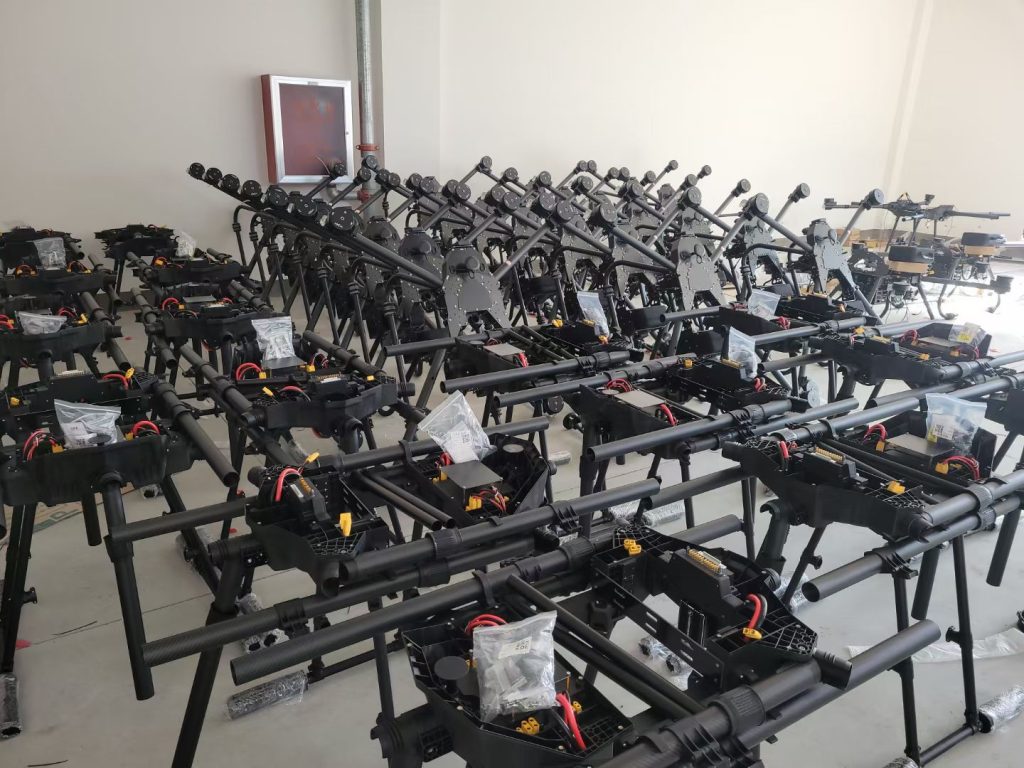
Choosing the right agricultural spraying drone is an important decision for farmers, agricultural contractors, distributors, and crop protection companies.
One of the first questions buyers face is whether they should purchase a 50KG agricultural spraying drone or choose a smaller model with a 20KG, 30KG, or similar payload capacity.
A larger drone is not automatically the best choice for every farm. The right capacity depends on farm size, crop type, terrain, spraying requirements, battery performance, water supply, transportation, and daily operating targets.
This guide compares 50KG agricultural spraying drones with smaller models and explains how buyers can choose the right capacity for their operation.
What Does Drone Payload Capacity Mean?
Before comparing different models, buyers should understand what the stated payload means.
A drone advertised as a “50KG agricultural spraying drone” may refer to its liquid-carrying capacity, maximum payload, or another specification.
Therefore, always ask the manufacturer to clearly provide:
- Maximum liquid payload
- Tank capacity
- Empty aircraft weight
- Maximum takeoff weight
- Battery weight
- Recommended operating payload
For an accurate comparison, buyers should compare the same specifications between different manufacturers.
50KG vs. Smaller Agricultural Spraying Drones
The main difference is the amount of liquid that the drone can carry per flight.
A simplified comparison might look like this:
| Feature | Smaller Drone | 50KG Drone |
|---|---|---|
| Liquid capacity | Lower | Higher |
| Refilling frequency | Higher | Lower |
| Aircraft size | Smaller | Larger |
| Transportation | Easier | Requires more planning |
| Battery requirement | Lower | Higher |
| Initial investment | Generally lower | Generally higher |
| Large-farm productivity | Moderate | Higher potential |
| Small-farm flexibility | Higher | May be unnecessary |
| Commercial applications | Suitable | Highly suitable |
The actual performance varies by model and manufacturer.
When Should You Choose a 50KG Agricultural Spraying Drone?
A 50KG model can be particularly attractive for large agricultural operations.
Consider a 50KG drone if you have:
- Large farmland
- High daily spraying requirements
- Multiple fields
- Limited spraying windows
- Long distances between fields
- Professional crop protection operations
- Agricultural contracting business
- Commercial distribution business
The larger payload can reduce the number of refill cycles required during operation.
1. Large Farms Usually Benefit More From Higher Payload
Farm size is one of the most important factors.
For a small farm, a 50KG tank may not provide enough additional value to justify the larger equipment and investment.
For a large commercial farm, however, reducing refill frequency can make a significant difference.
For example, suppose an operation requires 500KG of spraying liquid.
A 20KG drone would theoretically require:
500 ÷ 20 = 25 loads
A 50KG drone would theoretically require:
500 ÷ 50 = 10 loads
This is a simplified calculation and does not account for minimum operating volume, field conditions, application rate, or other operational limitations.
Nevertheless, it demonstrates the basic advantage of higher payload capacity: fewer refilling cycles.
2. Consider Your Daily Spraying Area
The second question is how much land needs to be treated each day.
If your farm only requires occasional spraying of a relatively small area, a smaller drone may be sufficient.
If you need to treat hundreds of hectares during a limited agricultural window, a higher-capacity model may provide greater operational efficiency.
Consider:
- Hectares per day
- Spraying frequency
- Crop growth stage
- Weather window
- Number of fields
- Distance between fields
The greater the daily workload, the more valuable higher payload capacity can become.
3. Consider Refilling Time
Payload capacity affects more than the amount of liquid carried.
It also affects the number of times the drone needs to return for refilling.
A complete refill cycle may involve:
- Landing
- Battery replacement
- Refilling liquid
- Checking equipment
- Taking off
- Returning to the planned route
If the refill process takes several minutes, reducing the number of cycles can improve total field productivity.
For large farms, the time saved through fewer refills can be significant.
4. Smaller Drones Can Be Easier to Transport
A 50KG agricultural spraying drone is larger and heavier than a smaller model.
This means transportation requires more planning.
Smaller drones may be easier to:
- Load into vehicles
- Carry between fields
- Store
- Deploy
- Operate in confined areas
If your farm has many small fields separated by narrow roads, a smaller drone may sometimes be more convenient.
Therefore, buyers should consider not only spraying capacity but also transportation requirements.
5. Battery Requirements Are Different
A larger payload generally requires more power.
A 50KG-class agricultural drone may therefore require a larger battery system than a smaller spraying drone.
Before purchasing, compare:
- Battery voltage
- Battery capacity
- Battery weight
- Flight time
- Full-load endurance
- Charging time
- Number of batteries
- Charger capacity
The key question is not:
“Which drone has the biggest battery?”
It is:
“Which battery system provides enough practical operating time for my application?”
6. Charging Infrastructure Matters
A large commercial drone operation may require multiple batteries and charging equipment.
For example, a farm may use one battery while another battery is charging.
This allows the drone to continue operating without waiting for a complete recharge.
For a 50KG drone, buyers should confirm:
- Charging time
- Charger power
- Number of simultaneous charging ports
- Required electrical supply
- Battery replacement cost
- Battery cycle life
This information should be included in the purchasing plan.
7. Compare Real Flight Time, Not Advertising Numbers
Flight-time specifications can be misleading if the payload condition is not clearly stated.
A manufacturer may advertise a maximum flight time based on an unloaded aircraft.
This does not mean the drone can achieve the same flight time while carrying a full tank.
Ask for:
Flight time without payload
Flight time with partial payload
Flight time with full payload
For commercial spraying operations, full-load performance is usually the most relevant figure.
8. Spray Width Is Also Important
Payload capacity is only one part of agricultural spraying productivity.
Spray width and flight speed also affect coverage.
The theoretical coverage can be estimated using:
Area per hour = Spray width × Flight speed × 3,600 ÷ 10,000
For example, if the effective spraying width is 8 meters and operating speed is 6 m/s:
8 × 6 × 3,600 ÷ 10,000 = 17.28 hectares/hour
This is a theoretical calculation.
Actual productivity will be lower because of:
- Turning
- Refilling
- Battery replacement
- Obstacles
- Field boundaries
- Transportation
- Weather
- Operator procedures
Therefore, buyers should request real-world test data from manufacturers.
9. Crop Type Can Change the Best Choice
Different crops have different requirements.
Rice
Large, relatively open fields can be suitable for high-capacity spraying drones.
Wheat
Large-scale wheat farms may benefit from higher payload and efficient route planning.
Corn
As crop height increases, aerial spraying can reduce the need for ground machinery to enter the field.
Orchards
Orchards may require more advanced obstacle avoidance and terrain-following functions.
Vegetables
The appropriate spraying configuration depends on crop height, row spacing, application rate, and field layout.
Therefore, crop type should be considered alongside payload capacity.
10. Terrain Matters
A 50KG agricultural spraying drone can be useful for difficult terrain, but the required configuration may differ from that used in flat farmland.
For hilly or mountainous farms, consider:
- RTK positioning
- Terrain following
- Obstacle avoidance
- Flight stability
- Battery performance
For open flat fields, some advanced functions may be less critical.
11. Orchard Operations May Require More Than Payload
If you operate an orchard, choosing a drone based solely on tank capacity is not recommended.
Trees can create complex flight environments.
Important functions may include:
- Obstacle detection
- Terrain following
- Accurate positioning
- Stable hovering
- Suitable spray system
- Appropriate nozzle configuration
A smaller drone with advanced navigation may sometimes be more suitable for a complex orchard than a larger drone with basic flight functions.
12. Consider the Cost of the Complete System
Do not compare only the drone’s purchase price.
The total system may include:
- Aircraft
- Batteries
- Charger
- Remote controller
- Spray system
- RTK system
- Obstacle sensors
- Spare parts
- Transport case
- Training
A larger drone usually requires a larger investment in supporting equipment.
For a commercial operation, calculate the total cost of ownership.
Example Comparison
| Cost Category | Smaller Drone | 50KG Drone |
|---|---|---|
| Aircraft | Lower | Higher |
| Batteries | Lower | Higher |
| Charger | Lower | Higher |
| Spare parts | Lower | Higher |
| Transport | Easier | More demanding |
| Potential productivity | Moderate | Higher |
| Large-scale suitability | Moderate | High |
The most economical choice depends on how much the equipment will actually be used.
13. When Is a Smaller Drone Better?
A smaller agricultural spraying drone may be a better option if:
- Your farm is relatively small
- Fields are fragmented
- Transportation is difficult
- You have a limited budget
- Spraying requirements are occasional
- You do not need high daily capacity
Smaller equipment can provide greater flexibility in certain applications.
14. When Is a 50KG Drone Better?
A 50KG agricultural spraying drone may be more suitable when:
- The farm is large
- Daily spraying volume is high
- Refilling takes significant time
- Multiple fields need treatment
- Spraying windows are short
- The drone will be used commercially
- You operate as an agricultural contractor
- You need higher productivity
For professional crop protection businesses, the larger payload can provide a meaningful operational advantage.
15. Should Agricultural Contractors Choose 50KG?
Agricultural contractors often have different requirements from individual farmers.
A contractor may need to serve multiple farms and complete large areas within strict timeframes.
Important factors may include:
- High payload
- Fast battery charging
- Multiple batteries
- Easy transportation
- Reliable spare parts
- Durable components
- Simple maintenance
- Technical support
For these users, a 50KG-class drone can be an attractive option.
16. What About Agricultural Drone Distributors?
For distributors, product capacity should be selected according to the target market.
Some markets may have demand for:
- Compact agricultural drones
- Mid-size spraying drones
- 50KG high-capacity drones
Offering multiple capacities can allow distributors to serve different customer groups.
A manufacturer that supports OEM and private-label production can also help distributors develop different product configurations.
17. Compare the Manufacturer’s Support
The manufacturer can be as important as the drone itself.
Before purchasing, ask about:
- Warranty
- Spare parts
- Battery replacement
- Technical support
- Operator training
- Product manuals
- Software support
- OEM services
- Production lead time
For international buyers, reliable after-sales support is especially important.
18. A Simple Decision Guide
Use the following guide as a starting point.
Choose a Smaller Drone If:
Small farm + limited spraying + easy transportation + lower budget
A smaller drone may provide sufficient capacity without unnecessary investment.
Choose a 50KG Drone If:
Large farm + high spraying volume + limited spraying window + commercial operation
A 50KG drone may provide better productivity through higher payload capacity and fewer refilling cycles.
Choose Based on Advanced Features If:
Orchards + hills + complex terrain
Navigation, obstacle avoidance, terrain following, and spraying technology may be more important than payload alone.
19. Questions to Ask a 50KG Drone Manufacturer
Before ordering, ask:
- What is the actual liquid payload?
- What is the maximum takeoff weight?
- What is the full-load flight time?
- What is the recommended operating speed?
- What is the effective spraying width?
- What is the maximum flow rate?
- What battery capacity is used?
- How long does charging take?
- How many batteries are included?
- Does the drone support RTK?
- Does it have obstacle avoidance?
- Does it support terrain following?
- What spare parts are available?
- What is the warranty period?
- Do you provide OEM/private-label services?
- What is the production lead time?
A reliable manufacturer should provide detailed specifications instead of only giving a product name and price.
20. The Best Payload Depends on Your Business Model
There is no universally perfect agricultural drone capacity.
For a small farm, a 50KG drone may be more equipment than necessary.
For a large commercial farm, however, a smaller drone may require too many refilling cycles and battery changes.
For agricultural contractors and distributors, the 50KG class may offer an attractive balance between payload capacity and commercial productivity.
The right choice depends on your:
Farm size + crop type + terrain + daily workload + water supply + battery infrastructure + budget
Conclusion
Choosing between a 50KG agricultural spraying drone and a smaller model requires a complete evaluation of your agricultural operation.
A 50KG drone can offer advantages for large farms, agricultural contractors, and commercial crop protection businesses because its higher liquid capacity can reduce refilling frequency and support higher operational productivity.
Smaller drones may be more suitable for small farms, fragmented fields, limited budgets, or applications where transportation flexibility is more important.
Before purchasing, compare full-load flight time, actual payload, spraying width, flow rate, battery system, charging speed, navigation technology, spare parts, warranty, and technical support.
For international buyers, working directly with an experienced agricultural spraying drone manufacturer in China can also provide access to OEM customization, private-label production, spare parts, and long-term technical support.
The best drone is not necessarily the largest or the cheapest. It is the model that matches your actual farm size, crop, terrain, workload, and operating conditions.
FAQ
Is a 50KG agricultural spraying drone better than a 20KG drone?
Not necessarily. A 50KG model is generally more suitable for larger-scale operations, while a 20KG-class drone may be easier to transport and more economical for smaller farms.
What is the main advantage of a 50KG spraying drone?
The main potential advantage is its higher liquid payload, which can reduce the number of refilling cycles required during large-scale spraying operations.
Does a 50KG drone require more batteries?
It may require a larger battery system because carrying a higher payload requires more power. Buyers should compare full-load flight time and charging time rather than battery capacity alone.
Is a 50KG drone suitable for orchards?
It can be, but orchard applications require careful consideration of obstacle avoidance, terrain following, positioning accuracy, and spraying configuration.
Which drone is best for a large farm?
For large farms with high daily spraying requirements, a 50KG-class drone can be a suitable option. The final choice should be based on actual field conditions and required productivity.
How can I compare different payload capacities?
Compare actual liquid payload, full-load flight time, effective spray width, flow rate, battery endurance, refilling time, transportation requirements, and total operating cost.
Can a manufacturer customize a 50KG agricultural spraying drone?
Many manufacturers offer OEM and private-label services. Customization can include branding, packaging, manuals, accessories, and selected product configurations.
What should I request before buying?
Request a complete technical specification, full-load flight test information, battery specifications, spraying-system details, quotation, warranty terms, spare-parts list, and available OEM options.






No comments yet