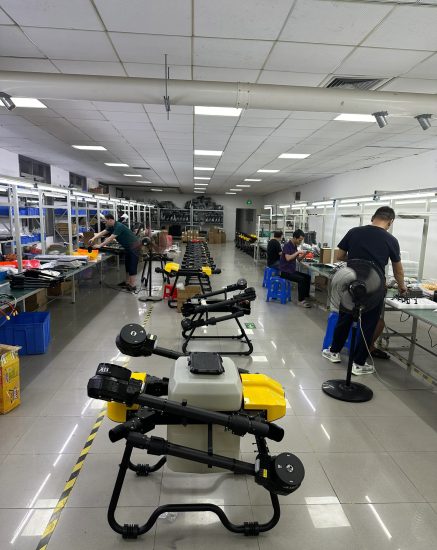


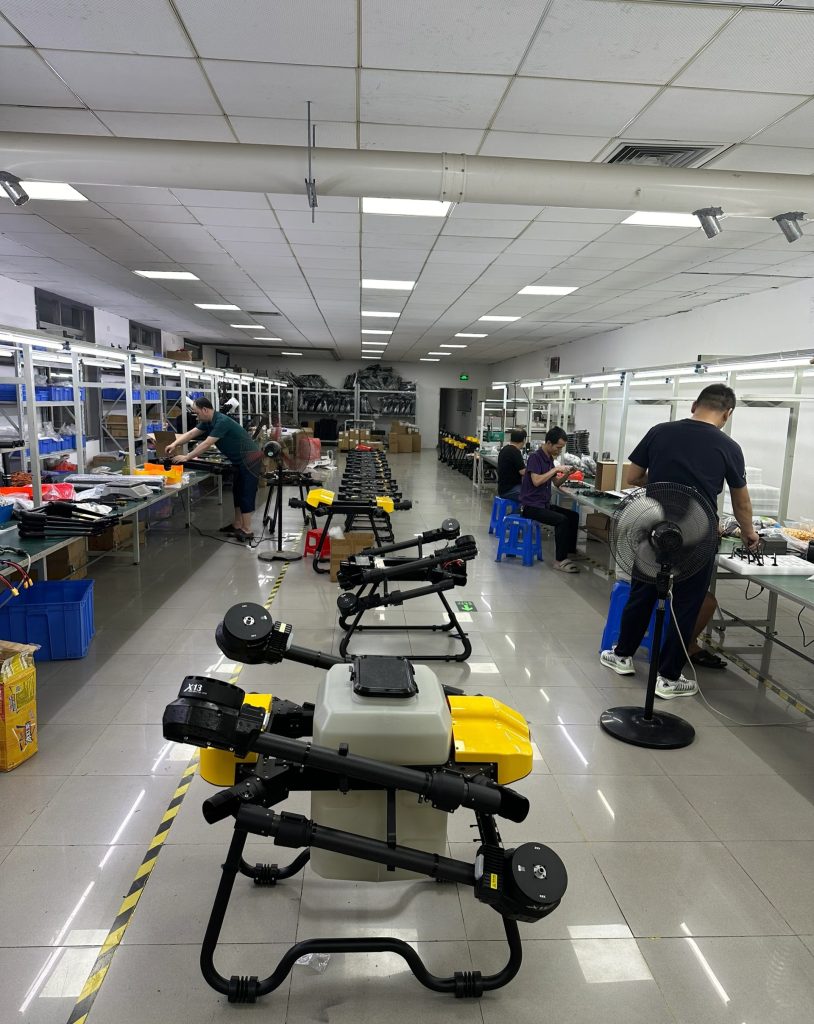
Buying agricultural spraying drones from China can give international buyers access to a wide range of models, production capabilities, and customization options. However, choosing the right supplier requires more than comparing product prices.
Before placing an order, buyers should evaluate the manufacturer’s production capability, drone specifications, spraying system, battery performance, safety functions, documentation, spare parts, warranty, and after-sales support.
This guide explains the most important factors to check before purchasing agricultural spraying drones from a Chinese manufacturer.
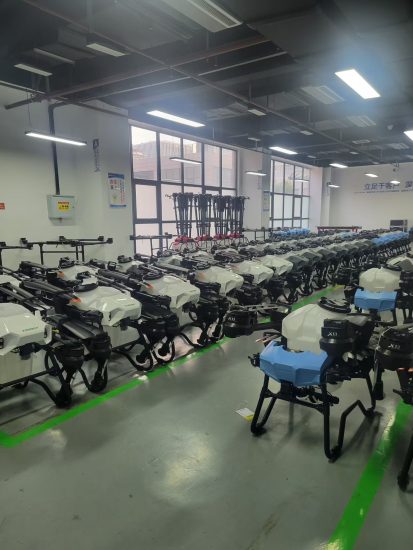
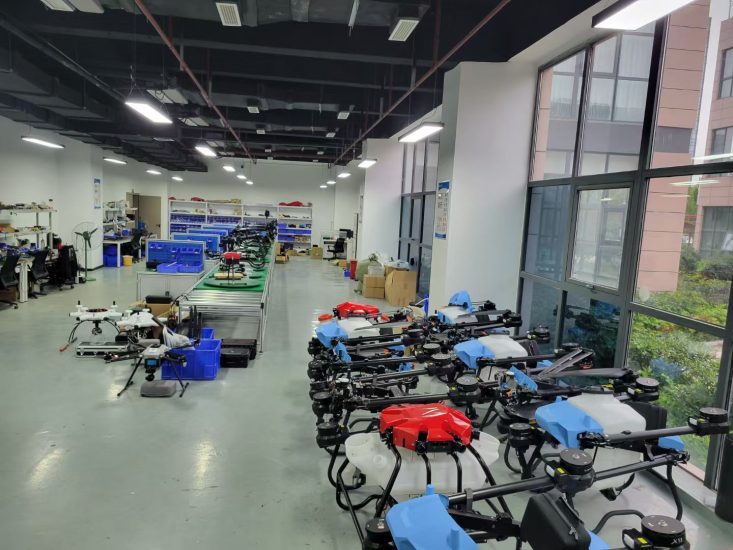
1. Verify the Supplier’s Manufacturing Capability
The first step is to determine whether you are dealing directly with a manufacturer, an OEM factory, or a trading company.
Ask for:
-
Company registration information
-
Factory address
-
Production facility information
-
Product catalog
-
Manufacturing capabilities
-
Quality-control procedures
-
Production capacity
-
Export experience
-
Product testing procedures
A supplier should be able to clearly explain where the drone is assembled, which components are produced internally, and which components are sourced from other suppliers.
If the supplier claims to be a manufacturer, consider requesting a live factory video or arranging a factory inspection before a large order.
2. Check the Drone’s Main Specifications
Do not evaluate an agricultural drone only by its advertised payload.
Check the complete specification sheet, including:
-
Tank capacity
-
Maximum payload
-
Empty weight
-
Maximum takeoff weight
-
Flight time
-
Operating speed
-
Maximum flight altitude
-
Spraying width
-
Pump flow rate
-
Number of nozzles
-
Battery capacity
-
Charging time
-
Remote-control range
-
Navigation system
-
Obstacle-detection system
The specifications should be internally consistent.
For example, a drone with a larger tank may have a shorter practical flight time when operating with a full load.
3. Understand the Difference Between Theoretical and Actual Flight Time
Flight time is one of the most frequently advertised specifications.
However, actual flight time depends on several variables:
-
Payload
-
Battery condition
-
Flight speed
-
Wind
-
Temperature
-
Flight altitude
-
Operating mode
-
Battery age
Therefore, ask the manufacturer how the advertised flight time was measured.
A useful question is:
What is the typical flight time with a full spraying tank under normal field conditions?
This is much more useful than simply asking for the maximum flight time.
4. Examine the Spraying System
The spraying system directly affects application performance.
Ask about:
Pump
Check the pump type, flow rate, pressure range, durability, and replacement availability.
Nozzles
Ask which nozzle types are available and what droplet sizes and spraying patterns they can produce.
Filters
Filters help reduce the risk of particles blocking the spraying system.
Ask how the filters are cleaned and replaced.
Flow Control
A good spraying system should provide stable and controllable liquid flow.
Ask whether the drone automatically adjusts spraying output according to flight speed or operating settings.
5. Check Tank Capacity Carefully
A larger tank is not automatically better.
A larger payload can increase:
-
Battery consumption
-
Takeoff weight
-
Motor load
-
Landing requirements
-
Structural stress
The ideal tank size depends on your crops, field conditions, operating distance, available refill points, and required productivity.
Ask the manufacturer to recommend the appropriate capacity for your specific application.
6. Evaluate Battery Quality
Battery performance has a major effect on agricultural drone productivity.
Ask for detailed battery information, including:
-
Voltage
-
Capacity
-
Cell configuration
-
Weight
-
Battery management system
-
Expected cycle life
-
Charging time
-
Operating temperature
-
Warranty
-
Replacement cost
Also ask whether the battery can be purchased separately in the future.
For commercial operators, long-term battery availability is important because batteries are consumable components.
7. Check the Charger
The charger should be evaluated together with the drone.
Ask:
-
How long does a complete charge take?
-
Can multiple batteries be charged?
-
Is fast charging available?
-
What electrical input does the charger require?
-
Does it provide temperature protection?
-
Does it have over-current and over-voltage protection?
International buyers should confirm that the charging equipment is suitable for the electrical system in the destination country.
8. Evaluate Navigation and Flight-Control Functions
Agricultural spraying drones often rely on automated flight functions to improve operational efficiency.
Depending on the model, functions may include:
-
GPS positioning
-
Automatic route planning
-
Automatic return-to-home
-
Route recording
-
Boundary mapping
-
Terrain following
-
Obstacle detection
-
Low-battery alerts
-
Signal-loss protection
-
Automatic spraying control
However, buyers should ask for practical demonstrations instead of relying only on marketing descriptions.
Ask the manufacturer to explain which functions are standard and which are optional.
9. Check Obstacle-Avoidance Performance
Obstacle detection can be particularly important when drones are used around trees, buildings, power lines, and other structures.
Ask:
-
What sensors are used?
-
In which directions can obstacles be detected?
-
What is the detection range?
-
Does obstacle detection work in low-light conditions?
-
Can the system detect thin objects?
-
How does the drone react after detecting an obstacle?
No obstacle-avoidance system should be treated as a substitute for responsible pilot operation.
10. Consider the Operating Environment
Tell the manufacturer where the drone will be used.
For example, the requirements for:
-
Rice fields
-
Corn fields
-
Wheat fields
-
Orchards
-
Vineyards
-
Mountain farms
-
Large flat farmland
can be very different.
Terrain, vegetation height, field size, wind, humidity, and obstacles can all influence drone selection.
A manufacturer that asks detailed questions about your application is generally more useful than a supplier that immediately recommends one standard model.
11. Verify Product Quality
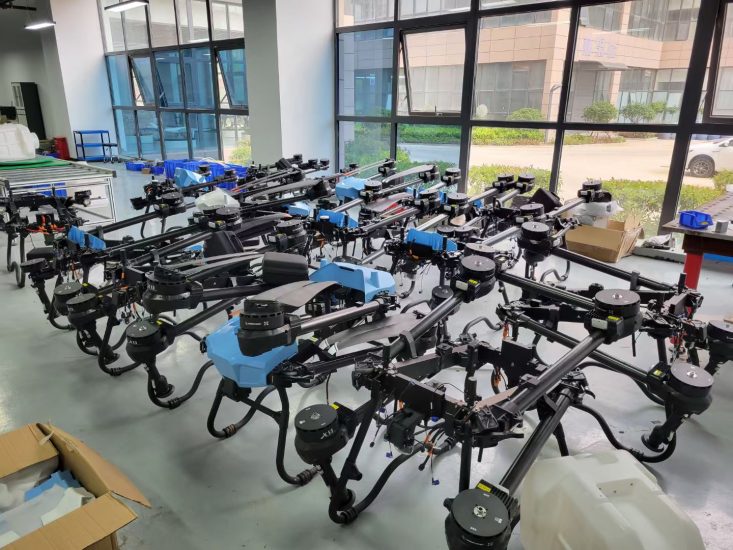
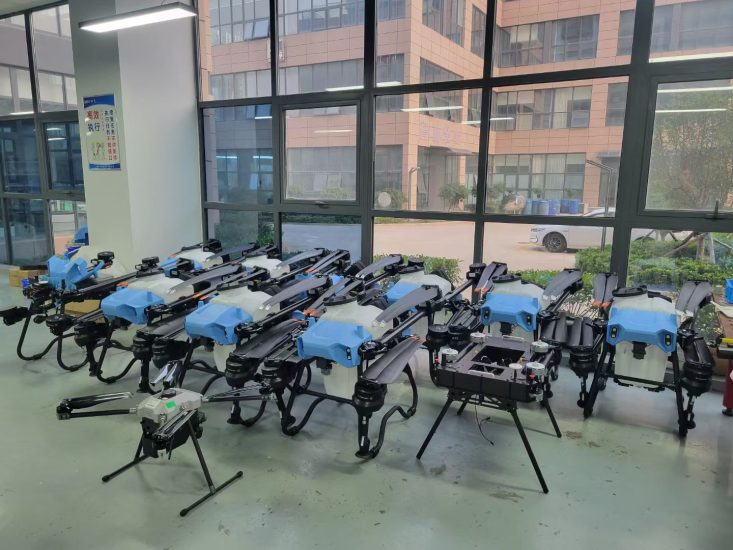
Before purchasing, ask how finished drones are tested.
A professional quality-control process may include testing of:
-
Motors
-
Propellers
-
Flight controllers
-
Pumps
-
Batteries
-
Chargers
-
Remote controllers
-
Communication systems
-
Spraying systems
-
Navigation functions
For larger orders, buyers may also consider third-party inspection before shipment.
12. Check Spare-Parts Availability
A drone is not a one-time purchase.
Commercial users may eventually need replacement components.
Ask whether the supplier can provide:
-
Motors
-
Propellers
-
Pumps
-
Nozzles
-
Filters
-
Pipes
-
Batteries
-
Chargers
-
Landing components
-
Remote controllers
-
Electronic components
Before purchasing, request a spare-parts price list.
For distributors, maintaining a stock of commonly required components can reduce customer downtime.
13. Understand the Warranty
Do not accept a vague statement such as “one-year warranty” without asking what it covers.
Clarify:
-
Warranty period
-
Covered components
-
Excluded components
-
Battery warranty
-
Charger warranty
-
Labor costs
-
Replacement procedures
-
Shipping responsibilities
-
Warranty claim process
The written warranty should match the commercial agreement.
14. Evaluate Technical Support
International buyers may need assistance with installation, operation, software, maintenance, and troubleshooting.
Ask whether the manufacturer provides:
-
English manuals
-
Installation instructions
-
Training videos
-
Remote technical support
-
Online troubleshooting
-
Software updates
-
Operator training
-
Maintenance guidance
For distributors, technical support is especially important because the distributor may need to support local customers.
15. Check Export and Shipping Documentation
Agricultural drones contain electronic components and lithium batteries, so international transportation requires appropriate documentation and packaging.
Ask the supplier what export documents it can provide.
Depending on the transaction and destination, documents may include:
-
Commercial invoice
-
Packing list
-
Certificate of origin
-
Product specification
-
Battery documentation
-
Transportation-related documents
-
User manual
Battery transportation requirements can vary by transport method and destination, so confirm the documentation before shipment.
16. Check Destination-Country Compliance
A drone that can legally operate in one market may require additional approval in another.
Before importing, investigate the requirements of the destination country.
Potential issues may include:
-
Drone registration
-
Radio-frequency requirements
-
Operator qualifications
-
Agricultural application regulations
-
Import requirements
-
Battery transportation requirements
-
Product safety requirements
The buyer should not rely solely on the supplier’s statement that a product is “certified.”
Request the actual documentation and verify whether it applies to your market and specific model.
17. Compare Total Purchase Cost
The quoted drone price is only one part of the final cost.
Your actual landed cost may include:
Drone + Batteries + Charger + Spare Parts + Packaging + Freight + Insurance + Duties + Taxes + Local Compliance Costs
For example, one supplier may offer a low drone price but charge more for batteries and spare parts.
Another manufacturer may offer a higher initial price but provide better equipment and support.
For business buyers, total cost of ownership is usually more important than the lowest factory quotation.
18. Ask About MOQ and Lead Time
If you are a distributor, confirm the minimum order quantity before negotiating the final price.
Ask about:
-
Sample availability
-
Sample price
-
MOQ
-
Production lead time
-
Peak-season production capacity
-
Spare-parts lead time
-
OEM production lead time
If you are testing a new supplier, starting with a sample or small order can reduce sourcing risk.
19. Check OEM and Private-Label Options
If you plan to sell agricultural drones under your own brand, discuss customization before ordering.
Possible customization may include:
-
Logo
-
Packaging
-
User manual
-
Product labels
-
Product colors
-
Spare-parts packaging
-
Remote-control branding
Ask the manufacturer about MOQ, tooling requirements, production lead time, and customization costs.
20. Request a Product Sample
A sample allows you to evaluate the actual product instead of relying entirely on photographs and specifications.
During testing, check:
-
Flight stability
-
Spraying performance
-
Battery endurance
-
Pump performance
-
Navigation
-
Remote controller
-
Ease of operation
-
Maintenance
-
Charging
-
Spare-parts availability
If the drone is intended for commercial agricultural operations, field testing is particularly valuable.
21. Ask for Realistic Performance Data
Be cautious with extremely high productivity claims.
For example, instead of accepting a statement such as “X hectares per hour,” ask for the conditions behind the number.
Important variables include:
-
Crop type
-
Tank capacity
-
Spraying volume per hectare
-
Flight speed
-
Field size
-
Refill time
-
Battery replacement time
-
Weather conditions
A realistic productivity calculation should consider the complete operating cycle rather than only the time spent flying.
22. Compare at Least Three Suppliers
Whenever possible, compare several manufacturers using the same requirements.
Use the same specification sheet when requesting quotations.
For example:
Item |
Supplier A |
Supplier B |
Supplier C |
|---|---|---|---|
Tank capacity |
— |
— |
— |
Battery capacity |
— |
— |
— |
Flight time |
— |
— |
— |
Pump flow |
— |
— |
— |
Nozzle system |
— |
— |
— |
Charger |
— |
— |
— |
Warranty |
— |
— |
— |
Spare parts |
— |
— |
— |
OEM support |
— |
— |
— |
Lead time |
— |
— |
— |
Total cost |
— |
— |
— |
This makes it easier to identify differences that are hidden by a simple product price.
23. Warning Signs to Watch For
International buyers should be careful if a supplier:
-
Refuses to provide basic specifications
-
Cannot explain the spraying system
-
Gives inconsistent company information
-
Makes unrealistic performance claims
-
Cannot provide warranty terms
-
Has no spare-parts plan
-
Refuses reasonable product testing
-
Cannot provide necessary export documents
-
Changes specifications after quotation
-
Pressures the buyer to make immediate payment
One warning sign does not automatically mean the supplier is unreliable, but several together should trigger additional verification.
24. A Practical Pre-Order Checklist
Before making payment, confirm all of the following:
-
[ ] Manufacturer identity verified
-
[ ] Factory capability checked
-
[ ] Drone model confirmed
-
[ ] Tank capacity confirmed
-
[ ] Payload confirmed
-
[ ] Spraying system confirmed
-
[ ] Pump and nozzle specifications confirmed
-
[ ] Battery specifications confirmed
-
[ ] Charger confirmed
-
[ ] Warranty confirmed
-
[ ] Spare-parts prices confirmed
-
[ ] Technical support confirmed
-
[ ] Export documents confirmed
-
[ ] Destination-market requirements checked
-
[ ] Packaging confirmed
-
[ ] Shipping terms confirmed
-
[ ] Lead time confirmed
-
[ ] Payment terms confirmed
Frequently Asked Questions
What is the most important thing to check when buying an agricultural spraying drone from China?
Product suitability is one of the most important factors. The drone should match your crops, field conditions, spraying requirements, payload requirements, and local operating environment.
Should I buy directly from a factory?
Direct factory sourcing can provide advantages in communication, customization, and production coordination. However, the supplier should first be verified as a capable manufacturer with reliable quality control and after-sales support.
How can I verify an agricultural drone manufacturer?
Request factory information, product documentation, technical specifications, production videos, certifications where applicable, customer references, and samples. For larger purchases, an independent inspection can provide additional assurance.
Should I test a sample before placing a large order?
Yes. A sample allows you to verify actual flight, spraying, battery, charging, and operational performance before committing to a larger purchase.
What documents should I request?
At minimum, request a commercial quotation, detailed specification sheet, user manual, warranty terms, packing information, and applicable export or compliance documents. Battery-related documentation should also be checked for international transportation.
Is the cheapest agricultural drone the best choice?
Usually, price should not be the only consideration. Product reliability, battery life, spraying performance, spare-parts availability, warranty, technical support, and total operating cost can have a much larger impact on long-term value.
Conclusion
Buying an agricultural spraying drone from China can be a practical sourcing option for farms, agricultural contractors, distributors, and equipment companies.
However, successful sourcing requires careful supplier verification.
Before placing an order, evaluate the manufacturer, drone specifications, spraying system, battery, charger, navigation, quality control, spare parts, warranty, technical support, export documentation, compliance requirements, and total landed cost.
The right supplier should not simply offer a competitive price. It should be able to provide a suitable product, transparent technical information, stable manufacturing quality, reliable spare-parts support, and long-term technical assistance.
For international buyers, taking the time to verify these factors before payment can significantly reduce sourcing risks and create a stronger foundation for long-term cooperation with a Chinese agricultural spraying drone manufacturer.
THE END


No comments yet