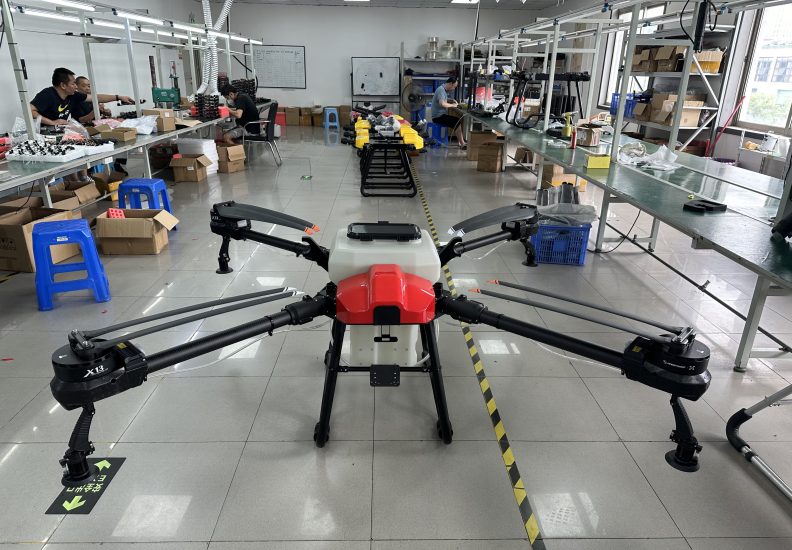


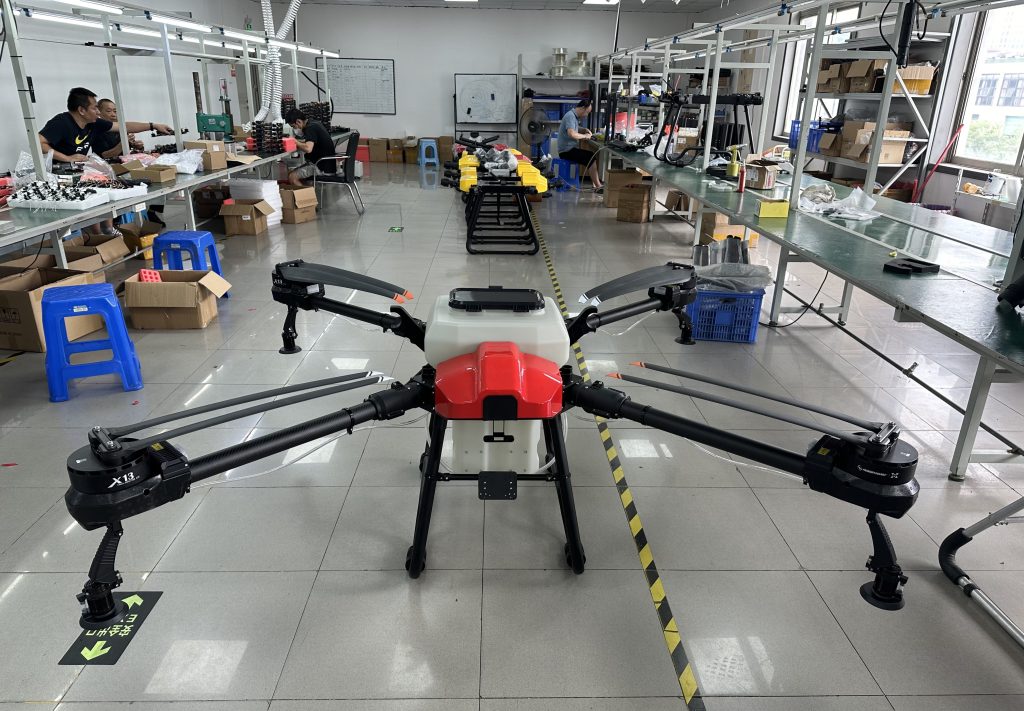
Choosing the right agricultural spraying drone is an important decision for farmers, agricultural contractors, distributors, and commercial crop-protection operators. Different farms require different drone capacities, spraying systems, battery configurations, flight times, and levels of automation.
A drone with a large tank is not necessarily the best choice for every farm. The right model should match the crop type, field size, terrain, application requirements, labor availability, and local regulations.
This guide explains the most important factors to consider when selecting an agricultural spraying drone, including payload capacity, flight endurance, spraying performance, battery systems, navigation, safety features, and operating efficiency.
1. Determine the Required Spray Capacity
The first factor to evaluate is the drone’s liquid tank capacity.
Common agricultural spraying drones are available in different payload classes, with smaller models designed for orchards, small farms, and specialized applications, while larger models are intended for commercial field operations.
A larger tank can reduce the number of refills required during a working day. However, a larger payload also increases the drone’s total takeoff weight and can affect flight endurance, maneuverability, and battery consumption.
When comparing models, consider:
-
Liquid tank capacity
-
Maximum takeoff weight
-
Recommended operating load
-
Pump flow rate
-
Spray width
-
Battery capacity
-
Refilling time
The best payload is not simply the largest available capacity. It should provide a practical balance between spraying productivity and flight performance.
2. Consider Flight Time and Battery Endurance
Flight endurance is one of the most important specifications when purchasing an agricultural spraying drone.
Manufacturers may advertise maximum flight time under specific test conditions, often without a full spray load. Actual working time can be shorter because of payload, wind, temperature, altitude, flight speed, and spraying settings.
For commercial operations, it is more useful to evaluate practical working endurance rather than maximum unloaded flight time.
Ask the supplier:
-
How long can the drone operate with a full spray tank?
-
What is the recommended battery configuration?
-
How many batteries are required for continuous operation?
-
How long does a battery take to charge?
-
Is a fast charger available?
-
What is the expected battery cycle life?
-
Can batteries be replaced quickly in the field?
A professional spraying operation should normally consider the entire battery system rather than purchasing the drone alone.
3. Evaluate Spraying System Performance
The spraying system directly affects application quality.
A good agricultural spraying drone should provide stable liquid flow and consistent droplet distribution across the working area.
Important specifications include:
Pump Flow Rate
Pump capacity determines how quickly liquid can be delivered to the nozzles.
Higher flow rates can support wider spray widths and higher application volumes, but the correct flow rate depends on the crop, chemical product, target application rate, flight speed, and nozzle configuration.
Nozzle Type
Different crops and applications may require different nozzle types.
The nozzle affects:
-
Droplet size
-
Spray pattern
-
Application rate
-
Drift potential
-
Coverage
-
Chemical distribution
Users should select nozzles according to the specific agricultural application instead of choosing them only based on maximum flow.
Spray Width
A wider spray width can increase field productivity, but actual effective coverage depends on flight altitude, wind conditions, nozzle performance, crop structure, and application requirements.
Therefore, advertised spray width should always be evaluated together with real operating conditions.
4. Match the Drone to Your Crop Type
Different crops create different spraying challenges.
For example, open-field crops such as wheat, corn, soybeans, and rice generally have different operating requirements from orchards, vineyards, vegetables, and specialty crops.
For orchard applications, the drone may need better terrain following and stronger airflow to help move droplets into the crop canopy.
For open fields, productivity and stable coverage may be more important.
Before purchasing, identify:
-
Crop type
-
Crop height
-
Planting density
-
Field size
-
Terrain conditions
-
Required spray volume
-
Typical weather conditions
-
Frequency of spraying
A drone designed primarily for open-field spraying may not be the ideal solution for dense orchards.
5. Check Flight Control and Navigation Systems
Modern agricultural spraying drones use satellite navigation, positioning systems, obstacle sensing, terrain-following technology, and automated flight functions.
These systems can improve operational consistency and reduce the workload for pilots.
Useful features may include:
-
GPS or other satellite positioning
-
RTK positioning
-
Automatic route planning
-
Terrain following
-
Obstacle detection
-
Automatic return-to-home
-
Low-battery warning
-
Abnormal-signal protection
-
Boundary recognition
-
Automatic spraying control
RTK positioning can be particularly useful when accurate flight paths and repeatable operations are required.
However, buyers should verify which navigation technologies are actually included in the standard configuration rather than assuming that every advertised feature comes with the drone.
6. Pay Attention to Terrain-Following Capability
Agricultural fields are rarely perfectly flat.
Hills, slopes, terraces, trees, buildings, power lines, and other obstacles can affect drone operations.
Terrain-following technology can help maintain a more consistent distance between the drone and the crop canopy.
This is particularly useful in:
-
Orchards
-
Hillside farms
-
Uneven farmland
-
Terraced fields
-
Areas with changing crop heights
When evaluating a drone, ask the manufacturer how its terrain-following system works and under what conditions it can operate reliably.
7. Evaluate Battery and Charging Infrastructure
Battery management has a direct impact on daily productivity.
A commercial operator may need multiple batteries so that one battery can be used while another is charging.
A complete system may include:
-
Flight batteries
-
Intelligent chargers
-
Charging stations
-
Generator or power supply
-
Battery storage equipment
-
Battery monitoring software
The charging solution should match the operating environment.
For remote farms, access to stable electricity may be limited. In such cases, the operator may need a suitable generator or mobile power solution.
Battery safety is also important. Batteries should be operated, charged, transported, and stored according to the manufacturer’s instructions and applicable regulations.
8. Consider Real Operating Efficiency
When comparing agricultural spraying drones, do not focus on a single specification.
A drone with a large tank may look attractive, but if refilling takes a long time or battery replacement is inefficient, overall productivity may not be significantly better.
A practical evaluation should consider:
Productivity = spray capacity + flight endurance + refill speed + battery turnaround + operating speed + field conditions
Actual field performance depends on many variables, so manufacturers should provide realistic operating data whenever possible.
Before purchasing, request information about typical field productivity rather than relying only on laboratory specifications.
9. Check Ease of Maintenance
Agricultural equipment operates in demanding environments. Dust, water, chemicals, mud, and vibration can affect equipment over time.
A good spraying drone should be designed for practical maintenance.
Check whether:
-
Spray lines are easy to clean
-
Nozzles can be replaced quickly
-
Pumps are accessible
-
Motors are easy to inspect
-
Propellers can be replaced
-
Batteries can be diagnosed
-
Spare parts are available
-
Technical support is provided
Easy maintenance can reduce downtime during critical crop-protection periods.
10. Evaluate Spare Parts and After-Sales Support
A drone is not simply a one-time hardware purchase. For commercial users, long-term technical support is extremely important.
Before placing an order, ask the supplier about:
-
Spare motors
-
Propellers
-
Pumps
-
Nozzles
-
Flow meters
-
Flight controllers
-
Batteries
-
Chargers
-
Remote controllers
-
Replacement arms
-
Technical manuals
-
Software updates
-
Warranty terms
For international buyers, also confirm whether spare parts can be shipped to the destination country and whether remote technical support is available.
11. Consider Local Regulations
Agricultural drone regulations vary by country and region.
Depending on the destination market, operators may need drone registration, pilot certification, operational approval, agricultural chemical-use compliance, insurance, or other documentation.
Before purchasing an agricultural spraying drone for commercial use, buyers should confirm the requirements of their local aviation and agricultural authorities.
Manufacturers and exporters should also provide accurate product documentation, including technical specifications, battery information, manuals, and applicable conformity documents.
12. How to Compare Agricultural Spraying Drones
A useful comparison should include more than price.
Specification |
What to Check |
|---|---|
Payload |
Tank capacity and recommended operating load |
Flight Time |
Practical endurance under working conditions |
Spray Width |
Effective operating width |
Pump |
Flow rate and control accuracy |
Nozzles |
Type, quantity, and replacement availability |
Navigation |
GPS, RTK, route planning |
Safety |
Obstacle detection and return-to-home |
Battery |
Capacity, charging time, cycle life |
Controller |
Range, display, control functions |
Maintenance |
Accessibility and cleaning |
Spare Parts |
Availability and delivery time |
Support |
Warranty and technical assistance |
This approach makes it easier to compare different manufacturers on the same criteria.
13. Should You Choose a Large or Small Agricultural Drone?
The answer depends on the operation.
A smaller drone may be suitable for:
-
Small farms
-
Narrow fields
-
Orchards
-
Specialized crops
-
Operators who prioritize portability
A larger drone may be more suitable for:
-
Large commercial farms
-
Agricultural contractors
-
High-volume spraying operations
-
Large open fields
-
Operations requiring higher daily productivity
Instead of choosing the largest model available, calculate the equipment requirements based on your actual workload.
14. Questions to Ask an Agricultural Drone Manufacturer
Before requesting a quotation, prepare a clear list of requirements.
For example:
-
What is the recommended payload?
-
What is the actual flight time with a full tank?
-
What is the maximum pump flow rate?
-
What spray width can be achieved under normal conditions?
-
Which nozzles are included?
-
How many batteries are recommended?
-
How long does charging take?
-
Is RTK included?
-
Does the drone support terrain following?
-
What spare parts are recommended?
-
What warranty is provided?
-
What technical support is available?
-
What certifications and documents are available?
-
Can the drone be customized for different markets?
-
What is the minimum order quantity for distributors?
Providing this information to the manufacturer allows the supplier to recommend a more appropriate configuration.
15. Final Buying Advice
The best agricultural spraying drone is not necessarily the one with the biggest tank, longest advertised flight time, or lowest price.
A professional purchasing decision should consider the complete operating system: drone, battery, charger, spraying system, navigation, software, spare parts, training, maintenance, and after-sales support.
For farmers and agricultural contractors, practical field productivity should be the primary consideration. For distributors and international buyers, product reliability, documentation, spare-parts availability, customization, and technical support are equally important.
Before placing a large order, it is advisable to review detailed technical specifications, request product videos or demonstrations, confirm operating data, and conduct testing under representative field conditions where possible.
A properly selected agricultural spraying drone can help reduce manual labor, improve spraying consistency, and increase operational efficiency. The key is to choose a system that matches the actual crop, terrain, workload, and regulatory requirements rather than selecting equipment based only on headline specifications.
THE END


No comments yet